Types of Advertisements: Examples and Applied Art Notes for UGC NET Visual Arts
APPLIED ART NOTES · ADVERTISING FORMS, MEDIA & EXAMPLES
What are the different types of advertisements? Start by asking what you are classifying: the medium, the message’s purpose, the intended audience or the way the ad is presented.
The main media groups include print, outdoor, broadcast and digital advertising, alongside direct-mail and point-of-purchase applications. Other familiar terms answer different questions: institutional describes an organisational focus, classified a listing format, and comparative a way of positioning an offer against alternatives.
One advertisement can have several correct labels. A paid newspaper ad for a local art-supply shop may be print by medium, retail by advertiser, local by reach, display by format and direct-response by the action it requests. These labels describe different dimensions; they do not contradict each other.
This illustrated guide explains types of advertisements with simple examples, design implications and revision comparisons for UGC NET Visual Arts. This guide combines documented brand examples with separately labelled fictional layouts. Brand images retain their source credits; original teaching examples are identified as such. Read the explanation beside each visual to understand the classification.
Start with Volkswagen’s print ad, McDonald’s billboard, Fevicol’s audiovisual idea and IBM’s functional poster. Then compare objectives, digital formats and response mechanisms. A campaign still, a photographed installation and a platform diagram are labelled differently throughout.
Jump to a topic or revision section
- What is an advertisement?
- How are advertisements classified?
- Types of advertisements by medium
- One idea, three media: see what changes
- Types of advertising by purpose and promotional focus
- Pioneering, competitive and retentive advertising
- Advertising by audience, advertiser and geographical reach
- Classified and display advertisements: the print distinction
- Digital advertisement types: search, display, social, video and native
- Ambient, guerrilla, viral and ATL / BTL / TTL advertising
- How to analyse an advertisement as an Applied Art student
- Worked example: classify one ad without mixing categories
- Revision chart: the distinctions to remember
- Practice questions with explanations
- How this topic connects with UGC NET Visual Arts
- Frequently asked questions
- Sources and teaching-example notes
What is an advertisement?
An advertisement is a specific promotional message presented to an audience. Advertising is the broader planned activity of producing and placing such messages. It can promote a product, a service, an organisation or an idea.
In the familiar textbook definition, the key features are payment, mediated rather than person-to-person presentation, promotion and an identifiable sponsor. The AMA also recognises that businesses, nonprofits, government bodies and individuals can be advertisers.
Modern practice needs one extra distinction: an unpaid post on a brand’s own account is owned promotional communication. Buying distribution for that post creates a paid placement. Meanwhile, influencer promotion can involve gifts or other benefits rather than a straightforward media-space payment.
| Term | What it refers to | Illustrative example |
|---|---|---|
| Advertisement | One particular message or execution | A paid magazine page announcing a drawing workshop |
| Advertising | The planned promotional activity | Researching, designing and placing workshop ads |
| Campaign | Coordinated messages working toward an objective | A poster, a search ad and a video promoting the same workshop |
| Publicity | Attention or coverage not purchased as that ad placement | An independent news report about the workshop |
| Sales promotion | An incentive or activity encouraging action | A temporary discount, coupon or sample offer |
A newspaper may report on a business after receiving its press release. Preparing that release costs time and money, but this does not automatically make the resulting independent editorial report a purchased advertisement. Equally, an article-like page paid for by an advertiser does not become independent journalism merely because it resembles a report.
Reference trail: American Marketing Association: Advertising · NIOS: Advertising and Salesmanship · ASCI: Code and guidelines
How are advertisements classified?
There is no single universally fixed list of “the ten types”. Textbooks and professional contexts arrange the field differently. The most reliable method is to name the classification basis before listing examples.
| Classification basis | Question to ask | Common labels |
|---|---|---|
| Medium or channel | Where does the audience encounter it? | Print, outdoor, radio, television, cinema, digital |
| Purpose or objective | What change is the message trying to produce? | Informative, persuasive, reminder, direct-response |
| Focus of promotion | What is being promoted? | Product, service, institution or public-interest cause |
| Audience | Who is expected to respond? | Consumer, industrial, trade or professional |
| Geographical reach | Which market is being addressed? | Local, regional, national or international |
| Format or execution | How is the message presented? | Classified listing, display creative, advertorial, testimonial |
| Placement or delivery approach | How is exposure organised? | Search, native placement, contextual targeting, retargeting |
Use this framework when answering an examination question. If a question asks about media, begin with channels. If it asks about objectives, explain intended communication effects. An answer that mixes both without explanation can be factually familiar but conceptually weak.
“A reminder advertisement on television” identifies an objective and a medium. “A newspaper classified” identifies a medium and a format. Neither expression names two competing types.
Reference trail: UGC: official Visual Arts syllabus · Odisha State Open University: Advertising, DJMC-6, Block 2 · OpenStax: Major Decisions in Developing an Advertising Plan
Types of advertisements by medium
Medium affects how long an audience can look, whether sound is available, how much information can be carried and what action can follow. The same creative idea usually needs redesigning when it moves between media.
| Medium / setting | Typical forms | Illustrative situation | Design implication |
|---|---|---|---|
| Newspaper and magazine ads, printed posters and leaflets | A magazine page introducing a new sketchbook | Hierarchy, legible copy, reproduction quality and print production matter | |
| Outdoor / out-of-home | Hoardings, billboards, street furniture and transit displays | A billboard near an art-college district | Strong recognition and limited information for a passing audience |
| Radio / audio | Radio spots, sponsored audio and podcast ads | A spoken message for a local exhibition | Words, voice, music and sound must communicate without a required picture |
| Television and cinema | Audiovisual spots and longer promotional films | A short commercial screened before a film | Sequence, pacing, sound and the relation of text to moving image matter |
| Digital / online | Search, website display, social-feed and online-video ads | A paid ad appearing to someone searching for drawing classes | Design for the placement, device, interaction and destination |
| Direct mail | Addressed or distributed postal communications | An invitation mailed to a selected group of galleries | Opening sequence, relevance, response instructions and physical handling |
| Point-of-purchase / point-of-sale | Shelf displays, wobblers, counter cards and store screens | A counter display beside a new set of drawing pencils | Visibility within a shopping environment and a clear link to the product |
Print advertising
Newspapers and magazines can carry both small listings and large image-led advertisements. A leaflet offers a different reading situation from a crowded newspaper page. A print ad may use photography, illustration, typography or a combination; print does not mean “text only”.
Outdoor and transit advertising
Out-of-home, or OOH, is the broader term for advertising encountered away from home. Billboards and many street displays are outdoor examples; some transit or place-based OOH is indoors. Digital out-of-home screens combine an OOH location with electronic display technology. A message should be designed for viewing distance, exposure time and surroundings.
Radio, television and cinema
Radio depends on sound. Television and cinema can combine image, speech, music and written copy. The distinction is the communication environment, not the message’s purpose: each can carry a product ad, an institutional message or a public-interest appeal.
Direct mail and direct marketing
Postal direct mail is one channel. Direct marketing is a wider approach involving communication intended to obtain an identifiable response. Email can support that approach, but it is not a physical postal mailer. “Direct” should not be treated as a synonym for handwritten or personally delivered.
Point-of-purchase advertising
A store display can inform, remind and encourage a decision close to purchase. Its placement matters: a beautiful counter card behind a stack of merchandise may fail because the intended audience cannot see it. A retailer’s newspaper advertisement is retail advertising too, even though it is not a shop-floor display.
Reference trail: UGC: official Visual Arts syllabus · NIOS: Advertising and Salesmanship · Odisha State Open University: Advertising, DJMC-6, Block 2
Real examples: identify the medium first
These campaign photographs, ad reproductions and portfolio examples show how the communication changes with its setting. Tap an image to visit its source.
Volkswagen: Think small
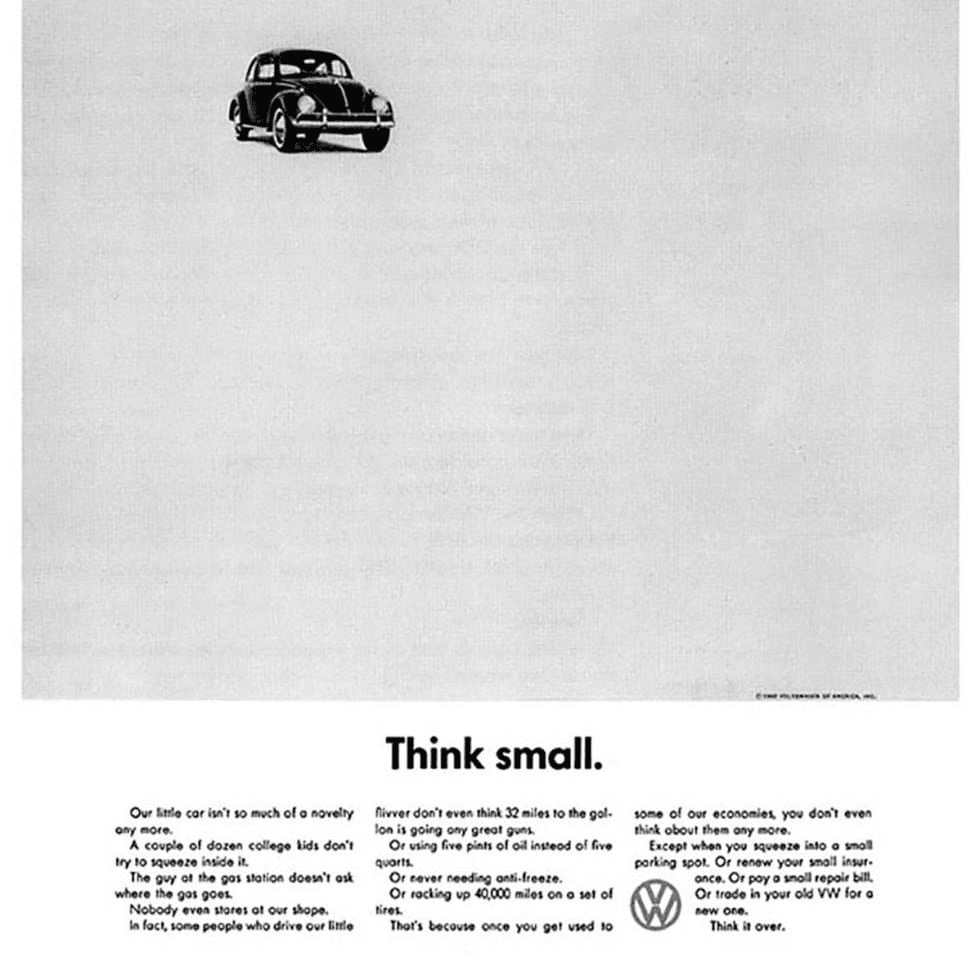
Why this example fits: The Beetle is the offer being promoted. The headline turns its small size into a reason to consider it, while the supporting copy explains practical benefits.
What to notice: Notice the large area of negative space, the unexpectedly small car and the movement from image to headline to supporting copy. This is a display ad even though it uses restrained monochrome design.
Visual credit: Volkswagen / DDB; image reproduced by El País. Campaign / format reference · Image source
McDonald’s: Follow the Arches
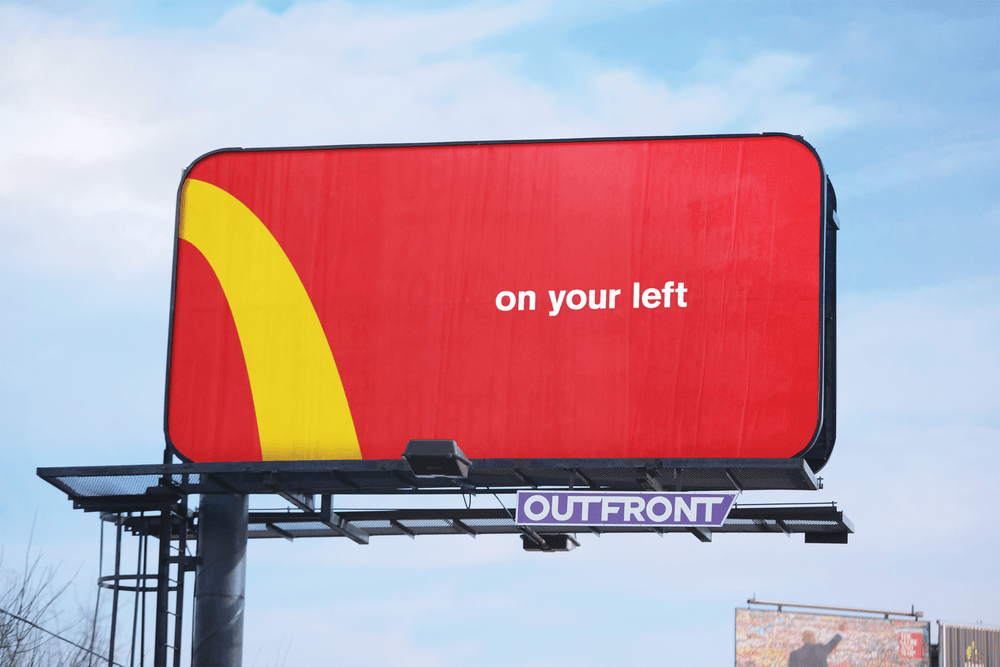
Why this example fits: It directs a passing audience towards a nearby restaurant. Rather than explain a new product, it activates recognition of an already familiar brand.
What to notice: A cropped part of the logo becomes a directional sign. Short copy and strong contrast suit brief viewing from the road. A location-specific message can sit within a wider campaign.
Visual credit: McDonald’s Canada / Cossette; photograph via Marketing Awards. Campaign / format reference · Image source
Fevicol: Bus

Why this example fits: The impossible-looking togetherness on the bus symbolises the adhesive’s bonding strength. It is persuasive communication through humorous exaggeration, not a literal product-strength test.
What to notice: The visual metaphor supplies the proposition before detailed copy is needed. For a film analysis, watch the sequence and sound as well as this reference image. The image shown here is campaign documentation, not a claim that the ad was a real transport event.
Visual credit: Pidilite / Fevicol; campaign also documented by Ogilvy. Campaign / format reference · Image source
British Airways: Magic of Flying
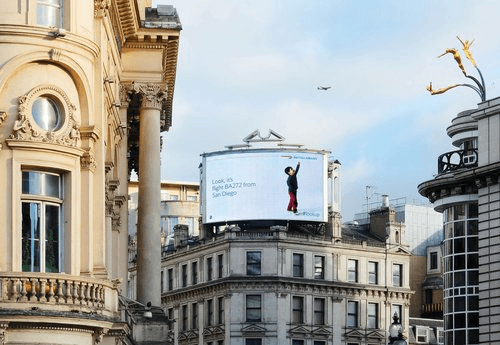
Why this example fits: The digital billboard reacted to British Airways planes passing overhead. The promoted offer is an airline service, while the medium is digital out-of-home.
What to notice: The surrounding event supplies part of the message. The screen, the pointing child and the actual aircraft operate together, so a static screenshot shows only one moment of the experience.
Visual credit: British Airways / OgilvyOne; campaign photograph from D&AD. Campaign / format reference · Image source
IKEA: pop-up bedroom mailer
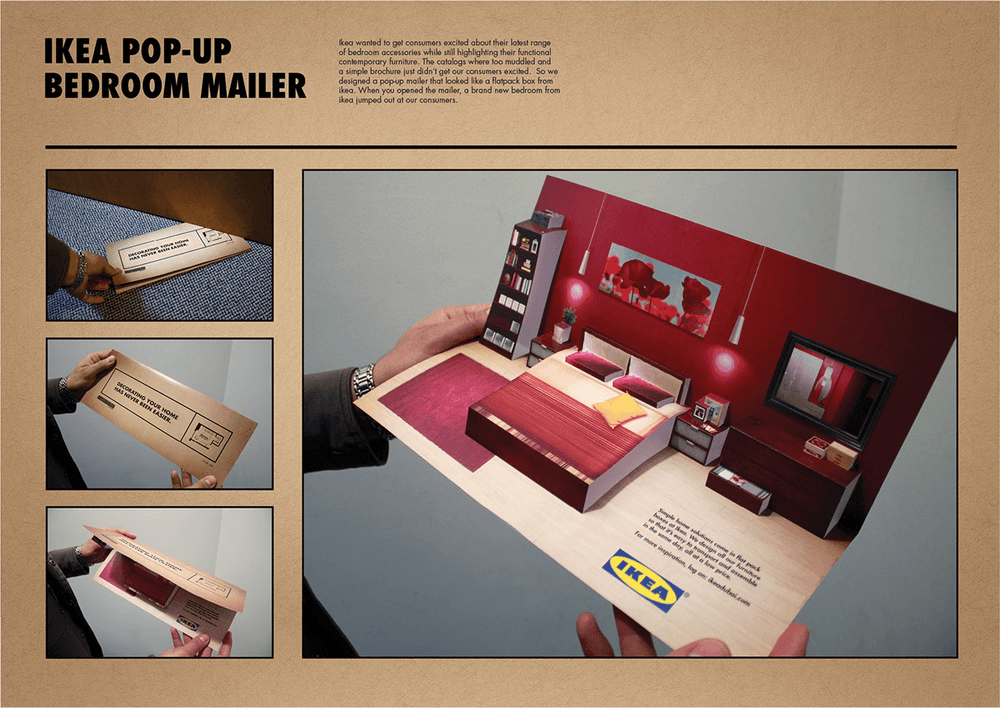
Why this example fits: A physical piece is delivered to the recipient and becomes a miniature bedroom when opened. This is an example of a mailer, rather than an email or an outdoor poster.
What to notice: The opening action communicates the flat-pack idea. Paper engineering, folds and the reveal are part of the communication design, not just decoration around a printed headline.
Visual credit: IKEA; project portfolio by Ali Mokdad, with Leo Rosa Borges credited on the project. Campaign / format reference · Image source
Coca-Cola: retail backboard artwork
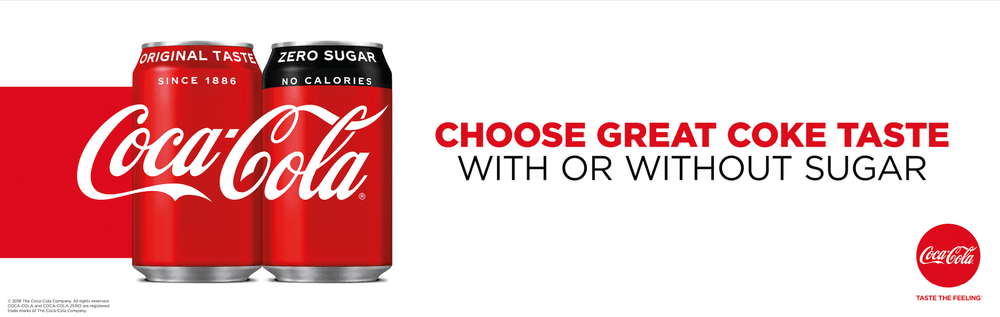
Why this example fits: The designer identifies this as artwork for retail backboards. The product choices and short message are meant to support recognition and selection in a shopping context.
What to notice: Pack visibility, product variation and a short reading sequence matter near purchase. This is a flat artwork preview, not a photograph proving how every store installed it.
Visual credit: Coca-Cola; retail campaign artwork shown in Ross Boag’s portfolio. Campaign / format reference · Image source
Radio / audio: listen to the message
A radio spot is an audio execution, so a poster cannot demonstrate its voice, music or timing. The Smokey Bear campaign offers radio alongside print, television and online assets. Open the official campaign’s Radio assets, then ask what the voice and sound communicate without a picture. The historical poster below identifies the same campaign family; it is not being presented as a radio advertisement.
One idea, three media: see what changes
Imagine a fictional art-supply store with the campaign idea “Draw every day”. The basic proposition stays recognisable across three placements. The amount of copy, the viewing conditions and the response path change.
for a new idea.
A5 sketchbooks
See the range in store.
One new idea.Sketchbooks · Art-supply store
EVERY
DAY.
| What stays consistent? | What changes? |
|---|---|
| Core message and recognisable identity | Headline size, information density and aspect ratio |
| Relationship between words and the visual idea | Whether the audience reads slowly or passes quickly |
| The product category and intended audience | A website action, a shop visit or simple brand recognition |
Simply shrinking the newspaper page into a mobile rectangle would not solve the design problem. The phone version needs comfortable reading on a small screen. The billboard needs rapid recognition. The newspaper allows a reader to return to additional detail. Those are different design conditions, not rankings of which medium is always superior.
Types of advertising by purpose and promotional focus
Purpose concerns what the advertiser wants the audience to know, feel or do. An ad may combine objectives, so identify the dominant one from the message and campaign context.
| Type | Main emphasis | Fictional example |
|---|---|---|
| Informative | Explain an offer, change or use | “Our new sketchbook opens flat. Here is how its binding works.” |
| Persuasive | Build preference or encourage choice | “Choose a sketchbook that makes daily drawing easier.” |
| Reminder | Maintain awareness of a familiar offer | “Your next drawing starts with a blank page.” |
| Comparative | Compare an offer with an identified or implied alternative | A side-by-side comparison of two specified paper weights |
| Direct-response | Request a measurable action | “Request the catalogue using this form.” |
| Institutional / corporate | Develop understanding of or regard for an organisation | An art-materials company explaining its training initiative |
| Product or service | Focus on a particular offer | A sketchbook launch or an advertisement for bookbinding services |
| Public-service / social | Advance a public-interest behaviour or cause | A clearly sponsored road-safety appeal |
Product advertising versus institutional advertising
A product advertisement makes an offer or product the central subject. Institutional advertising foregrounds the organisation, its identity, conduct or relationship with stakeholders. A corporate ad may benefit future sales indirectly without asking the audience to buy a particular item immediately. The presence of a company logo alone does not make every ad institutional.
Informative versus persuasive versus reminder
An informative execution explains something the audience needs to understand. A persuasive execution builds reasons or feelings supporting a choice. A reminder keeps a familiar offer mentally available. These functions can coexist: a reminder may also persuade, and an informative demonstration may provide the strongest reason to buy.
Comparative advertising
Comparison is a strategy within a message, rather than a separate medium. A designer should make the basis visible: which products, which attribute and under what conditions? A table comparing unrelated sizes or selectively omitting context can create a misleading impression. The comparison must be supportable; a dramatic graphic is not evidence.
Public-service advertising is not defined by free space
A public-interest message might run in paid, donated or otherwise supported space. Its social objective does not automatically tell you how the placement was funded. Likewise, not every advertisement issued by a government body is a public-service appeal; it could announce recruitment, a tender or a service.
Reference trail: OpenStax: Major Decisions in Developing an Advertising Plan · IGNOU eGyanKosh: Advertising, Unit 9
See the purpose in real advertising
The labels below are teaching interpretations of the visible message and documented campaign context. An ad can inform and persuade at the same time.
Informative: Volkswagen explains practical benefits
Why this example fits: The Beetle is the offer being promoted. The headline turns its small size into a reason to consider it, while the supporting copy explains practical benefits.
What to notice: Notice the large area of negative space, the unexpectedly small car and the movement from image to headline to supporting copy. This is a display ad even though it uses restrained monochrome design.
Visual credit: Volkswagen / DDB; image reproduced by El País. Campaign / format reference · Image source
Persuasive: Fevicol turns bonding strength into a visual metaphor
Why this example fits: The impossible-looking togetherness on the bus symbolises the adhesive’s bonding strength. It is persuasive communication through humorous exaggeration, not a literal product-strength test.
What to notice: The visual metaphor supplies the proposition before detailed copy is needed. For a film analysis, watch the sequence and sound as well as this reference image. The image shown here is campaign documentation, not a claim that the ad was a real transport event.
Visual credit: Pidilite / Fevicol; campaign also documented by Ogilvy. Campaign / format reference · Image source
Reminder: Amul renews attention through a topical pun
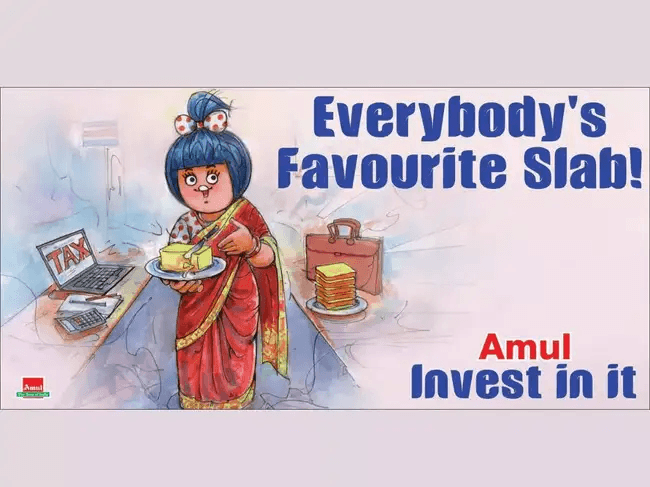
Why this example fits: A current-affairs reference brings a familiar product back into attention. The pun connects a tax slab with a butter slab, instead of educating the viewer about an unfamiliar product category.
What to notice: Character, wordplay and packaging identity provide continuity. This reproduced social post demonstrates reminder-style communication; the image alone does not establish whether its distribution was paid.
Visual credit: Amul; topical reproduced by The Economic Times from the brand’s social post. Campaign / format reference · Image source
Comparative: Avis builds a relative service argument
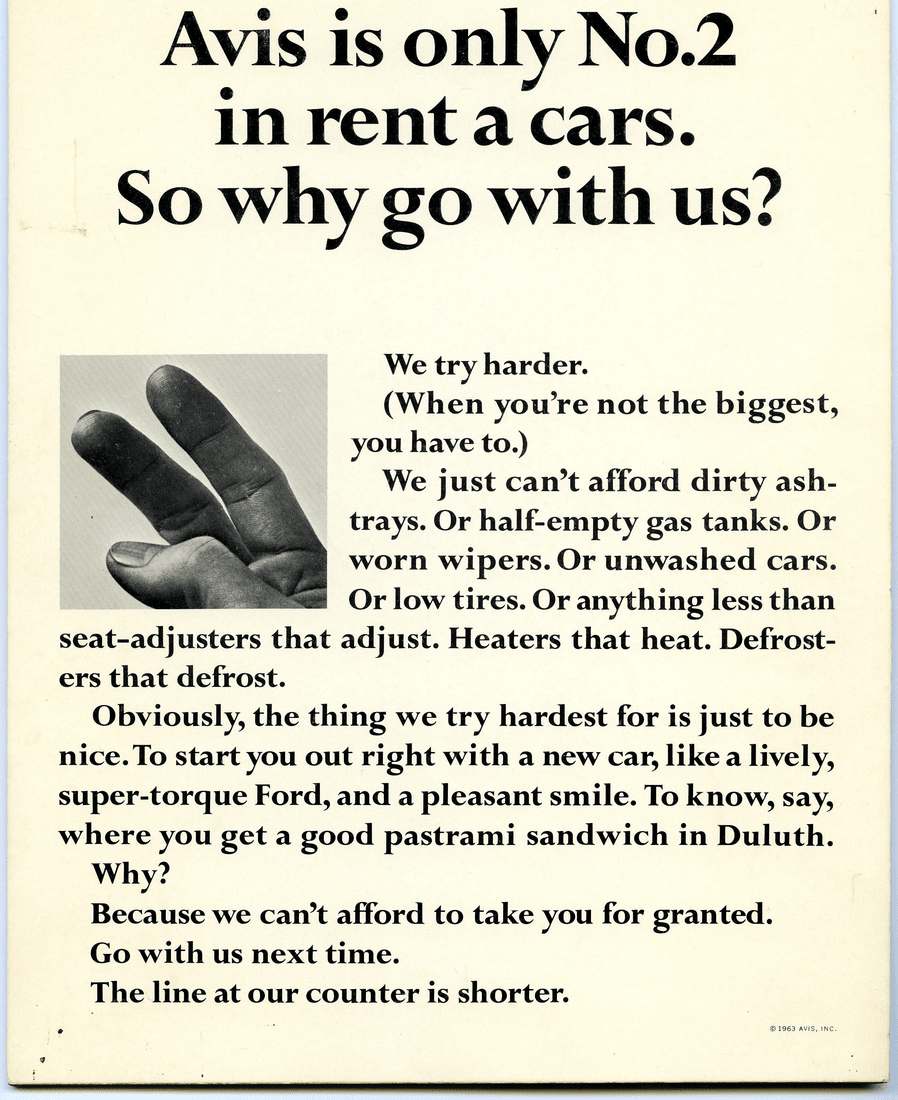
Why this example fits: The ad frames being second to the market leader as a reason to expect more effort. It is a relative positioning argument about a service, rather than a side-by-side technical test.
What to notice: The large headline states the tension, and the copy supplies the answer. Comparative communication can imply a competitor without placing two logos beside each other. This historical claim is not a current market ranking.
Visual credit: Avis / DDB; historical ad reproduced in Mark Tungate’s advertising-history discussion. Campaign / format reference · Image source
Direct response: an offer connected to an app action

Why this example fits: The historical promotion linked a specific offer to an app action and a location-based trigger near a competitor. The response path was built into the campaign mechanism.
What to notice: The wrapper image identifies the campaign; the mechanism is explained in the linked case study. Geofencing is location targeting, not proof of retargeting. An offer with an app action can be direct-response without resembling a conventional coupon poster.
Visual credit: Burger King / FCB New York; campaign identity image from ONE11’s case study. Campaign / format reference · Image source
Institutional: IBM expresses an organisational idea
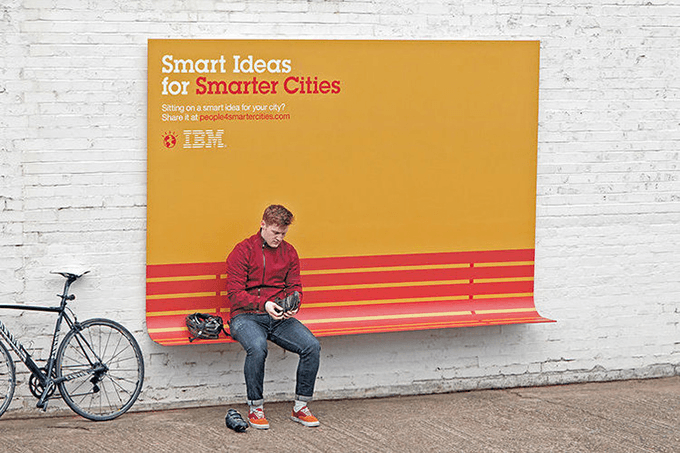
Why this example fits: The message develops IBM’s relationship with urban life rather than selling one named computer. The poster physically becomes a useful bench, connecting the brand idea with the setting.
What to notice: Form performs the message: the audience can use the communication object. This makes the ambient classification stronger than merely saying that the poster is outdoors.
Visual credit: IBM / Ogilvy Paris; photograph via Tonya Fossey’s portfolio. Campaign / format reference · Image source
Product: Coca-Cola foregrounds the available choices
Why this example fits: The designer identifies this as artwork for retail backboards. The product choices and short message are meant to support recognition and selection in a shopping context.
What to notice: Pack visibility, product variation and a short reading sequence matter near purchase. This is a flat artwork preview, not a photograph proving how every store installed it.
Visual credit: Coca-Cola; retail campaign artwork shown in Ross Boag’s portfolio. Campaign / format reference · Image source
Service: British Airways promotes an airline experience
Why this example fits: The digital billboard reacted to British Airways planes passing overhead. The promoted offer is an airline service, while the medium is digital out-of-home.
What to notice: The surrounding event supplies part of the message. The screen, the pointing child and the actual aircraft operate together, so a static screenshot shows only one moment of the experience.
Visual credit: British Airways / OgilvyOne; campaign photograph from D&AD. Campaign / format reference · Image source
Public service: a preventive action is the intended response

Why this example fits: The intended outcome is safer public behaviour rather than the purchase of a commercial product. The historical poster shows a preventive action and an identifiable campaign character.
What to notice: The illustration demonstrates an action; the character makes the appeal recognisable. Historical wording and statistics belong to this poster’s period and should not be copied as current data.
Visual credit: USDA Forest Service / National Association of State Foresters / Ad Council. Campaign / format reference · Image source
Pioneering, competitive and retentive advertising
Some advertising textbooks use these terms to discuss a product category’s development and the advertiser’s competitive situation. Terminology differs between authors, so learn the underlying distinction instead of assuming every label is interchangeable.
| Concept | Question being addressed | Teaching example |
|---|---|---|
| Pioneering / category-building | Why should people consider this unfamiliar category or use? | Explaining what a reusable drawing tablet does to people unfamiliar with such devices |
| Competitive / brand-preference | Why choose this brand rather than an alternative? | Highlighting a drawing tablet’s particular workflow benefits |
| Reminder / retentive | How can a familiar offer remain salient? | A concise message renewing awareness among existing buyers |
Primary demand concerns demand for a product category; selective demand concerns preference for a particular brand or offer. A cooperative campaign by an industry association can promote a category without favouring one member’s brand.
A newly introduced brand in an established category does not automatically need pioneering category education. People may already understand the category. Equally, an established product may need informative advertising when a feature changes or it enters a market unfamiliar with its use.
A launch can use explanation, persuasion and reminders across different audiences. Real campaigns do not always proceed through three neat, non-overlapping stages.
Reference trail: IGNOU eGyanKosh: Advertising, Unit 9 · OpenStax: Major Decisions in Developing an Advertising Plan
Category demand: milk rather than one dairy brand

Why this example fits: The campaign promotes milk as a category rather than one named dairy brand. The breakfast initiative also involves Kellogg’s. This illustrates category promotion in an established market, not the invention of a new product category.
What to notice: A familiar personality and a domestic scene connect the category with a use occasion. Analyse the persuasive construction; the historical ad is not being offered here as independent nutritional evidence. Multiple identities alone do not prove how media costs were divided.
Visual credit: Milk Processor Education Program; campaign release distributed through PR Newswire. Campaign / format reference · Image source
Category-building: the milk example supports a category already understood by its audience, so it is not evidence of a newly invented category. Competitive: Avis supplies a reason to prefer one service. Retentive: Amul supplies a reason to notice an already familiar brand again. Pioneering/category education can require a different execution from all three.
Advertising by audience, advertiser and geographical reach
Audience classification describes who receives and evaluates the message. The same physical item can be advertised differently to a student, a retailer and a purchasing officer.
| Audience or advertiser context | Example | What the designer should establish |
|---|---|---|
| Consumer | A sketchbook promoted to individual students | Use situation, benefit, accessibility and an appropriate response |
| Industrial / business-to-business | Printing equipment promoted to a print-production firm | Technical relevance, specifications, workflow and credible evidence |
| Trade | A manufacturer addressing dealers or distributors | Stocking, distribution, ordering and trade support |
| Professional | Specialised equipment addressed to a professional practice | Knowledge level, professional context and relevant information |
| Retail | An art-supply shop promoting its available range | Store identity, location or delivery area, availability and offer details |
These are overlapping contexts rather than perfectly exclusive boxes. Trade and industrial advertising often fall within business-to-business advertising. Professional audiences can also be organisational purchasers. Avoid defining B2B solely by expensive products: an inexpensive component sold to a manufacturer is still part of a business purchase.
Geography supplies another dimension. A local campaign addresses a defined local market; regional, national and international campaigns work across progressively wider markets. A newspaper name alone does not establish the advertiser’s reach, and a website can target one city despite being technically accessible worldwide.
Cooperative advertising concerns parties sharing support or advertising costs. A manufacturer and a retailer may participate together. This is different from a design merely showing two logos: co-branding does not by itself prove a cost-sharing arrangement.
Reference trail: IGNOU eGyanKosh: Advertising, Unit 9 · Odisha State Open University: Advertising, DJMC-6, Block 2
Use the brand visuals without guessing the audience
The McDonald’s roadside board addresses potential restaurant customers and directs them locally. The Coca-Cola backboard works in a retail setting. The IBM installation expresses a corporate idea to city audiences; IBM being a business supplier does not make every IBM ad a technical B2B procurement ad.
For industrial, trade and professional advertising, look for evidence in the actual message: machine specifications, dealer ordering terms or specialist professional use. A logo alone cannot prove these audiences. The table above illustrates how the same item can be framed for different purchasers.
Classified and display advertisements: the print distinction
Classified advertisements are organised as listings under categories such as employment, property or services. Display advertisements use a designed space with typographic and visual emphasis. Publishers can also offer display-classified options, so the boundary is not simply “words versus pictures”.
| Feature | Classified listing | Display advertisement |
|---|---|---|
| Organisation | Usually grouped under a subject heading | Often a distinct creative unit within the publication |
| Typical emphasis | Specific information and response details | Headline, image or graphic hierarchy, copy and identity |
| Common example | A short notice seeking a studio assistant | An image-led full or part-page exhibition advertisement |
| Pricing | May depend on words, lines or the publisher’s listing rules | May depend on size, placement and publication terms |
| Important qualification | Can include highlighted or display-classified treatments | Can be entirely typographic without a photograph |
STUDIO ASSISTANT
Part-time assistance for an artist’s studio. Drawing and organisation skills required. Apply with a short portfolio.
Concept example. No actual vacancy.to make.
Open studio weekend
Discover the practice behind the work.
Original educational examples by ashacademy, presented to compare information structure. These are not published advertisements.
Why “display” has two contexts
In print, display refers to a designed advertisement distinguished from ordinary category listings. In digital advertising, display commonly refers to graphical ad placements across websites and apps. An examination question should provide the context; do not assume the word always means a web banner.
Reference trail: Odisha State Open University: Advertising, DJMC-6, Block 2 · Google Ads Help: ad formats
Times of India: classified-format examples
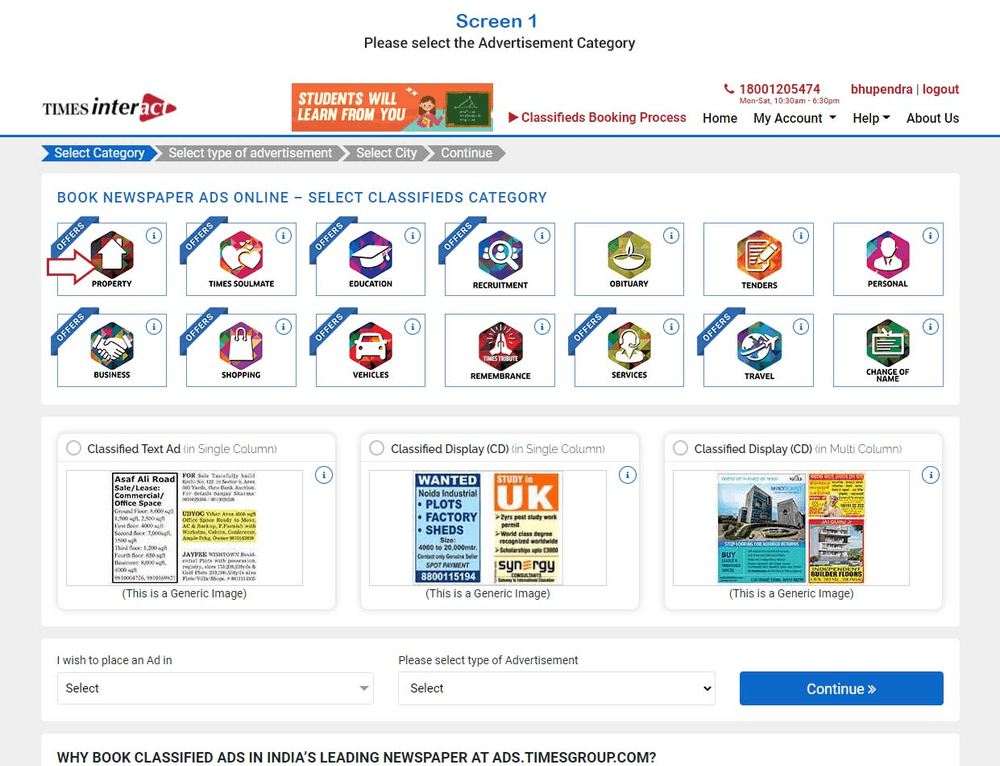
Why this example fits: The publisher shows text and display treatments within its classified offering. This directly demonstrates why classified cannot be defined as always having no graphic treatment.
What to notice: Look at category organisation and presentation together. This is a publisher’s format demonstration, not a live property offer or a universal rate card.
Visual credit: Times of India / Times Group advertising-booking interface. Campaign / format reference · Image source
Compare a real display ad: return to Volkswagen’s print execution. Its page is composed around an image, headline and supporting argument. Compare that hierarchy with the publisher’s category-based classified options, rather than deciding only by whether a photograph is present.
Digital advertisement types: search, display, social, video and native
Digital is the broader delivery environment. Within it, channel, format and targeting still need to be separated. A video can run in a social feed, on a publisher’s site or before another video; “video” does not identify just one platform.
| Type / approach | How to recognise it | Applied Art point |
|---|---|---|
| Search advertising | Paid results linked to a query or search context | Match the promise in the copy with the destination page |
| Digital display | Graphical placements across websites or apps | Readable hierarchy and adaptation to different available spaces |
| Social advertising | Paid placements within social platforms | Design for feed behaviour, mobile viewing and the placement’s conventions |
| Online video | Moving-image advertisements in online environments | Communicate through sequence; consider viewers who encounter it without sound |
| Shopping / product-listing ads | Product information such as image, title, price and seller | Accurate product data and a clear product image matter |
| Native advertising | Sponsored content fitted to the surrounding content experience | Recognisable sponsorship alongside visual integration |
| Email promotion | Promotional messages delivered to recipients’ inboxes | Subject line, scannability, relevance and a clear response path |
| Retargeting | Delivery to an audience defined by earlier interest or interaction | A targeting approach, not a visual layout or a guarantee of purchase |
Native advertising versus banner advertising
A native placement fits the look or function of the surrounding environment, such as a sponsored item in a content feed. A conventional banner occupies an allocated graphical space. Neither term determines the objective: both can introduce an offer or invite a response. Integration should not hide the commercial nature of the message.
Advertorials, infomercials and creator endorsements
An advertorial uses an article-like presentation for advertising. An infomercial uses an extended informational or demonstrative commercial format, commonly audiovisual. An influencer endorsement uses a creator’s relationship with an audience. These are different presentation approaches, and none should automatically be treated as independent editorial content.
What PPC, CPC and CPM actually describe
Pay-per-click describes a payment arrangement; CPC is cost per click. CPM expresses cost per thousand impressions. These are buying or measurement terms, not media such as print or television. Programmatic advertising concerns automated buying and selling processes; it does not name one visible creative format.
Platform products change. The distinctions above explain communication and design rather than promise that every named format is available in every campaign, territory or account.
Reference trail: Google Ads Help: ad formats · IAB Europe: Native Advertising One Sheet · IAB UK: Retargeting
Visual examples of digital formats
The three Google images are official schematic examples, not live brand ads. The other examples are documented brand executions or campaign previews.
Google Ads: search-ad format illustration
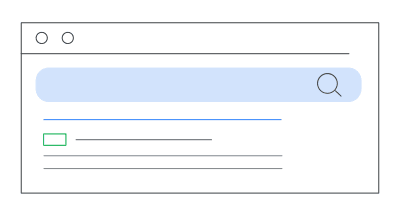
Why this example fits: The visual represents a paid text placement in a search-results environment. It demonstrates the channel without inventing a real advertiser or a live search result.
What to notice: Headline, supporting text, destination and placement context matter. This schematic is not a current screenshot, and interface details can change.
Visual credit: Google Ads Help; schematic format example. Campaign / format reference · Image source
Google Ads: website display-format illustration

Why this example fits: The ad is represented as an allocated graphical unit in a website environment. This differs from a publisher article styled as sponsored editorial content.
What to notice: A contained creative space needs readable hierarchy at its actual size. The diagram is a platform illustration, not a measured example of campaign effectiveness.
Visual credit: Google Ads Help; schematic display-ad example. Campaign / format reference · Image source
Google Ads: shopping-ad format illustration
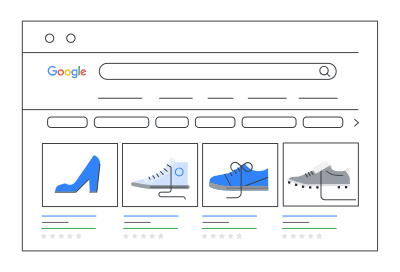
Why this example fits: The layout foregrounds individual products rather than a long narrative. A shopping ad combines a product image with structured information such as price and seller.
What to notice: Product visibility and accurate structured details are part of the creative experience. This schematic does not document a particular brand’s real campaign.
Visual credit: Google Ads Help; schematic shopping-ad example. Campaign / format reference · Image source
Duolingo: Cult Mass

Why this example fits: TikTok’s case study explicitly identifies paid amplification through Spark Ads. That evidence, rather than the mere existence of a brand post, supports calling it paid social advertising.
What to notice: The recognisable character and serial narrative fit the platform’s culture. This is the case-study preview, not a captured ad-placement interface. The historical example concerns an overseas market.
Visual credit: Duolingo; campaign preview from TikTok for Business. Campaign / format reference · Image source
Dove: Reverse Selfie

Why this example fits: The film examines the pressure created by edited selfies. The visual shown is a campaign still: its central idea becomes clearer when the viewer sees the transformation unfold in time.
What to notice: Sequence carries the argument. A still can show the before-and-after contrast, but does not replace studying the film’s order, pacing and sound. A social theme within a brand campaign does not automatically make it an independent public-service announcement.
Visual credit: Dove / Ogilvy / Mindshare; campaign still from WPP. Campaign / format reference · Image source
Netflix / T Brand Studio: Women Inmates
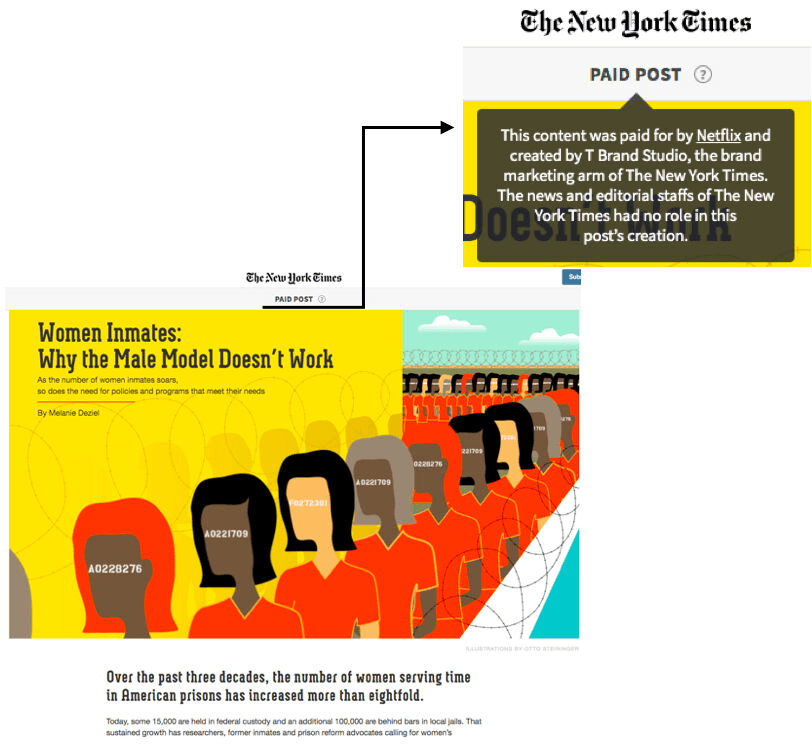
Why this example fits: The sponsored feature uses article-like storytelling in a publisher’s environment. Its Paid Post label distinguishes it from independent newsroom coverage.
What to notice: Notice editorial-style hierarchy alongside sponsorship disclosure. The annotations in this teaching screenshot highlight the label; they were not part of the original advertising design.
Visual credit: The New York Times / T Brand Studio / Netflix; annotated screenshot in a news-literacy teaching resource. Campaign / format reference · Image source
IKEA: cookware promotional email

Why this example fits: The portfolio identifies this as a direct email promoting IKEA cookware. The channel is the recipient’s inbox rather than a postal envelope.
What to notice: The image, headline, offer and response route create a top-to-bottom reading path. A long email still needs a clear first screen. The historical prices in this example are not current offers.
Visual credit: IKEA; email copywriter Jess Stuart’s project portfolio. Campaign / format reference · Image source
Retargeting: a banner might be shown after someone visits a product page, but you cannot establish that targeting history from the artwork alone. The same display format could be used for new or returning audiences. Infomercial: look for an extended commercial demonstration, explanation and response route; the word does not mean any short video that includes information. Endorsement: the Taye Diggs milk execution shows how a recognisable person can support a message. A creator partnership also needs its sponsorship status to be clear.
Ambient, guerrilla, viral and ATL / BTL / TTL advertising
These terms are useful when their limits are clear. Some describe the relationship to a setting, some an unconventional strategy, and others a planning convention. They should not be treated as additional screen sizes.
| Term | Useful meaning | Common mistake |
|---|---|---|
| Ambient | A communication idea makes distinctive use of its immediate surroundings | Calling every outdoor poster ambient |
| Guerrilla | An unconventional, often surprising promotional approach | Assuming it must be illegal, unplanned or cost-free |
| Viral | A spread pattern involving people sharing content | Claiming a designer can guarantee virality |
| ATL, above the line | Conventionally associated with broad-reach mass-media activity | Treating it as every expensive advertisement |
| BTL, below the line | Conventionally associated with more targeted or activation-oriented activity | Treating it as every small advertisement |
| TTL, through the line | An integrated approach connecting broad communication with targeted activity | Calling any mixture of two media automatically a coherent campaign |
An installation that turns an existing bus-stop structure into part of the message may have an ambient idea and a guerrilla approach. If people circulate its video, the campaign may also gain viral distribution. Those labels describe different aspects of one execution.
ATL and BTL usage varies across organisations and has become less clear-cut in digital practice. A social platform can deliver either broad reach or tightly targeted activity. Use the campaign’s planning logic rather than permanently assigning an entire medium to one side.
Reference trail: UGC: official Visual Arts syllabus · Odisha State Open University: Advertising, DJMC-6, Block 2
Follow the idea from setting to response
Ambient: the poster becomes a bench
Why this example fits: The message develops IBM’s relationship with urban life rather than selling one named computer. The poster physically becomes a useful bench, connecting the brand idea with the setting.
What to notice: Form performs the message: the audience can use the communication object. This makes the ambient classification stronger than merely saying that the poster is outdoors.
Visual credit: IBM / Ogilvy Paris; photograph via Tonya Fossey’s portfolio. Campaign / format reference · Image source
Unconventional activation: the competitor’s location becomes a trigger
Why this example fits: The historical promotion linked a specific offer to an app action and a location-based trigger near a competitor. The response path was built into the campaign mechanism.
What to notice: The wrapper image identifies the campaign; the mechanism is explained in the linked case study. Geofencing is location targeting, not proof of retargeting. An offer with an app action can be direct-response without resembling a conventional coupon poster.
Visual credit: Burger King / FCB New York; campaign identity image from ONE11’s case study. Campaign / format reference · Image source
Viral circulation: the Duolingo case describes a narrative that grew through platform culture and also received paid amplification. Those are separate mechanisms. A large audience does not prove that every impression came from people sharing.
ATL / BTL / TTL: the billboard illustrates broad public exposure; the physical mailer illustrates a more direct contact route; a coherent campaign can connect reach and response. These images help explain the planning logic, but do not reveal an advertiser’s complete media budget or turn every medium into a permanent ATL/BTL category.
How to analyse an advertisement as an Applied Art student
After naming the type, explain how the visual communication works. A strong answer connects the design to the brief rather than merely saying that an ad is attractive.
| Aspect | What to examine | A practical question |
|---|---|---|
| Audience and objective | Whom the message addresses and what change it seeks | Is this written for an experienced print buyer or a first-time student? |
| Headline and proposition | The main promise and the first reading point | Can I explain the offer in one sentence? |
| Image and text relationship | Whether the visual demonstrates, contrasts, symbolises or supplies missing meaning | Does the image add information or repeat the headline? |
| Hierarchy | Sequence of attention through scale, contrast and position | What do I read first, second and third? |
| Typography and colour | Legibility, tone, contrast and reproduction | Will the small information remain readable in the actual placement? |
| Identity | Advertiser, product recognition and campaign consistency | Can the audience tell who is speaking? |
| Response path | Website, form, visit, call or another appropriate action | Does the requested action fit the setting? |
| Evidence and disclosure | Support for claims and clarity about sponsorship | Is the message asking viewers to believe something it has not established? |
The AIDA sequence, attention, interest, desire and action, can help examine one persuasive approach. It is not a law followed by every audience member or every campaign. Some messages primarily reassure existing users; others communicate urgent information. Select an analytical model that fits the situation.
A billboard does not need every detail that appears on a landing page. An ad attracting attention with a dramatic promise also needs a destination that explains that promise honestly. Good design connects the stages instead of solving the first screen in isolation.
Write the intended response before choosing the visual style. “Understand a new service”, “recognise a familiar brand” and “complete an enquiry form” are different communication tasks.
For sponsored creator content in India, ASCI guidance emphasises prominent disclosure when a material connection exists, including benefits beyond cash. For study purposes, remember the communication principle: viewers should be able to recognise promotional content. Refer to the current official guidance for the detailed requirements.
Reference trail: ASCI: Code and guidelines
Compare three different design solutions
- Volkswagen: small image and negative space make restraint a deliberate attention device.
- McDonald’s: scale and a recognisable logo fragment support fast recognition.
- IBM: the physical object performs the usefulness promised by the message.
All three are designed advertisements. Their visual density and execution differ because the communication problem differs.
Worked example: classify one ad without mixing categories
Consider this fictional brief: an art-supply retailer pays to place a carousel in a social feed, directed at design students in one city. It introduces a new paper range and invites catalogue enquiries.
| Dimension | Classification | Reason |
|---|---|---|
| Medium | Digital / social | The paid message appears in a social feed |
| Format | Carousel | The creative uses several sequential panels |
| Advertiser context | Retail | The advertiser sells the range to customers |
| Audience | Consumer, with a defined student segment | The intended buyers are individual learners |
| Geography | Local | The campaign is directed at a defined city market |
| Promotional focus | Product | A particular paper range is central |
| Communication objective | Primarily informative | The range is new to the selected audience |
| Requested action | Direct response | Catalogue enquiries provide an identifiable response |
Now change only the headline to a general statement about the company’s long-standing support for art education, without foregrounding the paper range. The medium and format can remain the same while the focus becomes more institutional. Change only the distribution to a printed catalogue and the medium changes, while several other dimensions may remain intact.
This is why an accurate answer can be longer than a single label. In a multiple-choice question, use the specific wording to decide which dimension the examiner is testing.
Revision chart: the distinctions to remember
| Do not confuse | First term | Second term |
|---|---|---|
| Advertising / publicity | Purchased or sponsored promotional communication in its advertising context | Unpurchased editorial attention or coverage |
| Product / institutional | Focus on an offer | Focus on the organisation |
| Informative / reminder | Explain what the audience needs to learn | Maintain awareness of a familiar offer |
| Classified / display | Category-organised listing | A designed creative space |
| Print display / digital display | Publication-format context | Website or app graphical-placement context |
| Medium / objective | Where the message appears | What it aims to achieve |
| Native / advertorial | Fit with a surrounding content environment | Article-like advertising execution; can overlap with native |
| Viral / video | How content spreads | A moving-image format |
| Retargeting / banner | How an audience is selected | A particular creative format |
| PPC / digital | Payment arrangement | Delivery environment |
A useful note-making format is: term → classification basis → meaning → example → one distinction. Then practise describing a single ad in at least three dimensions. This builds a more flexible understanding than memorising an arbitrary count of types.
Practice questions with explanations
These are original ashacademy revision questions, not authenticated previous-year questions.
1. Can an institutional advertisement appear on television?
Answer and explanation: Yes. Institutional describes the organisational focus, while television identifies the medium. The two labels answer different questions.
2. Is a billboard always a product advertisement?
Answer and explanation: No. A billboard is a placement form. It can carry a product offer, an organisational message or a public-interest appeal.
3. A company pays for an article-like newspaper page. Is that independent publicity?
Answer and explanation: Not merely because it looks like an article. It is an advertorial or related paid presentation; the sponsorship and editorial status must be distinguished.
4. Does a public-service advertisement always use free media space?
Answer and explanation: No. Its public-interest objective and the payment arrangement are separate matters.
5. Is a visually rich social-media carousel automatically a display-classified advertisement?
Answer and explanation: No. Display-classified refers to a listing treatment in a classified context. A carousel describes a sequential creative format, typically in a digital placement.
6. Is retargeting a kind of headline or layout?
Answer and explanation: No. It concerns audience selection based on earlier interest or interaction. Several creative formats can serve that audience.
7. What changes when a print campaign is adapted for a billboard?
Answer and explanation: Viewing distance, exposure time, copy length, scale and the response route usually change. The core proposition can stay consistent.
8. Is “viral” a guarantee supplied by using humour or video?
Answer and explanation: No. It describes a circulation outcome or strategy involving sharing. A format or appeal cannot guarantee that outcome.
9. Which common syllabus area connects directly with modern advertising concepts?
Answer and explanation: Unit VIII includes modern advertising, design and visual communication. The detailed forms, media and campaign topics appear in Elective III: Applied Art.
10. What is the first step when a question asks for “types of advertisements”?
Answer and explanation: Identify the classification basis. Explain whether you mean media, purpose, audience, geography or execution before listing examples.
How this topic connects with UGC NET Visual Arts
In the common syllabus, Unit VIII includes modern advertising, design and visual communication. The more detailed material appears in Elective III: Applied Art, including advertising terminology, media, campaign planning, image-text development, target audiences and point-of-purchase applications.
This guide concentrates on classification and analysis. Advertising history, important campaigns and designers, typography, printing, packaging, media research and other Applied Art topics need separate study. No fixed question weightage is implied.
Explore the decoded syllabus guideRead the Western Art History TimelineRead the Indian Art History Timeline
Reference trail: UGC: official Visual Arts syllabus
Frequently asked questions
What are the main types of advertisements?
By medium, the main groups include print, outdoor or out-of-home, broadcast and digital, with direct-mail and point-of-purchase settings also important. By purpose, common terms include informative, persuasive and reminder. Product and institutional describe the focus of promotion. Always name the classification basis.
Are there exactly seven or ten types of advertising?
No universal count applies. A short list often selects one basis or combines several. For academic notes, a clear classification is more useful than a fixed number.
What is the difference between advertising and an advertisement?
Advertising is the activity or planned communication process. An advertisement is a particular message or execution within it.
What is the difference between commercial and social advertising?
Commercial advertising generally supports a business or market objective; social or public-service advertising focuses on a public-interest behaviour or cause. A company can sponsor a social message, and a social objective does not automatically establish how the placement was paid for.
Which advertising type is best?
The appropriate choice depends on audience, objective, budget, message, geography and viewing conditions. No medium or execution is best for every brief. Evaluate what it needs to achieve, then how the design serves that task.
Sources and teaching-example notes
The notes are independently written and combine standard advertising concepts with original examples and design analysis. Terminology can vary between textbooks and professional settings; this guide identifies the classification basis rather than presenting one organisation’s list as universal.
The source links below support the definition, syllabus connection and specialist distinctions. The blue sample layouts are original fictional educational demonstrations. The separately credited brand examples reproduce advertisements, campaign documentation or official format illustrations for critical study. Source links appear beside each visual; original campaign colours are preserved. Classifications and design readings are ashacademy’s interpretations, not labels necessarily assigned by the advertiser. The thumbnail is an AI-assisted editorial visual, with the original ashacademy identity applied separately.
- UGC: official Visual Arts syllabus
- American Marketing Association: Advertising
- NIOS: Advertising and Salesmanship
- Odisha State Open University: Advertising, DJMC-6, Block 2
- OpenStax: Major Decisions in Developing an Advertising Plan
- IGNOU eGyanKosh: Advertising, Unit 9
- Google Ads Help: ad formats
- IAB Europe: Native Advertising One Sheet
- IAB UK: Retargeting
- ASCI: Code and guidelines

You may also like
Fauvism: History, Characteristics, Artists and Important Artworks
Symbolism in Art: History, Characteristics, Artists and Artworks