Western Art History Timeline: Illustrated Notes for UGC NET Visual Arts
ILLUSTRATED REVISION NOTES · MOVEMENTS, ARTISTS & ARTWORKS
Understand the Western art history timeline through the works that define its changing ideas: Egyptian royal images, Greek sculpture, medieval churches, Renaissance perspective, Baroque drama and the experiments of modern and contemporary art.
This guide connects period → context → artist / work → material / technique → visual identification. Use the quick chronology first, then study each phase, compare neighbouring traditions and test yourself without the captions.
Art movements overlap. The ranges below are broad study frameworks, mainly for European and North American developments and connected histories. Ancient Egypt and Aegean art are included because they appear explicitly in the official Western Art syllabus. Ancient Mesopotamia and Persia belong to a separately listed Ancient Near-East section and require their own notes.
“c.” means approximately. BCE / CE correspond to BC / AD. An artwork’s conception, execution, later cast, restoration and photograph can have different dates. Those differences are part of accurate revision.
Syllabus connection: the common syllabus places the chronological study of Western art in Unit VI. The Art History elective provides a more detailed list of periods and practices. This article is a substantial revision framework, with selected examples, rather than a claim to cover every artist or every examination question. Read the original UGC syllabus.
Jump to a period, movement or revision section
- Prehistoric art: cave images, portable sculpture and megaliths
- Ancient Egyptian art: continuity, kingship and the afterlife
- Aegean art: Cycladic, Minoan and Mycenaean cultures
- Greek art: Archaic, Classical and Hellenistic developments
- Roman art: portraits, engineering and imperial narratives
- Early Christian art: new meanings and changing spaces
- Byzantine art: mosaics, icons and sacred presence
- Romanesque art: pilgrimage churches, portals and manuscripts
- Gothic art: architecture, stained glass and changing figures
- Proto-Renaissance: Giotto and the Italian Trecento
- Early Renaissance: perspective, bodies and classical study
- High Renaissance: Leonardo, Michelangelo, Raphael and Venice
- Northern Renaissance: oil, print and close description
- Mannerism: artifice, elongation and complex space
- Baroque art: drama, persuasion and diverse patrons
- Rococo: intimacy, ornament and elite sociability
- Neoclassicism: antiquity, civic ideals and moral history
- Romanticism: history, emotion and the sublime
- Realism and the challenge of contemporary subjects
- Impressionism: light, modern life and independent exhibitions
- Post-Impressionism, Neo-Impressionism and Symbolism
- Arts and Crafts, Art Nouveau and modern design
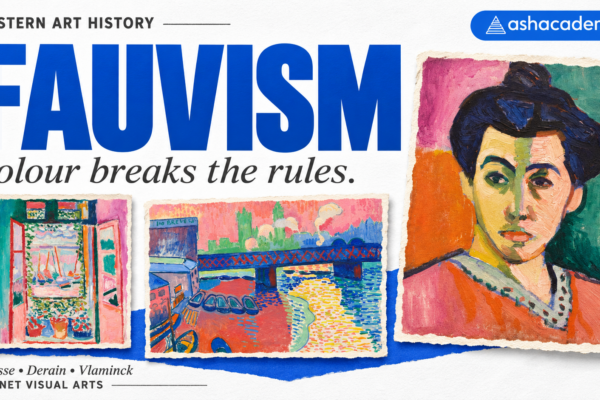
- Fauvism: colour as an independent structural force
- Expressionism: groups, printmaking and modern experience
- Cubism: Analytic and Synthetic approaches
- Futurism: movement, technology and political entanglement
- Abstraction: Kandinsky, Suprematism and Constructivism
- De Stijl and the Bauhaus: painting, space and design education
- Dada: readymades, chance, collage and anti-war critique
- Surrealism: automatism, dreams and unexpected encounters
- Modern sculpture: volume, void, construction and movement
- Abstract Expressionism: gesture, field and postwar networks
- Pop Art and Op Art: two different problems
- Minimalism and Conceptual Art: object, space, language and idea
- Fluxus, Happenings, Body Art and Performance
- Arte Povera, Process Art and Land / Environmental Art
- Feminist, queer and Black artistic practices: revising the canon
- Postmodern and contemporary practices: several histories at once
Comparison charts · Chronology anchors · Practice questions · References
Western art timeline: quick revision chart
These are overlapping study phases, not rigid start-and-stop dates. Where a work has a secure individual date, use that date instead of the whole movement’s range.
| Period / movement | Study range / dated anchor |
|---|---|
| Prehistoric art: cave images, portable sculpture and megaliths | European examples: Upper Palaeolithic through Neolithic; dates are site-specific |
| Ancient Egyptian art: continuity, kingship and the afterlife | Predynastic period through the pharaonic kingdoms; major survey span c. 3100–30 BCE |
| Aegean art: Cycladic, Minoan and Mycenaean cultures | Bronze Age, broadly 3rd–2nd millennia BCE |
| Greek art: Archaic, Classical and Hellenistic developments | Archaic c. 700–480 BCE; Classical c. 480–323 BCE; Hellenistic 323–31 BCE |
| Roman art: portraits, engineering and imperial narratives | Republican and Imperial traditions; major survey span c. 500 BCE–4th century CE |
| Early Christian art: new meanings and changing spaces | Especially 3rd–6th centuries CE |
| Byzantine art: mosaics, icons and sacred presence | From late antiquity to 1453, with several periods and regional continuities |
| Romanesque art: pilgrimage churches, portals and manuscripts | Broadly 11th–12th centuries, varying by region |
| Gothic art: architecture, stained glass and changing figures | From mid-12th-century France; regional traditions continue into the 15th–16th centuries |
| Proto-Renaissance: Giotto and the Italian Trecento | Late 13th–14th centuries |
| Early Renaissance: perspective, bodies and classical study | Especially 15th-century Italy |
| High Renaissance: Leonardo, Michelangelo, Raphael and Venice | Broadly c. 1490s–1520s, with regional differences |
| Northern Renaissance: oil, print and close description | Especially 15th–16th-century northern Europe |
| Mannerism: artifice, elongation and complex space | Broadly c. 1520–1600, especially in Italy |
| Baroque art: drama, persuasion and diverse patrons | Broadly c. 1600–1750; practices vary across Europe |
| Rococo: intimacy, ornament and elite sociability | Especially early–mid-18th century |
| Neoclassicism: antiquity, civic ideals and moral history | Mid-18th–early 19th centuries |
| Romanticism: history, emotion and the sublime | Late 18th–mid-19th centuries; overlaps Neoclassicism |
| Realism and the challenge of contemporary subjects | Especially France from the 1840s–1870s; wider related practices continue |
| Impressionism: light, modern life and independent exhibitions | Eight group exhibitions, 1874–1886; artistic practices extend beyond them |
| Post-Impressionism, Neo-Impressionism and Symbolism | Main practices from the 1880s; labels and individual careers differ |
| Arts and Crafts, Art Nouveau and modern design | Especially later 19th–early 20th centuries |
| Fauvism: colour as an independent structural force | Core group activity c. 1905–1908 |
| Expressionism: groups, printmaking and modern experience | Die Brücke founded 1905; Der Blaue Reiter formed 1911 |
| Cubism: Analytic and Synthetic approaches | Developed by Picasso and Braque c. 1907–1914; influence extends much further |
| Futurism: movement, technology and political entanglement | Italian manifesto published 1909; multiple later phases |
| Abstraction: Kandinsky, Suprematism and Constructivism | Especially from the 1910s; different aims and networks |
| De Stijl and the Bauhaus: painting, space and design education | De Stijl journal founded 1917; Bauhaus school 1919–1933 |
| Dada: readymades, chance, collage and anti-war critique | Zurich activity from 1916; related centres include New York, Berlin, Cologne and Paris |
| Surrealism: automatism, dreams and unexpected encounters | Breton’s first Surrealist Manifesto, 1924; movement continues internationally |
| Modern sculpture: volume, void, construction and movement | Late 19th–mid-20th centuries, with later continuities |
| Abstract Expressionism: gesture, field and postwar networks | Especially New York in the 1940s–1950s |
| Pop Art and Op Art: two different problems | Especially 1950s–1960s; later practices continue |
| Minimalism and Conceptual Art: object, space, language and idea | Especially 1960s–1970s, with extensive later legacies |
| Fluxus, Happenings, Body Art and Performance | Especially late 1950s onward; many continuing practices |
| Arte Povera, Process Art and Land / Environmental Art | Especially late 1960s onward |
| Feminist, queer and Black artistic practices: revising the canon | Especially visible from the 1960s–1970s onward, with earlier histories |
| Postmodern and contemporary practices: several histories at once | Later 20th–21st centuries; boundaries are contested |
Prehistoric art: cave images, portable sculpture and megaliths
European examples: Upper Palaeolithic through Neolithic; dates are site-specific
Begin with different kinds of objects, not a single “primitive style”. Painted caves, carved figures and monumental stone settings had different makers, uses and histories. European cave art is one regional history of image-making; it is not the universal beginning of art.
| Artist / work / site | Date or context | What to identify |
|---|---|---|
| Chauvet, Lascaux and Altamira | Upper Palaeolithic cave traditions | Animals, superimposed figures and use of irregular rock surfaces |
| Venus of Willendorf | Upper Palaeolithic, Gravettian context | Small limestone figure; conventional modern title, not a securely identified goddess |
| Stonehenge | Successive Neolithic and Bronze Age building phases | Standing stones, lintels, circular arrangement and changing landscape setting |

Image credit: Original uploader was Coen.vromans at nl.wikipedia · Public domain · Source and full credit.
Understand and recognise
- Separate parietal art, made on cave or rock surfaces, from portable or mobiliary art.
- Pigment, engraving, relief and carving are different processes. Natural contours could contribute to the appearance of an animal.
- A proposed ritual, hunting or fertility function is an interpretation unless securely supported by evidence.
Do not memorise one precise year for every cave image. Lascaux’s dating has been revised and remains a research question. Some familiar illustrations show facsimiles; read the photograph’s description before treating it as the original surface.
Study references: Tomory: Ancient Art, as a starting framework · French Ministry of Culture: dating Lascaux
Ancient Egyptian art: continuity, kingship and the afterlife
Predynastic period through the pharaonic kingdoms; major survey span c. 3100–30 BCE
Egyptian art linked images, writing, architecture, religious practice and royal power. Its visual conventions were purposeful systems of representation. They should not be explained as an inability to see or draw naturally. Changes across the Old, Middle and New Kingdoms matter.
| Artist / work / site | Date or context | What to identify |
|---|---|---|
| Palette of Narmer | Around the emergence of the Egyptian state | Registers, hierarchical scale, royal imagery and combined viewpoints |
| Giza pyramid complexes | Old Kingdom, Fourth Dynasty | Pyramid, mortuary temple, causeway and valley temple form a complex |
| Menkaura triads | Fourth Dynasty; Egyptian ministry: c. 2494–2472 BCE | King with Hathor and a personification of a nome; frontal grouping |
| Amarna art under Akhenaten | 14th century BCE | Distinctive royal bodies, intimate scenes and Aten-focused religious context |

Image credit: Warren LeMay from Cincinnati, OH, United States · CC0 · Source and full credit.
Understand and recognise
- Recognise composite representation: a head may be in profile while the eye and shoulders face the viewer. Do not assume every figure uses exactly the same formula.
- A ka statue, a painted tomb scene and a temple relief served different settings and functions.
- Royal idealisation and close observation coexist; Egyptian art is not stylistically unchanged across three millennia.
Keep dynasty, ruler, material and collection separate. Menkaura groups survive in different museums and are not identical objects. The date of a ruler’s reign is an approximate context, not the year each statue was carved.
Study references: Tomory: Egyptian Art · Egyptian Ministry of Tourism and Antiquities: Menkaura triads
Aegean art: Cycladic, Minoan and Mycenaean cultures
Bronze Age, broadly 3rd–2nd millennia BCE
The Aegean is not one school. Cycladic islands, Minoan Crete and Mycenaean mainland centres developed distinctive objects and architectural settings. Trade and contact connected them without making them interchangeable.
| Artist / work / site | Date or context | What to identify |
|---|---|---|
| Cycladic folded-arm figures | Especially 3rd millennium BCE | Marble bodies, simplified geometry; surviving white surfaces do not prove they were originally unpainted |
| Knossos and the Bull-Leaping Fresco | Heraklion Museum dates this fresco 1450–1400 BCE | Curving animal movement, coloured figures and a reconstructed painted-plaster composition |
| Lion Gate, Mycenae | 13th century BCE | Monumental masonry, relieving triangle and heraldic animals |
| Mycenaean tholos tombs | Late Bronze Age | Corbelled beehive-like chamber and entrance passage |

Image credit: Jebulon · CC0 · Source and full credit.
Understand and recognise
- Use “Minoan” for Crete and “Mycenaean” for the mainland cultural context; do not label the Lion Gate Minoan.
- Separate original fragments from modern restoration in familiar Knossos images.
- A corbelled vault is formed by projecting masonry courses; it is not the same construction as a true arch.
The conventional “Mask of Agamemnon” is not proof that the historical person wore it. Literary names and archaeological identifications require separate evidence.
Study references: Tomory: Greek Art as a broad context · Heraklion Archaeological Museum: Bull-Leaping Fresco
Greek art: Archaic, Classical and Hellenistic developments
Archaic c. 700–480 BCE; Classical c. 480–323 BCE; Hellenistic 323–31 BCE
Greek art developed through city-states, sanctuaries, civic commissions and later kingdoms. The human body became an important site of inquiry into proportion, movement, civic ideals and emotion. These broad periods overlap with regional and functional differences.
| Artist / work / site | Date or context | What to identify |
|---|---|---|
| Kouroi and korai | Archaic | Frontal standing figures; kouros usually male, kore female |
| Polykleitos, Doryphoros | Original type c. 450–440 BCE; surviving versions often Roman | Contrapposto and a proportional system associated with the Canon |
| Parthenon, Athens | 447–432 BCE, including architectural-sculptural campaigns | Predominantly Doric temple with Ionic elements; Athena and Athenian civic power |
| Nike of Samothrace; Laocoön group | Hellenistic contexts; object dating varies | Drapery, torsion, bodily energy and theatrical viewing |

Image credit: Jebulon · CC0 · Source and full credit.
Understand and recognise
- Doric: relatively plain capital and triglyph-metope frieze; Ionic: volutes; Corinthian: acanthus-leaf capital. Identify the actual member shown.
- Contrapposto organises weight and counterbalancing body parts; it is more than merely bending one knee.
- Greek sculpture was frequently coloured. The modern white-marble canon does not reproduce its full ancient appearance.
A Roman marble copy can preserve a Greek bronze sculptural type. Record the date of the original design and the date/material of the surviving object separately.
Study references: Tomory: Greek Art · Acropolis Museum: Parthenon Gallery
Roman art: portraits, engineering and imperial narratives
Republican and Imperial traditions; major survey span c. 500 BCE–4th century CE
Roman visual culture adapted Greek forms while developing new contexts for portraiture, public commemoration, domestic decoration and urban spectacle. Patronage included emperors, civic elites and private households across a large empire.
| Artist / work / site | Date or context | What to identify |
|---|---|---|
| Republican portrait busts | Especially late Republic | Veristic detail could construct age, authority and civic identity |
| Augustus of Prima Porta | Imperial image associated with Augustus | Idealised body, military costume and a political-religious programme |
| Colosseum, Rome | Flavian period, inaugurated 80 CE | Amphitheatre, circulation systems and superimposed architectural orders |
| Pantheon, Rome | Present main building: Hadrianic, 2nd century CE | Portico, rotunda, concrete dome, coffers and central oculus |
| Pompeian wall paintings | Before the destruction of 79 CE | Architectural illusion, myth, still life and domestic display |

Image credit: T. Le Berre · CC BY-SA 4.0 · Source and full credit.
Understand and recognise
- Arch, barrel vault, groin vault and dome describe different structural forms. Roman builders used concrete alongside stone and brick.
- A basilica was a Roman public building type before it became important in Christian church architecture.
- Historical relief can combine narrative, hierarchy and political idealisation rather than supply neutral reportage.
Roman portraiture is not always “realistic”, and Greek art is not always “idealistic”. The contrast is a starting comparison, not a rule that identifies every object.
Study references: Tomory: Roman Art · The Met: Timeline of Art History
Early Christian art: new meanings and changing spaces
Especially 3rd–6th centuries CE
Early Christian artists reused and reinterpreted existing visual forms. Funerary spaces, sarcophagi, house churches and later monumental basilicas show different relationships between community, worship and political recognition.
| Artist / work / site | Date or context | What to identify |
|---|---|---|
| Catacomb paintings | Late antique Rome | Good Shepherd, biblical narratives and symbolic imagery in burial settings |
| Sarcophagus of Junius Bassus | 359 CE | Carved biblical scenes organised in architectural compartments |
| Old St Peter’s, Rome | Constantinian, 4th-century foundation | Longitudinal basilican church; distinguish it from the later Renaissance-Baroque basilica |
Understand and recognise
- Identify nave, aisles, apse, clerestory and atrium by their position and function.
- An image of a shepherd can draw on older pastoral imagery while acquiring a Christian reading in a new context.
- Christian imagery developed over time; one representation of Christ is not the only early type.
Christian art did not begin only after Constantine. Nor did every Roman basilica begin as a church. Keep building type, use and conversion history separate.
Study references: Tomory: Early Christian Art
Byzantine art: mosaics, icons and sacred presence
From late antiquity to 1453, with several periods and regional continuities
Byzantine art belongs to the Eastern Roman world and its connected regions. Churches, manuscripts and icons shaped devotional experience through material brilliance, symbolic arrangement and images understood as more than decoration.
| Artist / work / site | Date or context | What to identify |
|---|---|---|
| Hagia Sophia, Constantinople / Istanbul | Justinianic church, 532–537 CE | Domed interior, pendentives and an unusually complex spatial organisation |
| Justinian and Theodora mosaics, San Vitale, Ravenna | 6th century; church consecrated 547 | Imperial ceremony, frontal figures, gold grounds and liturgical associations |
| Icons and iconoclasm | Especially debates of the 8th–9th centuries | Distinguish veneration of images, their theological defence and episodes of opposition |

Image credit: Steven Zucker · CC BY 2.0 · Source and full credit.
Understand and recognise
- Mosaic uses tesserae of stone, glass or other materials set into a ground. It is not a fresco-painting technique.
- Gold backgrounds and frontal poses can articulate sacred authority and presence rather than an unsuccessful attempt at illusion.
- Byzantine art was diverse: not every work is flat, static or anonymous in the same way.
Ravenna is in Italy, yet its monuments participate in late antique and Byzantine histories. Present-day national borders do not define historical artistic cultures.
Study references: Tomory: Byzantine Art · UNESCO: Early Christian Monuments of Ravenna
Romanesque art: pilgrimage churches, portals and manuscripts
Broadly 11th–12th centuries, varying by region
Romanesque describes several regional traditions rather than one uniform European style. Monasteries, pilgrimage networks and expanding church building encouraged monumental sculpture, narrative imagery and new architectural solutions.
| Artist / work / site | Date or context | What to identify |
|---|---|---|
| Sainte-Foy, Conques; Saint-Sernin, Toulouse | Major pilgrimage-church contexts | Portals, nave and aisles, ambulatory and radiating chapels in appropriate examples |
| Last Judgement portals | Conques, Autun and other centres | Tympanum, lintel, archivolts, jambs and trumeau provide different sculptural fields |
| Bayeux Tapestry | 11th century | Embroidered narrative of events surrounding the Norman Conquest |

Image credit: Myrabella · Public domain · Source and full credit.
Understand and recognise
- Rounded arches, substantial masonry and vaulting are useful starting cues, but regional and chronological exceptions exist.
- Figures often respond to architectural shape, theological hierarchy and narrative emphasis. Distortion is not simply lack of skill.
- The Bayeux Tapestry is embroidery, despite its conventional name; it is not a woven tapestry.
Romanesque is medieval. It is not a synonym for ancient Roman art. Separate structural vocabulary from the period label.
Study references: Tomory: Romanesque Art
Gothic art: architecture, stained glass and changing figures
From mid-12th-century France; regional traditions continue into the 15th–16th centuries
Gothic developments reorganised the relationship between structure, light and imagery. Churches also belonged to cities, patrons, workshops and devotional communities; a cathedral is not explained by engineering alone.
| Artist / work / site | Date or context | What to identify |
|---|---|---|
| Saint-Denis | 12th-century rebuilding under Abbot Suger | A key early context for the architectural history of Gothic |
| Chartres Cathedral | Major rebuilding after the fire of 1194; earlier elements survive | Sculptural portals, stained glass and a coordinated cathedral programme |
| Reims and other cathedral portals | 13th century | Compare different workshops, figure movement and drapery |
| Illuminated manuscripts and courtly objects | Later medieval contexts | Gothic visual culture extends beyond architecture |

Image credit: Dcconsta · CC BY-SA 3.0 · Source and full credit.
Understand and recognise
- Pointed arch, rib vault and flying buttress are distinct elements. Describe how they work together in the particular building.
- Jamb figures can move from close dependence on a column toward more bodily autonomy, but not in one identical sequence everywhere.
- Stained glass constructs coloured light and narrative; it is not simply a substitute for a wall painting.
Gothic is not the name for all medieval art. Renaissance and late Gothic practices overlap geographically and chronologically.
Study references: Tomory: Gothic Art · UNESCO: Chartres Cathedral
Proto-Renaissance: Giotto and the Italian Trecento
Late 13th–14th centuries
The term Proto-Renaissance is a convenient survey label, not a claim that medieval artists were merely waiting for the Renaissance. Italian painters explored narrative, bodily weight and spatial coherence within active religious and civic traditions.
| Artist / work / site | Date or context | What to identify |
|---|---|---|
| Giotto, Scrovegni / Arena Chapel cycle, Padua | 1303–1305 | Fresco narratives, bodily mass, gesture and emotionally connected groups |
| Giotto, Lamentation | Within the chapel cycle | Diagonal rocky slope, clustered mourners and figures seen from the back |
| Duccio and the Sienese tradition | Early 14th century | Narrative richness and devotional elegance; not an inferior version of Florence |

Image credit: Aruark · CC BY-SA 4.0 · Source and full credit.
Understand and recognise
- Compare the way figures occupy a ground, turn their bodies and respond to one another.
- Trecento refers to the 1300s; Quattrocento to the 1400s; Cinquecento to the 1500s.
- Buon fresco involves painting into fresh lime plaster; fresco secco uses a dry surface. Actual cycles can contain more than one procedure.
Giotto’s spaces should not automatically be described as the fully codified one-point perspective associated with fifteenth-century Florence.
Study references: Tomory: Italian Art: Proto-Renaissance · Scrovegni Chapel: Giotto’s cycle
Early Renaissance: perspective, bodies and classical study
Especially 15th-century Italy
Renaissance art combined new investigations of representation with the study of antiquity, religious commissions and civic competition. Workshops, guilds, merchants and rulers mattered alongside individual artists.
| Artist / work / site | Date or context | What to identify |
|---|---|---|
| Brunelleschi, Florence Cathedral dome | 15th-century engineering achievement | Double-shell dome and the practical demands of construction |
| Masaccio, Holy Trinity | c. 1420s | Fresco, convincing architectural recession and a calculated viewer position |
| Donatello, David | 15th century; exact dating debated | Freestanding bronze nude and a distinctive treatment of the biblical hero |
| Botticelli, Birth of Venus | c. 1480s | Mythological subject, linear rhythm and an idealised figure |

Image credit: Masaccio · Public domain · Source and full credit.
Understand and recognise
- Linear perspective uses a viewpoint, horizon and vanishing points to organise represented space. Atmospheric perspective alters colour, contrast and clarity with distance.
- Humanism is not equivalent to atheism: classical learning and Christian commissions frequently intersected.
- Distinguish the process of bronze casting from marble carving and fresco painting.
Donatello’s bronze David and Michelangelo’s marble David belong to different dates, materials, patronage situations and dramatic moments.
Study references: Tomory: Italian Art: Early Renaissance
High Renaissance: Leonardo, Michelangelo, Raphael and Venice
Broadly c. 1490s–1520s, with regional differences
This label groups influential solutions to composition, anatomy, space and artistic authority. Florence, Milan, Rome and Venice were connected but not stylistically identical. “Perfection” is a later evaluative judgement, not an objective dateable stage in all art.
| Artist / work / site | Date or context | What to identify |
|---|---|---|
| Leonardo, Last Supper | 1495–1498 | Apostles grouped around Christ; experimental wall-painting technique |
| Leonardo, Mona Lisa | Louvre range: 1503–1519; oil on poplar panel | Portrait of Lisa Gherardini, sfumato and the relation of figure to landscape |
| Michelangelo, David | 1501–1504; marble | Concentrated body and gaze before action; monumental scale |
| Michelangelo, Sistine Chapel ceiling | 1508–1512 | Complex programme, sculptural bodies and illusionistic architectural framing |
| Raphael, School of Athens | 1509–1511 | Philosophical assembly organised through monumental perspective |
| Giorgione and Titian | Venetian developments in the early 16th century | Colour, light, landscape and the possibilities of oil painting |

Image credit: Clayton Tang · CC BY-SA 3.0 · Source and full credit.
Understand and recognise
- Sfumato softens transitions; chiaroscuro models form through light and shade. They are not interchangeable names.
- Leonardo’s Last Supper is not a straightforward example of durable buon fresco. Its experimental technique contributed to its fragile survival.
- Michelangelo also painted; Raphael also worked on architecture. Medium specialisms are not exclusive identities.
The Sistine ceiling and Michelangelo’s later Last Judgement are separate campaigns. Do not give them one date.
Study references: Tomory: Italian Art: High Renaissance · Galleria dell’Accademia, Florence: collection · Louvre: Mona Lisa
Northern Renaissance: oil, print and close description
Especially 15th–16th-century northern Europe
Netherlandish and German artists developed powerful forms of devotional painting, portraiture and reproducible images. Northern art is not simply the Italian Renaissance arriving late: its techniques, patrons and visual priorities had their own histories.
| Artist / work / site | Date or context | What to identify |
|---|---|---|
| Jan van Eyck, Arnolfini Portrait | 1434; oil on oak | Convex mirror, light, textures and a signed date |
| Van Eyck brothers, Ghent Altarpiece | Completed 1432; attribution and conservation questions require care | Complex polyptych and religious programme |
| Albrecht Dürer, prints | Late 15th–early 16th centuries | Distinguish woodcut from engraving; connect print circulation with artistic reputation |
| Holbein, The Ambassadors | 1533 | Double portrait, objects of knowledge and anamorphic skull |
| Bosch and Bruegel | Distinct artists and generations | Religious imagination, social observation and complex pictorial worlds |

Image credit: Jan van Eyck · Public domain · Source and full credit.
Understand and recognise
- Oil paint allows layered effects and revisions; Jan van Eyck did not invent oil painting.
- Anamorphosis requires an unusual viewing position to resolve a distorted image.
- A print can exist in impressions, states and editions. Its date is not necessarily the date a later impression was pulled.
Do not call the Arnolfini Portrait a conclusively documented wedding ceremony or identify pregnancy from dress alone. The sitters and function have been debated.
Study references: Tomory: Flemish and German Art · National Gallery: Arnolfini Portrait catalogue
Mannerism: artifice, elongation and complex space
Broadly c. 1520–1600, especially in Italy
Mannerism describes several self-conscious and sophisticated artistic practices after the High Renaissance. Elongation, unusual proportions, difficult poses and compressed spaces could be deliberate choices serving refined patrons and complex themes.
| Artist / work / site | Date or context | What to identify |
|---|---|---|
| Parmigianino, Madonna with the Long Neck | 1534–1540; unfinished | Elongated neck and limbs, unstable scale relationships and elegant surface |
| Pontormo and Bronzino | 16th-century Florence | Complex figure groupings, cool refinement and heightened artifice |
| Giambologna, Rape of the Sabine Women | Late 16th century | Spiralling sculptural group inviting movement around it |

Image credit: Parmigianino · Public domain · Source and full credit.
Understand and recognise
- Figura serpentinata describes a twisting, often spiralling pose. It is not another word for contrapposto.
- Look at the relationship between foreground figures and background architecture rather than only counting elongated limbs.
Mannerism is not merely “bad Renaissance drawing”. It overlaps with late Renaissance practices and does not begin everywhere in one year.
Study references: Tomory: Later Italian and regional Renaissance contexts · Italian Ministry of Culture: Madonna with the Long Neck
Baroque art: drama, persuasion and diverse patrons
Broadly c. 1600–1750; practices vary across Europe
Baroque art served Catholic renewal, courts, civic bodies and commercial markets in different ways. Dramatic illumination, physical immediacy, movement and spectacular settings are useful cues, but they do not describe every seventeenth-century painting.
| Artist / work / site | Date or context | What to identify |
|---|---|---|
| Caravaggio, Calling of Saint Matthew | 1599–1600 | Directed light, contemporary clothing and a biblical event in an accessible setting |
| Bernini, Ecstasy of Saint Teresa | 1647–1652 | Sculpture, architecture and light integrated in a chapel |
| Artemisia Gentileschi, Judith subjects | Several versions; date each independently | Bodily agency, dramatic action and forceful compositional organisation |
| Velázquez, Las Meninas | 1656; Prado | Infanta Margarita, attendants, the painter and a complex mirror-viewer relationship |
| Rubens, Rembrandt and Vermeer | Different courts, cities and patronage networks | Flemish and Dutch contexts should be compared rather than merged |

Image credit: Caravaggio · Public domain · Source and full credit.
Understand and recognise
- Tenebrism uses strong dark-light contrasts with enveloping darkness; chiaroscuro is the broader modelling principle.
- A Dutch interior or still life can be Baroque-period without resembling Bernini’s theatrical sculptural setting.
- The Counter-Reformation is central to some commissions, not a complete explanation for Dutch market painting.
Do not reduce Artemisia’s entire career to one biographical event. Nor should “Flemish” and “Dutch” be treated as identical political and cultural categories.
Study references: Tomory: Baroque; Flemish, Dutch and Spanish Art · Museo del Prado: Las Meninas
Rococo: intimacy, ornament and elite sociability
Especially early–mid-18th century
Rococo is associated with intimate interiors, decorative ensembles and elite social settings. Curving ornament and light colours are useful visual features, but works can also carry irony, desire and reflection on social behaviour.
| Artist / work / site | Date or context | What to identify |
|---|---|---|
| Watteau and the fête galante | Early 18th century | Elegantly dressed figures, leisure and ambiguous theatrical mood |
| Fragonard, The Swing | c. 1767 | Diagonal movement, garden setting, concealed viewpoints and erotic suggestion |
| Boucher; decorative interiors | 18th-century France | Mythology, sensuality, ornament and integrated decoration |

Image credit: Jean-Honoré Fragonard · Public domain · Source and full credit.
Understand and recognise
- Asymmetry, shell-like curves and delicate ornament help identify many Rococo settings.
- A fête galante is not simply any outdoor portrait. Connect the subject, costume and social setting.
Rococo and late Baroque overlap. Avoid treating Rococo as the entire art of eighteenth-century Europe.
Study references: Tomory: French Art
Neoclassicism: antiquity, civic ideals and moral history
Mid-18th–early 19th centuries
Excavations, classical scholarship, academies and political change shaped Neoclassicism. Ancient subjects could support royal, republican or imperial meanings, depending on who commissioned and viewed them.
| Artist / work / site | Date or context | What to identify |
|---|---|---|
| Jacques-Louis David, Oath of the Horatii | 1784; exhibited at the Salon of 1785 | Firm contours, clear architectural divisions and a story of civic sacrifice |
| David, Death of Marat | 1793 | A contemporary political death recast through an austere commemorative image |
| Canova, marble sculpture | Late 18th–early 19th centuries | Idealised classical bodies and highly controlled surface treatment |

Image credit: Anne-Louis Girodet / After Jacques-Louis David · Public domain · Source and full credit.
Understand and recognise
- Distinguish a classical subject from a Neoclassical work: the first concerns subject matter, the second a historical artistic formation.
- Compare the men’s taut gestures and the women’s curved grouping in Oath of the Horatii.
Oath of the Horatii predates the French Revolution of 1789 and was produced within royal patronage. Its later revolutionary readings should not erase that context.
Study references: Tomory: French Art · Louvre: Oath of the Horatii
Romanticism: history, emotion and the sublime
Late 18th–mid-19th centuries; overlaps Neoclassicism
Romanticism includes varied approaches to history, literature, landscape, political upheaval and personal experience. It cannot be reduced to love scenes or uncontrolled feeling. The sublime concerns experiences of overwhelming scale, power or terror.
| Artist / work / site | Date or context | What to identify |
|---|---|---|
| Goya, Third of May 1808 | Painted 1814 | Execution, violence, illumination and the refusal of conventional heroic triumph |
| Géricault, Raft of the Medusa | 1818–1819 | A recent disaster treated at the scale of history painting |
| Delacroix, Liberty Leading the People | 1830 | July Revolution, allegory and contemporary political action |
| Friedrich, Turner and Constable | Different landscape practices | Spiritual reflection, weather, atmosphere and changing relations to nature |

Image credit: Eugène Delacroix · Public domain · Source and full credit.
Understand and recognise
- A painting can refer to an earlier event: distinguish 1808, the event in Goya’s title, from 1814, the painting’s date.
- Romanticism is not necessarily opposed to close observation or careful studio preparation.
Liberty Leading the People concerns the July Revolution of 1830, not the French Revolution of 1789.
Study references: Tomory: Spanish, English and French Art · Louvre: Liberty Leading the People and the July Revolution
Realism and the challenge of contemporary subjects
Especially France from the 1840s–1870s; wider related practices continue
Realism gave contemporary labour, ordinary life and material social conditions an enlarged claim to artistic importance. Scale and subject could challenge academic hierarchies even when a picture did not look photographically exact.
| Artist / work / site | Date or context | What to identify |
|---|---|---|
| Courbet, A Burial at Ornans | 1849–1850 | Provincial funeral treated at monumental scale |
| Millet, The Gleaners | 1857 | Rural labour, bodily repetition and the relation between figures and harvest landscape |
| Daumier, prints and paintings | 19th-century social observation | Caricature, urban experience and reproducible political images |
| Manet, Olympia | 1863; Salon of 1865 | Modern subject, direct gaze and confrontation with established pictorial conventions |

Image credit: Jean-François Millet · Public domain · Source and full credit.
Understand and recognise
- Realism as a historical movement differs from realism as a general descriptive quality.
- An academically smooth picture can be less politically challenging than a roughly handled scene of ordinary labour.
- Photography altered visual culture, but it did not simply make painting obsolete.
Manet is a crucial figure in modern painting, yet he did not exhibit in the eight independent Impressionist group exhibitions.
Study references: Tomory: French Art; Modern Trends · The Met: Impressionism, Art and Modernity
Impressionism: light, modern life and independent exhibitions
Eight group exhibitions, 1874–1886; artistic practices extend beyond them
The Impressionists shared an exhibition initiative more than one identical method. They painted modern leisure, urban change, domestic life and landscape, exploring light, coloured shadows, cropping and visible handling.
| Artist / work / site | Date or context | What to identify |
|---|---|---|
| Monet, Impression, Sunrise | 1872; shown in 1874 | Harbour, orange sun and abbreviated forms; title linked to the movement’s name |
| Monet, Degas, Renoir and Pissarro | Independent exhibitions and varied careers | Compare landscape, dance, figure scenes and changing urban-rural subjects |
| Berthe Morisot and Mary Cassatt | Major contributors with distinct practices | Domestic spaces, modern social experience and ambitious experimentation |

Image credit: Claude Monet · Public domain · Source and full credit.
Understand and recognise
- Broken colour and visible brushwork can evoke changing light, but not every Impressionist painted entirely outdoors.
- Degas’s studio-based arrangements and concern with drawing complicate the stereotype of a group concerned only with spontaneous landscapes.
1874 is the first exhibition date, not the creation date of every Impressionist work. Impression, Sunrise was painted in 1872.
Study references: Tomory: Modern Trends / Modern Art · The Met: Impressionism, Art and Modernity
Post-Impressionism, Neo-Impressionism and Symbolism
Main practices from the 1880s; labels and individual careers differ
Post-Impressionism is a retrospective umbrella for distinct responses to Impressionism. Cézanne, Van Gogh, Gauguin and Seurat did not constitute one organised group with a single manifesto. Symbolism is related but not identical.
| Artist / work / site | Date or context | What to identify |
|---|---|---|
| Cézanne | Still lifes, landscapes and bathers | Constructive brushwork and tensions between surface and represented space |
| Van Gogh, The Starry Night | June 1889 | Rhythmic marks, cypress, village and an intensely organised sky |
| Seurat, A Sunday on La Grande Jatte | 1884–1886 | Neo-Impressionist division of colour and a highly planned composition |
| Gauguin; Symbolist practices | Late 19th century | Simplified areas, suggestion, myth and subjective meaning; colonial context requires scrutiny |

Image credit: Vincent van Gogh · Public domain · Source and full credit.
Understand and recognise
- Pointillism describes dot-like application; Divisionism concerns separated colour and optical relationships. Do not treat them as perfectly interchangeable.
- Van Gogh’s work is based on observation as well as memory and invention. A psychological diagnosis alone does not explain its structure.
- Recognise colonial power relations in the circulation and representation of non-European cultures.
Seurat’s systematic handling, Cézanne’s constructive marks and Van Gogh’s directional impasto are different approaches, even when grouped under a survey label.
Study references: Tomory: Modern Trends / Modern Art · MoMA: The Starry Night
Arts and Crafts, Art Nouveau and modern design
Especially later 19th–early 20th centuries
Changes in industrial production made design, craft, architecture and everyday objects central artistic questions. These movements do not fit comfortably into a painting-only timeline, yet they help explain the emergence of modern visual culture.
| Artist / work / site | Date or context | What to identify |
|---|---|---|
| William Morris and Arts and Crafts | Later 19th-century Britain | Labour, craft, ornament and criticism of industrial production |
| Art Nouveau; Mucha, Horta and others | Especially c. 1890–1910 | Flowing contour, organic ornament and integration across media |
| Vienna Secession | Founded 1897 | Artists’ organisation, exhibitions and design reform; not one uniform pictorial style |
Understand and recognise
- A poster, textile, building and painting can share design concerns without being made through the same technique.
- Art Nouveau and Art Deco are different historical formations; the latter is associated especially with interwar design.
Arts and Crafts should not be simplified to “everything handmade”; its debates concerned labour, access, design and the social role of production.
Study references: Tomory: Modern Trends; supplement with design histories
Fauvism: colour as an independent structural force
Core group activity c. 1905–1908
Matisse, Derain, Vlaminck and others used intense, often non-naturalistic colour to construct form and feeling. The group was short-lived, while individual careers continued and changed substantially.
| Artist / work / site | Date or context | What to identify |
|---|---|---|
| Matisse, Open Window, Collioure | 1905 | Harbour seen through an opening; colour links interior and exterior |
| Matisse, Woman with a Hat | 1905 | Portrait with chromatic contrasts rather than local colour alone |
| Derain and Vlaminck | Early 20th-century landscapes | High-keyed colour, visible marks and forceful organisation |

Image credit: Henri Matisse · Public domain · Source and full credit.
Understand and recognise
- Local colour is the expected colour of an object; a Fauve colour decision may be expressive or compositional instead.
- Colour is not simply decoration added after drawing: it can organise the picture’s structure.
Fauvism and German Expressionism share some concerns, but they are not the same group or movement.
Study references: Tomory: Modern Art · The Met: Fauvism
Expressionism: groups, printmaking and modern experience
Die Brücke founded 1905; Der Blaue Reiter formed 1911
Expressionist artists used distortion, line and colour to intensify experience. Urban life, spirituality, sexuality, social criticism and the impact of war mattered differently to individual artists and groups.
| Artist / work / site | Date or context | What to identify |
|---|---|---|
| Die Brücke: Kirchner, Heckel, Schmidt-Rottluff and others | Dresden, then Berlin | Angular forms, emphatic colour and important woodcut practices |
| Der Blaue Reiter: Kandinsky, Marc, Münter and others | Munich and connected networks | Colour, spiritual inquiry and varied approaches toward abstraction |
| Munch; Kollwitz; Schiele | Different locations and affiliations | Study individual careers rather than assigning every expressive work to one German group |

Image credit: Ernst Ludwig Kirchner · Public domain · Source and full credit.
Understand and recognise
- Recognise woodcut’s cut marks and strong figure-ground contrast, while remembering that expressionist printmaking includes other techniques.
- Expressionism as a movement differs from expression as a quality found in art from many periods.
The Scream predates Die Brücke’s foundation. Munch is an important precursor and independent figure, not a founding member of that group.
Study references: Tomory: Modern Art
Cubism: Analytic and Synthetic approaches
Developed by Picasso and Braque c. 1907–1914; influence extends much further
Cubism rethought the relationship between objects, pictorial space and the flat support. Fragmentation and contrasting views are part of its language, but the movement is not adequately explained as drawing everything with cubes.
| Artist / work / site | Date or context | What to identify |
|---|---|---|
| Picasso, Les Demoiselles d’Avignon | 1907 | A major transitional work; Iberian and African references require historical context |
| Analytic Cubism | Especially c. 1910–1912 | Small facets, restricted colour and interpenetrating forms |
| Synthetic Cubism and papier collé | From 1912 | Construction with larger shapes, signs and pasted materials |
| Juan Gris, Léger and others | Distinct developments within and beyond Cubism | Different approaches to colour, objects and pictorial construction |
| Picasso, Guernica | 1937; Reina Sofía | A later political-historical painting combining Cubist and other resources; not an example made during the 1907–1914 founding phase |

Image credit: Juan Gris · Public domain · Source and full credit.
Understand and recognise
- Collage incorporates attached materials; papier collé specifically involves pasted paper.
- Letters, wood-grain papers and newspaper can function as both material facts and signs of objects.
- African objects entered European modernism through unequal colonial collecting and display systems; do not describe their makers merely as anonymous sources for Picasso.
Les Demoiselles d’Avignon is not a typical example of mature Analytic Cubism. Likewise, a faceted painting need not be completely non-objective.
Study references: Tomory: Modern Art · The Met: Cubism · Museo Reina Sofía: Guernica
Futurism: movement, technology and political entanglement
Italian manifesto published 1909; multiple later phases
Futurists pursued images of speed, urban energy and the machine age through painting, sculpture, writing and performance. Their celebration of violence and the movement’s political connections need critical examination alongside its formal innovations.
| Artist / work / site | Date or context | What to identify |
|---|---|---|
| Marinetti, Futurist manifesto | 1909 | Literary-political declaration; distinguish it from later visual-art manifestos |
| Balla, Dynamism of a Dog on a Leash | 1912 | Repeated feet, leash and tail evoke successive movement |
| Boccioni, Unique Forms of Continuity in Space | 1913 original model; bronze casts later | Body and surrounding forces merge into a striding form |

Image credit: Wmpearl · Public domain · Source and full credit.
Understand and recognise
- Repetition, force lines and interpenetrating planes offer different ways to suggest duration and movement.
- A manifesto date is not the founding date of every work or later subgroup.
Boccioni’s 1913 design must be distinguished from the dates of individual bronze casts. Do not automatically date a photographed bronze’s manufacture to 1913.
Study references: Tomory: Modern Art · MoMA: Boccioni, Unique Forms of Continuity in Space
Abstraction: Kandinsky, Suprematism and Constructivism
Especially from the 1910s; different aims and networks
Abstraction did not emerge through one artist or one uncontested “first” picture. Spiritual expression, geometric organisation and revolutionary material practice generated different approaches. Russia and transnational European networks were central to these developments.
| Artist / work / site | Date or context | What to identify |
|---|---|---|
| Kandinsky, Composition 8 | 1923 | Circles, diagonals and geometric elements organised as an expressive field |
| Malevich, Black Square | First exhibited 1915; several later versions | Suprematist non-objective form and a radical exhibition context |
| Tatlin; Rodchenko; Popova; Stepanova | Constructivist and Productivist contexts | Material, construction, production and the social role of art |

Image credit: Xyxyzyz · CC0 · Source and full credit.
Understand and recognise
- Abstract art may transform a visible subject; non-objective art need not refer to one. Usage varies between writers.
- Suprematism and Constructivism are not synonyms. Their positions on autonomous form, materials and social production differ.
- Women such as Popova and Stepanova are central participants, not supplementary names.
Do not announce a single undisputed inventor of abstract art. Also identify which Black Square version is being shown.
Study references: Tomory: Modern Art · Guggenheim Bilbao: Composition 8 teaching guide
De Stijl and the Bauhaus: painting, space and design education
De Stijl journal founded 1917; Bauhaus school 1919–1933
De Stijl and the Bauhaus connected artistic experiments with architecture, objects and design. One was a journal-centred network with evolving positions; the other an institution whose teaching and political conditions changed across several locations.
| Artist / work / site | Date or context | What to identify |
|---|---|---|
| Mondrian and Neo-Plasticism | Especially from the 1910s–1920s | Vertical-horizontal relationships and carefully balanced colour planes |
| Theo van Doesburg and Gerrit Rietveld | De Stijl networks | Painting, furniture and architecture as related fields |
| Gropius, Bauhaus Dessau building | 1925–1926 | Functional differentiation, glass façade and modern institutional architecture |
| Klee, Kandinsky, Albers, Moholy-Nagy and others | Distinct teaching practices | Colour, materials, perception, photography and design |

Image credit: · Public domain · Source and full credit.
Understand and recognise
- The Bauhaus operated in Weimar, Dessau and Berlin. Its directors were Walter Gropius, Hannes Meyer and Ludwig Mies van der Rohe.
- The school did not teach a single unchanging “Bauhaus style”; workshops and priorities changed.
Bauhaus is an institution as well as a term used loosely for design. It is not another name for all geometric abstraction or modern architecture.
Study references: Tomory: Modern Art; additional institutional histories required
Dada: readymades, chance, collage and anti-war critique
Zurich activity from 1916; related centres include New York, Berlin, Cologne and Paris
Dada challenged established ideas of artistic authorship, taste, reason and cultural authority during and after the First World War. Its different centres used performance, photomontage, sound poetry, chance and found materials.
| Artist / work / site | Date or context | What to identify |
|---|---|---|
| Cabaret Voltaire, Zurich | 1916 | Performance and experimental gathering associated with Hugo Ball, Emmy Hennings and others |
| Duchamp, Fountain | 1917; original lost, later versions survive | A signed readymade and a challenge to exhibition selection |
| Hannah Höch and Berlin Dada | Photomontage and social critique | Reassembled printed imagery, gender and politics |
| Arp and Schwitters | Distinct practices | Chance arrangements, collage and assembled materials |

Image credit: Marcel Duchamp / Alfred Stieglitz · Public domain · Source and full credit.
Understand and recognise
- A readymade is selected and recontextualised; it is not simply a handmade sculpture that looks ordinary.
- Photomontage assembles photographic elements, often drawn from mass media.
The famous Stieglitz photograph documents Fountain’s 1917 presentation. A 1964 ceramic version is a later authorised edition, not the lost original.
Study references: Tomory: Modern Art · SFMOMA: Fountain, 1917/1964
Surrealism: automatism, dreams and unexpected encounters
Breton’s first Surrealist Manifesto, 1924; movement continues internationally
Surrealists explored dreams, desire, unconscious processes and the disruption of habitual thought. Their images range from precise illusionism to automatic and biomorphic forms. The movement also involved literature, objects, photography, film and politics.
| Artist / work / site | Date or context | What to identify |
|---|---|---|
| Dalí, The Persistence of Memory | 1931; oil on canvas | Soft watches within a sharply rendered coastal dreamscape |
| Max Ernst | Collage, frottage and grattage | Processes generating unforeseen textures and associations |
| Miró and Masson | Automatic and biomorphic practices | Forms can emerge through exploratory marks rather than a preplanned realistic scene |
| Magritte, Meret Oppenheim, Leonora Carrington and Dorothea Tanning | Distinct contributions | Image-language puzzles, transformed objects and alternative imaginative worlds |
Understand and recognise
- Automatism attempts to reduce conscious control; it is not proof that no decisions or revisions occurred.
- Frottage rubs over a textured surface; grattage scrapes paint to reveal or generate texture.
Surrealism is not a synonym for anything strange. Identify the artist, process and historical context. Frida Kahlo’s relationship to the label also needs qualification rather than automatic classification.
Study references: Tomory: Modern Art · The Met: Surrealism · Fundació Gala-Salvador Dalí: The Persistence of Memory
Modern sculpture: volume, void, construction and movement
Late 19th–mid-20th centuries, with later continuities
A painting-centred chronology misses major changes in sculpture. Modelling, carving, welding, assembling and kinetic construction led to different understandings of body, space and material.
| Artist / work / site | Date or context | What to identify |
|---|---|---|
| Rodin | Late 19th–early 20th centuries | Modelled surfaces, fragments and expressive bodily structure |
| Brancusi | Early–mid-20th century | Reduced forms, polished surfaces and the relation between object and base |
| Hepworth and Henry Moore | 20th-century sculpture | Pierced forms, landscape, body and the active role of voids |
| González; Calder | Welded construction and kinetic sculpture | Space can be framed or traversed rather than occupied only by solid mass |
Understand and recognise
- Direct carving differs from modelling an original for casting. A cast can also be made long after the model.
- A mobile can use actual movement, while a stationary sculpture may suggest movement without physically moving.
A title such as Bird in Space refers to a series of versions. Give the material and date of the particular object rather than assigning one date to the entire series.
Study references: Tomory: Modern Art
Abstract Expressionism: gesture, field and postwar networks
Especially New York in the 1940s–1950s
Abstract Expressionism includes distinct practices shaped by wartime migration, Surrealist experiments and postwar cultural institutions. Large scale and abstraction are important, but the painters did not all make the same kind of expressive gesture.
| Artist / work / site | Date or context | What to identify |
|---|---|---|
| Jackson Pollock | Poured and dripped paintings, especially late 1940s–early 1950s | Distributed marks, layered paint and working around a support |
| Willem de Kooning | Abstraction and figure painting | Revision, bodily marks and resistance to a clean figure-abstraction divide |
| Rothko and Barnett Newman | Colour-field and expansive colour relationships | Scale, edge, interval and the viewer’s encounter |
| Lee Krasner and Joan Mitchell | Distinct, substantial careers | Gestural organisation and colour should be studied in their own right |
Understand and recognise
- Action painting and colour-field painting are useful distinctions, not perfectly sealed categories.
- A poured painting involves decisions about viscosity, rhythm, layering and scale; it is not adequately explained as random spilling.
Abstract Expressionism is not another name for German Expressionism. They differ in period, networks, materials and historical circumstances.
Study references: Tomory: Later modern context; supplement beyond the older survey · MoMA: Abstract Expressionism
Pop Art and Op Art: two different problems
Especially 1950s–1960s; later practices continue
The similar-sounding labels refer to different concerns. Pop Art engages mass-media imagery, commodities and reproduction. Op Art investigates optical effects and perceptual instability through structured relationships of shape and colour.
| Artist / work / site | Date or context | What to identify |
|---|---|---|
| Richard Hamilton; Eduardo Paolozzi | British Pop contexts of the 1950s | Advertising, collage, consumer culture and image circulation |
| Warhol; Lichtenstein; Oldenburg | American Pop developments, especially 1960s | Repetition, commercial imagery, comic conventions and transformed commodities |
| Bridget Riley; Victor Vasarely | Op Art | Repeated forms, vibration, after-images and apparent movement |
Understand and recognise
- A painted imitation of a printed dot pattern differs from an actual industrial printing process.
- Op Art can produce apparent motion without mechanical movement; kinetic art uses actual motion.
Pop does not mean simply “popular”, and Op does not mean the work is digitally generated. Identify the visual mechanism or cultural source.
Study references: Tomory: Later modern context; additional sources · MoMA: Pop art · MoMA: art terms and collection examples
Minimalism and Conceptual Art: object, space, language and idea
Especially 1960s–1970s, with extensive later legacies
Minimal artists focused attention on literal materials, serial form and the relation between object, space and viewer. Conceptual practices questioned what constitutes an artwork through propositions, language, instructions and systems. The movements overlap without being identical.
| Artist / work / site | Date or context | What to identify |
|---|---|---|
| Donald Judd, Untitled | 1967 MoMA example | Repeated metal units; intervals and surrounding wall-space are integral |
| Robert Morris, Dan Flavin and Carl Andre | Different Minimal practices | Objects, industrial light, floor arrangements and bodily viewing |
| Joseph Kosuth, One and Three Chairs | 1965 | Chair, photograph and dictionary definition establish different kinds of representation |
| Sol LeWitt; Lawrence Weiner | Conceptual practices | Instructions, systems and language can organise or constitute the work |
Understand and recognise
- An industrially fabricated object can still involve precise artistic decisions.
- Conceptual art is not defined by a total absence of objects; the relation between idea, material form and realisation matters.
Minimalism and Conceptual Art cannot be placed after all modern art had “ended”. Period labels overlap and are debated.
Study references: Tomory: Use later specialist sources · Tate: Minimalism · MoMA: Donald Judd, Untitled, 1967 · Tate: Conceptual art · MoMA: One and Three Chairs
Fluxus, Happenings, Body Art and Performance
Especially late 1950s onward; many continuing practices
These approaches shifted attention toward events, instructions, duration, participation and embodied action. They are related histories rather than four names for the same medium.
| Artist / work / site | Date or context | What to identify |
|---|---|---|
| Allan Kaprow and Happenings | Late 1950s–1960s | Structured events, environments and participant activity |
| Fluxus; George Maciunas, George Brecht, Yoko Ono and others | International network, especially from the 1960s | Event scores, everyday actions, editions and exchanges across media |
| Body and performance practices | Different artists and dates | The artist’s or participant’s body, time and a specific situation can be integral |
| Nam June Paik and video practices | From the 1960s | Electronic images, television systems and performance intersect |
Understand and recognise
- A performance photograph may be documentation rather than the complete artwork. Ask what happened, when, where and for whom.
- A score can be realised more than once; the written instruction and a particular realisation have different dates.
Performance is not necessarily theatre, and a Happening is not simply any unplanned occurrence. Do not infer that a work was spontaneous merely because it looks informal.
Study references: Tomory: Use later specialist sources · Tate: Fluxus · MoMA: art terms and collection examples
Arte Povera, Process Art and Land / Environmental Art
Especially late 1960s onward
These formations changed the significance of material, site, time and transformation. They do not form one compulsory sequence after Minimalism. Different artists challenged the commodity object, conventional display and the stability of form in different ways.
| Artist / work / site | Date or context | What to identify |
|---|---|---|
| Arte Povera; Germano Celant | Term introduced 1967 | Italian network; Kounellis, Merz, Penone, Pistoletto and others used varied everyday materials |
| Process Art; Eva Hesse and Richard Serra | Especially 1960s–1970s | Gravity, flexibility, accumulation and material behaviour |
| Robert Smithson, Spiral Jetty | 1970 | Site, earthwork, geological time and changing visibility |
| Land and environmental practices | Different artists, sites and aims | Distinguish changing a landscape, reflecting on ecology and making a work at a specific site |
Understand and recognise
- “Poor” materials do not imply poor artistic quality or identical economic circumstances.
- A site-specific work depends on its relation to a place; moving a component may change the work.
- Land Art is not automatically environmentally harmless. Scale, intervention and ecological consequences must be examined.
Do not equate Process Art with any artwork that involved a process. Here the activity, transformation or material behaviour has a particular artistic prominence.
Study references: Tomory: Use later specialist sources · MoMA: Arte Povera · MoMA: art terms and collection examples
Feminist, queer and Black artistic practices: revising the canon
Especially visible from the 1960s–1970s onward, with earlier histories
These histories question whose bodies, experiences, labour and institutions have been recognised. They are political and intellectual positions spanning many media, not one visually uniform style. They also intersect while preserving important differences.
| Artist / work / site | Date or context | What to identify |
|---|---|---|
| Judy Chicago, The Dinner Party | 1974–1979 | Collaborative installation, ceramics, textiles and a reconstruction of women’s history |
| Faith Ringgold | Painting and story quilts | Narrative, race, gender and the relation between image and text |
| Cindy Sherman | Photographic practice | Staged identities and conventions of representation; do not treat every image as autobiography |
| Queer practices; David Wojnarowicz, Félix González-Torres and others | Different individual contexts | Identity, desire, public life, loss and the AIDS crisis |
Understand and recognise
- Feminist art is not simply art made by a woman, and queer art cannot be identified by one colour scheme or figure type.
- Race, class, sexuality and colonial histories affect both artistic production and the formation of museum collections.
The syllabus uses the historical phrase “Feminist and Gay art”. Study its context while recognising the broader and contested terminology used in later scholarship.
Study references: Tomory: Beyond the scope of the older survey · Judy Chicago: artist biography · Official UGC Visual Arts syllabus
Postmodern and contemporary practices: several histories at once
Later 20th–21st centuries; boundaries are contested
Appropriation, installation, institutional critique, neo-figuration, graffiti, moving image and digital practices complicate a single succession of styles. Contemporary art is globally connected; it cannot be understood as Europe and North America acting alone.
| Artist / work / site | Date or context | What to identify |
|---|---|---|
| Appropriation and institutional critique | Different artists and decades | Examine quotation, authorship, display, ownership and the museum’s authority |
| Neo-figuration and Neo-Expressionism | Especially later 20th century | Renewed figuration has varied local histories; it is not a simple return to Renaissance naturalism |
| Graffiti; Basquiat, Haring and others | Distinct street and gallery trajectories | Public space, graphic language and changing systems of recognition |
| Installation, video and digital practices | 20th–21st centuries | Spatial arrangement, time, interaction and technological conditions become part of analysis |
Understand and recognise
- Postmodernism is a debated critical formation, not a single date when artists stopped making modern art.
- A digital image is not necessarily Conceptual Art; medium and artistic proposition are different categories.
- Follow specific works, exhibitions and institutions rather than forcing every current artist into one movement.
This selective Western-art framework is useful for revision, but it is not a complete world art history or an exhaustive account of contemporary art.
Study references: Tomory: Current institutional and specialist sources required · MoMA: art terms and collection examples · Official UGC Visual Arts syllabus
Comparison charts: avoid the most common mix-ups
| Compare | First concept | Second concept | Revision cue |
|---|---|---|---|
| Roman / Romanesque | Ancient Roman world | Medieval regional traditions, especially 11th–12th centuries | Similar words; different periods |
| Romanesque / Gothic | Rounded arches and substantial masonry in many examples | Pointed arches, rib vaults and structural-light relationships in many examples | Identify actual features, not a stereotype |
| Early / High Renaissance | 15th-century investigations, such as Masaccio and Donatello | c. 1490s–1520s major practices, such as Leonardo, Michelangelo and Raphael | Regional histories overlap |
| Renaissance / Mannerism | Coherent space and bodily proportion in many central examples | Elongation, artifice and complex spatial relationships | Neither label means every work follows one formula |
| Baroque / Rococo | Drama, power, religion and diverse markets | Intimacy, elite sociability and decorative ensembles | Compare patron and setting |
| Neoclassicism / Romanticism | Classical exemplars, civic virtue and clarity | History, imagination, nature and the sublime | They overlap rather than replace one another immediately |
| Realism / Impressionism | Contemporary subjects and challenges to social-artistic hierarchies | Modern life, light, handling and independent exhibitions | Subject alone cannot settle the classification |
| Impressionism / Post-Impressionism | Shared exhibition network, 1874–1886 | Retrospective umbrella for distinct later responses | Not two identical organised groups |
| Fauvism / Expressionism | A short-lived French grouping around bold colour | Several groups and individual practices, especially German networks | Shared devices do not mean identical membership |
| Analytic / Synthetic Cubism | Small facets and restricted palette in many works | Larger constructed signs and pasted materials from 1912 | Do not equate all Cubism with cubes |
| Dada / Surrealism | Readymades, chance, performance and cultural critique | Dreams, automatism, desire and disrupted associations | Many connections, different histories |
| Pop / Op | Mass-media and commodity imagery | Optical effects and structured perception | Popular culture versus optical mechanism |
| Minimal / Conceptual | Literal objects, seriality and viewer-space relations | Ideas, language, instructions and representation | Overlapping practices, different emphasis |
Chronology anchors worth learning accurately
Learn these individual anchors after you understand the larger sequence. A title’s date, a manifesto date and an institution’s founding date are different kinds of evidence.
| Anchor | Date | Why it matters |
|---|---|---|
| Parthenon campaigns | 447–432 BCE | Classical Greek architecture and sculpture |
| Scrovegni Chapel cycle | 1303–1305 | Giotto and Trecento narrative |
| Arnolfini Portrait | 1434 | Early Netherlandish painting |
| Michelangelo’s David | 1501–1504 | High Renaissance marble sculpture |
| Oath of the Horatii | 1784 | Pre-Revolutionary Neoclassical commission |
| Liberty Leading the People | 1830 | The July Revolution |
| First Impressionist exhibition | 1874 | An exhibition date, not the date of all included works |
| The Starry Night | 1889 | An individual Post-Impressionist work |
| Die Brücke / first Fauve Salon moment | 1905 | Two different networks in the same year |
| Futurist manifesto | 1909 | A manifesto rather than a painting |
| Black Square first exhibited | 1915 | Suprematist exhibition history |
| Zurich Dada / Fountain | 1916 / 1917 | Separate events in connected histories |
| Bauhaus school | 1919–1933 | Institutional dates |
| First Surrealist Manifesto | 1924 | Breton’s formal statement |
| One and Three Chairs | 1965 | A Conceptual Art anchor |
| Arte Povera term | 1967 | Celant’s critical formulation |
| The Dinner Party | 1974–1979 | A collaborative feminist installation |
Material and technique glossary
| Term | Plain explanation | Do not confuse it with |
|---|---|---|
| Fresco | Painting involving a plaster surface; buon fresco uses fresh lime plaster | Any wall painting, regardless of procedure |
| Tempera | Pigment bound in a medium such as egg in familiar panel-painting examples | A period label or one universal historical recipe |
| Oil glazing | A transparent or translucent paint layer modifies what is beneath | Opaque impasto, which builds body and texture |
| Woodcut / engraving | Relief printing from a cut block / intaglio printing from incised lines | A photograph of either process |
| Contrapposto | Weight shift balanced through the body | Any twisting pose |
| Sfumato / tenebrism | Soft tonal transitions / pronounced dark-light staging | Two names for one technique |
| Collage / photomontage | Attached materials / assembled photographic imagery | A single unaltered photograph |
| Readymade | A selected object reframed as art | Any everyday object regardless of context |
| Installation / performance | Spatial arrangement / action unfolding through time | Their photographic documentation |
A practical way to revise
Make a six-column sheet: movement | artist | artwork | date | medium | two visual cues. For architecture, add plan and structural system. For performance, add location, duration and the status of its documentation. For sculpture, add original model and cast dates where relevant.
First explain a work without looking at its caption. Then compare it with a neighbouring phase. Finally practise chronological ordering using individual works, not only movement names.
Western art history practice questions with explanations
These are original ashacademy revision questions, not authenticated previous-year questions. They target chronology, technique and conceptual distinctions.
1. Arrange: Arnolfini Portrait; Oath of the Horatii; Parthenon; Michelangelo’s David.
Answer and explanation: Parthenon → Arnolfini Portrait → Michelangelo’s David → Oath of the Horatii. Their anchors are 447–432 BCE, 1434, 1501–1504 and 1784. A work’s classical subject does not make its production date ancient.
2. Does “Romanesque” mean an artwork made in ancient Rome?
Answer and explanation: No. Romanesque is a medieval survey category, especially useful for 11th–12th-century regional traditions. “Roman” refers to the ancient civilisation and its connected visual cultures.
3. Which unit of the common syllabus focuses on Western art chronology?
Answer and explanation: Unit VI. Unit VII focuses on Indian art up to the nineteenth century; Unit IX lists the Far East, Southeast and Central Asia and the Ancient Near-East. Use the official syllabus to maintain these distinctions.
4. Did Jan van Eyck invent oil painting?
Answer and explanation: No. He was a major exponent of sophisticated oil techniques, but oil as a painting medium has an earlier history. An important contribution is not the same as invention.
5. Is Leonardo’s Last Supper a straightforward buon fresco?
Answer and explanation: No. It used an experimental wall-painting technique. Do not infer fresco technique simply because a work is painted on a wall.
6. Which revolution is represented by Liberty Leading the People?
Answer and explanation: The July Revolution of 1830. The 1789 French Revolution is the common distractor, but it is a different event.
7. Why should Impression, Sunrise and the first Impressionist exhibition have different dates?
Answer and explanation: The painting is dated 1872; the exhibition occurred in 1874. Artwork production and public exhibition are separate events.
8. Are Cézanne, Van Gogh and Seurat members of one organised Post-Impressionist group?
Answer and explanation: No. Post-Impressionism is a retrospective umbrella. Their constructive, expressive and colour-systematic approaches differ substantially.
9. What distinguishes Analytic and Synthetic Cubism?
Answer and explanation: Analytic works often use small facets and restricted colour. Synthetic approaches, from 1912, build with larger signs and pasted materials. This is a distinction of method and development, not simply realistic versus abstract.
10. Can a photographed bronze of Unique Forms of Continuity in Space be dated simply “cast 1913”?
Answer and explanation: No. The original model dates to 1913; the bronze casts are later. Check the collection record for the particular cast.
11. Identify the three representational registers in One and Three Chairs.
Answer and explanation: A physical chair, a photograph of a chair and a dictionary definition. Kosuth uses their relationship to examine representation and meaning; the work is not merely three different physical chairs.
12. Does Pop Art produce optical vibration, while Op Art uses advertising imagery?
Answer and explanation: Those descriptions are reversed. Pop engages mass media and commodities; Op investigates optical and perceptual effects. Some works cross boundaries, so examine the actual example.
References and how these notes were prepared
Survey reference: Edith Tomory, A History of Fine Arts in India and the West, Orient Longman; first published 1982, 1989 reprint consulted. Selected Western-art sections were read, including Egyptian, Greek, Roman, Early Christian, Byzantine, Romanesque, Gothic, Italian and northern Renaissance, regional schools and Modern Art. The textbook’s organisation is used as one reference, not reproduced verbatim. Approximate chapter references are supplied; unreliable scan pagination is not presented as precise printed-page evidence.
Critical use of an older survey: an older textbook can supply a framework while containing dated terminology, chronological assumptions and evaluative judgements. These notes do not adopt its moral assessments of modern movements as neutral facts. Institutional records supplement object identification, revised dating and later twentieth- and twenty-first-century practices.
Traceable checks: the official UGC syllabus; national archaeological and museum records; the Acropolis Museum; Heraklion Archaeological Museum; Galleria dell’Accademia; the National Gallery, London; the Louvre; The Metropolitan Museum of Art; MoMA; SFMOMA; Guggenheim teaching resources; Tate’s terminology pages; and relevant artist or foundation records. Links accompany the sections where they are used.
Images: reproductions, historical photographs and licensed photographs are credited individually, with links to their source and rights information. Photographs of reconstructed or restored displays are identified where relevant. The thumbnail is an AI-assisted editorial design with a marble-head interpretation and a painting reference; it is not documentary evidence for identifying an original artwork. The study illustrations in the article are separately sourced and captioned. Contemporary works without a cleared reproduction are discussed with links to institutional resources.
Frequently asked questions
Is this the complete Western Art syllabus?
It covers the major chronological framework and selected artists, works and concepts listed in Unit VI and the Art History elective. It is not exhaustive. Expand each movement through specialist reading, collection records, authentic question practice and your own comparative notes.
What is the easiest way to remember Western art movements in order?
Start with broad phases: ancient → medieval → Renaissance → Baroque and eighteenth-century developments → nineteenth-century movements → early twentieth-century avant-gardes → postwar and contemporary practices. Then attach one securely dated work to each, remembering that several movements operated at the same time.
Should I memorise exact start and end years?
Use exact dates for documented artworks, exhibitions, manifestos and institutions. Preserve approximate ranges for larger movements; forcing them into rigid dates creates errors.
Are modern and contemporary art the same?
No single boundary is accepted everywhere. “Modern” often refers to particular historical and critical formations; “contemporary” refers to later and current practices in changing contexts. Neither is a synonym for any artwork that looks unfamiliar.
Explore the art reference libraryExplore UGC NET Visual Arts classes

You may also like
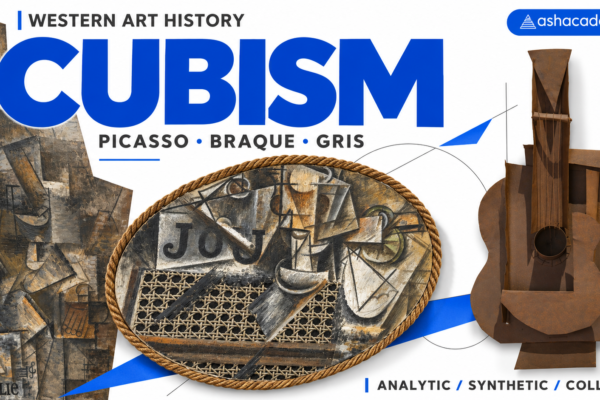
Cubism: History, Characteristics, Artists and Important Artworks
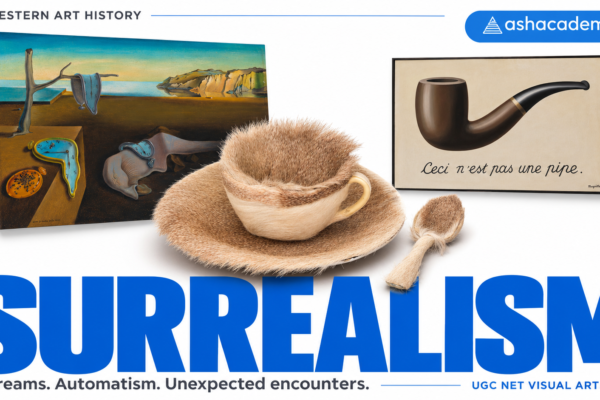
Surrealism: History, Characteristics, Artists and Important Artworks