Neo-Impressionism: History, Characteristics, Artists and Artworks
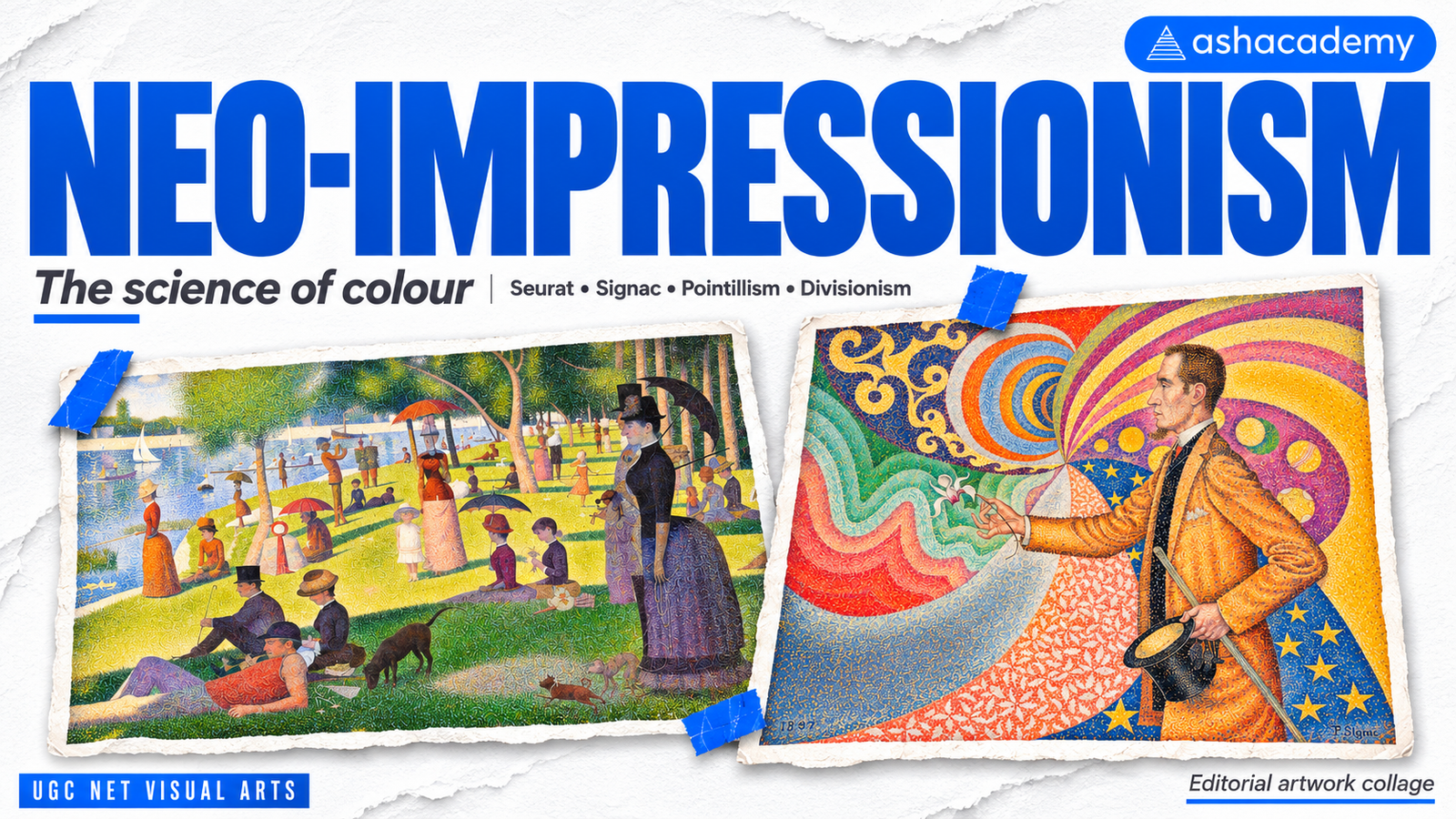
Neo-Impressionism transformed the Impressionists’ interest in light and modern life into a more deliberate investigation of colour, perception and pictorial order. Georges Seurat and Paul Signac are its central names, but Camille Pissarro, Henri-Edmond Cross, Maximilien Luce and Théo van Rysselberghe reveal how varied the movement became.
This illustrated guide explains its history, characteristics, colour theories, major artists and important artworks for art-history study and UGC NET Visual Arts revision. Read the paintings at two distances: first as complete compositions, then as arrangements of separate marks. A dot becomes meaningful through its relationship with the whole picture.
Revision note: Learn three connected terms precisely: Neo-Impressionism = the movement; Divisionism = the principle of separated colour; Pointillism = a technique of small dots. The technique alone does not explain the movement’s compositions, ideas or history.
In this guide
Quick revision · Historical context · Origins and milestones · Three key terms · Colour theory decoded · Visual characteristics · Main artists · 14 artworks explained · Movement comparison · Impact and legacy · Exam revision · Practice quiz · FAQs · Sources
Neo-Impressionism at a glance
| Question | Revision answer |
|---|---|
| Where did it emerge? | France, especially Paris and the Seine suburbs; Belgium became an important centre. |
| When? | Its decisive public emergence was in 1886, after experiments in the mid-1880s. It continued into the early twentieth century. |
| Who developed it? | Georges Seurat, with Paul Signac as a central collaborator, later leader and theorist. |
| Who named it? | Critic Félix Fénéon, in 1886. |
| Defining public event | The eighth and final Impressionist exhibition, Paris, 1886. |
| Landmark painting | Seurat’s A Sunday on La Grande Jatte – 1884, painted 1884–86; border added 1888–89. |
| Colour method | Separate touches of colour, complementary relationships and the intended effect of optical mixture. |
| Important publication | Paul Signac, D’Eugène Delacroix au néo-impressionnisme, 1899. |
| Wider classification | Usually studied within the broader, diverse field of Post-Impressionism. |
1. Historical context: why a new Impressionism?
By the 1880s, artists could paint subjects that had once seemed unsuitable for ambitious art: suburban recreation, railway landscapes, factories, cafés and everyday urban entertainment. Neo-Impressionists inherited this modern subject matter. Their difference lay in how they organised it. They sought a more systematic relationship between what the artist observed, how paint was applied and how a viewer perceived colour.
The Seine’s outskirts brought leisure and industry into the same field of vision. A riverbank could be a bathing place, a boating destination and a view towards factory chimneys. Seurat’s Bathers at Asnières makes this proximity visible. Do not treat such landscapes as untouched countryside simply because they contain grass, water and bright daylight.
Independent exhibiting structures mattered as much as a new brushstroke. Seurat’s Bathers was rejected by the official Salon in 1884. Exhibitions organised outside its selection system gave experimental painters a route to audiences. The Artistes Indépendants and the final Impressionist exhibition helped bring the new approach into public discussion.
Source: National Gallery of Victoria, Radiance: The Neo-Impressionists.
Meaning and ideology: observation organised into harmony
The prefix neo means “new.” The movement continued the study of light and contemporary experience while questioning the idea that a picture should depend primarily on a rapidly captured sensation. Planned colour relationships and compositional structure could, its advocates believed, give modern painting greater coherence.
Avoid a rigid opposition in which every Impressionist worked spontaneously and every Neo-Impressionist followed a mechanical formula. Impressionists also planned, revised and worked in studios; Neo-Impressionists also observed outdoors and made intuitive choices. The distinction concerns an emphasis on systematic colour division and pictorial organisation, rather than a complete separation of working habits.
Radical politics formed part of the movement’s social network. Signac and Fénéon had anarchist commitments; other artists addressed workers, inequality or imagined social harmony. However, a painting does not become an anarchist statement merely because it uses divided colour. Political interpretation requires evidence about the particular artist, image and context.
Source: MoMA, A Curator’s Guide to Félix Fénéon Exhibition Highlights.
Source: National Gallery, Neo-Impressionism glossary.
2. Origins, naming and important milestones
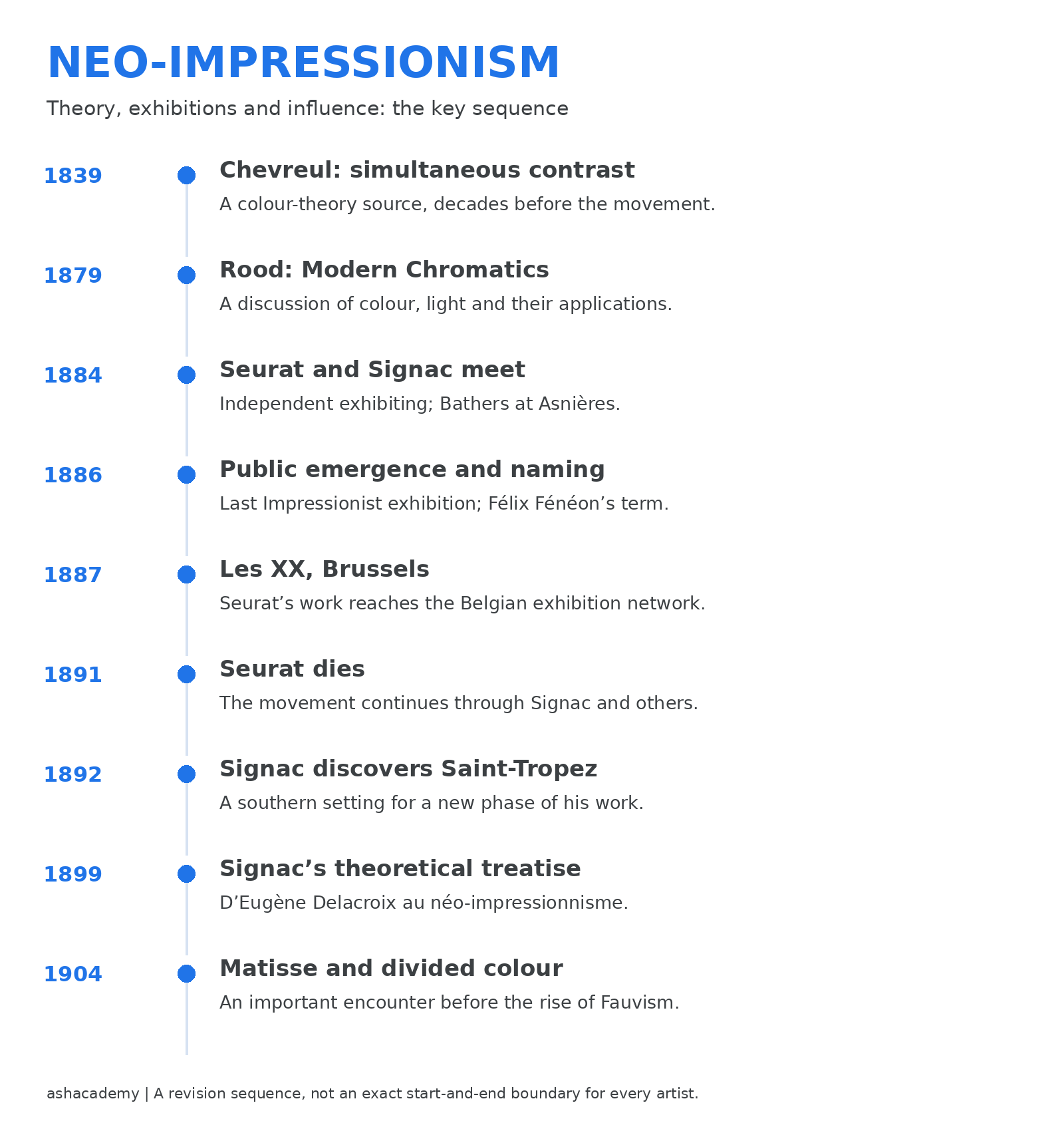
1884: Seurat and Signac met in the independent exhibition environment. Their shared interests developed through observation, experiment and discussion. This preparatory stage is distinct from the movement’s naming in 1886: an artistic method can develop before it receives a critical label.
1886: Seurat exhibited La Grande Jatte at the eighth and final Impressionist exhibition. Signac, Camille Pissarro and Lucien Pissarro also participated. Fénéon gave the new tendency its name. The Musée d’Orsay identifies his article in the Brussels review L’Art moderne, dated 19 September 1886, as the naming reference.
1887: Seurat’s participation in the exhibition of Les XX in Brussels helped extend the movement’s audience in Belgium. An exhibition association such as Les XX should not be mistaken for the name of the colour technique. Belgian artists developed individual responses rather than simply copying a French formula.
1891–1899: Seurat’s death in 1891 did not end the movement. Signac continued its advocacy; Cross and others expanded the possibilities of separated colour. Signac’s 1899 treatise D’Eugène Delacroix au néo-impressionnisme presented the approach as part of a historical development in colour painting. It is a later theoretical statement, not an 1886 founding manifesto signed by all participants.
Source: Musée d’Orsay, Neo-Impressionism: From Seurat to Paul Klee.
Source: Musée des impressionnismes Giverny, Neo-Impressionism.
3. Neo-Impressionism, Divisionism and Pointillism: the difference
| Term | What it describes | What it does not mean |
|---|---|---|
| Neo-Impressionism | A historical movement associated with Seurat, Signac and their circle, with shared colour concerns and exhibition networks. | Every painting containing dots belongs to this movement. |
| Divisionism | Separating colour into individual touches so relationships between hues and tones remain active across the surface. | Marks must always be small, circular and identical. |
| Pointillism | Applying paint in small dot-like marks, from French point, a dot or point. | A complete explanation of the artist’s subject, ideology or composition. |
| Chromo-luminarism | A historical term associated with the investigation of colour and luminosity, especially Seurat’s programme. | A separate group founded at a different exhibition. |
A practical test: imagine a painting built from small rectangular strokes whose colours remain separated. It may employ a divisionist approach without looking like a field of identical pinpoints. Conversely, decorative dots in an unrelated modern illustration do not establish a historical connection with Seurat’s circle.
These labels overlap in museum writing and are sometimes used loosely as near-synonyms. For an examination answer, explain their different levels: movement, colour principle and mark-making technique. This keeps the terminology useful without pretending that nineteenth-century usage was perfectly uniform.
Source: The Met, Neo-Impressionism exhibition overview.
4. Colour theory decoded: what happens between the marks?
Simultaneous contrast: a colour changes with its neighbour
Michel-Eugène Chevreul’s De la loi du contraste simultané des couleurs appeared in 1839. Its relevance lies in relational perception: a colour’s appearance is affected by adjacent colours. Chevreul was a chemist and colour theorist, not a Neo-Impressionist painter, and his book preceded the movement by decades.
Traditional complementary pairs important to this artistic discussion are red–green, blue–orange and yellow–violet. Side-by-side complementary hues can make a boundary seem more forceful. This is different from physically stirring complementary pigments together, which often reduces chromatic intensity. A complement is a relationship within a colour model; do not automatically transfer these painterly pairs into every modern RGB or printing model.
Source: Smithsonian Libraries, Using Color.
Source: The Met Library, Chevreul’s 1839 publication.
Rood and optical mixture: observation, theory and ambition
American physicist Ogden N. Rood published Modern Chromatics, with Applications to Art and Industry in 1879. His discussion of colour and light offered painters another vocabulary for considering how different kinds of mixture behave. The publication date is earlier than Neo-Impressionism’s public emergence.
In mélange optique, or optical mixture, separate touches are intended to contribute to a combined colour impression at a suitable viewing distance. At close range, the marks remain visible; farther away, their relationships can contribute to a more unified appearance. That does not mean each pair of colours produces a guaranteed third colour for every viewer.
A painted canvas reflects light from pigments; it is not a monitor emitting RGB light. Mark size, spacing, underlayers, viewing distance, illumination, pigment properties and reproduction quality affect what we perceive. Describe the artists’ aspiration to increased luminosity as a historical artistic theory, rather than claiming that dots literally convert paint into pure light.
Source: University of Chicago Library, Modern Chromatics.
Charles Henry and the expressive role of line
Colour was only one part of the programme. Seurat also investigated how directions, rhythms and tonal arrangements could contribute to a painting’s emotional character. Charles Henry’s theories are relevant here. In works such as Chahut, repeated upward diagonals help organise the impression of gaiety. This was an artistic system of association, not a universal scientific law that every diagonal makes everyone happy.
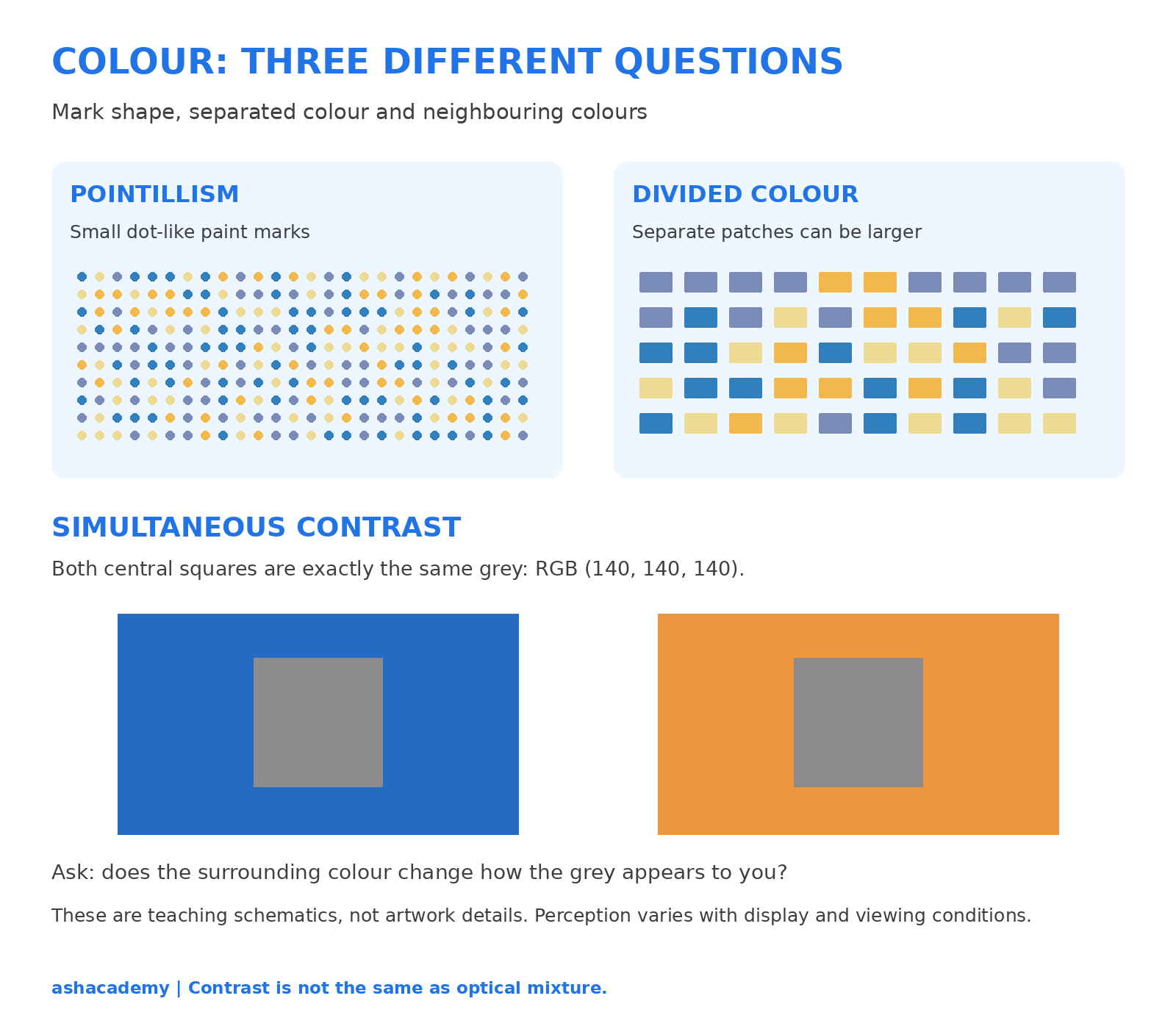
Revision note: Do not confuse simultaneous contrast with optical mixture. Contrast concerns how adjacent colours alter each other’s appearance; optical mixture concerns a combined impression of separate marks at a viewing distance. An artwork can involve both.
5. Visual characteristics: how to identify the approach
| Visual feature | What to look for | A useful example |
|---|---|---|
| Separated touches | A surface built from individually visible dabs, dots or patches. | Seurat, La Grande Jatte |
| Relational colour | Warm and cool hues, complements and varied tints used in combination. | Signac, The Red Buoy |
| Compositional order | Repeated verticals, diagonals, contours and carefully placed figures. | Seurat, Chahut |
| Modern subjects | Suburban leisure, entertainment, working lives and contemporary portraiture. | Luce, Morning, Interior |
| Simplification | Forms organised into silhouettes, broad zones or decorative rhythms. | Cross, The Golden Isles |
| Later mosaic-like surfaces | Larger, more widely separated marks; increasing decorative colour intensity. | Compare Cross and Signac with early Seurat. |
Begin visual identification with the whole composition. Does the work feel like a carefully balanced stage, a sequence of horizontal bands, or a field of sparkling patches? Only then examine the brushwork. This order prevents an identification based on a few dots while overlooking the painting’s structure.
Oil painting is prominent, but the wider circle also worked in drawing and watercolour. Seurat’s preparatory studies demonstrate that systematic painting did not eliminate drawing or tonal analysis. A finished canvas should not be imagined as thousands of marks applied without planning underneath.
Nor did the method require every artist to use an identical palette. “Pure colour” in historical advocacy expresses a preference for separated chromatic elements; it should not become the unsupported rule that every artist always used every pigment straight from the tube, never mixed a tint and never varied the procedure.
6. Main artists and their different contributions
The table follows birth-year order, which is different from the order in which the painters adopted Neo-Impressionism. Pissarro was the oldest of these artists, while Seurat was the movement’s central innovator.
| Artist | Life dates | Contribution and distinction |
|---|---|---|
| Camille Pissarro | 1830–1903 | An established Impressionist who experimented with divided colour for a limited phase; did not remain a strict practitioner throughout his career. |
| Henri-Edmond Cross | 1856–1910 | Mediterranean landscapes, decorative colour arrangements and an increasingly liberated treatment of divided touches. |
| Maximilien Luce | 1858–1941 | Brought the approach to urban scenes, working lives and intimate interiors, alongside landscape. |
| Georges Seurat | 1859–1891 | Central innovator; united divided colour with disciplined composition, figure studies and modern subjects. |
| Théo van Rysselberghe | 1862–1926 | A major Belgian practitioner whose portraits preserve personal likeness within divided colour. |
| Paul Signac | 1863–1935 | Collaborator, advocate and later leader; developed luminous marine subjects and published the 1899 treatise. |
The wider network: Lucien Pissarro, Charles Angrand, Albert Dubois-Pillet, Hippolyte Petitjean, Anna Boch, Georges Lemmen and Willy Finch also belong in the discussion. Their inclusion prevents the movement from being reduced to a two-artist partnership. Study each artist’s actual period of engagement instead of labelling every work in a long career Neo-Impressionist.
7. Important Neo-Impressionist artworks, explained visually
The following sequence is thematic: Seurat’s development first, followed by Signac and the wider circle. Full works are retained so that composition can be studied. Click an image for a larger view; the collection record supplies the catalogued details. English titles are accompanied by French titles where helpful.
1. Seurat: Bathers at Asnières, 1884
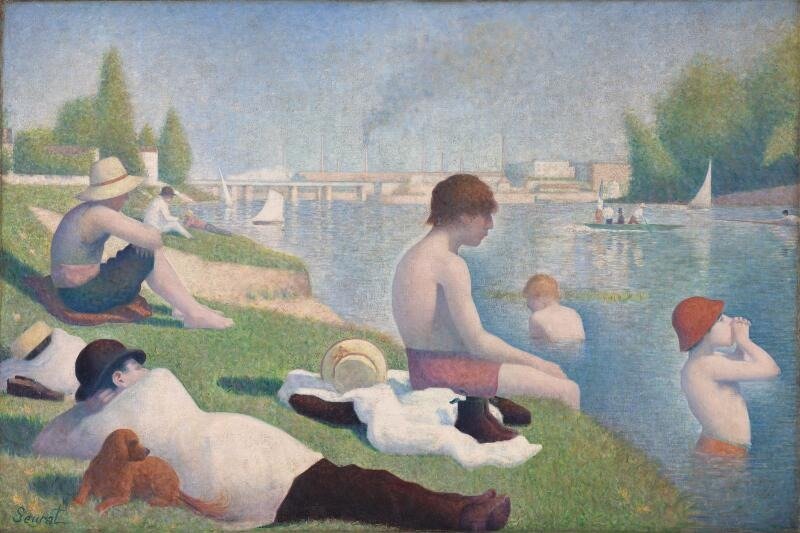
Look closely: Follow the horizontal riverbank, the side-on faces and the calm arrangement of the bodies. The distant bridges and chimneys place this quiet scene beside a modern industrial landscape.
This is a crucial precursor, rather than a fully developed demonstration of Seurat’s later Pointillism. The National Gallery explains that parts were subsequently reworked with dotted colour. Its monumental scale and still, simplified figures already show an ambition beyond a quickly recorded riverside impression. Exam distinction: the work’s 1884 date does not mean the mature method was complete everywhere on its surface.
2. Seurat: Bathers, preparatory study, 1883/1884
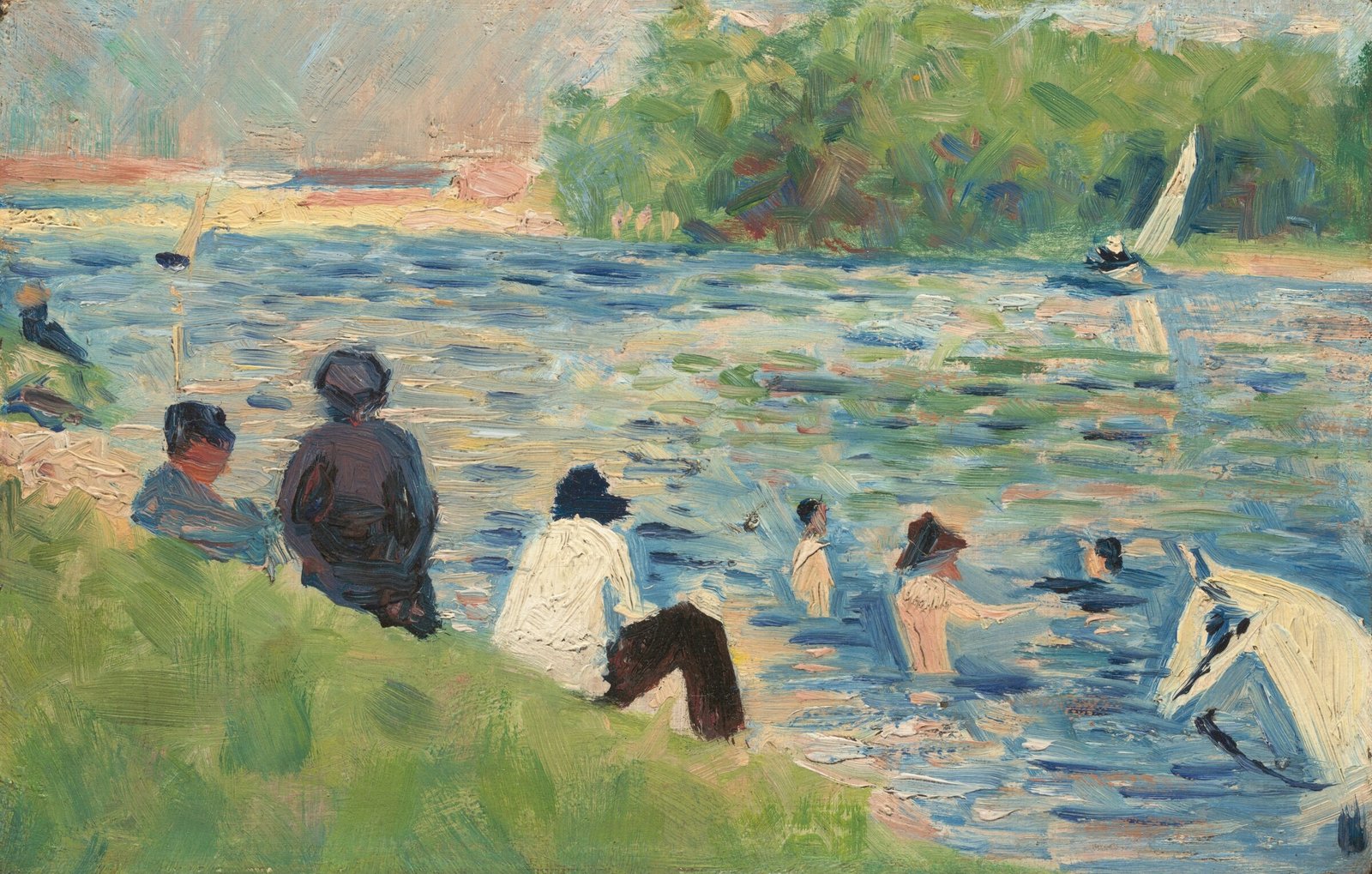
Look closely: Compare the loose, visible strokes and the horse at the right with the more resolved final composition. A study can test an arrangement that the finished picture changes.
The medium is oil on wood, unlike the large oil-on-canvas painting in London. This comparison shows the importance of preparation: the final design emerged through studies and decisions. For artwork matching, remember that a preliminary study and a finished painting may share a subject while having different dates, supports and collections.
3. Seurat: A Sunday on La Grande Jatte – 1884, 1884–86

Look closely: Read the alternating sun and shade, repeated tree trunks, parasols and upright figures. The large foreground profiles establish a stage-like edge; the painted dotted border participates in the colour arrangement.
The picture was shown at the final Impressionist exhibition in 1886. Its figures inhabit a modern leisure site, yet their stillness and repeated contours feel highly orchestrated. The subject belongs to contemporary life; the organisation asks us to consider order and duration as well as a passing moment. These are visual observations, not proof of a single hidden message shared by every figure.
Revision note: The title includes “1884,” but the Art Institute dates the painting 1884–1886 and the painted border 1888–1889. Distinguish title, execution dates, exhibition year and later alteration.
4. Seurat: Circus Sideshow, 1887–88
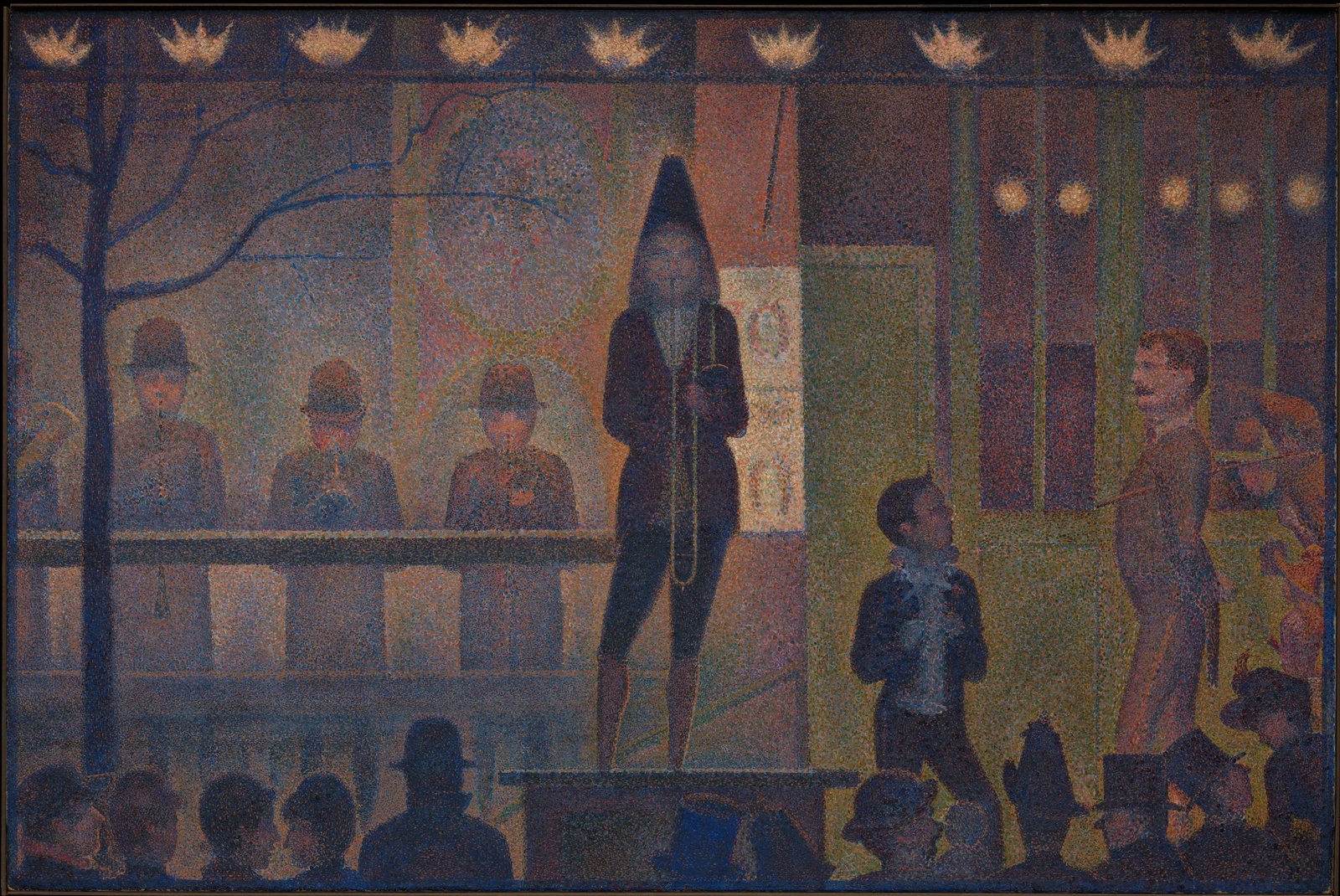
Look closely: Find the band of spectators below, performers above and repeated lights across the top. Dotted colour operates in an artificially lit night scene, not only in bright daylight.
A parade here is a sideshow performance outside a circus, not the same scene as Seurat’s later The Circus. Compare the closed, frontal arrangement and dark atmosphere with the open green setting of La Grande Jatte. The two works demonstrate how a related method can produce different lighting conditions and moods.
5. Seurat: Chahut, 1889–90
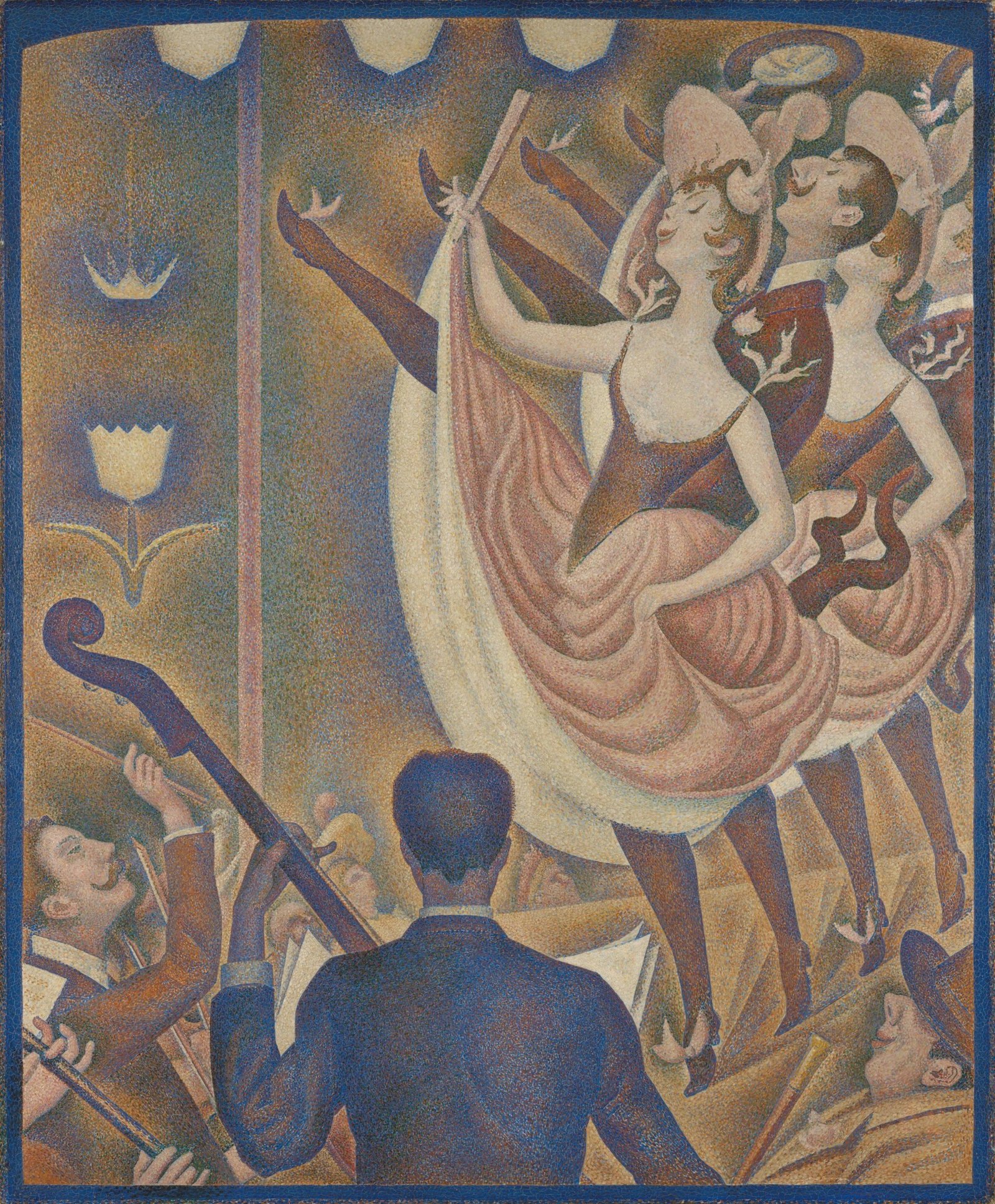
Look closely: Trace the dancers’ raised legs, facial curves and the slant of the instrument. The repeated upward directions connect bodies, expressions and musical performance.
The cancan subject is energetic, but the arrangement is calculated. This painting is an especially useful answer when asked how Neo-Impressionism extends beyond colour optics: line, rhythm and stylisation organise the emotional effect. Describe the visible upward repetitions before invoking a theoretical explanation. A viewer can then check the observation against the image.
6. Seurat: Le Cirque, 1891
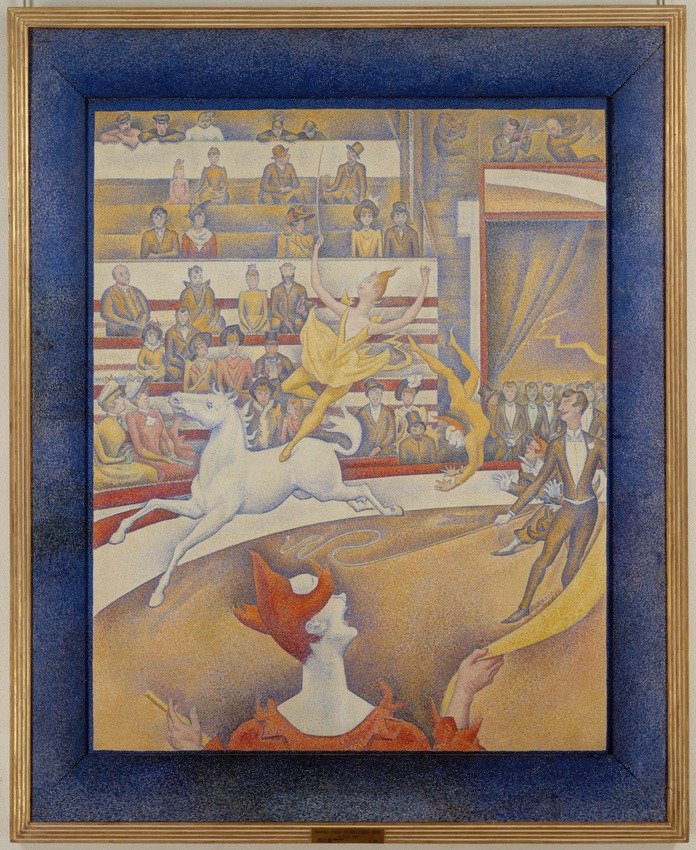
Look closely: Compare the horse’s curve, the acrobat’s diagonal and the foreground clown with the stacked rows of spectators. Movement in the ring is set against a more rigid audience structure.
The Musée d’Orsay catalogues this work as 1891. It remained unfinished at Seurat’s death. Keep it separate from Circus Sideshow in both title and date. Its organised curves, warm colour emphasis and rhythmic repetitions show why Seurat’s late painting cannot be described adequately as “dots used to copy nature.”
7. Signac: Portrait of Félix Fénéon, Opus 217, 1890
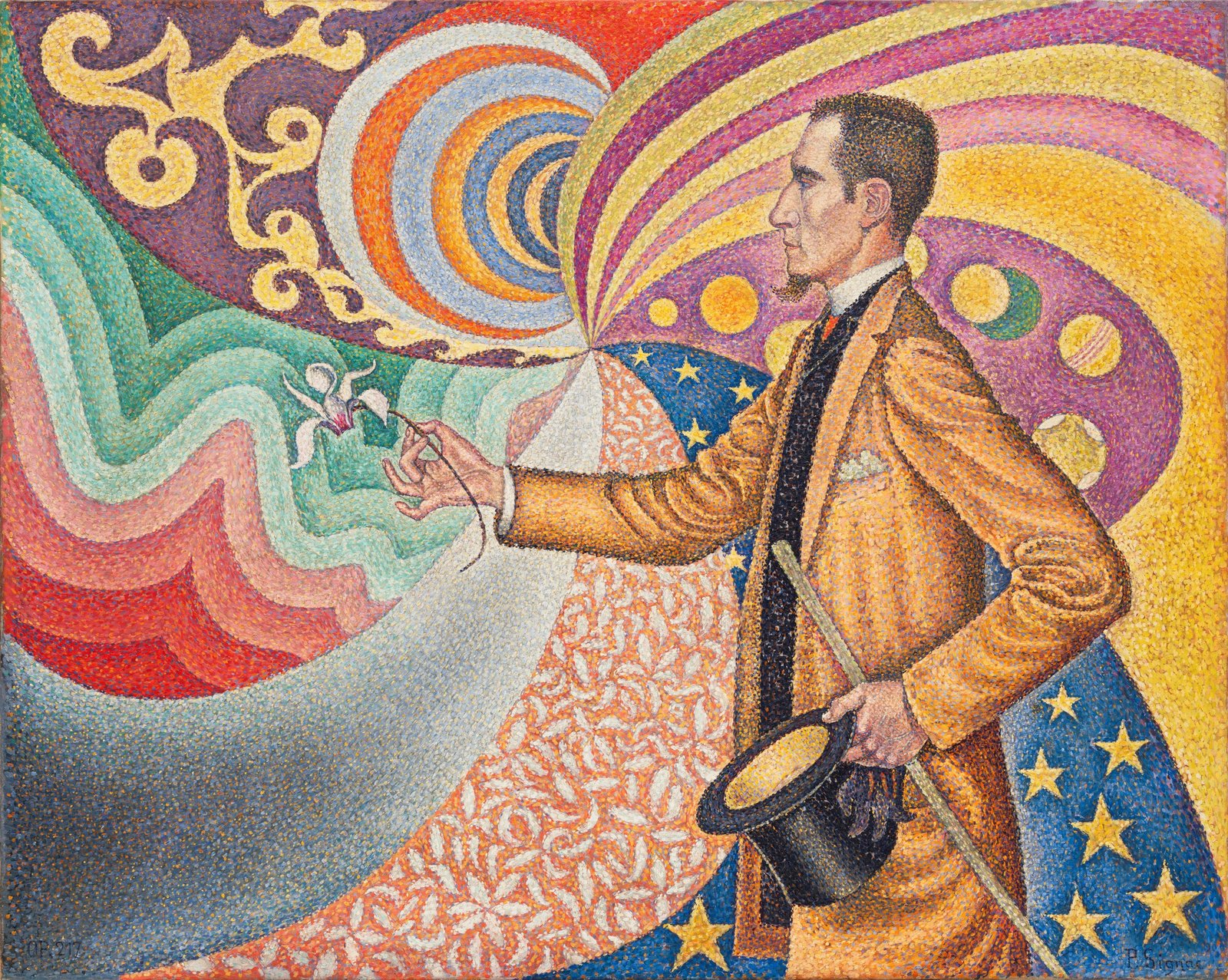
Look closely: Look at Fénéon’s crisp profile against the pinwheel-like background. The flower, cane, bent arm and abstract pattern establish rhythmic relationships without losing the sitter’s identity.
The full title, retained in the caption, refers to beats, angles, tones and tints. “Opus 217” evokes the language of musical works and systematic arrangement. The sitter is the critic who named the movement. This makes the portrait valuable for connecting artist, theorist, artwork and terminology, rather than memorising Fénéon only as a name in a one-line definition.
8. Signac: Women at the Well, Opus 238, 1892
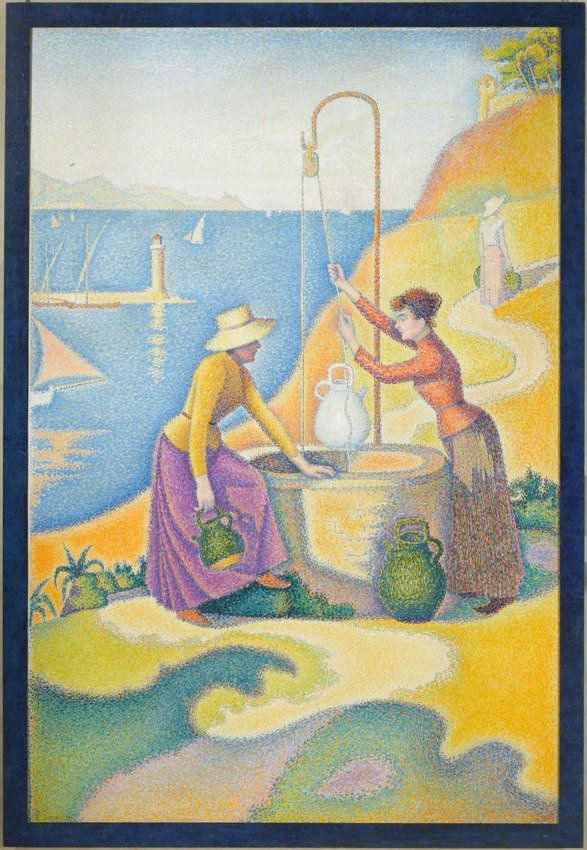
Look closely: The two figures form an interlocking arrangement around the well. Curved silhouettes, warm ground and the blue sea give the scene a deliberate decorative unity.
The current museum record dates the painting to 1892; it was exhibited at the Salon des Indépendants in 1893. The distinction matters when different dates appear in summaries. Its idealised southern setting also broadens the subject range beyond Parisian entertainment. It is not a documentary account of every aspect of life in Saint-Tropez.
9. Signac: The Red Buoy, 1895
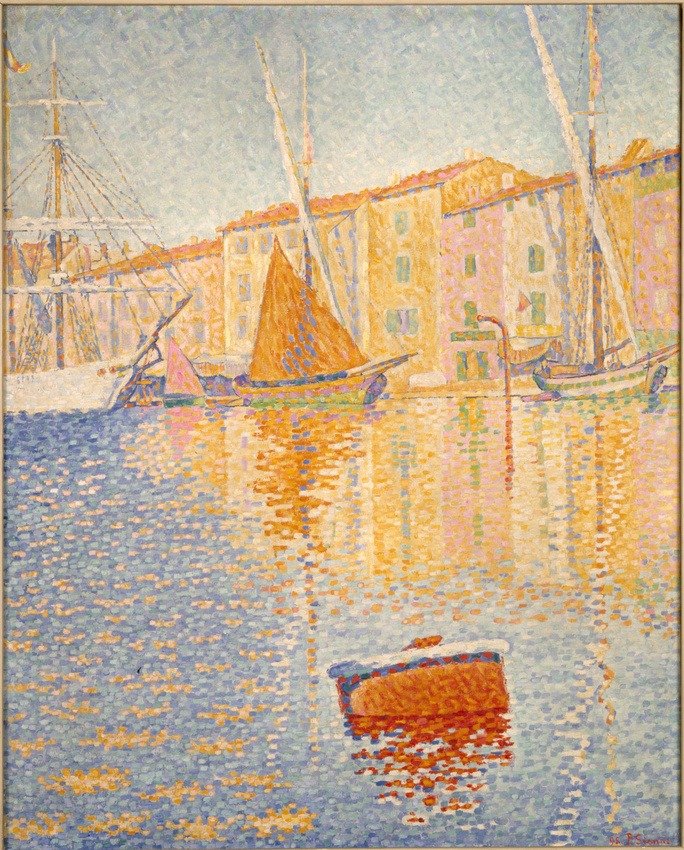
Look closely: The red-orange buoy anchors the foreground against blue water. Compare the buoy’s concentrated shape with the more fragmented reflections and vertical masts.
This is a clear example for discussing complementary colour relationships in a specific composition. Identify where the warm and cool hues meet, then explain how the buoy attracts attention. Avoid reducing the whole canvas to a generic colour-wheel rule: placement, value, size and surrounding marks also contribute to its emphasis.
10. Cross: The Golden Isles, 1891–92
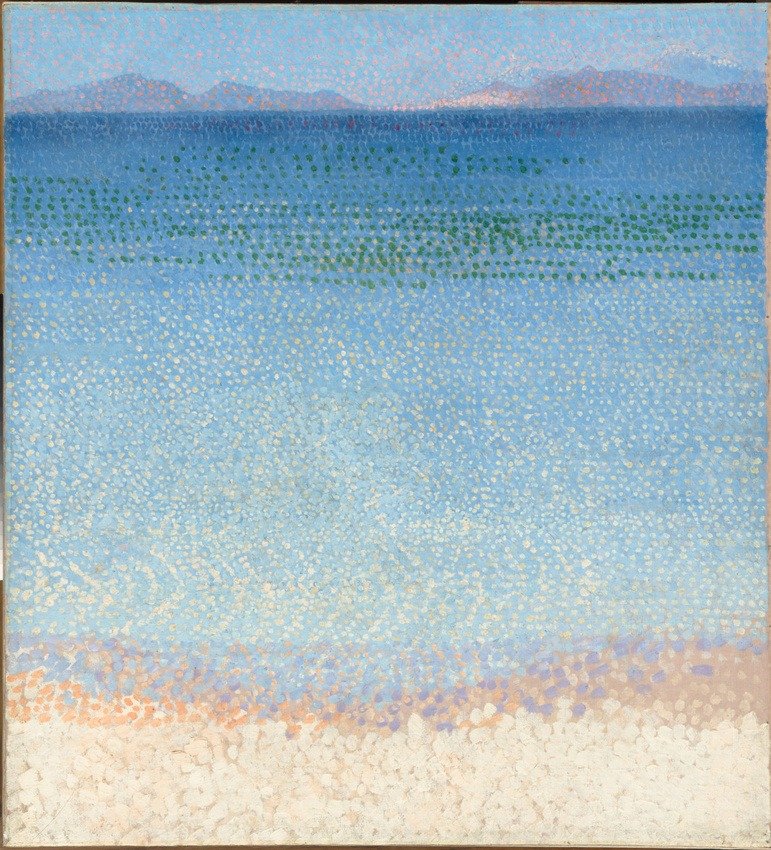
Look closely: Sand, sea and sky become broad horizontal zones. Dabs change in size and spacing, while the high horizon compresses the distant islands into a narrow band.
Cross removes much descriptive incident to concentrate on colour and light. The landscape remains recognisable, but its large bands invite us to read the painting as an organised surface. The museum connects its high horizon with Japanese prints. This is a particularly useful comparison with Seurat’s populated, stage-like figure compositions.
11. Cross: The Evening Air, circa 1893
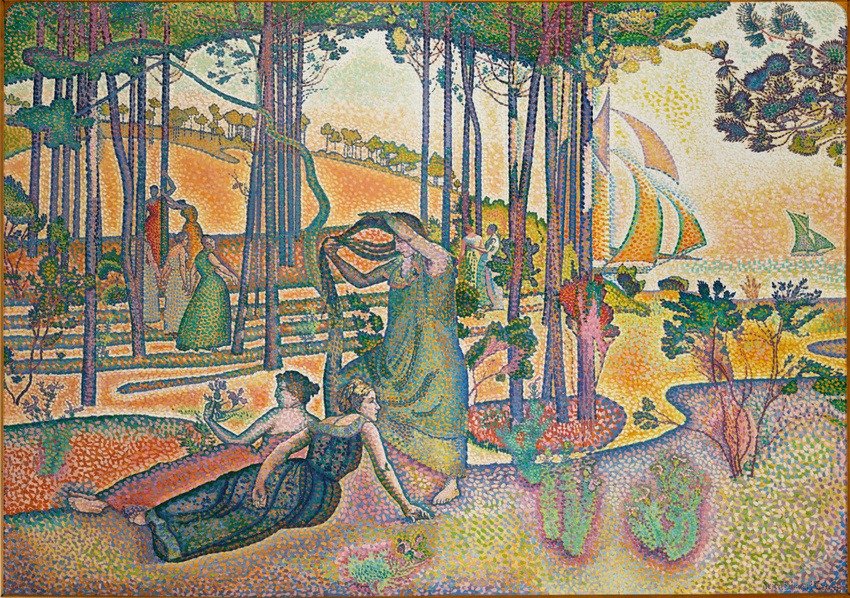
Look closely: Tree trunks build a vertical screen; reclining and seated figures create curving rhythms below. Notice how the patches distribute colour across vegetation, ground and bodies.
Use the current Musée d’Orsay catalogue’s circa 1893 dating for this study. Cross’s landscape proposes a harmonious, imagined relation between people and nature. Compare its decorative organisation with The Golden Isles: one uses a wide figural setting, the other a much more reduced arrangement of bands. A shared technique does not produce a single fixed compositional formula.
12. Pissarro: View from my Window, 1886–88
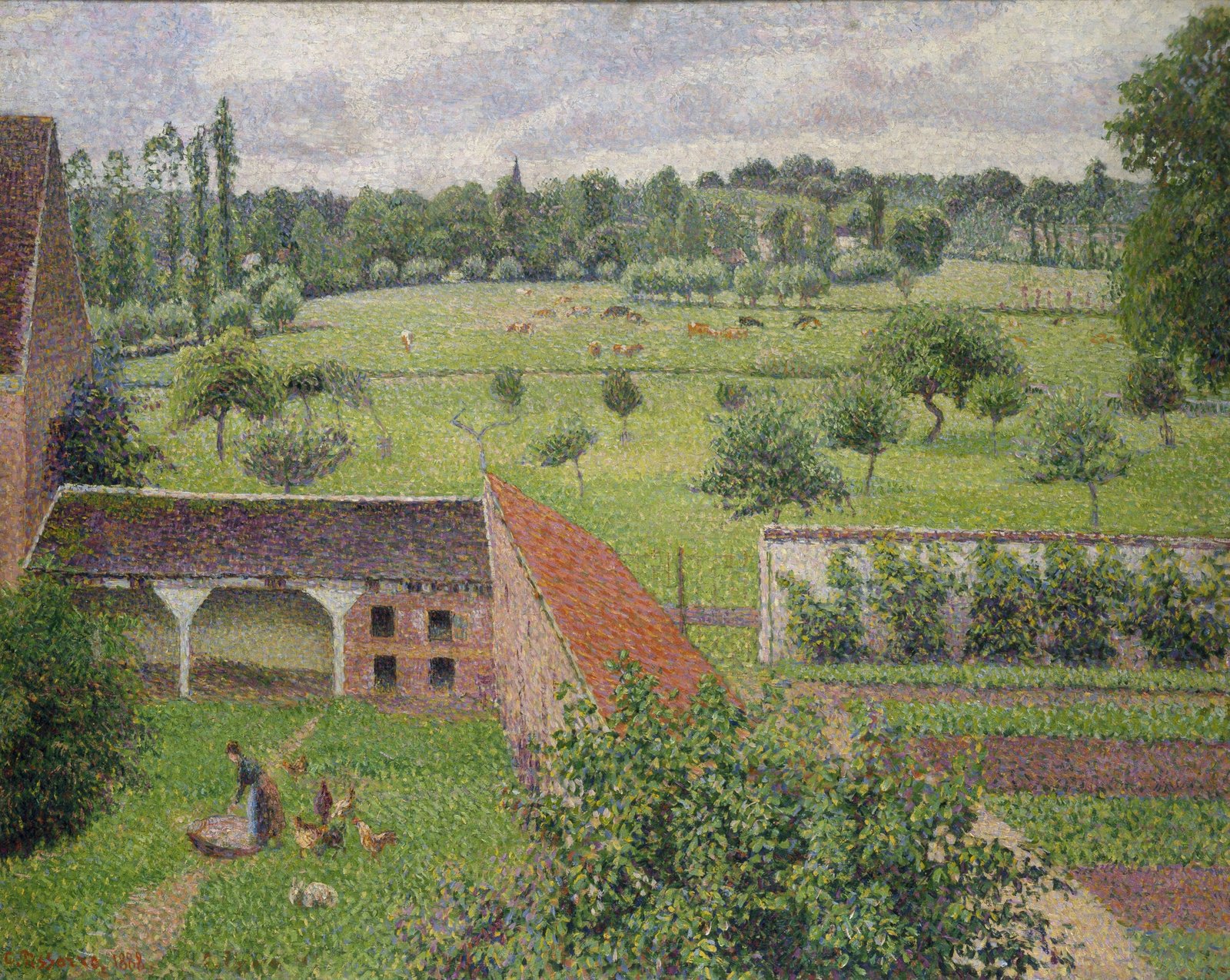
Look closely: A high viewpoint lets the fields and garden boundaries organise the view. The touches are broader than an imagined rule of identical tiny dots would allow.
The Ashmolean records that the picture was first exhibited in 1886 and reworked and dated in 1888. Its account also stresses that Pissarro’s method was not strictly Pointillist and that he returned to a freer Impressionist manner by 1890. His participation shows a dialogue between generations; it does not mean that every Pissarro painting belongs to Neo-Impressionism.
13. Luce: Morning, Interior, 1890
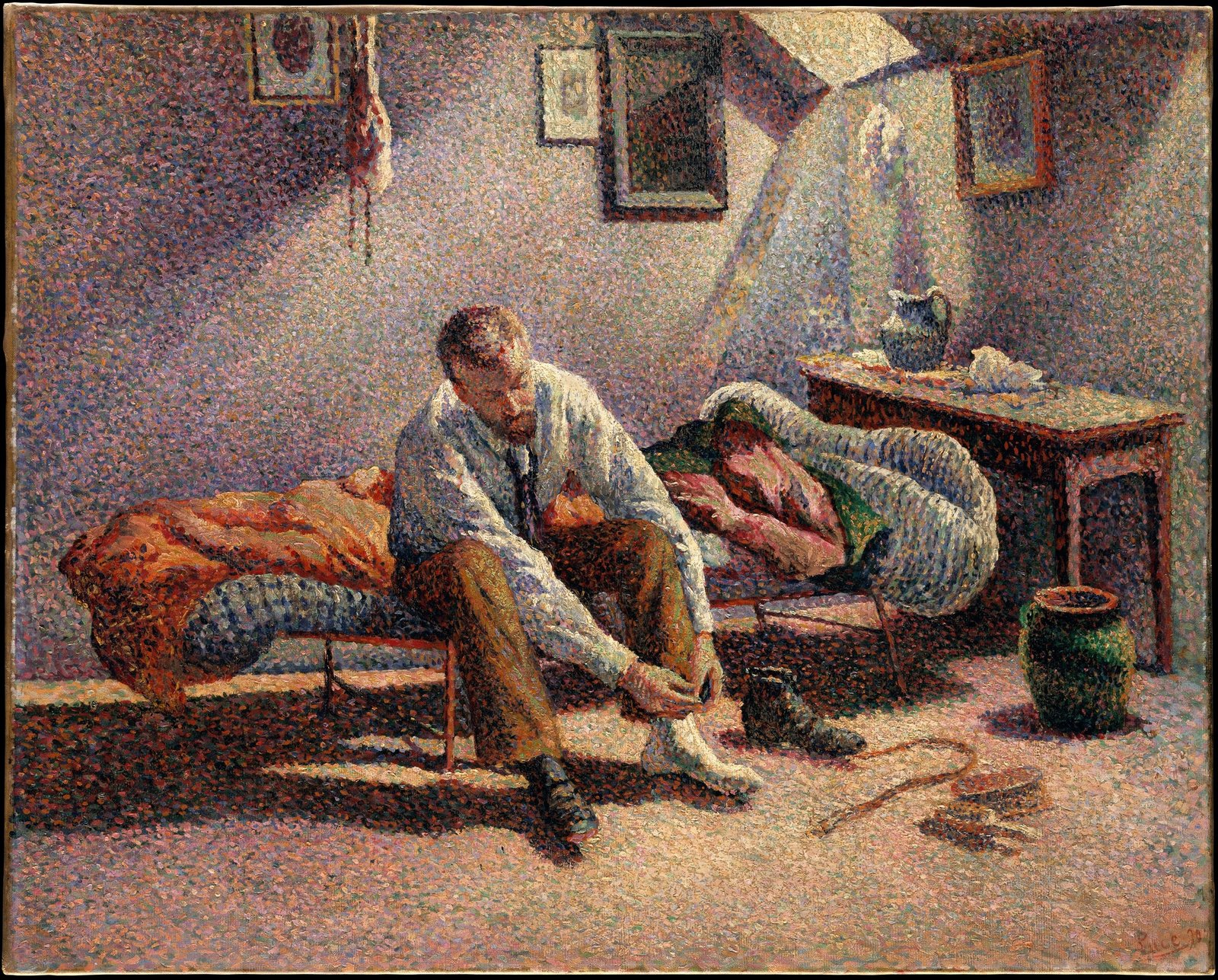
Look closely: Morning light enters the modest room and breaks into warm and cool touches over the figure, bed and floor. Read the ordinary action before examining the stippled surface.
The Met identifies the sitter as Luce’s friend, painter Gustave Perrot, getting dressed. The painting brings the method into an intimate interior rather than a monumental outdoor crowd. It demonstrates how a familiar action can become a sustained study of light without losing its everyday human setting.
14. Van Rysselberghe: Portrait of Maria Van Rysselberghe-Monnom, 1892
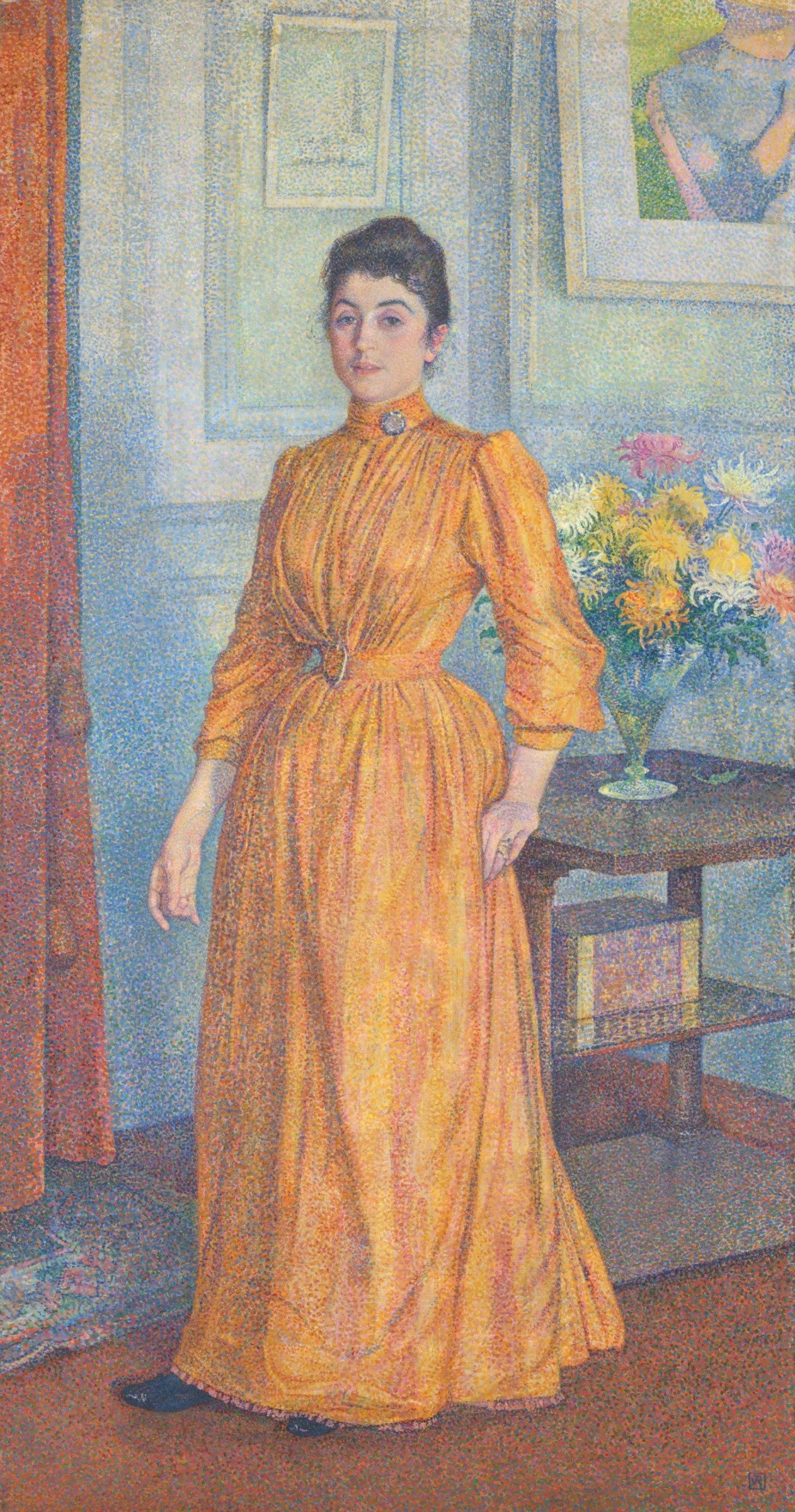
Look closely: Observe the orange dress against the blue surroundings, then look at how the face and posture remain individual within the divided surface.
The sitter is the artist’s wife. The museum emphasises that Van Rysselberghe retained an interest in personal likeness and character. This portrait corrects the assumption that all Neo-Impressionist figures must appear anonymous or mannequin-like. Compare the treatment of identity here with Signac’s Fénéon and Seurat’s leisure crowds.
8. Impressionism, Neo-Impressionism and Post-Impressionism
| Aspect | Impressionism | Neo-Impressionism |
|---|---|---|
| Historical reference point | Independent group exhibitions began in 1874. | Distinctive public emergence and naming in 1886. |
| Shared concerns | Light, colour, perception and modern experience. | Continues these concerns while giving colour division a more explicit theoretical programme. |
| Typical surface | Varied broken strokes; differences between individual painters are substantial. | Separated touches, ranging from small dots to broader patches. |
| Compositional tendency | Often an emphasis on a momentary encounter or changing conditions. | Often a stronger impression of planned geometry, repetition or decorative organisation. |
| Artists to recall | Monet, Renoir, Morisot, Degas and Pissarro. | Seurat, Signac, Cross, Luce and Van Rysselberghe; Pissarro for a limited phase. |
| Avoid this absolute | “Every Impressionist painting was finished quickly outdoors.” | “Every Neo-Impressionist used identical dots and no pigment mixtures.” |
Post-Impressionism is a broader art-historical category, not a single uniform painting method. Seurat’s systematic colour, Cézanne’s structural investigations and Gauguin’s different uses of colour and form should not be collapsed into one technique. Neo-Impressionism can be studied within this wider field while retaining its own history and vocabulary.
Revision note: Use overlapping categories carefully. Neo-Impressionism is not another name for all Post-Impressionism. Pointillism is not the defining technique of Cézanne, Gauguin or every painting made after Impressionism.
9. Impact and legacy: from divided colour to freer colour
After Seurat’s death, the approach continued to change. Cross and Signac developed more expansive colour arrangements and larger touches. The eye could move between a recognisable view and an increasingly decorative surface. Later painters could learn from this division of colour without accepting the whole theoretical programme.
Henri Matisse’s engagement with Signac and Cross in 1904 is an important bridge towards Fauvism. His Luxe, calme et volupté belongs in that discussion. The connection concerns encounters, divided marks and heightened colour; it does not make every Fauvist painting Neo-Impressionist. Fauvism gave colour other expressive freedoms and developed its own identity.
The broader legacy includes increased attention to how the painted surface is constructed. A picture could represent a landscape while declaring that it was a system of marks and colour relations. This helped open possibilities later artists explored in different directions. It is more accurate to describe a contribution to modern painting than to claim that Seurat single-handedly invented all subsequent abstraction.
Source: Dita Amory, The Met: Seurat and Neo-Impressionism.
Source: Sabine Rewald, The Met: Fauvism.
10. UGC NET Visual Arts revision: chronology, terms and matching
These are revision priorities derived from the movement’s history, not predictions about a future paper. The questions below are original practice questions, not claimed previous-year questions. First learn a few reliable associations, then use the images to explain why they matter.
| Date | Event or publication | Distinction to retain |
|---|---|---|
| 1839 | Chevreul’s simultaneous-contrast publication. | A theoretical source before the movement. |
| 1879 | Rood, Modern Chromatics. | Do not attribute the book to Seurat. |
| 1884 | Bathers at Asnières; Seurat–Signac encounter in the independent exhibition context. | Preparatory development, before the 1886 label. |
| 1886 | Final Impressionist exhibition; Fénéon names Neo-Impressionism. | Public event and naming coincide in this year. |
| 1887 | Seurat shown at Les XX, Brussels. | Important Belgian exhibition connection. |
| 1891 | Seurat dies; The Circus remains unfinished. | The movement continues after him. |
| 1892 | Signac discovers Saint-Tropez; Women at the Well. | Painting date differs from its 1893 exhibition. |
| 1899 | Signac’s D’Eugène Delacroix au néo-impressionnisme. | Later theoretical advocacy. |
| 1904 | Matisse’s engagement with divided colour in the southern French context. | A bridge to a later movement, not the origin of Neo-Impressionism. |
| Match the artist | With the artwork | Useful visual cue |
|---|---|---|
| Seurat | La Grande Jatte | A riverside crowd organised through repeated profiles and parasols. |
| Seurat | Circus Sideshow | Night-time performers and spectators in a frontal arrangement. |
| Seurat | Chahut | Cancan dancers and repeated upward directions. |
| Signac | Portrait of Félix Fénéon | Profile portrait before a rhythmic pinwheel background. |
| Signac | The Red Buoy | Warm buoy against blue harbour water. |
| Cross | The Golden Isles | Reduced bands of sand, water and sky. |
| Luce | Morning, Interior | An everyday action in a light-filled modest room. |
| Van Rysselberghe | Portrait of Maria Van Rysselberghe-Monnom | Orange dress, blue surroundings, individual likeness. |
Commonly confused facts
Seurat and Signac: remember both, but distinguish Seurat’s central innovation from Signac’s long advocacy and 1899 publication. Fénéon and Chevreul: one is the critic who named the movement; the other is an earlier scientist whose colour research mattered to its background.
Pissarro: an Impressionist with a Neo-Impressionist phase, not an artist who permanently abandoned Impressionism. Dots and light: optical mixture was an artistic ambition with conditions and limits, not a claim that the canvas emits light. Dates: title dates, making dates, reworking dates and exhibition dates answer different questions.
How to build one useful revision page: write 1886 at the centre; connect Seurat to La Grande Jatte, Fénéon to the name and Signac to 1899. Add the three technical terms on one side and three artwork images on the other. Then practise explaining each connection without reading the captions. This checks understanding as well as memory.
11. Original practice quiz with explanations
Try each answer before opening the explanation. For the visual questions, return to the full images above rather than relying only on a title.
1. Who coined the term Neo-Impressionism? A. Chevreul B. Félix Fénéon C. Ogden Rood D. Charles Henry
Answer: B, Félix Fénéon, in 1886. Chevreul and Rood belong to the colour-theory background; Henry is relevant to aesthetic theories. They did not name the movement.
2. Which pairing is most precise? A. Divisionism—separated colour B. Pointillism—all Post-Impressionism C. Neo-Impressionism—any dotted image D. Divisionism—only identical circles
Answer: A. Divisionism concerns colour separation. Pointillism describes dot-like application; Neo-Impressionism names the historical movement. The other answers replace a distinction with an overgeneralisation.
3. Arrange these: Chevreul’s publication; Rood’s Modern Chromatics; the last Impressionist exhibition; Signac’s treatise.
Answer: 1839 → 1879 → 1886 → 1899. The two colour-theory publications precede the movement’s public emergence, while Signac’s book follows it.
4. Visual identification: dancers, repeated raised legs and upward facial curves. Which painting? A. Chahut B. Morning, Interior C. The Red Buoy D. The Golden Isles
Answer: A, Seurat’s Chahut, 1889–90. The coordinated upward rhythms matter as much as the dotted surface. The other works have different subjects and compositional structures.
5. Why is “La Grande Jatte was painted entirely in 1884” inaccurate?
Answer: “1884” forms part of its title, but the Art Institute dates the painting 1884–86, with the painted border added 1888–89. A title is not always a complete execution history.
6. Which statement about Pissarro is correct? A. He invented Neo-Impressionism alone B. Every work of his is Pointillist C. He experimented for a limited phase D. He wrote Signac’s 1899 treatise
Answer: C. The Ashmolean documents his modified use of the method and return to freer Impressionist painting by 1890. Authorship of the 1899 treatise belongs to Signac.
7. Match: Seurat / Signac / Cross / Luce with Chahut / The Red Buoy / The Golden Isles / Morning, Interior.
Answer: Seurat—Chahut; Signac—The Red Buoy; Cross—The Golden Isles; Luce—Morning, Interior. Reinforce the names by recalling a compositional cue for each image.
8. What does the orange-dress portrait of Maria demonstrate about the movement?
Answer: Van Rysselberghe could combine separated colour and complementary relationships with individual likeness. Neo-Impressionist portraiture did not require every sitter to become an anonymous type.
9. Is a canvas made from large separated rectangular touches necessarily excluded from Divisionism?
Answer: No. The principle concerns separated colour relationships, not an obligatory circular shape. Historical attribution still needs evidence beyond the appearance of the marks.
10. Why should a Neo-Impressionist painting not be explained simply as an RGB screen?
Answer: A canvas reflects light from pigments, while a screen emits light. Viewing distance, spacing, colour relationships and material conditions affect the painting’s appearance. The artists’ optical ambitions should not be confused with an identical physical mechanism.
12. Frequently asked questions
What is Neo-Impressionism in simple words?
Neo-Impressionism is a late nineteenth-century movement that developed a systematic use of separated colour touches and planned pictorial relationships, especially in the work of Seurat, Signac and their circle.
Who is considered the founder of Neo-Impressionism?
Georges Seurat is its central originating figure. Paul Signac was a crucial collaborator and became its leading advocate after Seurat’s death. The critic Félix Fénéon supplied the name.
Is Neo-Impressionism the same as Pointillism?
The words overlap in common usage, but they are more precise when distinguished. Neo-Impressionism is the movement; Pointillism describes small dot-like paint application. Divisionism concerns the separation of colour touches.
What is the difference between Impressionism and Neo-Impressionism?
Both explore light, colour and modern experience. Neo-Impressionism gives a more explicit role to systematic colour division and planned organisation. Individual works still vary, and neither movement can be reduced to one rigid procedure.
Which is the most important Neo-Impressionist painting to revise first?
Begin with Seurat’s A Sunday on La Grande Jatte – 1884, painted 1884–86. Learn its 1886 exhibition context and later border dates, then compare it with a Signac harbour scene and a Cross landscape.
Did Neo-Impressionism end when Seurat died?
No. Seurat died in 1891, but Signac, Cross and other artists continued and transformed the approach. Its influence extended into later investigations of colour, including Fauvism.
Sources and further study
The historical account uses museum and library resources. Dates, media and collection identities for individual paintings follow the linked institutional records in their captions. “Look closely” passages are ashacademy’s visual-analysis prompts. Where a museum supplies a range or approximate date, that uncertainty is retained.
The Met, Neo-Impressionism: The Circle of Paul Signac, exhibition overview.
Musée d’Orsay, Neo-Impressionism: From Seurat to Paul Klee, 2005 exhibition essay.
Musée des impressionnismes Giverny, Neo-Impressionism.
Marina Ferretti Bocquillon, Radiance: The Neo-Impressionists, National Gallery of Victoria.
Art Institute of Chicago, Seurat and the Making of La Grande Jatte, exhibition themes.
National Gallery, London, Neo-Impressionism glossary.
MoMA, A Curator’s Guide to Félix Fénéon Exhibition Highlights.
Smithsonian Libraries, Color in a New Light: Using Color.
University of Chicago Library, The Origins of Color: Modern Chromatics.
Library of Congress, Ogden N. Rood, Modern Chromatics, 1879 catalogue record.
Sabine Rewald, “Fauvism,” The Metropolitan Museum of Art, 2004.
Visual credits: original artwork reproductions are credited individually; they have been resized proportionally without cropping. Some institutional photographs include frames. The colour-study and chronology charts are original ashacademy teaching graphics. The featured cover is an AI-assisted editorial design inspired by La Grande Jatte; use the separately credited full reproduction in the article for close study. Screen reproductions do not reproduce the original paintings’ scale, texture or colour exactly.
Continue your Western art-history revision
Study the preceding movements alongside Neo-Impressionism to distinguish shared subjects from different methods. Return to the comparison table after reading the earlier guide.

You may also like
Fauvism: History, Characteristics, Artists and Important Artworks
Symbolism in Art: History, Characteristics, Artists and Artworks