Symbolism in Art: History, Characteristics, Artists and Artworks
Symbolism is a late nineteenth-century literary and artistic movement that gives priority to ideas, inner experience and suggestion. A Symbolist image asks more than “What does this scene look like?” It also asks “What feeling, state of mind or unseen reality might this image evoke?”
This illustrated guide explains Symbolism in art through its historical context, manifesto, visual characteristics, major artists and 15 original artwork reproductions. It includes a chronology, comparison tables and UGC NET Visual Arts revision. The paintings and prints are shown in full so that subject, composition, colour and medium can be studied together.
Revision note: Symbolism is not simply the presence of a symbol. Art from many periods uses symbolic imagery. Capital-S Symbolism refers to a particular late nineteenth-century movement and its related artistic networks. Nor does every dreamlike image belong to Surrealism.
In this guide
Quick revision · Historical context · Meaning and ideology · Manifesto and milestones · Visual characteristics · Artists · 15 artworks explained · How to interpret · Movement comparisons · Legacy · Exam revision · Practice quiz · FAQs · Sources
Symbolism at a glance
| Question | Revision answer |
|---|---|
| Main concern | To suggest ideas, emotions and inner realities through visible forms. |
| Historical setting | Late nineteenth-century Europe; especially the 1880s–1900s, with important earlier precursors and later continuities. |
| Naming milestone | Jean Moréas, Symbolist manifesto in Le Figaro, 18 September 1886. |
| Important art-critical text | G.-Albert Aurier, Le Symbolisme en peinture: Paul Gauguin, Mercure de France, March 1891. |
| Key exhibition network | Joséphin Péladan’s Salons de la Rose+Croix, Paris, 1892–1897. |
| Central artists to begin with | Moreau, Puvis de Chavannes, Böcklin, Redon, Gauguin and Khnopff. |
| Wider field | Burne-Jones, Evelyn De Morgan, Ensor, Klimt, Munch and Simberg demonstrate its international range. |
| Common subjects | Myth, spiritual experience, dreams, desire, mortality, anxiety and transformation. |
| Important caution | There is no single compulsory Symbolist palette, brushstroke or painting technique. |
1. Historical context: why turn towards the invisible?
Symbolism emerged in an industrialising Europe in which scientific explanation, urban growth and material progress were powerful cultural ideals. Some writers and artists felt that descriptions of the measurable world could not adequately express longing, spiritual uncertainty or the experience of being a self. Their response was to explore what an image might suggest beyond outward appearances.
This did not mean that all Symbolists held the same religious beliefs or rejected every aspect of modern life. The field accommodated Christian imagery, classical mythology, spiritualism, literary fantasy and personal psychological experience. What connected many works was a dissatisfaction with treating observation as the sole purpose of art.
The movement’s literary associations matter. Baudelaire, Verlaine, Rimbaud and Mallarmé belong to the poetic background and discussion; Moréas supplied the best-known 1886 manifesto. Poetry and music offered models for art that could communicate indirectly through association, rhythm and atmosphere.
Source: Musée d’Orsay, movement study route.
The phrase fin de siècle means “end of the century.” In this context it identifies a cultural atmosphere of transition, uncertainty and competing hopes or fears around the close of the nineteenth century. It is useful historical vocabulary, not a separate painting technique or the title of one Symbolist exhibition.
Source: National Galleries of Scotland, Symbolism glossary.
2. Meaning and ideology: suggestion rather than literal explanation
A Symbolist work can depict a recognisable body, landscape or mythical creature while directing attention towards a less tangible experience. A closed eye can invite reflection on inward vision; a journey across water can suggest a passage between states of being. Such readings become convincing when they are supported by the whole image and its documented context.
Subjectivity is central: the artist selects, transforms and organises appearances through a personal vision. Colour need not reproduce local colour exactly, and space need not behave like a transparent window. Yet Symbolism also includes highly finished, carefully modelled paintings. Its diversity is one reason that a single stylistic checklist cannot identify every example.
An image may be deliberately open-ended. Rather than supplying a code in which each object has only one translation, the artist can create a relationship between sensations, associations and ideas. This openness is not permission to invent an interpretation without evidence. It asks the viewer to distinguish what is visible, what is documented and what remains a proposal.
Source: MoMA, Symbolism.
Symbol, allegory and ambiguity
| Term | Working meaning | How to use it carefully |
|---|---|---|
| Symbol | A visible form that can evoke a further idea or association. | Ask whether the meaning is conventional, personal or dependent on a specific work. |
| Allegory | A representation that gives a more developed form to an abstract idea, often through personification or a structured narrative. | A painting can be both allegorical and associated with Symbolism. |
| Suggestion | Communication through atmosphere, analogy, rhythm or indirect association. | Explain how formal choices create the effect instead of only saying “it is mysterious.” |
| Ambiguity | The coexistence of more than one plausible reading. | Retain uncertainty when the evidence does not establish one final answer. |
| Symbolism | The historical movement and related late nineteenth-century artistic tendencies. | Do not apply the movement label to every earlier artwork containing symbols. |
3. Origins, manifesto and important milestones
Pictorial precursors before the manifesto
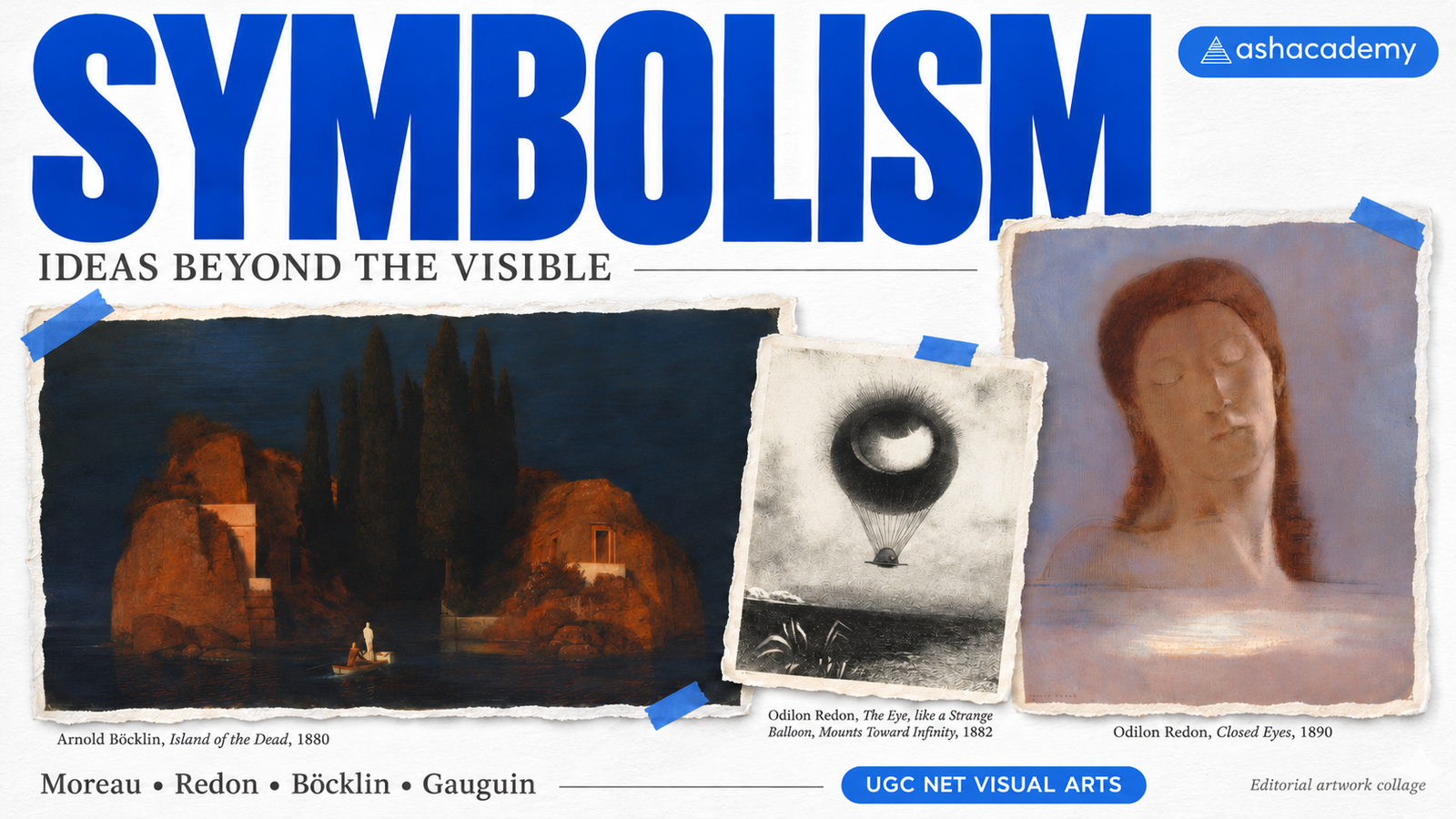
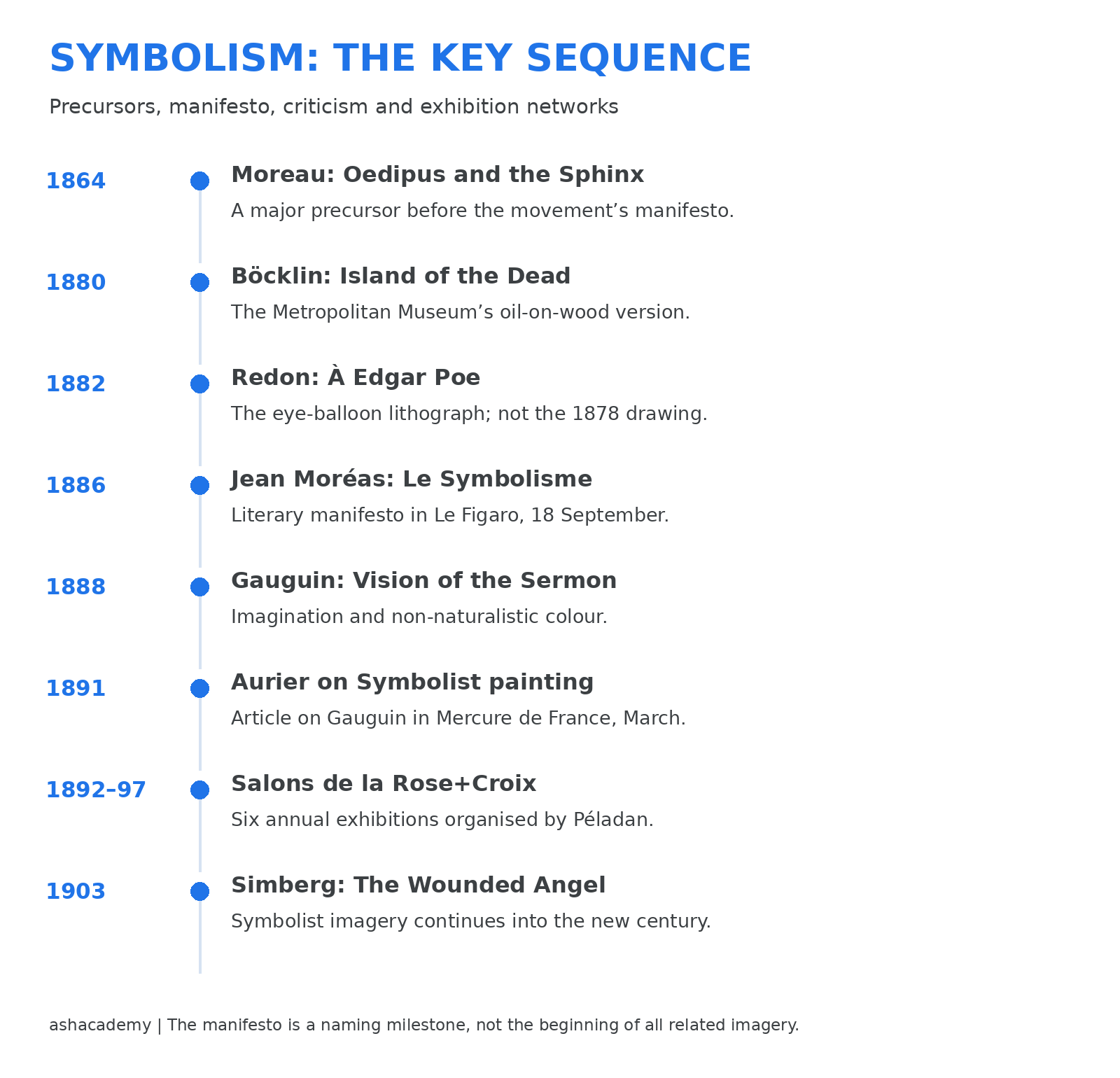
Moreau’s Oedipus and the Sphinx dates to 1864; Böcklin’s Met version of Island of the Dead to 1880; Puvis de Chavannes’s The Poor Fisherman to 1881. These works demonstrate that the visual concerns later associated with Symbolism were developing before the literary movement received its famous public declaration.
Therefore, “Symbolism began in 1886” is useful only as a naming milestone. It should not be expanded into the claim that no Symbolist-associated art existed before that year. The broader history involves precursors, parallel experiments, critical definitions and international exchange.
Source: Nicole Myers, The Met, Symbolism.
1886: Jean Moréas and Le Figaro
Moréas’s Le Symbolisme appeared in Le Figaro on 18 September 1886. It was a literary manifesto. It advocated an art of ideas and suggestion against approaches it understood as excessively descriptive. It was not a group painting manifesto signed by Moreau, Redon, Gauguin and every later artist placed under the Symbolist label.
Source: Jean Moréas, manifesto text reproduced in Les Premières Armes du symbolisme.
1891: Albert Aurier on Symbolist painting
Aurier’s article on Gauguin appeared in Mercure de France in March 1891. His five-part formulation is valuable for revision: ideistic, Symbolist, synthetic, subjective and decorative. “Ideistic” here means directed towards an idea; it does not mean academically idealised anatomy.
| Aurier’s term | Easy explanation |
|---|---|
| Ideistic | The work aims to express an idea. |
| Symbolist | Forms convey that idea. |
| Synthetic | Forms and signs are selected and brought into a coherent arrangement. |
| Subjective | The object is understood through the perceiving subject’s vision. |
| Decorative | The picture’s organised surface is integral to its expressive purpose. |
Use this as a historically situated critical programme, not a rulebook followed identically by every Symbolist. Gauguin’s simplified colour shapes suit it particularly well, but Moreau’s intricate surfaces demonstrate another route to evocative imagery.
Source: Wildenstein Plattner Institute, Gauguin research catalogue: Aurier’s March 1891 article.
1892–1897: the Salons de la Rose+Croix
The first Salon de la Rose+Croix was organised by Joséphin Péladan at Galerie Durand-Ruel, Paris, in 1892. Six annual exhibitions ran through 1897. They promoted a particular mystical and spiritually oriented form of Symbolism and brought together artists from several countries.
These Salons were an important network, but they were not the whole movement. An artist did not have to participate in them to make work associated with Symbolism. Equally, the presence of mystical imagery does not establish membership in a particular organisation.
Source: Peggy Guggenheim Collection, Mystical Symbolism: The Salon de la Rose+Croix in Paris, 1892–1897.
4. Visual characteristics: how Symbolism works in an image
| Feature | What to examine | Examples in this article |
|---|---|---|
| Myth and visionary subjects | Figures from classical, biblical or imagined worlds, transformed through the artist’s vision. | Moreau, Oedipus and the Sphinx; The Apparition. |
| Interior experience | Closed eyes, inward attention, anxious bodies or uncertain states between sleep and death. | Redon, Closed Eyes; Munch, The Scream. |
| Expressive colour | Colour selected for mood or idea rather than only matching an observed object. | Gauguin, Vision of the Sermon. |
| Rhythmic composition | Repeated contours, ornamental patterns or emphatic divisions of space. | Klimt, The Kiss; Burne-Jones, The Love Song. |
| Ambiguous settings | Spaces that resist an ordinary explanation of place, time or event. | Böcklin, Island of the Dead; Khnopff, Caresses. |
| Varied media | Oil, watercolour, drawing, lithography and other forms. | Compare Moreau’s watercolour with Redon’s lithograph. |
There is no required dark palette. Symbolist works can be jewel-like, pale, saturated, monochrome or luminous. The relevant question is how the chosen means support the idea or experience. A brightly coloured image can be deeply inward, while a dark image can remain straightforwardly descriptive.
Nor is technical realism incompatible with Symbolism. Moreau can give mythical bodies convincing volume while making the encounter uncanny. Gauguin can simplify figures and flatten the ground. Redon can dissolve clear contours. These different procedures share an interest in meanings beyond literal outward appearance.
5. Main artists, in birth-year order
Birth-year chronology helps organise the generations. It does not identify who “joined” first: Symbolism was not a single organisation with one membership register.
| Artist | Life dates | Contribution and distinction |
|---|---|---|
| Pierre Puvis de Chavannes | 1824–1898 | Restrained colour and simplified, monumental arrangements; an important precursor for younger painters. |
| Gustave Moreau | 1826–1898 | Mythological and biblical subjects treated as richly suggestive visions. |
| Arnold Böcklin | 1827–1901 | Imaginary landscapes that evoke mortality, stillness and myth. |
| Edward Burne-Jones | 1833–1898 | British artist whose idealised figures, music and dreamlike past overlap with Symbolist concerns. |
| Odilon Redon | 1840–1916 | Noirs, fantastic prints, inward imagery and later colour experiments. |
| Paul Gauguin | 1848–1903 | Synthetic forms, non-naturalistic colour and imagined spiritual or existential subjects. |
| Evelyn De Morgan | 1855–1919 | British spiritual allegories; her work broadens a history often centred on male artists. |
| Fernand Khnopff | 1858–1921 | Belgian Symbolist associated with enigmatic figures, inwardness and ambiguous relationships. |
| James Ensor | 1860–1949 | Belgian painter and printmaker; masks, crowds and satire complicate the idea that Symbolism always escaped social life. |
| Gustav Klimt | 1862–1918 | Viennese artist whose allegorical subjects and decorative surfaces connect Symbolism with other artistic contexts. |
| Edvard Munch | 1863–1944 | Psychologically charged figures and environments; a crucial connection with later Expressionism. |
| Hugo Simberg | 1873–1917 | Finnish artist who brought supernatural beings into recognisable everyday settings. |
Extend the map: Ferdinand Hodler, Jan Toorop and Jean Delville are also important. Hodler’s Night investigates sleep and mortality; Toorop’s The Three Brides develops an intricate Symbolist drawing language. The Kröller-Müller Museum currently dates The Three Brides to 1892–1893. Keep catalogued date ranges when revising rather than forcing every work into one year.
Source: Museo Nacional Thyssen-Bornemisza, Ferdinand Hodler.
Source: Kröller-Müller Museum, The Three Brides.
6. Fifteen important artworks, explained visually
The works below are grouped by artistic concern rather than arranged as one strict chronological sequence. Captions retain artist, title, date, medium, collection and source. “Look closely” passages are visual-analysis prompts; they are distinguished from documented catalogue information. Click an image to open a larger view.
1. Moreau: Oedipus and the Sphinx, 1864

Look closely: The Sphinx grips Oedipus while their faces meet at close range. Look from that concentrated encounter down to the remains in the foreground; bodily detail intensifies the psychological confrontation.
Moreau exhibited the painting at the Salon of 1864, well before the manifesto. The Greek narrative supplies a recognisable subject, but the poised encounter can also invite reflection on danger, knowledge and desire. Begin with the myth before proposing a wider interpretation. The presence of a Sphinx alone is not a complete account of the painting’s significance.
2. Moreau: The Apparition, 1876
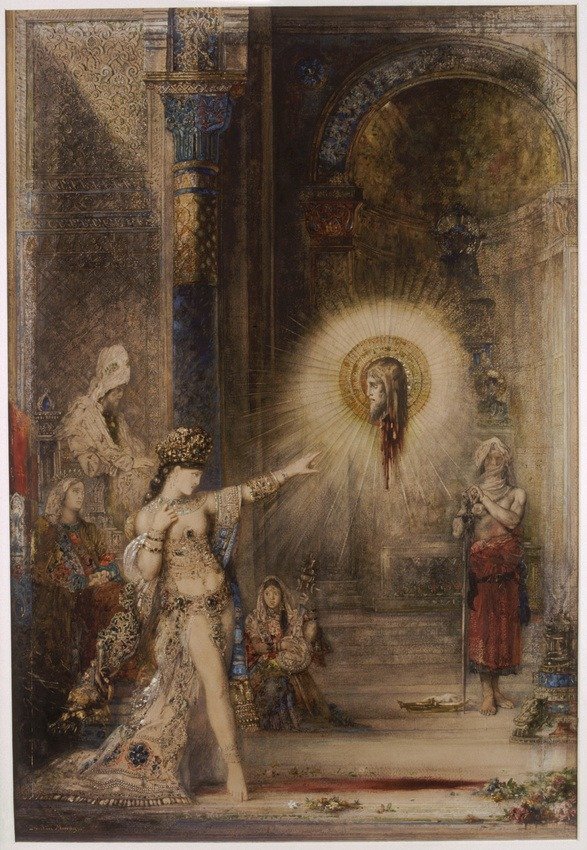
Look closely: Salomé faces the suspended head of John the Baptist in a densely ornamented architectural setting. Light and bodily gesture establish a relationship between the visible figure and the vision.
The illustrated version is the 1876 watercolour catalogued by the Musée d’Orsay; the record identifies its conservation location as the Louvre’s Department of Graphic Arts. Moreau made related works, so do not substitute an oil version’s medium or collection. The visionary appearance transforms a biblical episode into an image whose emotional and psychological implications exceed a literal record of events.
3. Puvis de Chavannes: The Poor Fisherman, 1881
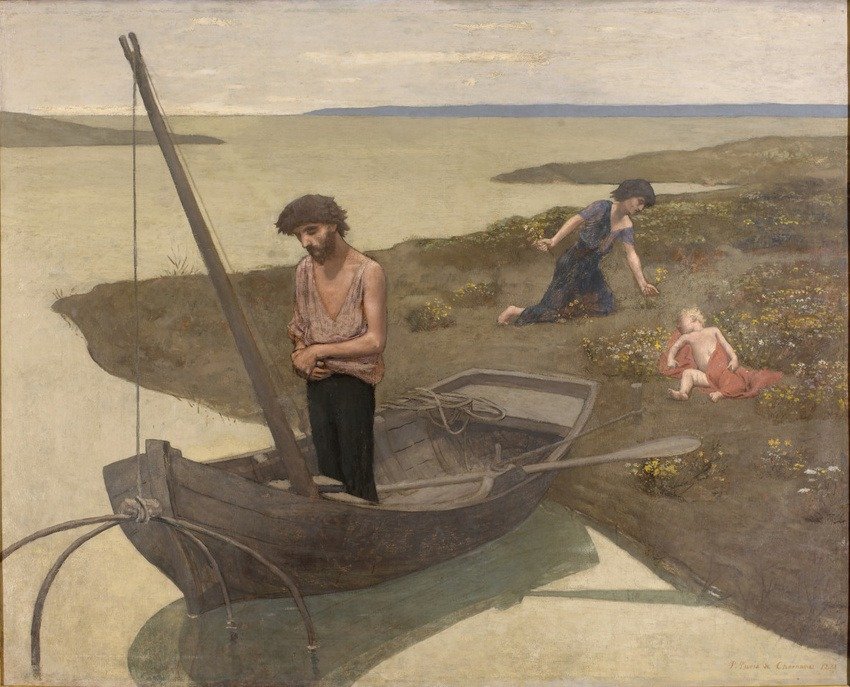
Look closely: The restrained landscape and large quiet areas surround a bowed figure. Compare the simplified setting with the intricate surfaces of Moreau: they pursue evocative effects by different means.
The painting’s poverty and resignation are conveyed through reduced modelling, muted colour and stillness. Its subject is not an exotic monster or a spectacular dream. This makes it useful for correcting an overly narrow definition of Symbolism. The museum also distinguishes its 1881 Salon appearance from its acquisition by the state in 1887.
4. Böcklin: Island of the Dead, 1880, Met version
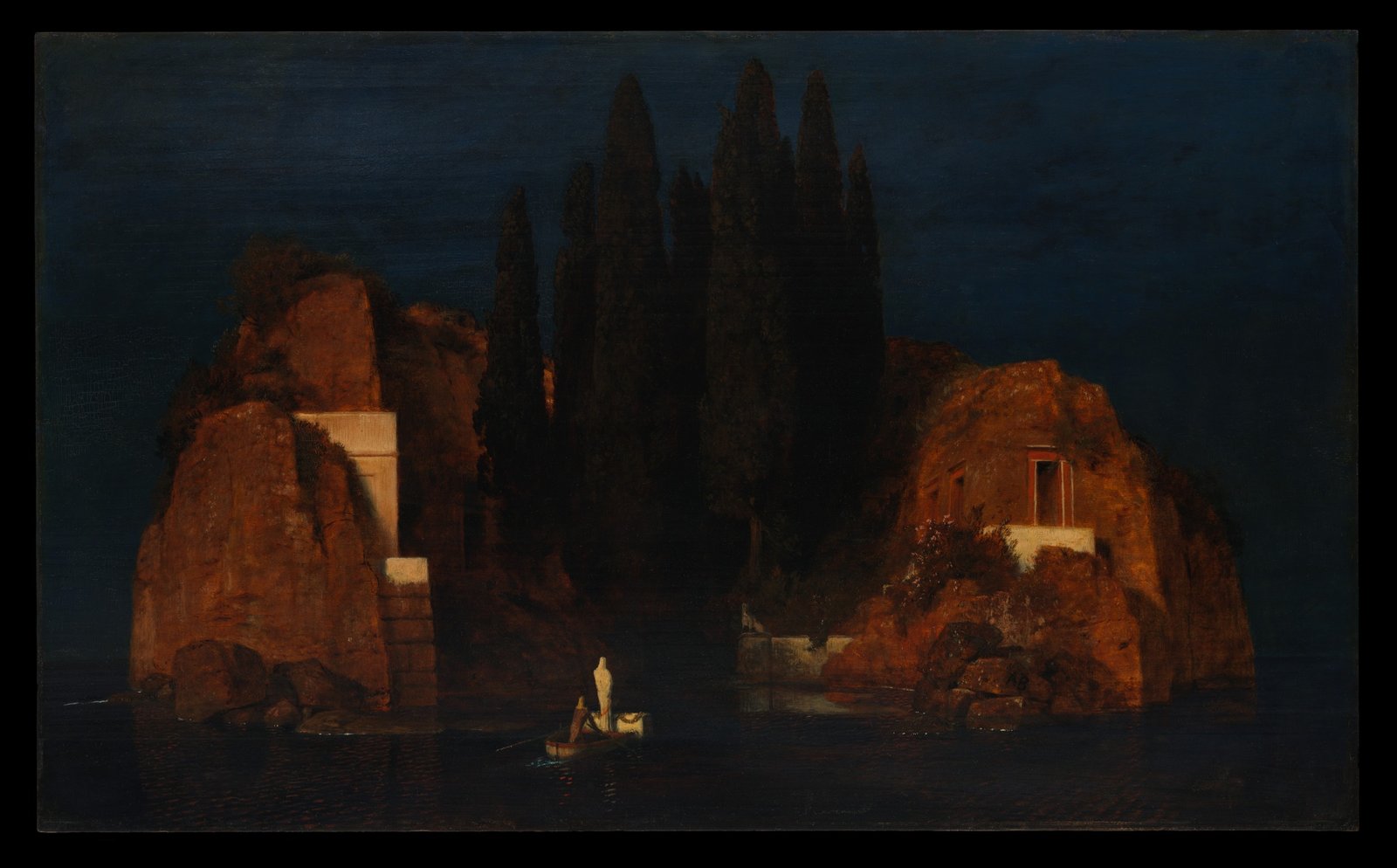
Look closely: A small boat approaches the island; a pale standing figure and coffin contrast with the dark cypresses. The scale difference makes the destination feel monumental and closed.
The Met’s oil-on-wood version was commissioned by Marie Berna as a memorial to her late husband. The artist made multiple versions. Link the date and support to this specific collection record. Water, tomb-like openings and the boat support an interpretation involving mourning and passage; they do not require a single invented identification of every figure.
5. Burne-Jones: The Love Song, 1868–77
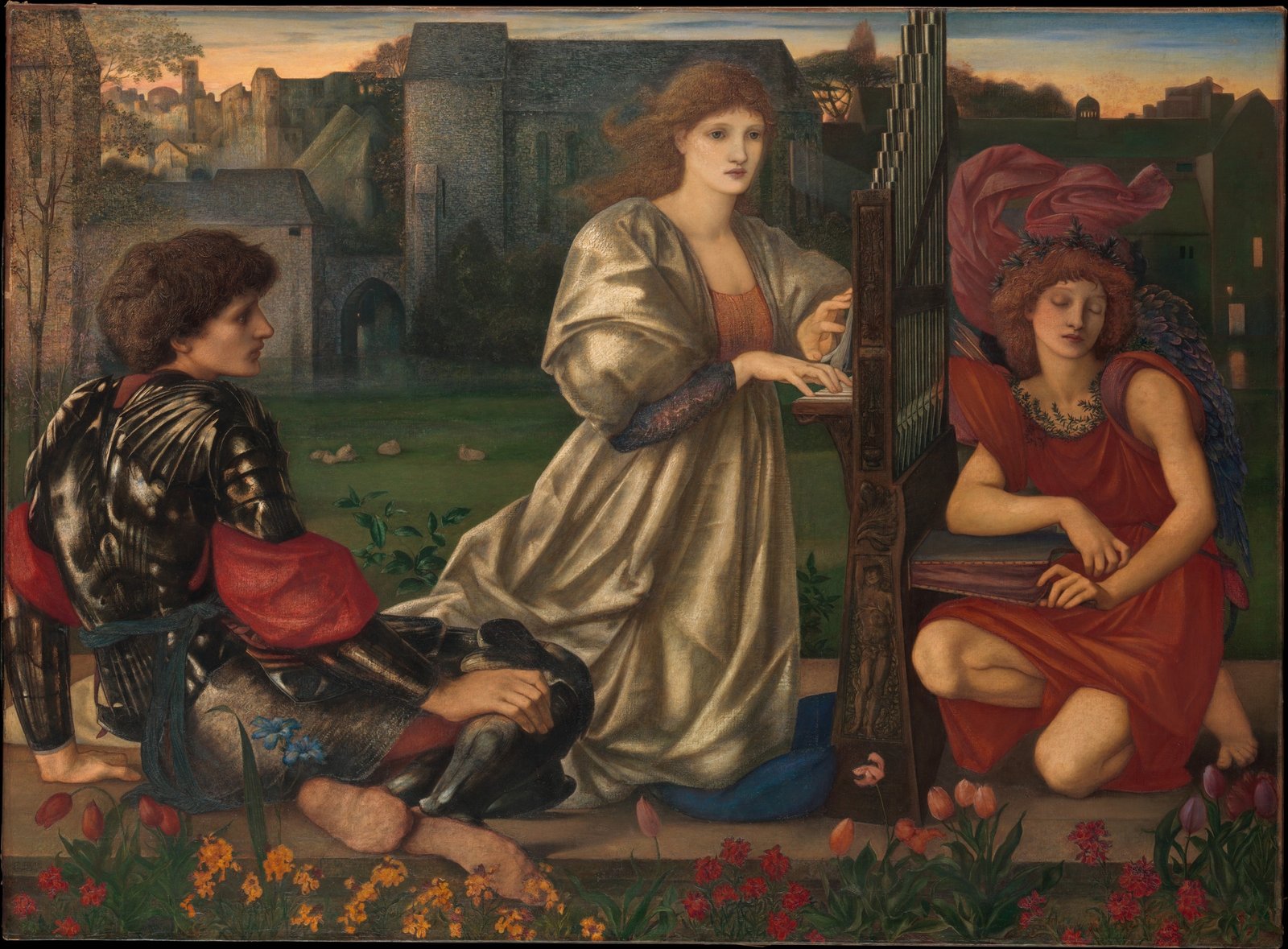
Look closely: The knight listens beside a woman at an organ, while a winged figure works the instrument. Notice how the arrangement joins music, stillness and an idealised landscape.
The Met identifies the winged figure as Cupid. Music provides a useful comparison for art that works through emotion and association rather than a fully explained action. The date range reflects a long development. Burne-Jones is a British precursor and overlapping figure, not a signatory to Moréas’s later French manifesto.
6. Evelyn De Morgan: The Soul’s Prison House, 1880–88
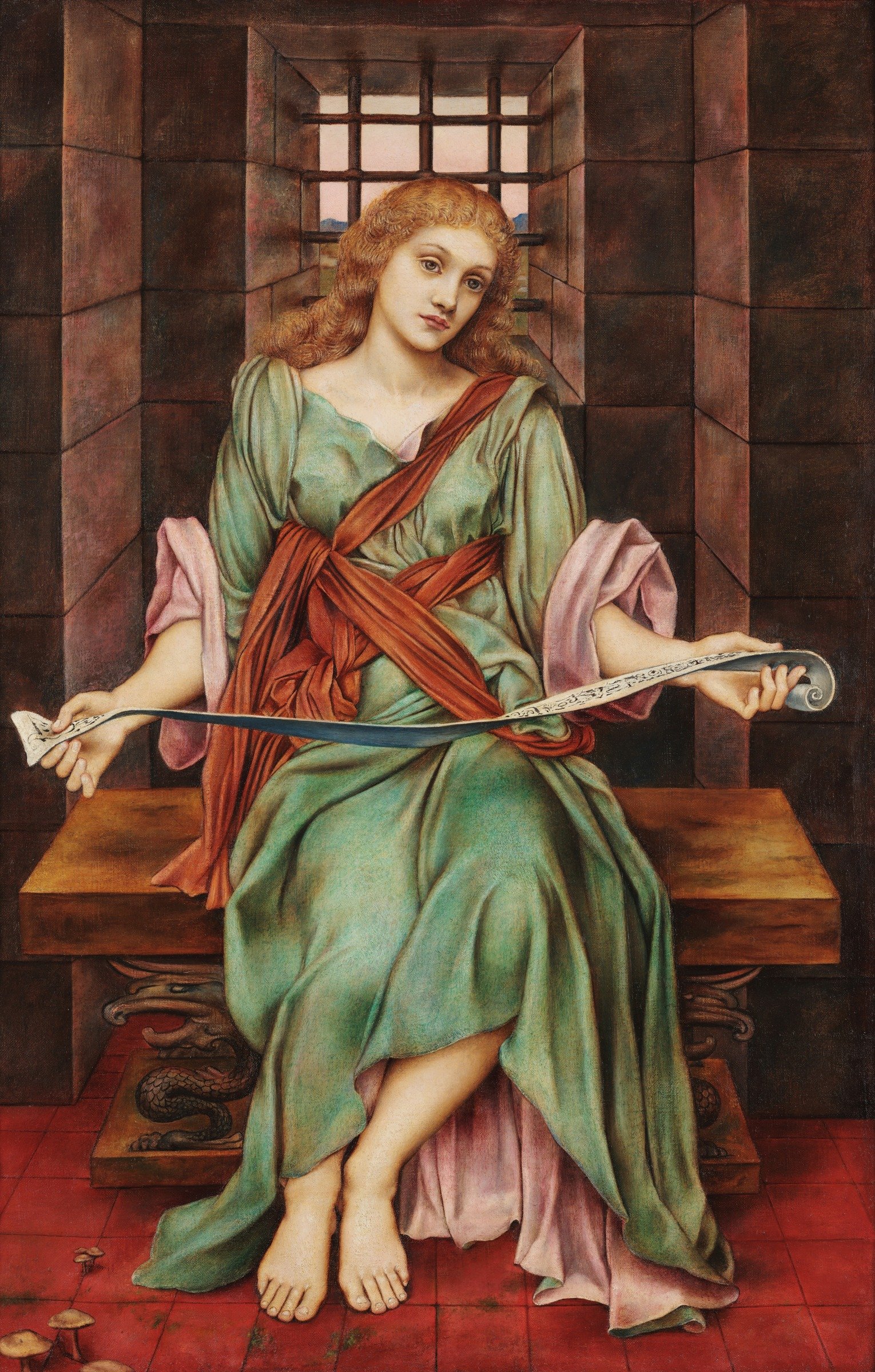
Look closely: The seated woman, musical instrument and barred opening create a relation between enclosure and the light beyond. Read the setting before assigning a meaning to each object.
The De Morgan Foundation explains the image through the artist’s spiritualist understanding of the soul enclosed in the body and awaiting release. This is documented interpretive context, not a meaning inferred from the title alone. Its catalogue describes the medium as oil in glycerine on canvas, using the artist’s “Process.” Keep the unusual medium rather than automatically reducing every work to ordinary oil painting.
7. Redon: The Eye, Like a Strange Balloon, Mounts toward Infinity, 1882
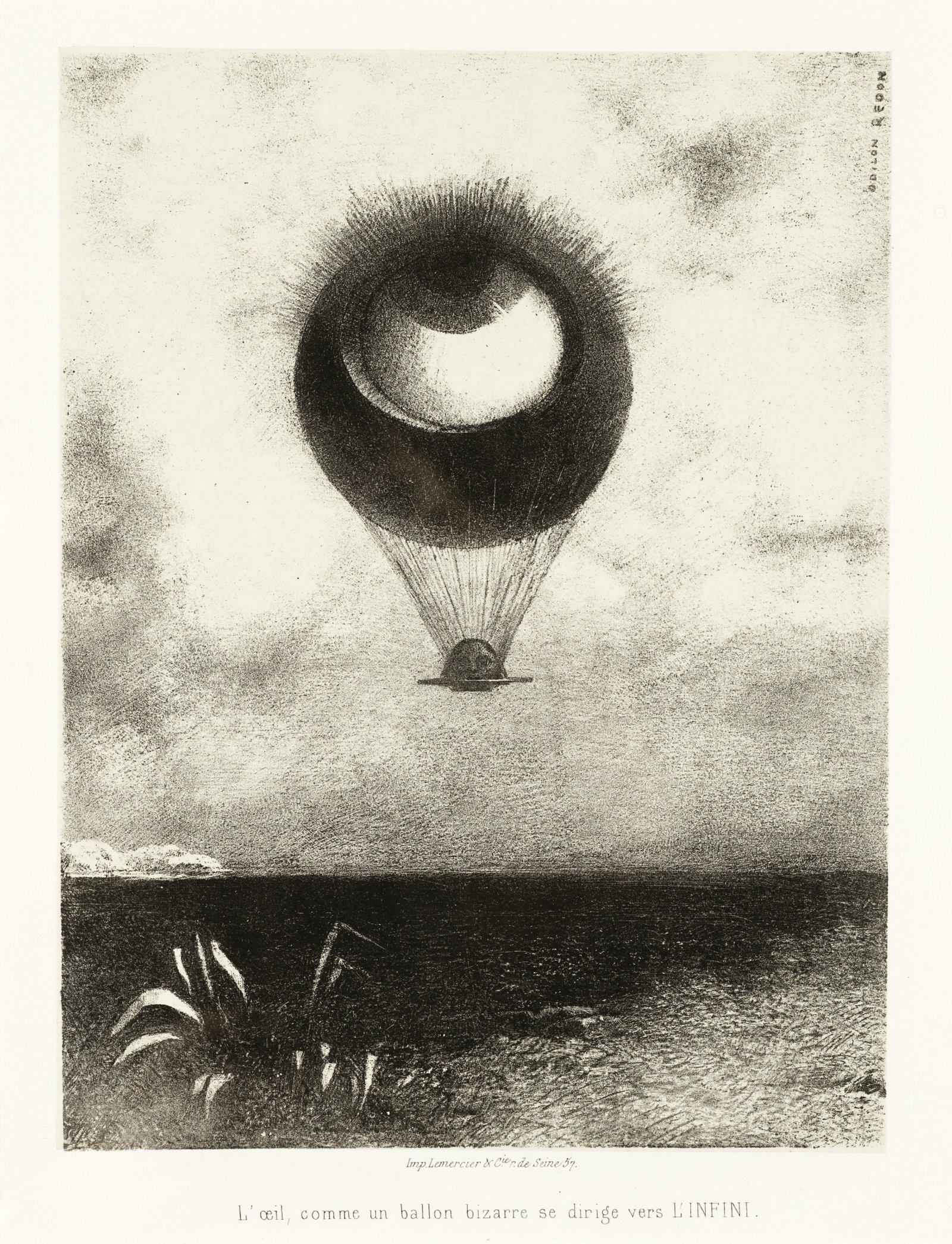
Look closely: The eye takes the structural position of a balloon above a landscape. Dense blacks, granular greys and pale paper make the improbable object visually persuasive.
This is a lithograph from Redon’s À Edgar Poe portfolio, represented here by the LACMA impression. It is distinct from the 1878 charcoal-and-chalk Eye-Balloon drawing in MoMA. A drawing and a later print can share an idea without sharing date, medium or collection. The plate demonstrates how Symbolist imagery circulated through printmaking as well as painting.
Source: MoMA, the separate 1878 Eye-Balloon drawing.
8. Redon: Closed Eyes, 1890
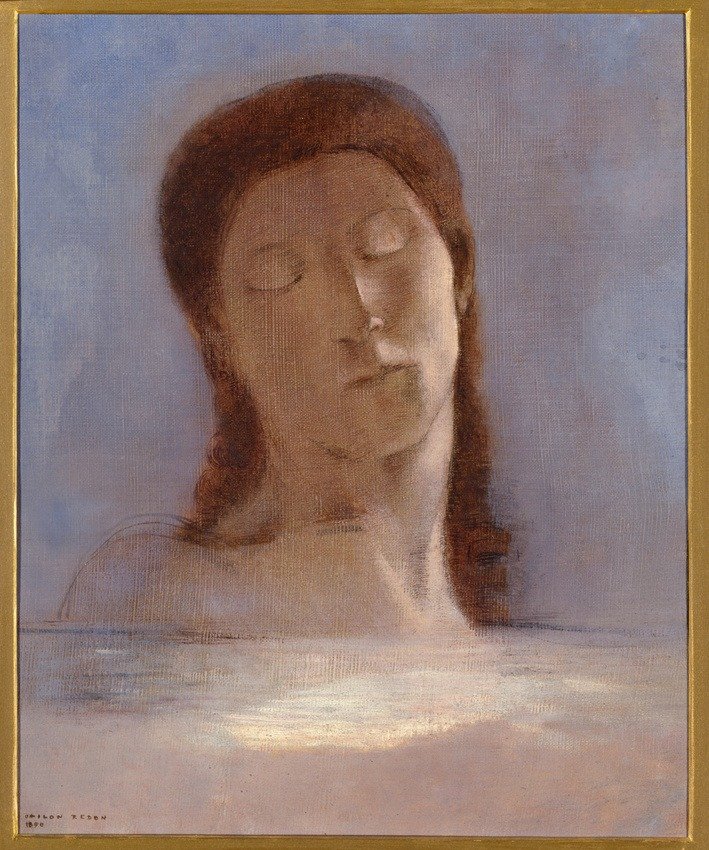
Look closely: The closed eyelids turn attention away from outward observation. The lightly painted bust seems suspended in an uncertain space, with few details fixing an ordinary setting.
The museum relates the work to an earlier drawing and suggests a connection with Redon’s wife, Camille Falte, without treating the identification as certain. Its material is oil on canvas mounted on cardboard. The painting invites associations with sleep, inward vision and absence; a careful description retains the difference between these possibilities and a definitive diagnosis of the figure’s state.
9. Gauguin: Vision of the Sermon, 1888
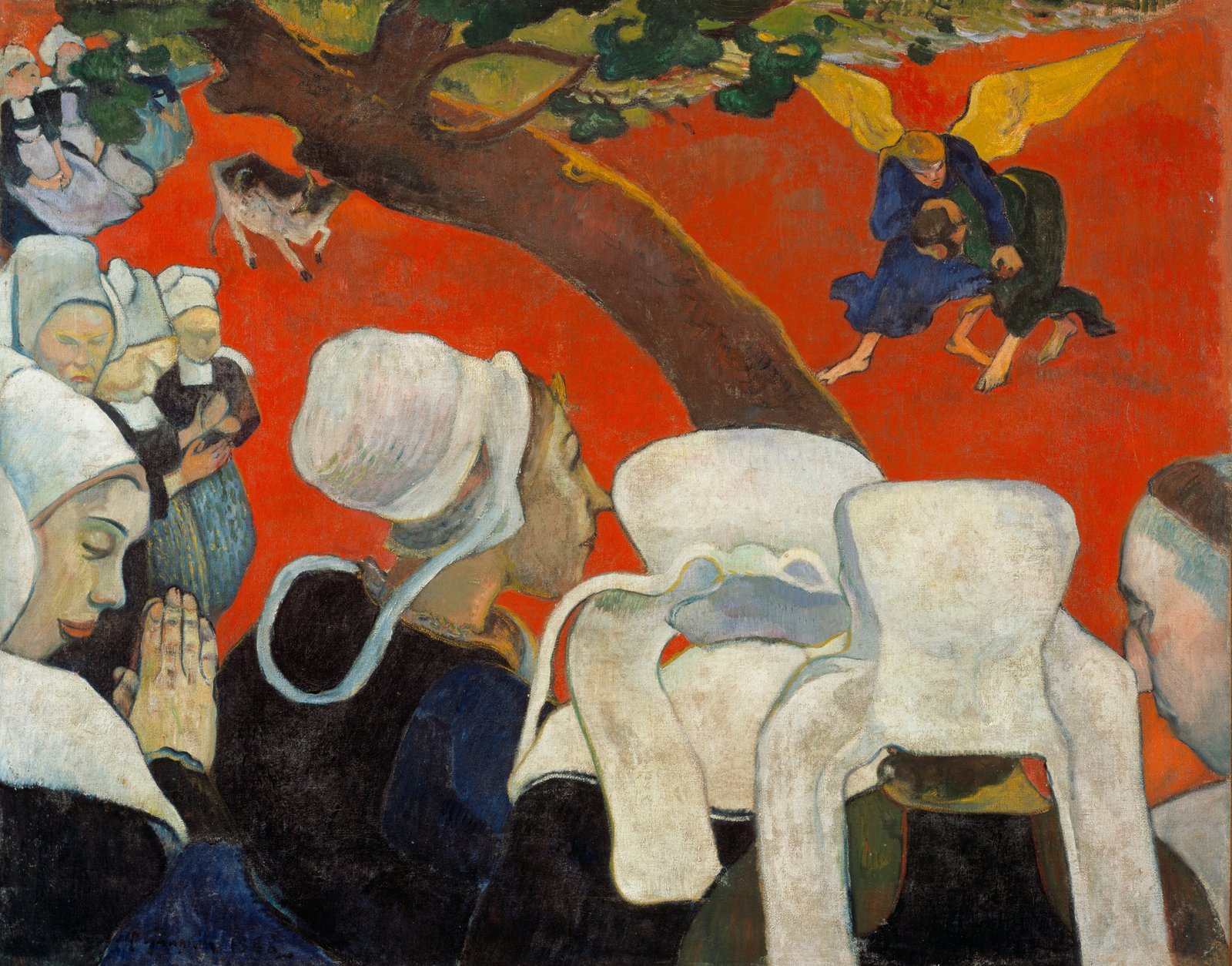
Look closely: Breton women in white headwear occupy the foreground. A diagonal tree and an emphatic red field distinguish their space from Jacob’s wrestling encounter with the angel.
The National Galleries of Scotland connects the scene with Genesis and with Gauguin’s explanation that the landscape and struggle exist in the praying people’s imagination. The red ground is therefore more than an unusual landscape colour. It helps articulate an imagined experience. This is a key work for connecting Symbolism, Synthetism and non-naturalistic colour, while keeping the three terms distinct.
10. Gauguin: Where Do We Come From? What Are We? Where Are We Going?, 1897–98

Look closely: Survey the long arrangement of figures and the changes in age, posture and attention. The title directs the scene towards questions of origin, existence and destination rather than one ordinary event.
The MFA dates the large canvas 1897–98. It is an imagined philosophical construction made in the context of Gauguin’s life in French-colonial Tahiti. Avoid describing it as an unmediated record of timeless Polynesian belief. Questions about the artist’s invented mythology, colonial position and representation of people belong alongside formal analysis.
11. Khnopff: Caresses, 1896
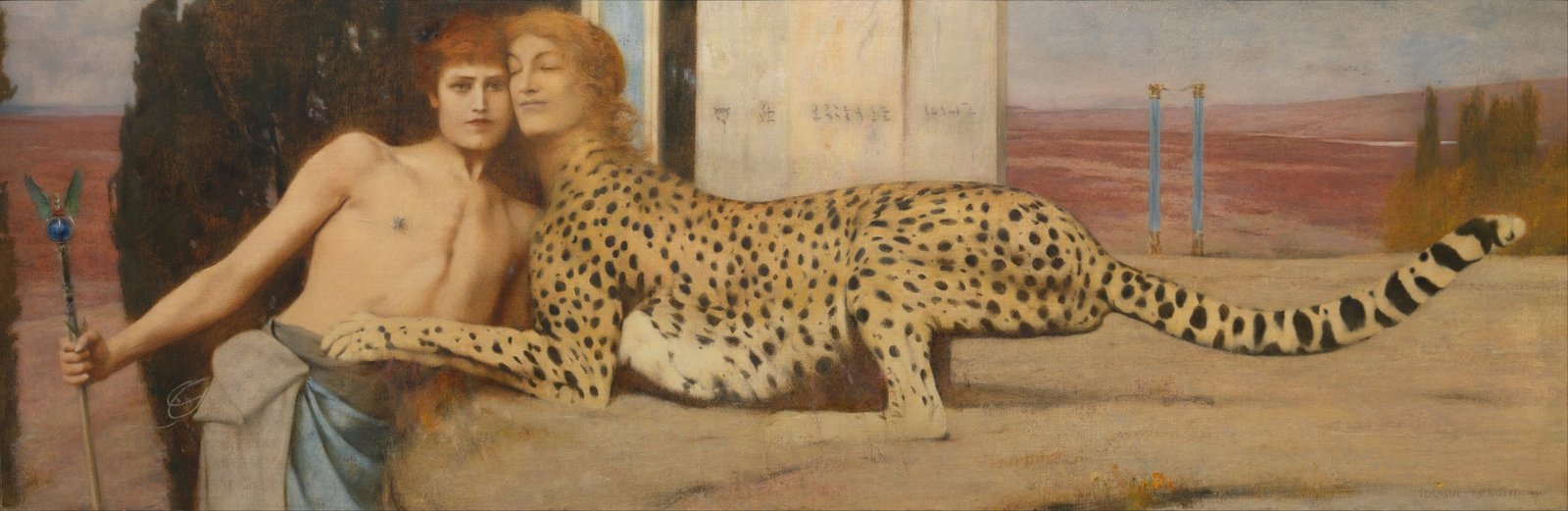
Look closely: A human-headed feline presses close to an enigmatic figure. Their faces and touch suggest intimacy, while the hybrid body unsettles an ordinary interpretation of the encounter.
The Royal Museums of Fine Arts of Belgium records the painting as Des caresses, 1896, oil on canvas. Related museum interpretation leaves several possible readings open. It is better to identify the hybrid imagery and ambiguous relationship than to present one speculative biographical explanation as established fact.
12. Ensor: Christ’s Entry into Brussels in 1889, painted 1888
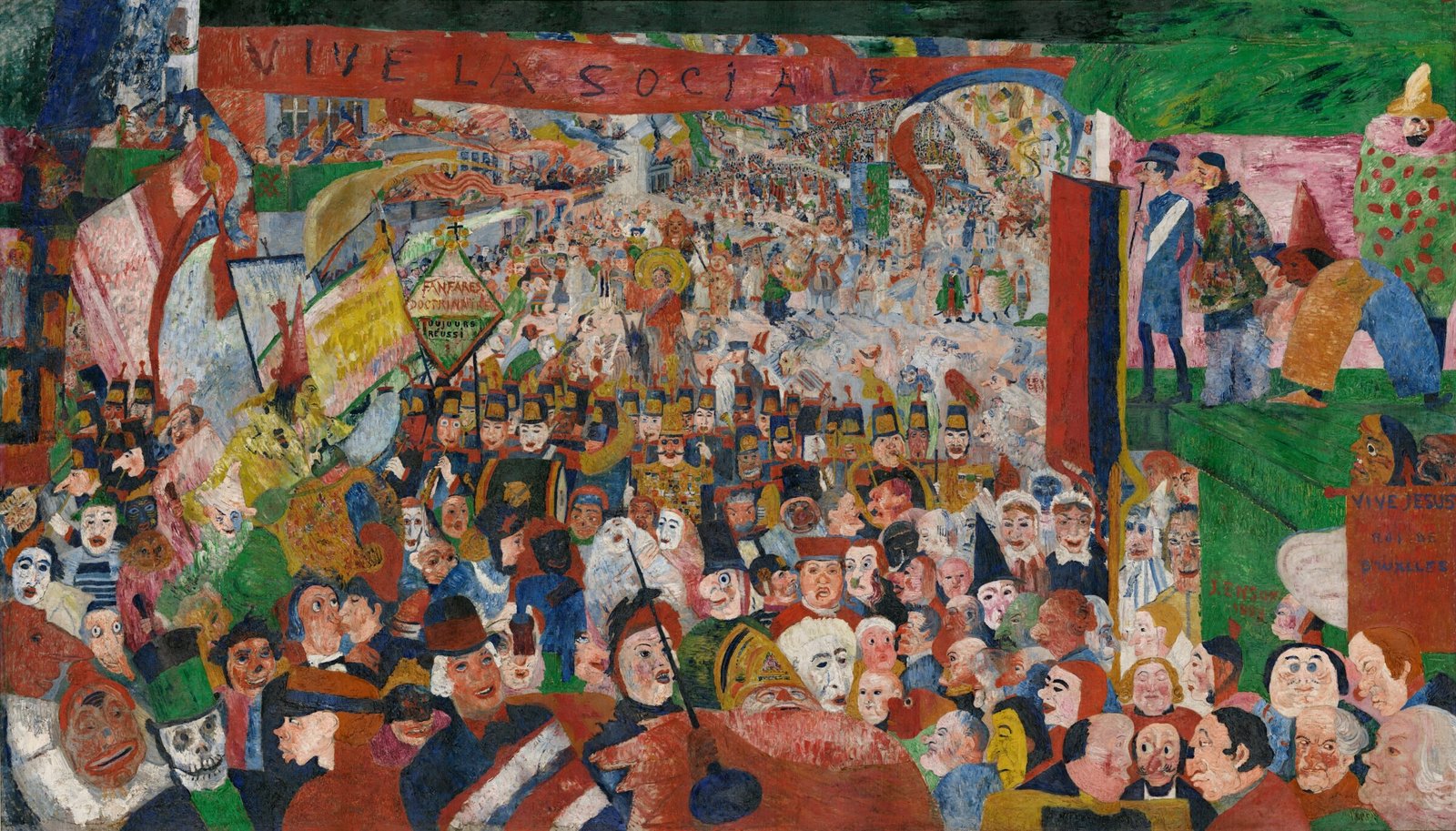
Look closely: Search for Christ among the swelling crowd, masks, banners and compressed faces. The mass of contemporary figures makes a biblical entry into an unsettling public spectacle.
1889 is in the title; 1888 is the painting date. Getty’s record makes this distinction important for artwork matching. Ensor complicates the claim that Symbolism always abandons modern social experience. Religious imagery, caricature and contemporary crowds can expose a disturbing public world rather than offer a serene escape from it.
13. Klimt: The Kiss, 1908, completed 1909
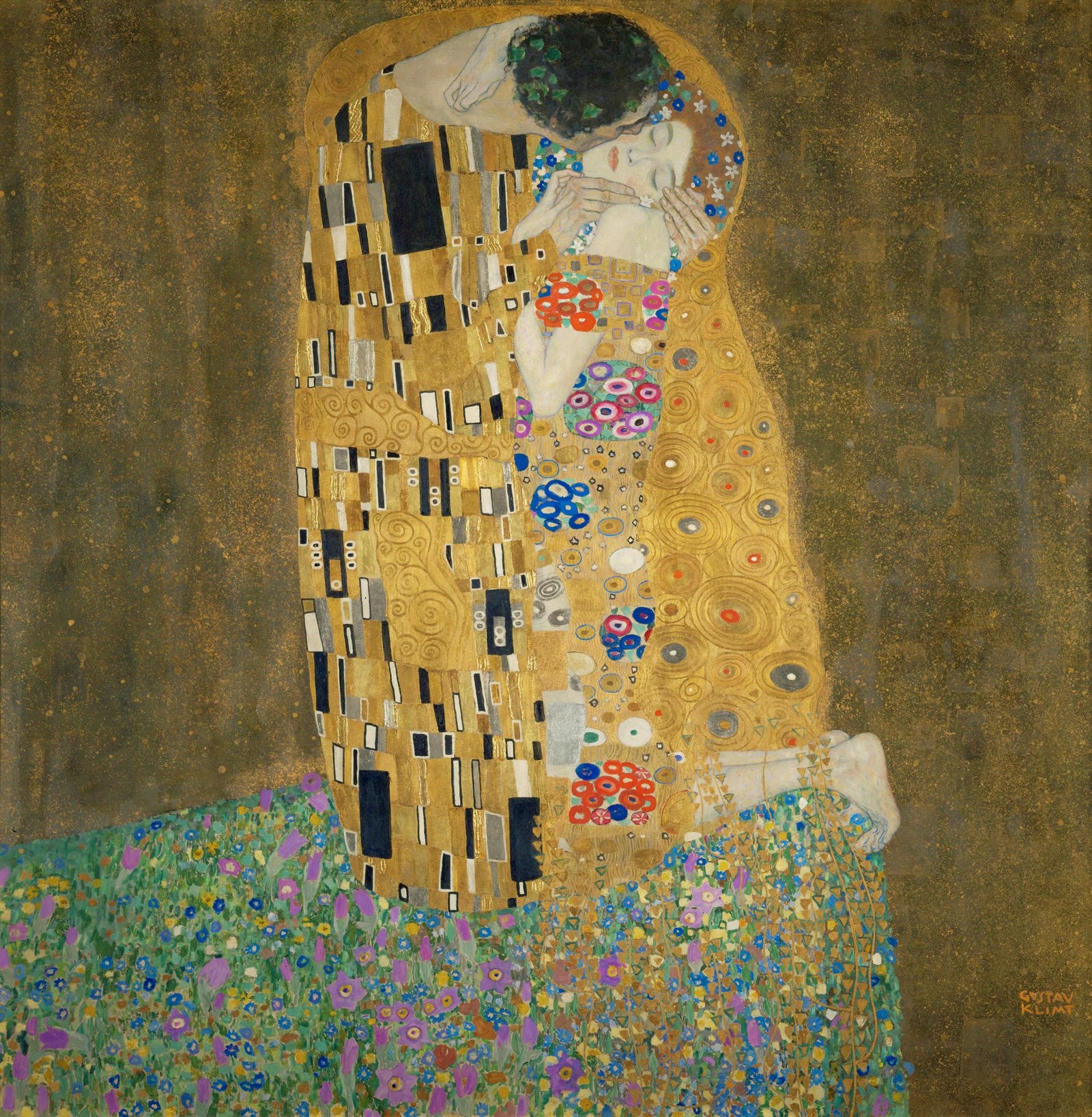
Look closely: Compare the recognisable faces and bodies with the ornamental surfaces that surround them. Clothing patterns and the golden field shift attention between embrace and decorative design.
Belvedere’s checklist dates the work 1908, completed 1909 and identifies a complex combination of paint and metal leaf. It is useful to study Symbolist implications of love and union alongside the work’s decorative modernism. A Symbolist interpretation does not cancel its Viennese Secession and Art Nouveau connections; these labels address overlapping aspects of its history.
14. Munch: The Scream, 1893, National Museum version
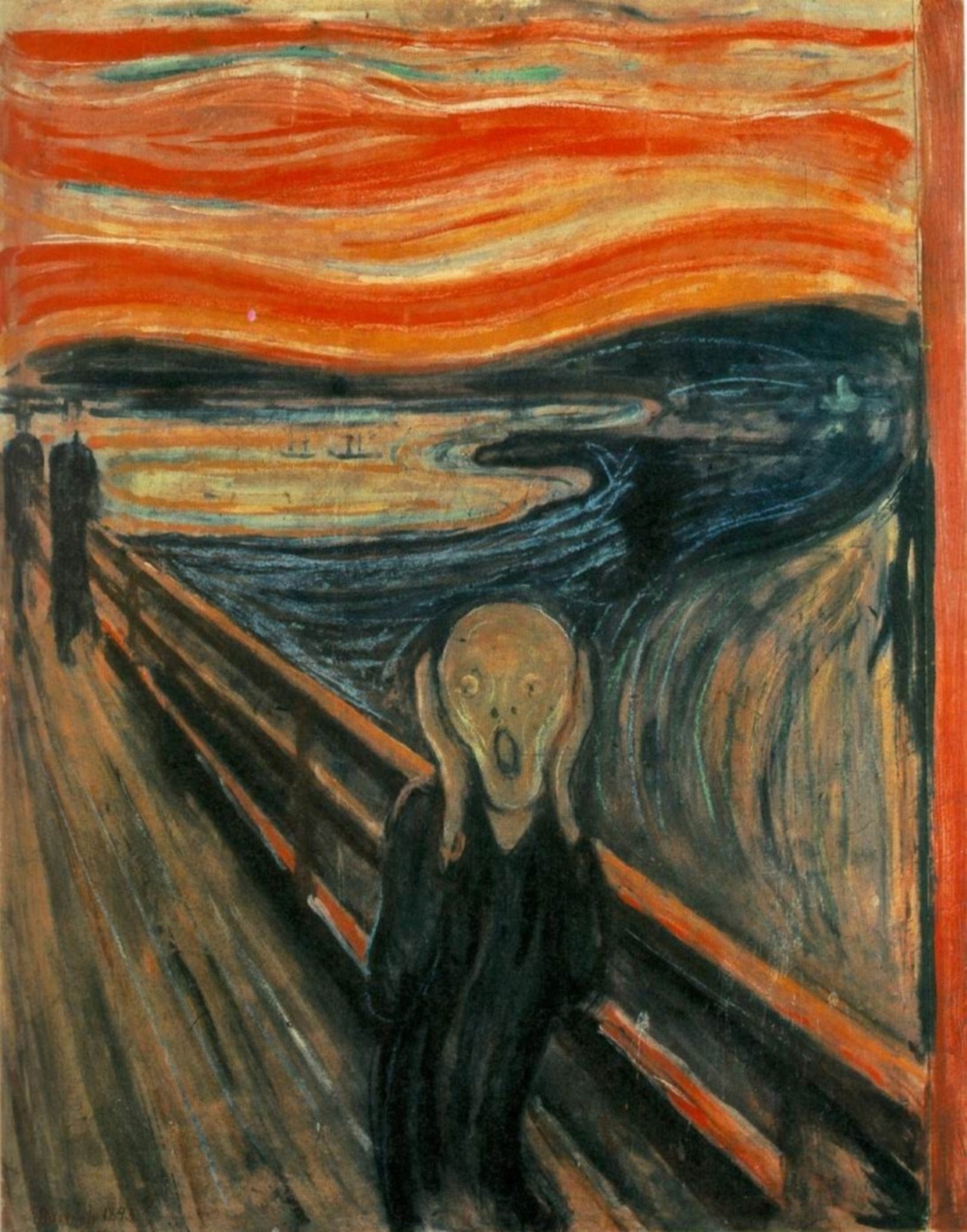
Look closely: The bridge cuts diagonally into space while the landscape and sky curve around the foreground figure. The contrast between firm perspective and surrounding waves reinforces instability.
The National Museum describes this work as a turning point from Symbolism towards twentieth-century Expressionism. Its current catalogue medium is tempera and grease crayon on cardboard. Munch made other painted, pastel and printed versions, so always specify the 1893 Oslo collection version. Do not identify every reproduction as the same physical object.
15. Simberg: The Wounded Angel, 1903
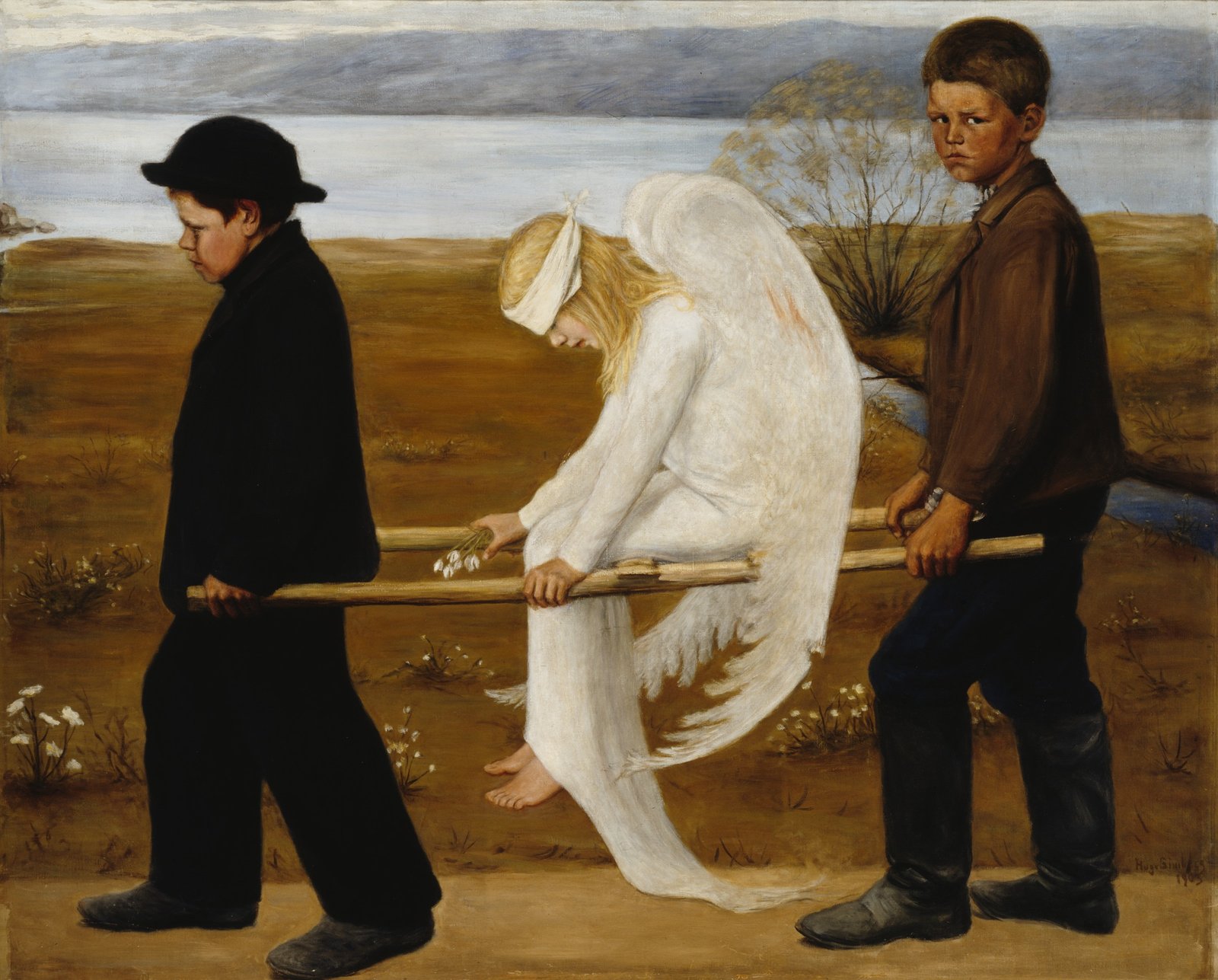
Look closely: Two boys carry a bandaged angel through an ordinary-looking landscape. The encounter between a supernatural being and practical human action gives the scene its distinctive tension.
The painting belongs to the Ateneum’s Ahlström Collection. The injured angel can invite reflection on vulnerability, care and suffering; those are proposed readings supported by the visible subject, not a definitive explanation of the artist’s intention. Its combination of recognisable setting and impossible event is a useful example of how Symbolist imagery need not abandon the everyday world completely.
7. How to interpret a Symbolist artwork without inventing meanings
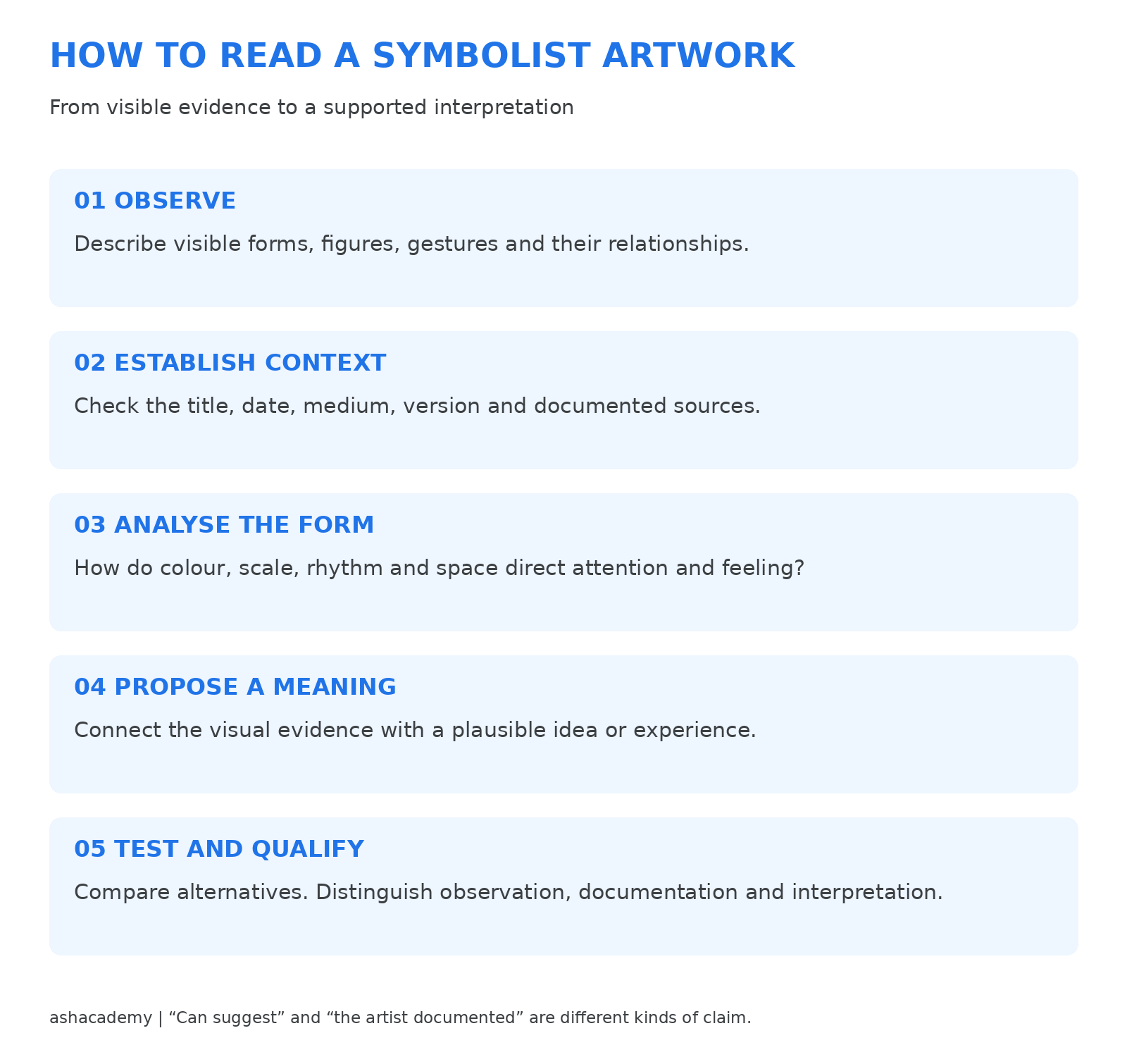
Observe first. Record the figures, objects, actions and relationships that can actually be seen. “A boat approaches an island” is an observation; “the boat contains the artist’s childhood trauma” requires evidence that the picture does not supply by itself.
Establish the context. Check title, date, medium, narrative source and collection. Determine whether a museum identifies a mythological person, a biblical scene, a sitter or a particular version. A wrong title or version can distort the entire interpretation.
Analyse the form. Explain how the image directs attention: colour, repeated curves, scale, framing, empty space or an unusual viewpoint. Meaning is not located only in a list of depicted objects. A quiet field of colour can be as significant as a dramatic mythical creature.
Propose and test. Use language such as “suggests,” “can evoke” or “the museum interprets” according to the evidence. Compare another plausible reading. The goal is a clear argument with limits, not an unsupported claim that the image has been completely decoded.
Gender, spirituality and the limits of inherited explanations
Women appear in many historical Symbolist images as spiritual ideals, temptresses or threatening hybrids. These types reveal cultural constructions and anxieties; they should not be repeated as truths about women. “Femme fatale” is a term for a represented type, not a neutral description of female identity.
Including Evelyn De Morgan also shifts the question from “What did male painters make women symbolise?” to “How did a woman artist use allegory and spiritual belief?” Likewise, Gauguin’s imagined Tahitian world needs to be discussed in its colonial circumstances. Critical context strengthens visual analysis by identifying whose vision is being presented.
Source: De Morgan Foundation, Evelyn De Morgan.
8. Symbolism compared with related movements
| Comparison | Shared concern | Essential difference |
|---|---|---|
| Realism and Symbolism | Both may depict recognisable people and environments. | Realism often centres contemporary material and social existence; Symbolism gives greater emphasis to suggestion and inward or spiritual meaning. These are tendencies, not absolute opposites. |
| Impressionism and Symbolism | Both can use colour and atmosphere expressively. | Impressionism is associated with changing light and perception; Symbolism more explicitly privileges ideas, imagination and associative meaning. |
| Neo-Impressionism and Symbolism | Both can organise colour deliberately and resist an unplanned copy of nature. | Neo-Impressionism has a specific programme of colour division; Symbolism has no compulsory dotted technique. |
| Synthetism and Symbolism | Gauguin connects simplified form with subjective or imagined experience. | Synthetism describes a particular approach to combining form, colour and the artist’s conception; Symbolism is a broader literary-artistic field. |
| Art Nouveau and Symbolism | Curving lines, ornamental design and imaginative imagery can overlap. | Art Nouveau is also a decorative and design movement across objects, architecture and graphics; the terms are not interchangeable. |
| Surrealism and Symbolism | Both explore imagery beyond everyday rational description. | Surrealism has a different twentieth-century history, including Breton’s 1924 manifesto and a programme involving dreams and psychic automatism. |
| Expressionism and Symbolism | Subjective experience and emotional force can connect them. | Expressionism develops different early twentieth-century contexts and formal emphases; Munch is an important bridge. |
Source: MoMA, Surrealism and Breton’s 1924 manifesto.
Revision note: Remember Moréas – Symbolism – 1886 and Breton – Surrealism – 1924. A dreamlike subject alone does not erase this historical distinction.
9. Impact and legacy
Symbolism expanded the authority of subjective colour, imaginative form and emotional association. A painting did not have to justify itself only as a convincing view of an external scene. This emphasis helped later artists consider how pictures might construct experiences, evoke psychological states or move towards more abstract organisation.
Its legacy took several routes. Munch’s work connects Symbolist concerns with Expressionism. The Nabis developed spiritual and decorative possibilities associated with Gauguin’s example. Redon and Böcklin offered later artists models of improbable beings and uncanny environments. Surrealism could draw on such precedents while developing a different intellectual and institutional programme.
Do not turn influence into an inevitable ladder. Symbolism did not simply disappear when another movement began, and not every later artist adopted its spiritual beliefs. The useful question is which element was taken up: a subject, a formal device, an imaginative permission or a particular earlier work.
Source: National Galleries of Scotland, Symbolism and its later connections.
10. UGC NET Visual Arts revision
The priorities below are study aids, not predictions about a future examination. Practise matching names and dates, but also learn the evidence that makes a classification convincing.
| Date | What to remember | Common confusion |
|---|---|---|
| 1864 | Moreau, Oedipus and the Sphinx. | Predates the 1886 manifesto. |
| 1880 | Böcklin, Met Island of the Dead. | Identify the version and its oil-on-wood support. |
| 1882 | Redon’s À Edgar Poe lithographic portfolio. | Do not substitute the 1878 Eye-Balloon drawing’s date. |
| 1886 | Moréas’s literary manifesto in Le Figaro. | Not Breton’s Surrealist manifesto. |
| 1888 | Gauguin, Vision of the Sermon; Ensor paints Christ’s Entry into Brussels in 1889. | The year in Ensor’s title is not its execution date. |
| 1891 | Aurier’s art-critical formulation in Mercure de France. | Aurier is not the author of the 1886 manifesto. |
| 1892–1897 | Six Salons de la Rose+Croix, organised by Péladan. | An exhibition network, not a universal Symbolist membership list. |
| 1893 | Munch, the National Museum’s The Scream. | Other versions exist. |
| 1896 | Khnopff, Caresses. | Do not automatically identify it as Moreau’s Sphinx painting. |
| 1903 | Simberg, The Wounded Angel. | Symbolist tendencies continue into the twentieth century. |
| Artist | Artwork association | Visual cue |
|---|---|---|
| Moreau | Oedipus and the Sphinx / The Apparition | Mythological confrontation / Salomé and a visionary head. |
| Puvis de Chavannes | The Poor Fisherman | A reduced, still landscape and bowed fisherman. |
| Böcklin | Island of the Dead | Boat, pale figure, coffin and dark cypresses. |
| Redon | Closed Eyes / the eye-balloon lithograph | Inward vision / a fantastic floating eye. |
| Gauguin | Vision of the Sermon | Breton women, diagonal tree and red ground. |
| Evelyn De Morgan | The Soul’s Prison House | A seated figure, instrument, enclosure and light beyond. |
| Khnopff | Caresses | An enigmatic encounter with a human-headed feline. |
| Ensor | Christ’s Entry into Brussels in 1889 | Masks, banners and a crowded contemporary spectacle. |
| Klimt | The Kiss | Embrace, ornamental patterns and metal-leaf surfaces. |
| Munch | The Scream | Frontal figure, diagonal bridge and curving environment. |
| Simberg | The Wounded Angel | Two boys carrying an injured angel. |
One-page revision method: place 1886, 1891 and 1892–97 in a central column. Beside them write Moréas, Aurier and Péladan. Add one Moreau, one Redon and one Gauguin image. Under each, separate subject, medium and interpretation. This checks historical memory and visual reasoning together.
11. Original practice questions with explanations
These are original practice questions, not claimed authentic previous-year questions. Open each answer after attempting it.
1. Who wrote the Symbolist manifesto published in Le Figaro in 1886? A. Aurier B. Moréas C. Breton D. Péladan
Answer: B, Jean Moréas. Aurier wrote an important 1891 art-critical article; Breton belongs to Surrealism’s 1924 manifesto; Péladan organised the Rose+Croix Salons.
2. Which sequence is correct? Moreau’s Oedipus; Moréas’s manifesto; Aurier on Gauguin; the first Rose+Croix Salon.
Answer: 1864 → 1886 → 1891 → 1892. Visual precursors came before the naming milestone. Criticism and exhibition organisation then contributed to the movement’s public history.
3. Which is NOT one of Aurier’s five terms? A. Subjective B. Synthetic C. Decorative D. Pointillist
Answer: D, Pointillist. The formulation is ideistic, Symbolist, synthetic, subjective and decorative. A dotted paint surface is not a compulsory Symbolist method.
4. Image identification: Breton women, a diagonal tree and an emphatic red ground. Which artist? A. Gauguin B. Böcklin C. Ensor D. Puvis de Chavannes
Answer: A, Gauguin, Vision of the Sermon, 1888. The composition connects an observed group with a religious vision understood as imagined experience.
5. Is Redon’s 1882 eye-balloon image illustrated here an oil painting?
Answer: No, it is a lithograph. The 1878 Eye-Balloon in MoMA is a separate charcoal-and-chalk drawing. Medium, date and collection must follow the specific object.
6. What is the execution date of Ensor’s Christ’s Entry into Brussels in 1889? A. 1886 B. 1888 C. 1889 D. 1897
Answer: B, 1888. The title contains 1889. This is a title-versus-making-date distinction, not an inconsistency in the Getty catalogue.
7. Which statement is most accurate? A. All Symbolists used dark colours B. All used flat forms C. Shared concerns could be expressed through different styles D. All exhibited with Péladan
Answer: C. Compare Moreau, Redon and Gauguin. Palette, handling and exhibition affiliation vary; ideas and suggestive functions are more useful connecting concerns.
8. Match Moréas / Aurier / Péladan with manifesto / 1891 article / Rose+Croix Salons.
Answer: Moréas—1886 manifesto; Aurier—1891 article; Péladan—Salons beginning in 1892. Keep the roles of poet, critic and exhibition organiser distinct.
9. Why should The Scream not be assigned only one movement without explanation?
Answer: Its historical position connects Symbolism with later Expressionism. The National Museum explicitly identifies it as a turning point. Explain the relationship and specify the 1893 version rather than relying on a label alone.
10. Is “the boat represents a passage towards death” the same kind of claim as “a boat is visible”?
Answer: No. The first is an interpretation that needs support; the second is an observation. Titles, documented context and formal relationships help test an interpretation, while alternatives may remain possible.
12. Frequently asked questions
What is Symbolism in art in simple words?
Symbolism uses visible forms to suggest ideas, emotions and inner experience. Its late nineteenth-century artists often explored myth, imagination, spirituality and mortality through varied visual languages.
Who founded Symbolism?
There is no single founder who invented every aspect of Symbolist painting. Jean Moréas supplied the famous 1886 literary manifesto. Earlier painters such as Moreau and Puvis de Chavannes prepared part of its visual groundwork, while Aurier helped formulate a painting programme in 1891.
What are the main characteristics of Symbolist painting?
Suggestive imagery, subjective colour and form, imaginative or spiritual subjects and attention to inner experience are recurring concerns. There is no compulsory technique, palette or degree of naturalistic detail.
Is Symbolism the same as Surrealism?
No. They share interests in imagery beyond ordinary description, but their histories differ. Moréas’s Symbolist manifesto dates to 1886; Breton’s Surrealist manifesto to 1924. Dreams alone do not establish a movement classification.
Can a realistic-looking painting be Symbolist?
Yes. Naturalistically modelled figures can serve an imaginative or symbolic purpose, as in Moreau. Study the work’s use of imagery and context rather than treating technical realism as an automatic exclusion.
Which Symbolist artworks should I revise first?
Begin with Moreau’s Oedipus and the Sphinx, Böcklin’s Island of the Dead, Redon’s Closed Eyes and Gauguin’s Vision of the Sermon. Then compare Khnopff, Munch and the other examples to understand the movement’s range.
Sources and further study
The historical account draws on museum, institutional and primary-text resources. Individual captions link to the relevant catalogue record. Date ranges, material distinctions and uncertain identifications are retained. Artwork descriptions and “Look closely” prompts offer visual analysis rather than a claim to recover every artist’s private intention.
Nicole Myers, “Symbolism,” The Metropolitan Museum of Art, 2007.
National Galleries of Scotland, Symbolism glossary.
National Galleries of Scotland, Symbolism feature, 2016.
The Museum of Modern Art, Symbolism.
Peggy Guggenheim Collection, Mystical Symbolism: The Salon de la Rose+Croix in Paris, 1892–1897.
Musée d’Orsay, study route covering Symbolism and related movements.
De Morgan Foundation, The Soul’s Prison House catalogue record.
National Museum, Oslo, The Scream catalogue and interpretive account.
Belvedere, Vienna Modernism checklist: The Kiss, dating and technical description.
MoMA, Surrealism, for comparison with the 1924 movement.
Visual credits: full artwork reproductions are credited in their captions and resized proportionally without cropping. Some photographs include frames or paper margins. The featured image is an AI-assisted editorial collage; the separately credited artwork plates are the references for close study. The timeline and interpretation chart are original ashacademy teaching graphics. Screen colour and scale differ from original objects.
Continue your Western art-history revision

You may also like
Fauvism: History, Characteristics, Artists and Important Artworks
Neo-Impressionism: History, Characteristics, Artists and Artworks