UGC NET Visual Arts Syllabus December 2026: Decoded Unit by Unit
Syllabus decoded • Paper 2 • December 2026 preparation
The UGC NET Visual Arts syllabus for December 2026 covers much more than remembering artists and paintings. It connects visual understanding, art history, aesthetics, materials, techniques and contemporary practice. The official subject PDF sets out 10 common units followed by five detailed elective sections. Reading both layers helps you understand the actual breadth of preparation.
This guide explains how to turn that syllabus into a workable study plan. You will find the original English and Hindi syllabus links, a unit map, practical study tasks and a method for connecting artworks with concepts. The explanations and study sequence below are ashacademy’s learning framework, rather than additional official syllabus wording.
Free resource from ashacademy
Download the UGC NET Visual Arts Syllabus Decoded PDF
Keep the complete ashacademy syllabus decode series in one place. This free illustrated guide brings together our overview and Units I-X, with visual explanations, comparisons, process notes and revision frameworks to help you organise your preparation.
147 pages · English · PDF · Approximately 37 MB
Includes the original 145-page compilation plus two navigation pages, clickable contents and unit bookmarks. A searchable text layer has been added.
The PDF opens in Google Drive in a new tab. Use the download icon to save your copy. No sign-in is required for this publicly shared file.
Free access. No compulsory account, phone number or email submission. Once the file opens, use your PDF reader’s download or save control. On a slow connection, allow time for the illustrated document to load.
What will you find inside?
- A visual explanation of how the syllabus is structured.
- Units I-X covering visual fundamentals, relationships between art forms, materials, traditional and modern processes, aesthetics, Western and Indian art histories, Asian art, and folk, tribal and craft practices.
- Comparisons and revision pages that connect concepts with visual examples.
- Clickable contents and bookmarks so you can return to a unit without scrolling through the entire document.
This is an independent study guide by ashacademy. It is not an official UGC or NTA publication, a full textbook, or a substitute for the detailed elective sections in the original syllabus. Download the official English or Hindi syllabus separately below and use it as your master coverage checklist.
Preview the illustrated syllabus guide


How to study with this PDF
- Orient yourself. Read the overview, then use the contents page to choose a unit.
- Turn reading into recall. Close the page and explain a concept, identify an example, or distinguish two related terms.
- Build a coverage checklist. Compare each unit with the official syllabus and mark topics that need deeper study.
- Test your understanding. Use genuine PYQs with their year, session and answer-key provenance recorded. A revision summary cannot establish which questions will appear in a future examination.
Search tip: use Ctrl+F or your PDF reader’s search tool. Because the source pages are illustrated images, OCR may misread some small text and proper names. Check the visible page when an exact spelling matters.
Official-source check: 21 October 2026. The December 2026 NTA bulletin directs candidates to UGC’s syllabus directory. That directory labels these syllabi as applicable from June 2019 onwards. The linked Visual Arts PDF is the official subject syllabus currently listed there; it should not be described as a newly issued “December 2026 revised syllabus” simply because the examination cycle has changed.
Subject code: 79. The official directory uses “Visual Art”; candidates also search for “Visual Arts” and “Fine Arts”. This guide concerns the UGC NET Visual Arts subject, rather than a university entrance-test syllabus.
Download the official UGC NET Visual Arts syllabus PDF
Use the buttons below to open the original UGC syllabus documents. These are official files, not a shortened coaching handout. If the PDF opens in your browser, use its download icon to save a copy.
Source: UGC’s official syllabus directory. If a direct PDF link changes, open the directory and select the English or Hindi download beside Visual Art.
UGC NET Visual Arts December 2026: exam pattern at a glance
| Component | Questions | Marks |
|---|---|---|
| Paper 1: Teaching and Research Aptitude | 50 | 100 |
| Paper 2: Visual Arts | 100 | 200 |
| Combined examination | 150 | 300 |
The December 2026 bulletin specifies a computer-based examination lasting 180 minutes for both papers together, without a break. Questions are objective multiple-choice questions, carrying two marks each, with no negative marking. All questions are compulsory. The Visual Arts examination is not a practical drawing or portfolio test.
The published examination window is 14–18 December and 21 December 2026. This is the overall UGC NET window, not a confirmed Visual Arts subject date. Check the latest subject schedule and your admit card for your own date, centre and shift.
Reference: NTA’s updated December 2026 bulletin/corrigendum, “Dates at a Glance” and Chapter 3. Later NTA notices take precedence.
UGC NET Visual Arts syllabus: the 10-unit map
The labels below are concise reading aids. Download the original PDF for the full wording and the detailed elective content.
| Unit | Core area |
|---|---|
| I | Visual fundamentals and composition |
| II | Relationships between art forms |
| III | Traditional materials and techniques |
| IV | Modern processes and contemporary media |
| V | Indian and Western aesthetics |
| VI | Western art: prehistory to postmodern developments |
| VII | Indian art: prehistory to the nineteenth century |
| VIII | Twentieth- and twenty-first-century Indian practice, communication and art education |
| IX | Asian art and the ancient Near East |
| X | Indian community traditions, folk, tribal and craft practices |
The syllabus decoded: what should you actually study?
Unit I: learn to explain what you see
Begin with observation. When looking at an image, ask what controls the viewer’s attention, how space is organised and how parts relate to the whole. This turns terms into tools you can apply.
Study task: Make paired sketches to distinguish shape from form, actual from implied texture, and symmetrical from asymmetrical balance. Add a one-sentence explanation to each. Draw a simple object with a light source, then mark changes in tone. Use a second sketch to test perspective.
Avoid this mistake: Treating every organising principle as an isolated definition. A composition can use balance, contrast and rhythm together. Practice explaining which relationship is most visible and why.
Unit II: build connections across art forms
Use comparison to understand how an idea changes when it moves between media. Consider a literary narrative, its painted interpretation and a staged or filmed version. Each communicates through different combinations of image, language, time, movement and sound.
Study task: Choose one narrative you already know. Create a three-column sheet headed “what is represented”, “how the medium communicates” and “what changes for the audience”. Explain one connection with specific evidence.
Avoid this mistake: Assuming that a painted narrative simply illustrates a text without interpretation. Ask what the artist selects, rearranges or emphasises.
Unit III: understand a process from preparation to result
For a technical term, learn the sequence of actions that produces the finished work. A useful notebook format is: support, material, tool, preparation, working stages, resulting surface and common confusion.
Study task: Draw a cross-section of a printing matrix. Mark where the ink sits and which areas meet the paper. Then compare that process with a second method. This visual exercise is more reliable than learning several process names as a disconnected list.
Avoid this mistake: Using “material”, “medium”, “support” and “technique” as interchangeable words. Explain the role each plays in a particular object.
Unit IV: ask how the work is made and experienced
Develop a vocabulary for comparing practices that use different technologies, spaces and modes of participation. Distinguish the physical or digital means of production from the concept and the viewer’s experience.
Study task: Take one documented contemporary work and write four short notes: its components, how they are arranged, the viewer’s role and the importance of the site. For digital images, explain why an enlargement behaves differently depending on how the image is constructed.
Avoid this mistake: Defining a work only through the equipment used. A camera, projector or computer is a production tool; it does not, by itself, explain the work’s meaning.
Unit V: connect aesthetic ideas with arguments
Prepare theory through questions. What is art? How does representation work? How do viewers experience meaning or emotion? What makes an aesthetic judgement different from a statement about personal preference?
Study task: Give each thinker or theoretical term a revision card with four fields: central problem, explanation in your own words, relevant text or context, and a concept it should not be confused with. When a translation is involved, record the original term beside the English rendering.
Avoid this mistake: Memorising an author’s name and a slogan while losing the argument. A good revision note lets you explain the idea without repeating the wording of a textbook.
Unit VI: organise Western art through change
Chronology becomes useful when it explains a transformation. For every period or movement, ask what changes in subject matter, pictorial space, form, materials, patronage or the role of the artist.
Study task: Build a timeline with a small number of verified representative works. Under each, add one formal observation and one contextual fact. Compare neighbouring developments before adding more names.
Avoid this mistake: Reducing an entire movement to one visual formula. Begin with distinguishing features, then learn exceptions and variations. Our Renaissance vs Baroque study guide demonstrates how a focused comparison can support this method.
Unit VII: connect Indian objects with place and context
Build a structure that joins chronology with geography. A regional map can help you remember sites, while a comparative sheet makes differences in form and architectural organisation easier to retain.
Study task: For each monument or object, record location, approximate period, material, function, patronage where securely documented, and visible identifying features. Mark uncertain attributions rather than silently converting them into facts.
Avoid this mistake: Assigning every surviving part of a monument to a single date or patron. Complex sites often require separate notes for their different phases. Use images that identify the actual structure being discussed.
Unit VIII: study modern Indian art as connected histories
Prepare artist biographies alongside institutions, exhibitions, collectives, debates and changes in practice. Keep the history of communication and design connected to its social and technological context.
Study task: Make an artist-work-medium table and a separate institutional timeline. Add documented links between the two. For a design example, identify audience, message, image-text relationship and distribution medium.
Avoid this mistake: Assuming that artists working in the same decade share a single style or intention. Compare actual works and statements before applying a broad label.
Unit IX: give each region its own framework
A single “Asian art” page is rarely enough for effective revision. Use regional headings, maps and short chronologies so that geography, political history and religious context remain clear.
Study task: Create a visual index of verified objects and sites. Each entry should contain region, date or period, medium, function and one identifying feature. Add cross-cultural connections only when you can support the specific connection.
Avoid this mistake: Treating visual similarity as proof of direct influence. Distinguish a useful comparison from a documented historical relationship.
Unit X: learn traditions through makers and use
Move beyond matching a tradition to a state. Study the people who make it, the materials and processes involved, its social or ritual use, and the ways production or circulation may change.
Study task: Use a five-part card: community or maker, place, material, purpose and contemporary transformation. Where possible, consult documentation that includes practitioners’ perspectives.
Avoid this mistake: Presenting living traditions as frozen survivals from an unchanged past. Keep established historical information separate from assumptions about present-day practice.
What do the five elective sections mean?
The official PDF continues beyond the common units with Art History, Drawing and Painting, Applied Art, Printmaking (Graphic Art), and Sculpture. These detailed sections help you identify the depth and terminology that a short unit summary cannot provide.
Read “elective” carefully. The December 2026 bulletin describes all questions as compulsory. Do not assume that the PDF heading gives you a choice of separate optional sections in the examination. Read the full subject document and the current examination instructions before deciding what to leave out.
How to use this material: Build one master checklist rather than five disconnected notebooks. Place each detailed topic under a suitable common unit, then add a second tag for the relevant practice area. A topic can have more than one useful connection. Your specialisation can help you begin confidently, but it should not become a reason to ignore unfamiliar fields.
For every unfamiliar term, ask: Can I define it, recognise an example, explain a process and distinguish it from a related term? These four questions turn a long PDF into specific learning targets.
One artwork, several learning connections

Try using this print as a learning exercise rather than learning its title alone. First look without reading notes. Describe the direction of the wave, the scale of the boats and the placement of Mount Fuji. Then check the museum record for the artist, date, medium and series.
Finally, close your notes and write a short identification from memory. Reopen the source to correct omissions. This sequence combines visual observation, factual recall and technical understanding without inventing an exam prediction.
How to prepare the syllabus for December 2026
Begin with a diagnostic review of your present knowledge. Mark each checklist item as “unfamiliar”, “understood”, “practised” or “ready for revision”. Allocate time according to the gaps you actually find.
- Map the scope. Read the official document and transfer its topics to your checklist. Keep a link to the original beside your notes.
- Build foundations. Clarify visual terminology and basic processes before expanding long lists of artists and objects.
- Study through comparisons. Use timelines, regional maps, process diagrams and paired artwork analysis. Choose a format that matches the type of knowledge.
- Practise genuine PYQs. Record year, session and answer-key provenance. Keep manually researched solutions distinct from official final-key answers.
- Analyse errors. Label each error as a factual gap, visual confusion, chronology problem, misunderstood term or reading mistake. Revise the cause.
- Revisit after a gap. Test recall before rereading. Add unfamiliar images and reworded questions so that revision is more than recognising your own notes.
- Practise the combined test. Include Paper 1 and Paper 2 in timed preparation. Use results to improve pacing rather than assuming subject knowledge alone is sufficient.
What should you prioritise first?
Prioritise foundational gaps, topics that connect several areas, and errors that recur in your own practice. This is a preparation recommendation, not an official unit-wise marks distribution. A fixed number of questions per unit should not be claimed without a stated dataset and a transparent analysis.
A repeatable study session
Use a short sequence: recall the previous topic, study one manageable concept, examine an image or process, answer a few questions and record one correction. Keep a separate slot for Paper 1. The length of each session should reflect your available time and current level.
Your final revision checklist
- I can explain key terms without looking at notes.
- I can identify representative works and state the evidence for my identification.
- I can order major developments and locate important sites.
- I can distinguish similar materials, processes and theoretical terms.
- I have reviewed unfamiliar areas beyond my own specialisation.
- I can explain why an incorrect option is unsuitable.
- I have checked current NTA notices and practised both papers under time limits.
Frequently asked questions
Is the ashacademy Syllabus Decoded PDF free?
Yes. The illustrated guide is free to download without a compulsory login or contact form. It is an independent learning resource by ashacademy.
Is the decoded guide the same as the official UGC syllabus PDF?
No. The decoded guide explains and illustrates the syllabus for study and revision. The official UGC document sets out the authoritative subject scope and detailed elective topics. Use the two resources together.
Does the guide replace complete topic-wise preparation?
No. Use it to map the subject, understand connections and identify gaps. Study individual topics through reliable books, documented artworks and carefully checked questions.
Where can I download the UGC NET Visual Arts syllabus in English and Hindi?
Use the official UGC PDF buttons near the beginning of this guide. The directory lists both language versions under Visual Art.
Is there a separate newly revised Visual Arts syllabus for December 2026?
The official directory checked for this guide lists the syllabus as applicable from June 2019 onwards, and the December 2026 bulletin points to that directory. Do not interpret the examination year in a blog title as proof of a subject-syllabus revision.
Is Paper 2 only about art history?
No. Prepare visual understanding and practice alongside historical and theoretical study. Use the complete official PDF to check your coverage.
Can I prepare only my MFA specialisation?
That is an incomplete preparation strategy. Use your strongest area as a starting point, then systematically address the rest of the subject checklist. Do not assume optional question choices from the word “elective”.
Does UGC NET Visual Arts include a drawing test?
The current NTA scheme is an objective computer-based examination. It does not specify a practical drawing test as part of UGC NET.
Is there negative marking in December 2026?
The current December 2026 bulletin specifies no negative marking for incorrect responses. Read the latest NTA instructions before the examination.
How should I use books and notes with the syllabus?
Choose references topic by topic. Use an overview to establish context, a focused source for difficult areas, museum records for object information and practice questions to test understanding. A resource is useful when it helps you answer a clear learning question, rather than simply adding more pages to read.
Official sources and further learning
- UGC official subject-syllabus directory, including the original English and Hindi Visual Arts PDFs.
- NTA December 2026 public notices, including the bulletin corrigendum and registration notice.
- NTA UGC NET official website for subsequent examination updates.
- The Metropolitan Museum of Art: Hokusai object record for the illustrated study example.
Build a clearer Visual Arts preparation plan
Explore ashacademy’s UGC NET Visual Arts online classes for structured subject preparation, or browse the Visual Arts e-library for learning resources. Start by identifying what you need to understand, then choose the support that helps you close those gaps.
Learn about Samraath, founder and academic head of ashacademy.
Editorial note: This educational guide was prepared with AI assistance using the linked official documents. The unit explanations, study tasks and revision method are teaching guidance. The original UGC syllabus and latest NTA notices remain authoritative for examination requirements.

You may also like
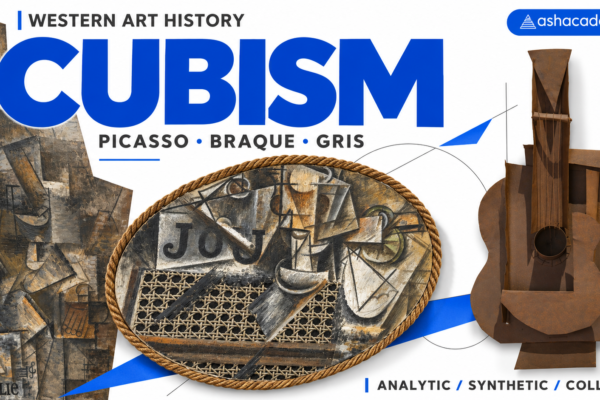
Cubism: History, Characteristics, Artists and Important Artworks
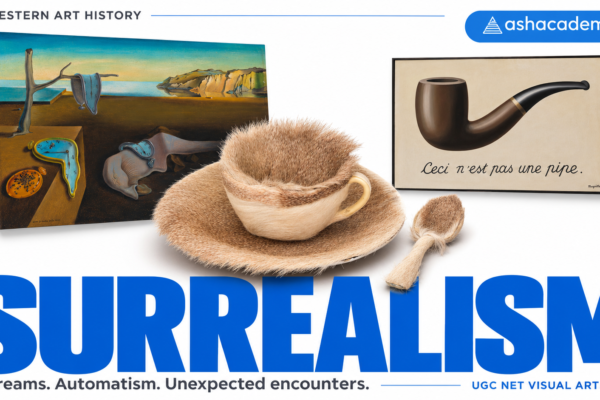
Surrealism: History, Characteristics, Artists and Important Artworks