Neoclassicism: History, Characteristics, Artists and Artworks
Western art movements • UGC NET Visual Arts • illustrated study notes
Neoclassicism: why modern artists returned to the ancient world.
Neoclassicism was a revival and reinterpretation of ancient Greek and Roman art, architecture and ideals, especially from the mid-18th to the early 19th century. Artists used clear contours, ordered compositions, carefully modelled figures and classical subjects to explore beauty, virtue, duty and public authority. It developed before the French Revolution and served several different patrons and political systems.
For UGC NET Visual Arts, connect four things: historical context → visual language → artist → specific artwork. This guide brings together original paintings, sculptures and design objects, alongside chronology, comparison tables and revision exercises. Look at the complete works before learning the names.
1. Historical context: why did Neoclassicism emerge?
Neoclassicism grew through an international network rather than a single national breakthrough. Rome was an important meeting point for artists, collectors, archaeologists and travellers. Paris became a centre of ambitious history painting; London and other European cities developed related approaches in architecture, sculpture and design. Workshops, academies, diplomatic patronage and printed images connected them.
| Context | What changed | Why it mattered for art |
|---|---|---|
| Archaeology | Formal excavations at Herculaneum began in 1738; excavation at Pompeii began in 1748. | Ancient wall paintings, objects, buildings and ornament became newly visible and widely discussed. |
| The Grand Tour | Travellers studied and collected ancient and Renaissance art, especially in Italy. | Demand grew for views of Rome, antiquities, copies, portraits and historically informed designs. |
| The Enlightenment | Debates valued reason, education, knowledge and reform. | Art could present examples for public reflection, rather than only provide private amusement. |
| Academies and public exhibitions | Training, competitions, history painting and the Salon shaped artistic careers. | Large narratives addressed a public audience; status and taste were negotiated through institutions. |
| Changing political patronage | Monarchies, revolutionary governments, Napoleon and later regimes commissioned art. | The classical vocabulary could express different, sometimes opposing, political purposes. |
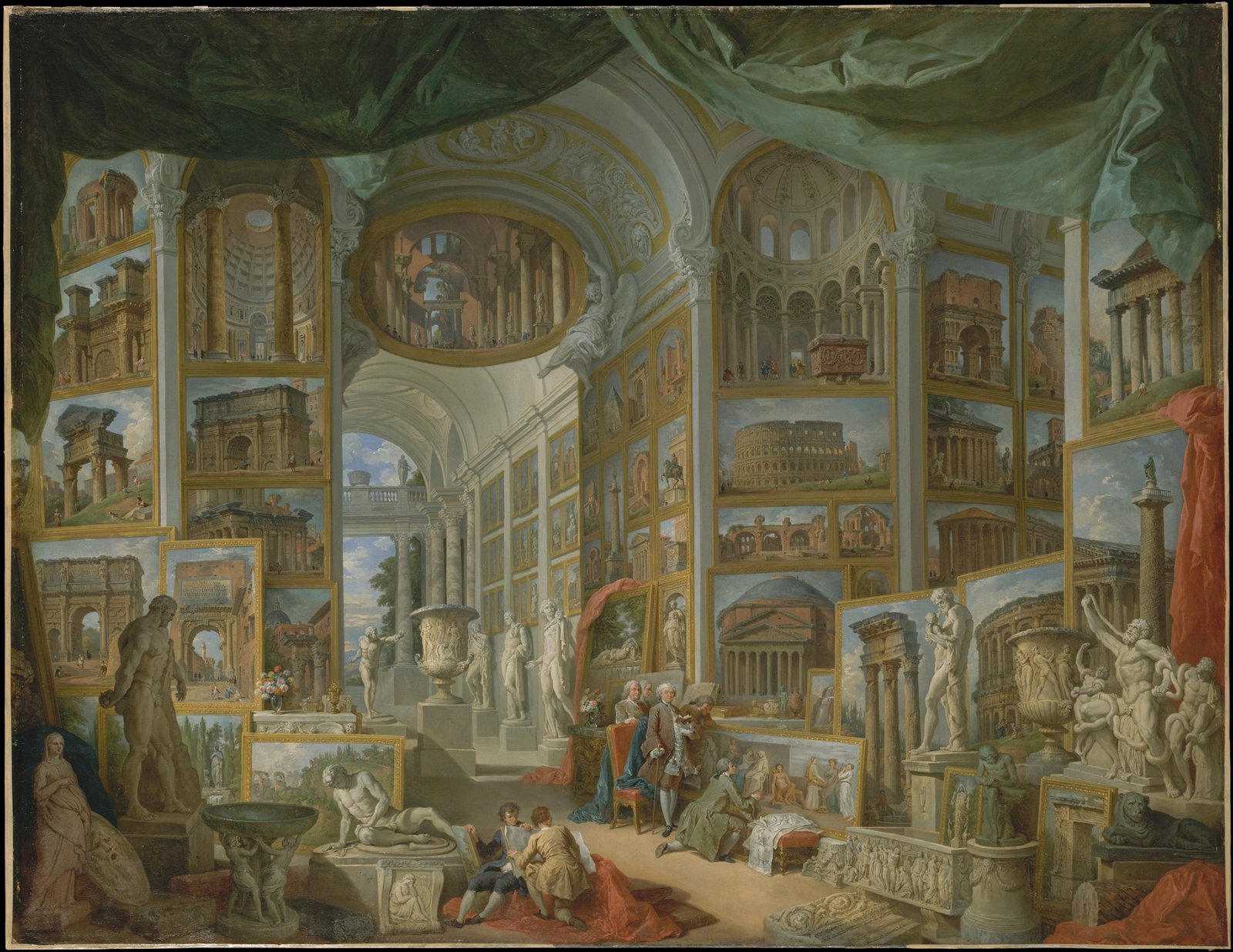
The excavations did not uncover an ancient world that had been entirely unknown. Classical texts, surviving monuments, Renaissance studies and earlier collecting already supplied models. What changed was the quantity and circulation of evidence, together with the questions that modern viewers asked of it. Herculaneum’s initial discovery and the beginning of formal excavation are also different events: do not use 1738 as the date of every first encounter with the site.
Source: Getty: history of Herculaneum.
Source: Archaeological Park of Pompeii: the 1748 excavation beginning.
2. Meaning and ideology: the classical model as a modern argument
“Neo” means new: Neoclassicism is a new engagement with classicism, not ancient art made in antiquity. Classical models also reached artists through Raphael and Nicolas Poussin. Looking backward was a way of making a contemporary argument about good form, education, conduct or power.
Winckelmann: ideal beauty and disciplined expression
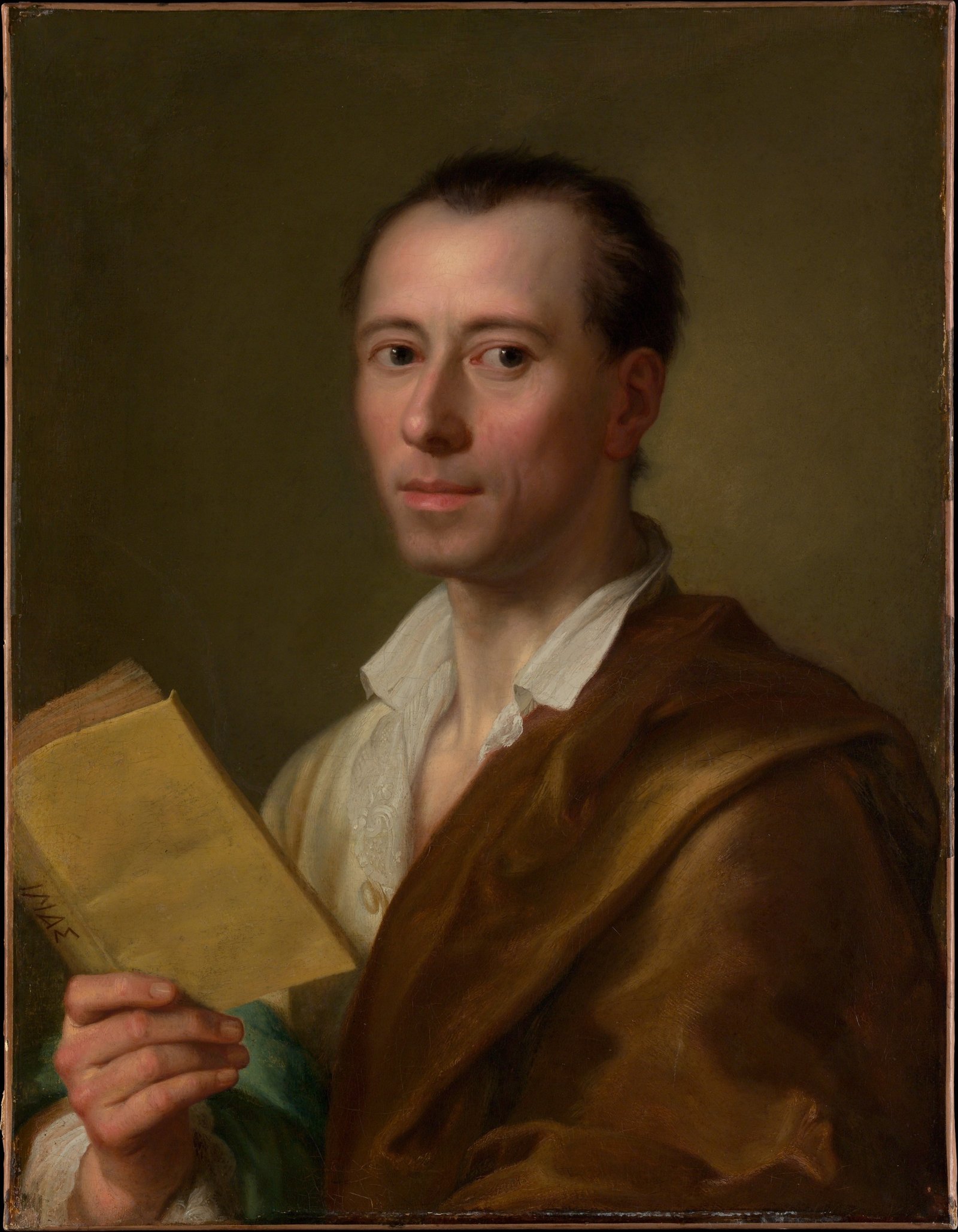
Johann Joachim Winckelmann (1717–1768) was a major theorist of ancient art, not the painter of the works associated with his ideas. His Thoughts on the Imitation of Greek Works in Painting and Sculpture appeared in 1755; History of the Art of Antiquity followed in 1764. English translations vary in their wording of the titles.
The short phrase “noble simplicity and quiet grandeur” is a useful reminder of his ideal. It proposes dignity and self-command even under pressure. Imitating the Greeks meant learning an exemplary artistic language and an ideal of beauty; it did not mean copying every visible irregularity from an individual body. His preference for Greek art was a historical argument, not a neutral description of all cultures.
Four connected ambitions
| Idea | Easy meaning | How it can appear |
|---|---|---|
| Ideal beauty | Select and organise forms rather than simply transcribe appearances. | Balanced proportions, coherent contours and carefully posed bodies. |
| Exemplum virtutis | An example of virtue offered for consideration. | Cornelia values her children; Socrates accepts a difficult moral choice. |
| Public instruction | A work can ask its audience to reflect on conduct and values. | History painting makes duty, sacrifice and judgement visible. |
| Authority and legitimacy | Classical associations can make modern power appear dignified. | Roman imagery can support a revolutionary hero, a ruler or a civic institution. |
Neoclassical artists often challenged the luxury, playful sensuality and decorative excess associated with Rococo taste. But this was not a clean replacement of one uniform style by another. Portraits, elegant interiors and sensuous sculpture continued. Nor did every artist share David’s revolutionary commitments.
Source: National Gallery: meaning, classical models and public purpose.
Source: documenta 14: Winckelmann’s publications and intellectual legacy.
3. Origins and milestones: publications, academies and exhibitions
Think of the movement as a network of objects, books, teaching and patronage. Illustrated publications allowed people who had never visited an ancient site to study its buildings and ornament. Academic training encouraged drawing from antique sculpture and the living model, while history painters adapted literary stories for public exhibition.
| Date | Milestone | Revision value |
|---|---|---|
| 1755 | Winckelmann, Thoughts on the Imitation of Greek Works. | Key theoretical text; do not confuse with his 1764 history. |
| 1760–61 | Mengs paints Parnassus for Villa Albani, Rome. | An early statement of the new classical ideal in painting. |
| 1762 | First volume of Stuart and Revett’s The Antiquities of Athens. | Measured study disseminates knowledge of Greek architecture. |
| 1764 | Winckelmann’s History of the Art of Antiquity; Robert Adam’s publication on Diocletian’s palace at Spalato. | Theory and architectural documentation develop together. |
| 1768 | Royal Academy of Arts founded in London; Kauffmann and Mary Moser are its two women founders. | Institutional history; not a “Neoclassicist artists’ group”. |
| From 1773 | Robert and James Adam’s Works in Architecture appears in parts. | Design reaches a wider audience through publication. |
| 1774 | David wins the Prix de Rome. | A major stage in his training, not the founding date of Neoclassicism. |
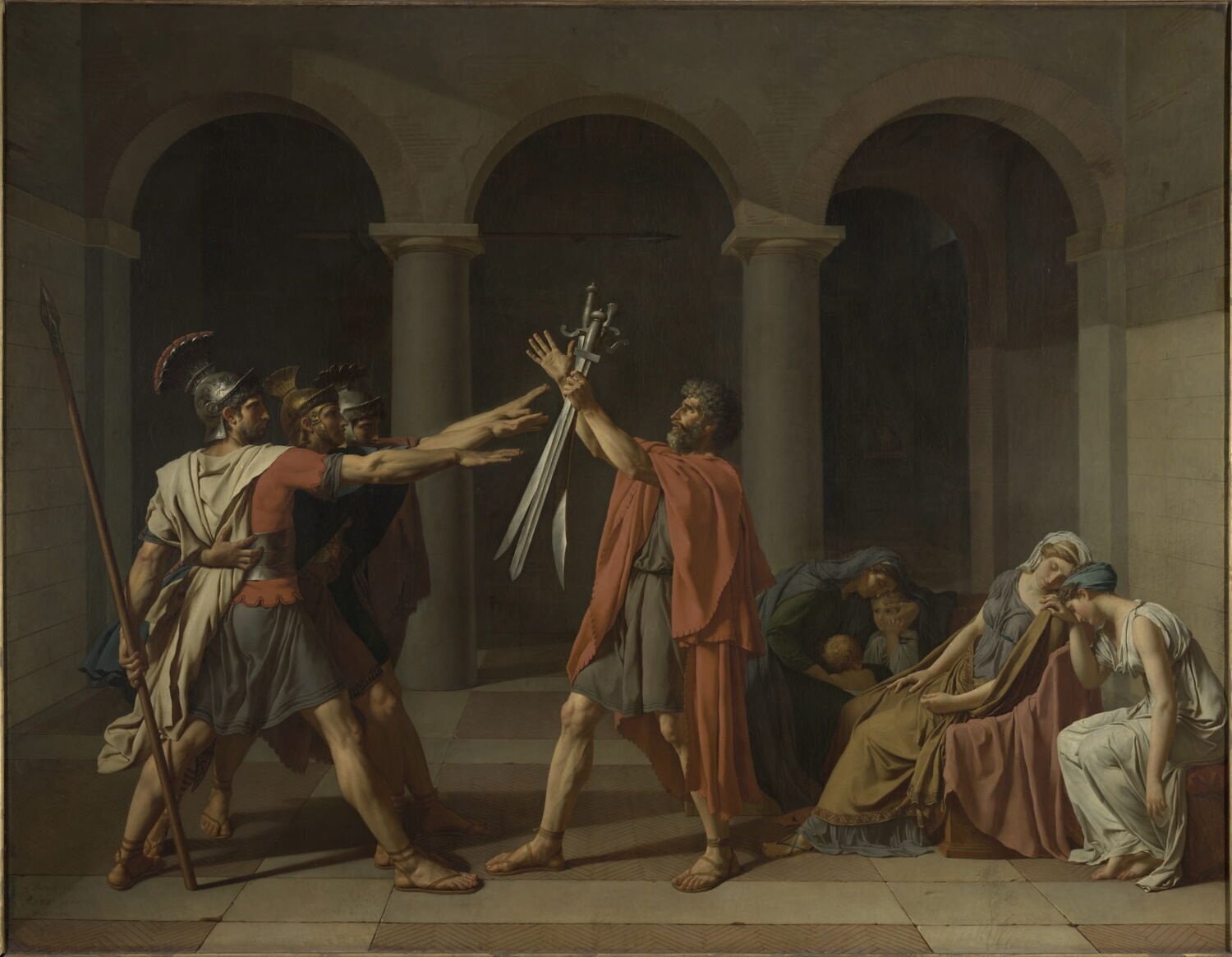
| 1785 | Oath of the Horatii is exhibited at the Paris Salon. | The signed 1784 date and 1785 exhibition are distinct. |
| 1799 | David opens a paid exhibition of The Intervention of the Sabine Women. | Public display was not limited to the official Salon. |
Source: Cybele Gontar, The Met: publications, Mengs and the Roman context.
Source: National Portrait Gallery: the Royal Academy’s women founders.
4. Visual characteristics: how to recognise Neoclassical art
| Feature | What to look for | Qualification |
|---|---|---|
| Contour and drawing | Edges make bodies and objects clearly legible; gestures read distinctly. | “Linear” does not mean flat or unmodelled. |
| Composition | Ordered figure groups, purposeful intervals and a controlled relationship to architecture. | Not every composition is symmetrical. |
| Space | Often a shallow, stage-like arrangement that makes the action easy to read. | Landscape, deep interiors and complex spaces also occur. |
| Bodies and drapery | Sculptural modelling, studied poses and deliberate folds. | Idealisation differs between artists and subjects. |
| Colour and light | Colour and illumination support hierarchy and focus. | Clear reds and blues can be strong; Neoclassicism is not necessarily dull or monochrome. |
| Surface and technique | Many paintings have a polished finish with little emphasis on conspicuous brushmarks. | Oil painting was not the only medium: fresco, drawing, prints, marble and ceramics matter. |
| Subject | Antiquity, mythology, moral narratives, modern heroes, portraits and allegories. | A Greek or Roman setting is common but not compulsory. |
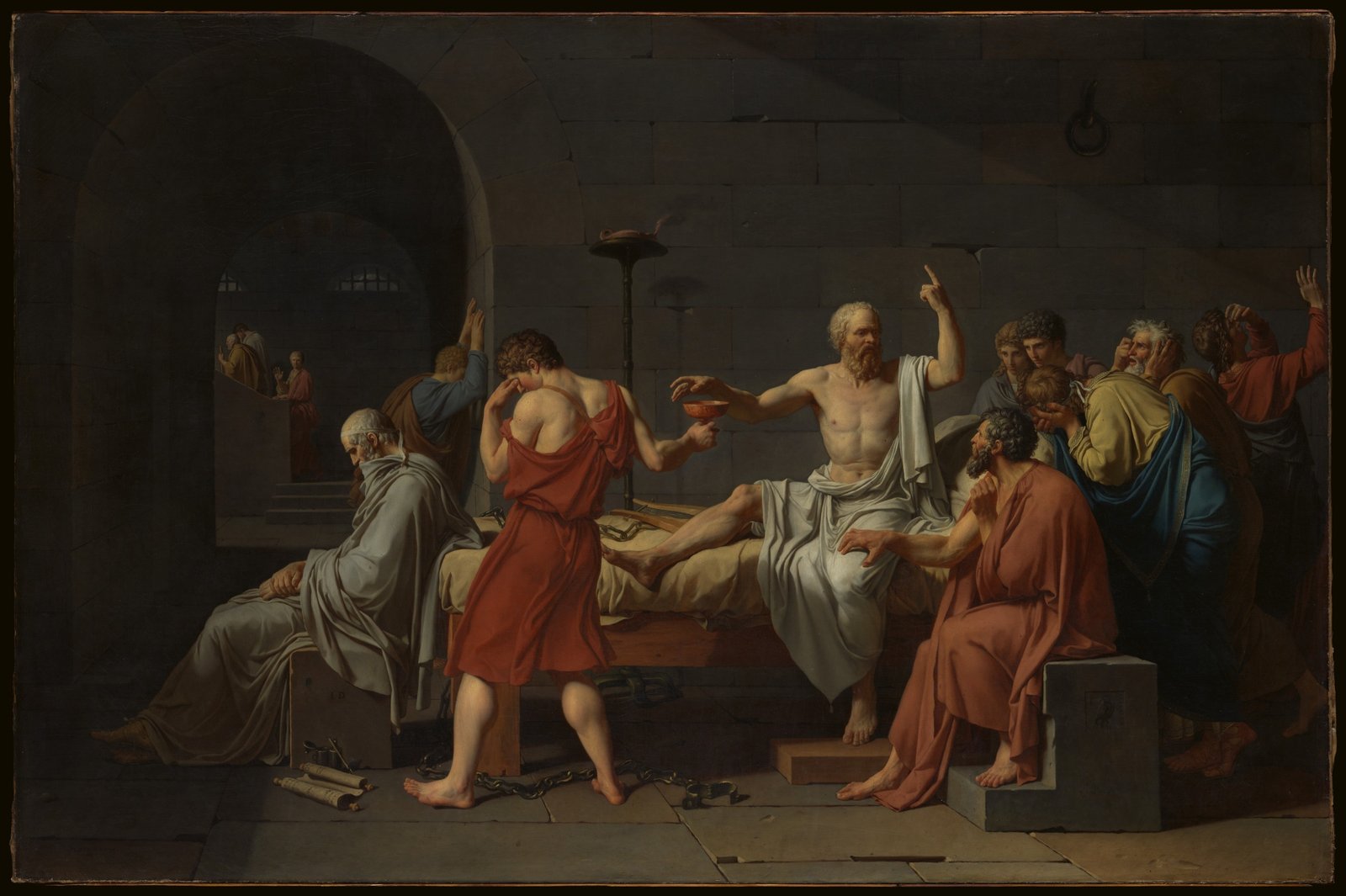
A practical method is to describe one visible feature before naming a style: “Clear contours, a staged grouping and restrained central action organise the moral narrative.” Then add artist, title and date. A single column in the background or a single white statue is insufficient evidence by itself.
Source: Kathryn Calley Galitz, The Met: David’s pictorial language and legacy.
5. Main artists: contribution and differences
The following artists are arranged by birth year, not by when they joined a group. Their different careers demonstrate how broad the movement was. The list identifies major study figures rather than claiming to include every Neoclassical artist.
| Artist | Life dates | Individual contribution |
|---|---|---|
| Gavin Hamilton | 1723–1798 | Painter, excavator and dealer in Rome; important for classical history subjects and the circulation of antiquities. |
| Anton Raphael Mengs | 1728–1779 | Early idealising classical compositions, especially Parnassus; close to Winckelmann’s intellectual world. |
| Benjamin West | 1738–1820 | Extended elevated history painting to modern events and contemporary dress. |
| Angelica Kauffmann | 1741–1807 | Classical history, portraiture and female-centred moral narratives; a Royal Academy founder. |
| Jean-Antoine Houdon | 1741–1828 | Portrait sculpture combining close observation of individuals with public dignity. |
| Jacques-Louis David | 1748–1825 | Moral history painting, revolutionary imagery, portraits and Napoleonic representation. |
| John Flaxman | 1755–1826 | Sculpture, relief design and influential outline illustrations of classical and literary subjects. |
| Antonio Canova | 1757–1822 | Ideal marble bodies, sensuous surfaces and carefully controlled mythological groups. |
| Bertel Thorvaldsen | 1770–1844 | Classical figure types and balanced sculptural poses developed through a Roman workshop practice. |
| Jean-Auguste-Dominique Ingres | 1780–1867 | David’s pupil; exceptional contour and finish, portraiture and a long, varied classical legacy. |
6. Mengs and the Roman circle: early Neoclassicism
Mengs’s Parnassus, painted in fresco for Villa Albani, Rome, in 1760–61, brings Apollo and the Muses into an ordered classical conception. It is a key work for understanding the movement before David’s great history paintings. Its ancient subject and controlled arrangement also connect it to the Renaissance tradition of Raphael.
Winckelmann supplies theory; Mengs supplies painted form. Keep those roles distinct. Also distinguish the Villa Albani fresco from versions or related paintings of Parnassus in other collections: a shared title does not guarantee the same medium, location or object.
Gavin Hamilton’s Roman career connected painting with excavating, collecting and dealing in antiquities. His Achilles Lamenting the Death of Patroclus (1760–63, National Galleries of Scotland) is useful for recognising the importance of Homeric narrative within the wider classical revival. There was no single “founder” who did all of this work alone.
Source: National Galleries of Scotland: Gavin Hamilton and his classical history painting.
7. Angelica Kauffmann: virtue through a different protagonist
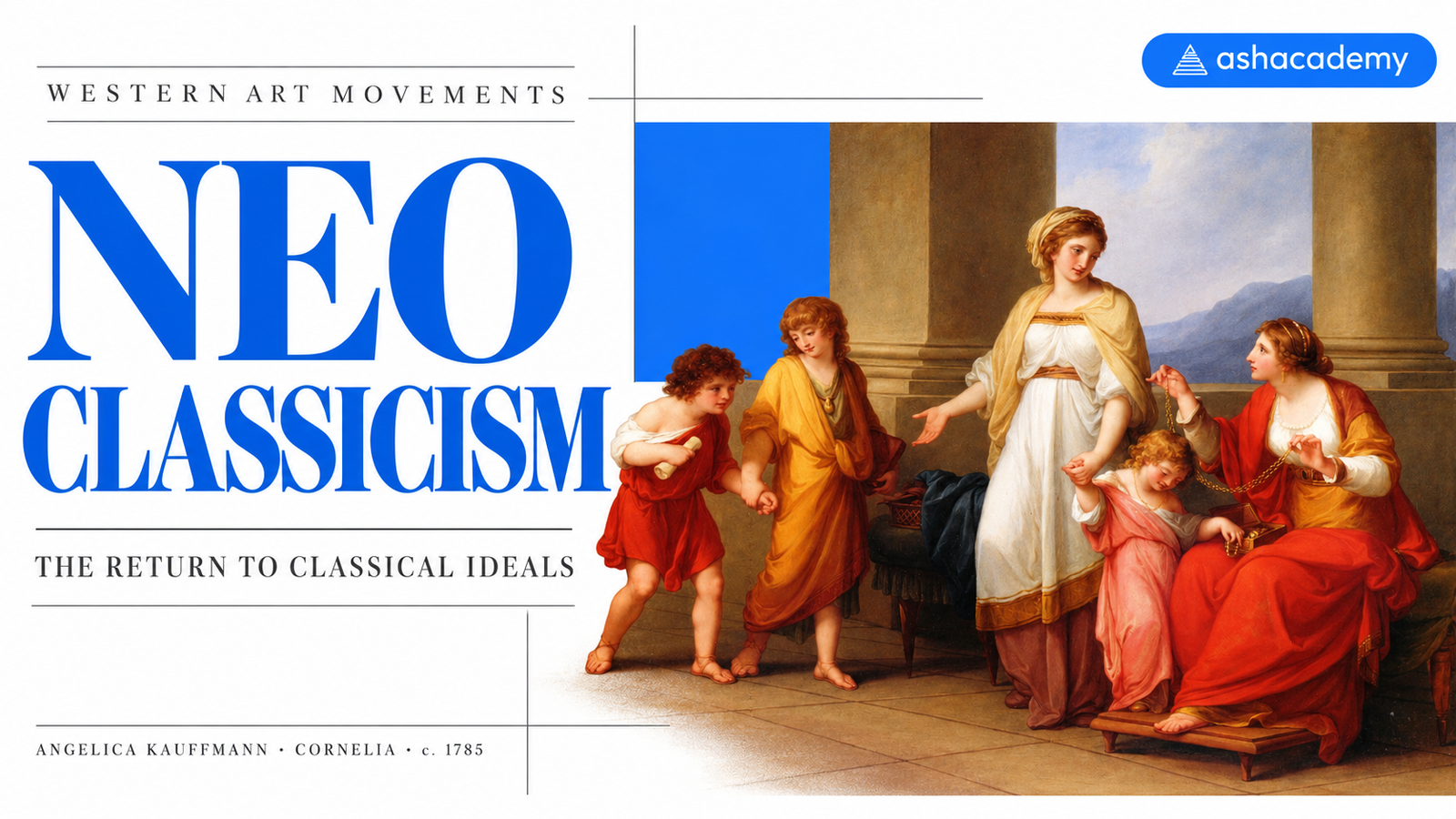
Kauffmann’s Cornelia develops a Roman example of virtue through motherhood and education. A visitor displays precious possessions; Cornelia presents her children as what she values most. The painting offers an ethical comparison between material display and the formation of people.
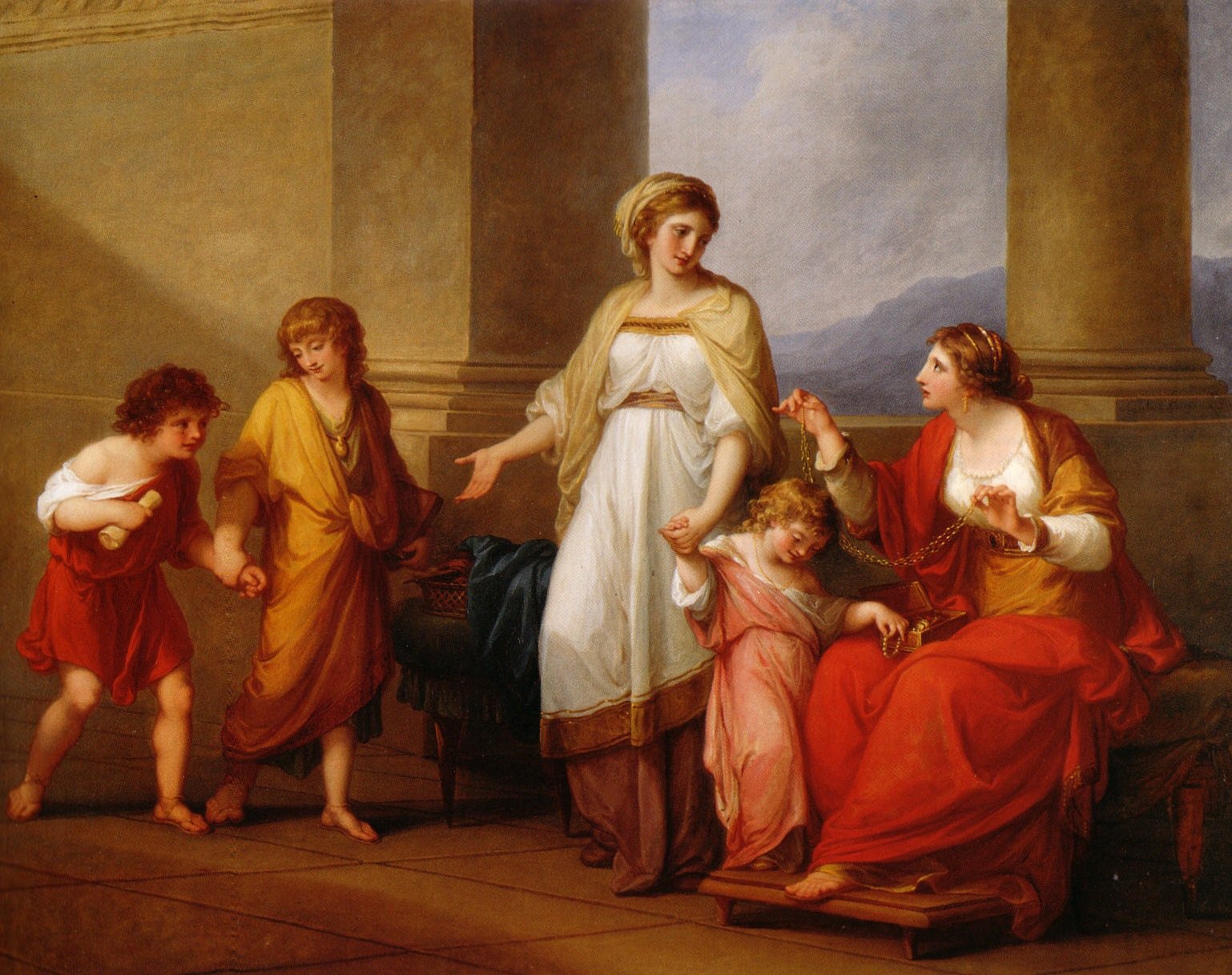
Her contribution should not be reduced to “a woman who painted like David.” She gave female figures an active moral and narrative role and built an international career in history painting and portraiture. The example shows a shared classical language serving a distinct emphasis. Contemporary ideals of virtue were also shaped by gender: the values presented for women and men were not always the same.
Source: Angelika Kauffmann Research Project, edited by Bettina Baumgärtel.
8. Benjamin West: a modern event can become history painting
The Death of General Wolfe was painted in 1770 and represents the British commander’s death at Quebec in 1759. The event’s date and the painting’s date are different. West organised modern figures into an elevated, emotionally persuasive history painting rather than requiring them all to wear ancient Roman costume.
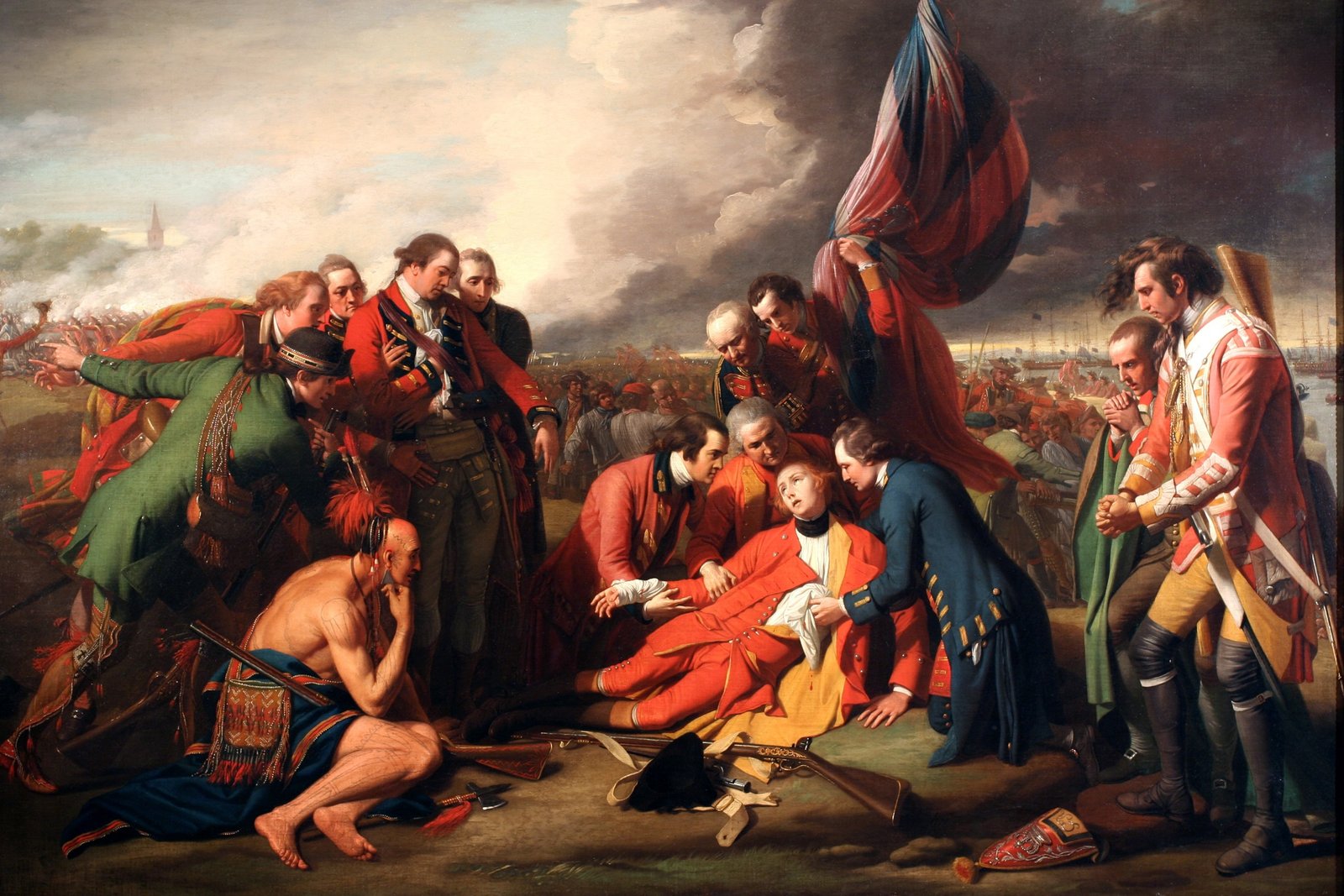
The National Gallery of Canada describes a range of posed reactions and an intended example of self-sacrifice. The work demonstrates why subject matter alone cannot classify a painting: modern history can be treated with the ambition and dignity associated with classical history painting. Its British imperial narrative also deserves to be recognised rather than presented as politically neutral.
9. Jacques-Louis David: moral history, revolution and power
Oath of the Horatii: public duty and private grief
Three brothers extend their arms towards swords held by their father. David opposes their angular resolve to the grieving family at the right. The austere setting and separated groups make the ethical conflict easy to grasp: a public commitment has a private human cost.
The Death of Socrates: reason under pressure
Return to the full work in the visual-characteristics section. Socrates reaches towards the cup while continuing to teach; the surrounding figures respond differently to the impending death. The image makes conviction and mortality into a deliberately staged moral problem. The Met notes that Plato’s presence invokes his written account: the scene should not be treated as a literal eyewitness reconstruction.
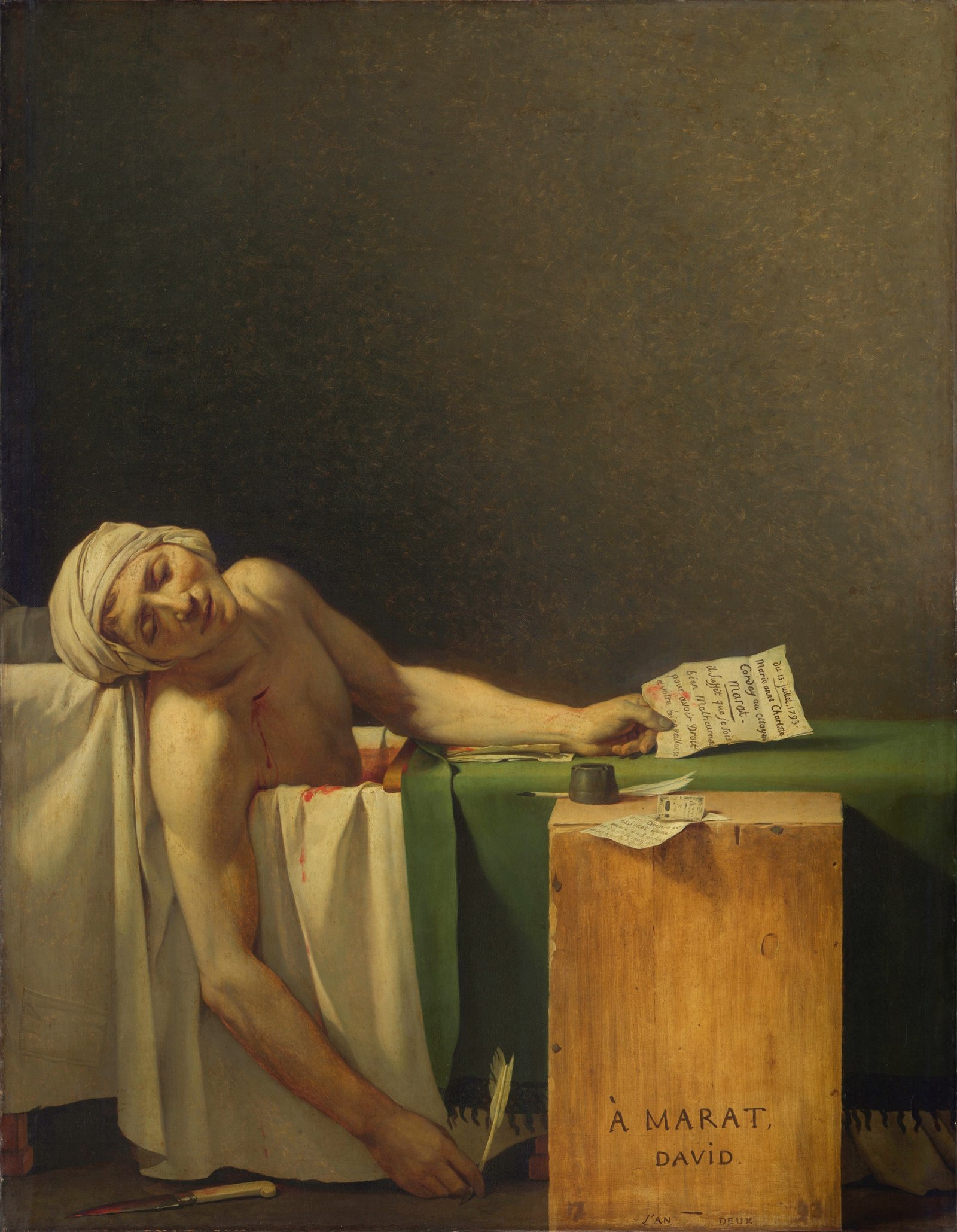
The Death of Marat: a modern revolutionary martyr
Marat, assassinated in 1793, is presented through a strikingly reduced setting. The bath, letter, writing tools and box organise the image around the dead revolutionary’s body and activity. David turns a current political death into a persuasive public memorial. “Classical” here lies partly in the disciplined presentation and exemplary claim, not in antique costume.
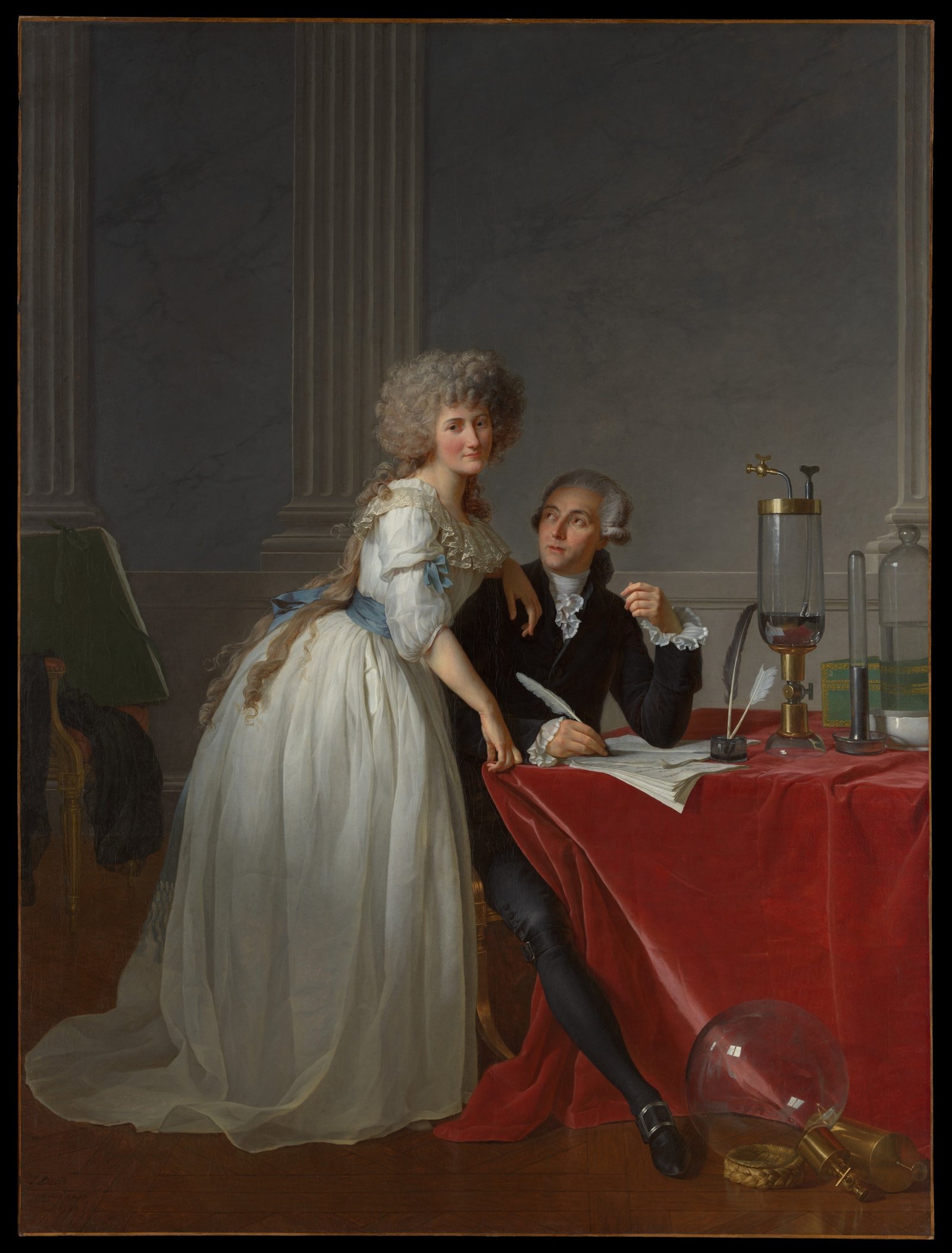
The Lavoisiers: portraiture and the world of knowledge
David also painted portraits. In the 1788 double portrait of Antoine Laurent Lavoisier and Marie Anne Lavoisier, the couple, instruments and striking red-covered table create an image of cultivated modern identity. It helps correct the shortcut that every Neoclassical painting must depict an ancient hero.
Further David works to know
| Work | Date / medium | Why it matters |
|---|---|---|
| The Lictors Bring to Brutus the Bodies of His Sons, Louvre | 1789; oil on canvas | The cost of public duty is developed through family tragedy. |
| The Intervention of the Sabine Women, Louvre | 1799; oil on canvas | Women interrupt battle; reconciliation differs from the oath of armed commitment in Horatii. |
| Bonaparte Crossing the Great St Bernard Pass | First composition completed 1800–1801; oil on canvas; several versions exist | A modern leader receives heroic treatment. The military crossing happened in May 1800. |
| The Coronation of Napoleon, Louvre | 1805–1807; oil on canvas | Imperial representation: distinguish the painted work from the coronation ceremony of 2 December 1804. |
David’s changing commissions are central to the story. A stylistic vocabulary can be adapted to royal, revolutionary and imperial contexts. Avoid defining Neoclassicism as a style that supported only one form of government, or assuming that David’s political position remained identical throughout his career.
Source: Louvre: Brutus.
Source: Louvre: The Sabine Women and its exhibition history.
Source: Fondation Napoléon: the Alpine crossing painting and its versions.
Source: Louvre: The Coronation of Napoleon.
10. Antonio Canova: ideal form does not mean absence of feeling
Psyche Revived by Cupid’s Kiss
Canova’s marble group, developed between 1787 and 1793, presents a mythological encounter between Cupid and Psyche. Bodies, wings and arms form an open, carefully balanced arrangement. The contrast of marble surface, drapery and rocky support gives the work a tactile presence.
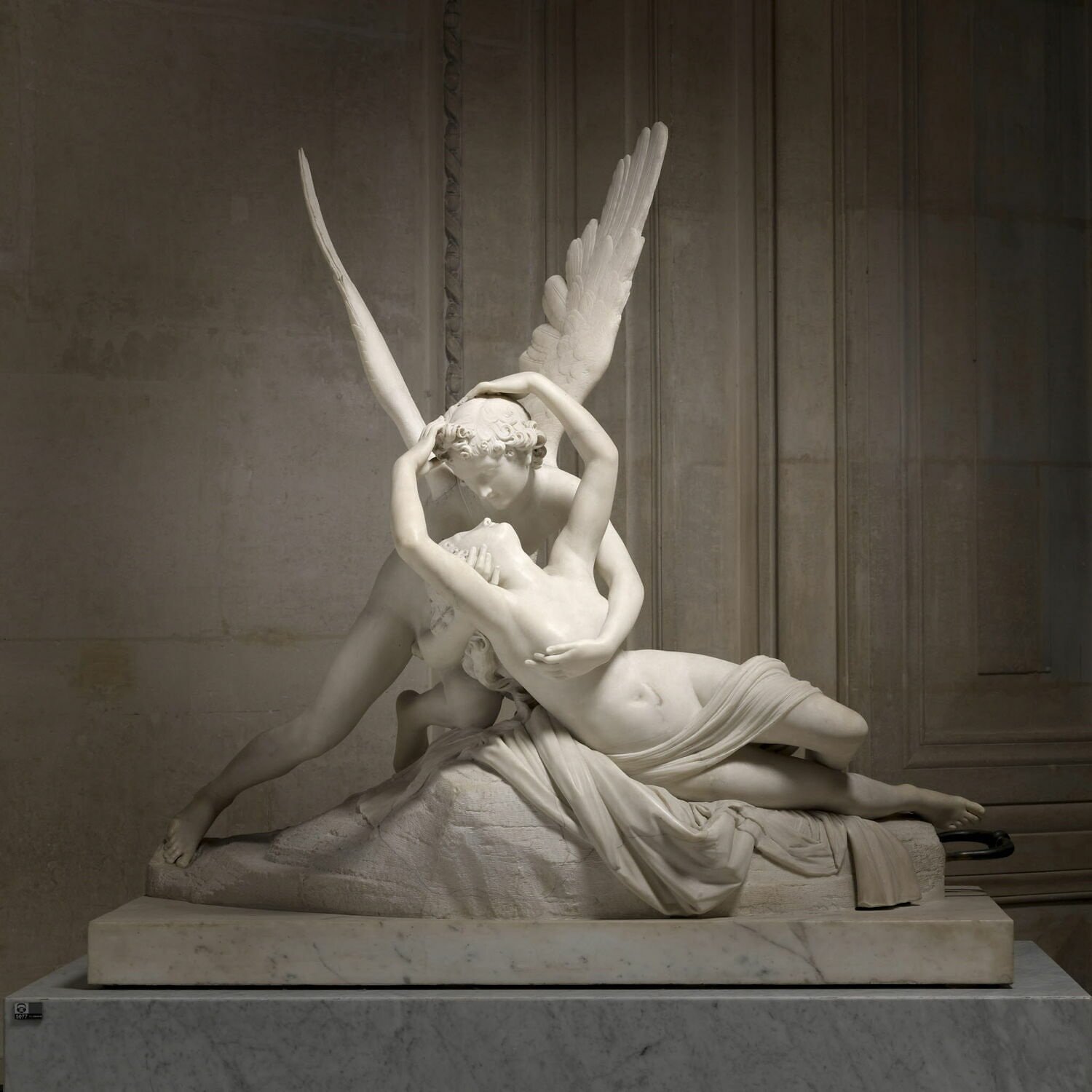
The Louvre describes the myth through Psyche’s collapse after opening a forbidden container and Cupid’s revival of her. For visual analysis, the essential point is how a narrative of feeling becomes an idealised sculptural group. “Calm” and “controlled” do not require an empty emotional life.
The Three Graces: identify the version
The 1814–1817 Bedford version of The Three Graces is jointly owned by the V&A and National Galleries of Scotland. It followed the group commissioned for Joséphine, now in the Hermitage. Do not transfer the date and collection of one version to another.
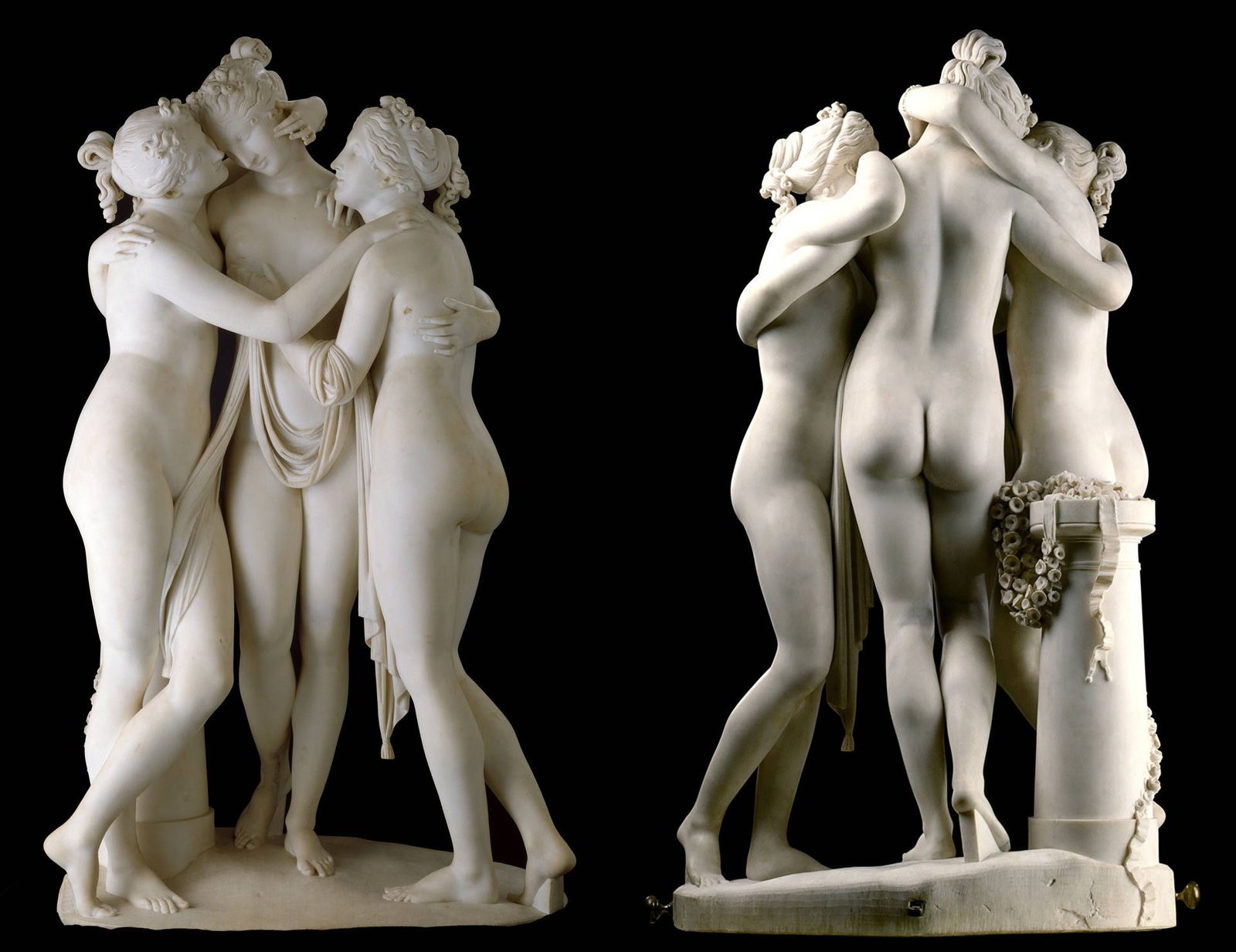
Canova’s work depends on the translation of models into finished marble and on the treatment of the surface. White marble became strongly associated with the classical ideal in modern taste, but ancient Greek and Roman sculpture was often coloured. Do not project the modern whiteness of museum marbles onto all ancient practice.
Source: Louvre: Canova and the Cupid–Psyche narrative.
Source: The Met, Chroma: evidence of ancient polychromy.
11. Thorvaldsen, Houdon and Flaxman: three sculptural paths
Thorvaldsen: Jason and the model-versus-marble problem
Thorvaldsen began Jason in Rome in 1802. The plaster was completed and the marble commissioned by Thomas Hope in 1803; the marble was delivered in 1828. The museum’s A822 catalogue therefore spans 1803–1828. Those dates refer to different stages in a long production history, not a simple contradiction.
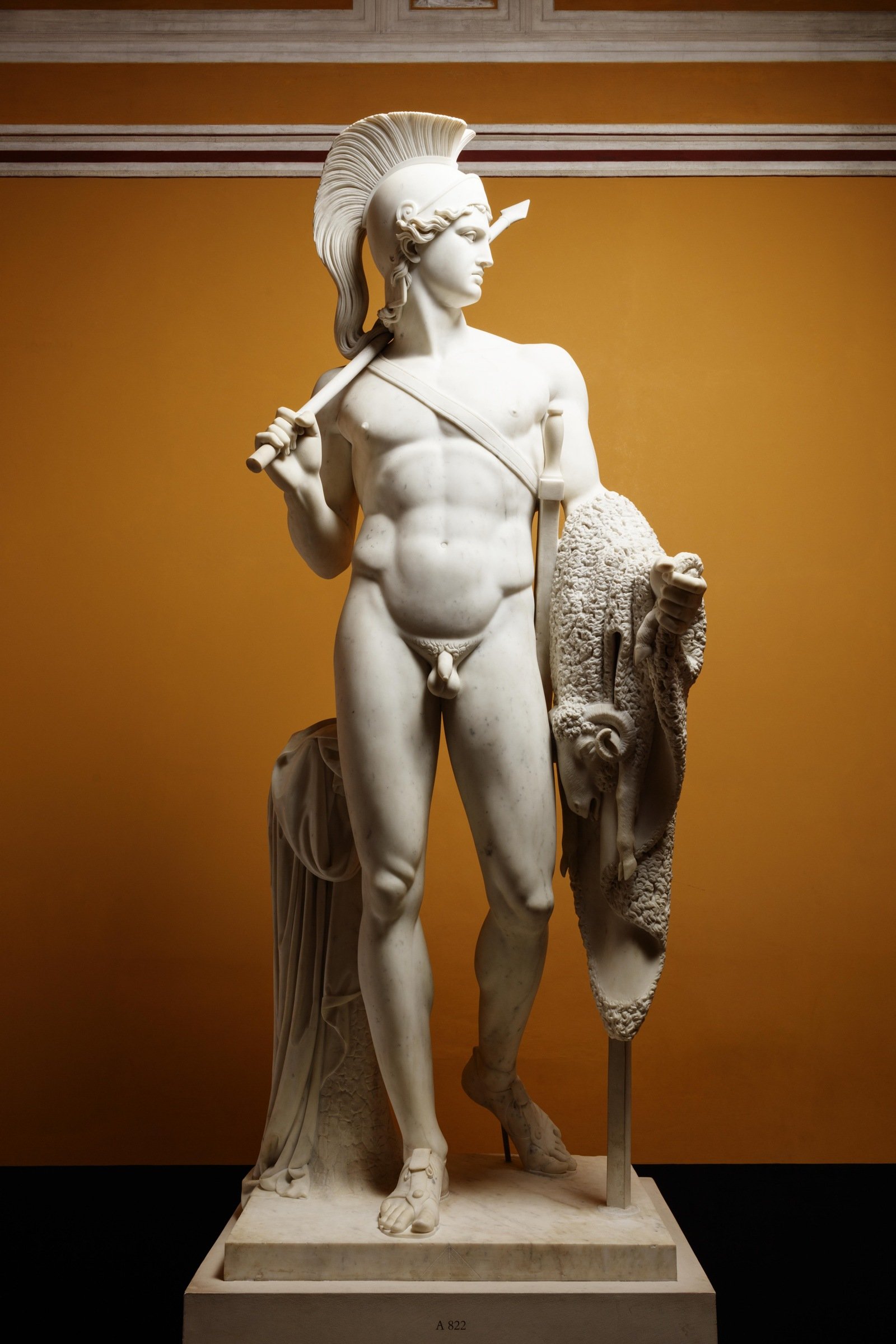
Compared with Canova’s close, interlocking group, this standing hero makes the individual figure and its measured pose prominent. That is a comparison of the selected works, not a claim that every Thorvaldsen sculpture is motionless or every Canova sculpture is emotional.
Houdon: public dignity with individual observation
Jean-Antoine Houdon’s George Washington, made for the Virginia State Capitol, combines a recognisable contemporary individual with public symbolism. The project began with a 1784 commission; Houdon studied Washington in 1785, and the marble was completed in 1792 and installed in 1796. A life mask and observation mattered alongside the language of civic virtue.
Flaxman: the power of an outline
John Flaxman worked in sculpture and design and became especially influential through outline illustrations of Homer and Dante in the 1790s. A contour can organise action without oil colour, complex shadow or a fully painted background. His career also links fine art with reproducible designs and decorative production.
Source: Thorvaldsens Museum Archives: Jason’s extended production.
Source: The Frick Collection: Houdon’s Washington commission and dates.
Source: National Portrait Gallery: Flaxman’s outline engravings.
12. Ingres: line, idealisation and a complicated legacy
Ingres studied with David but developed a distinctive language of contour, finish and stylisation. In Grande Odalisque (1814), the extended back and flowing silhouette show that his commitment to line did not always mean anatomical literalness. The imagined harem setting belongs to Orientalist representation, not to an eyewitness description of a real place.
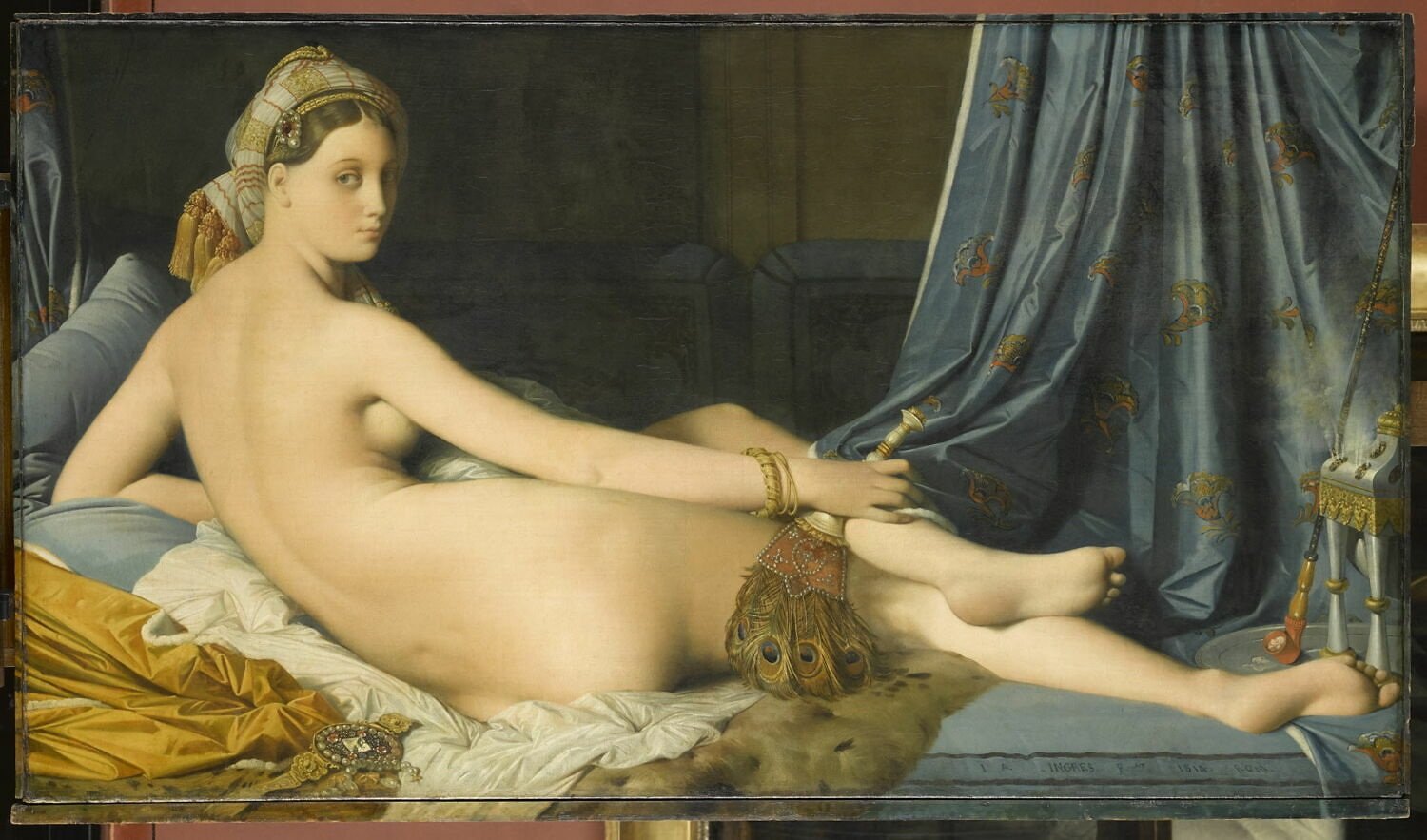
The Louvre records that the painting was made for Caroline Murat and exhibited at the Salon of 1819. Again, painting date and exhibition date are different. Ingres is a key figure for the persistence of classical ideals into the 19th century, while this work shows why “Neoclassicism equals only Roman moral stories” is too narrow.
For matching questions, also know The Vow of Louis XIII (1824, oil on canvas, Montauban Cathedral) and The Apotheosis of Homer (1827, oil on canvas, Louvre). The former revisits religious and Raphael-related ideals; the latter assembles a classical cultural canon. His long career extends well beyond a short movement date range.
Source: French Ministry of Culture: The Apotheosis of Homer.
Source: Musée Ingres Bourdelle: 1824 work and the Montauban Cathedral painting.
13. Architecture and decorative arts: beyond easel painting
Architectural Neoclassicism used antique orders, porticoes, pediments, domes and geometric planning in new settings. The result could be a church, museum, public monument, private house or coordinated interior. The classical revival did not require every building to imitate the same ancient temple.
Robert Adam: the interior as a coordinated design
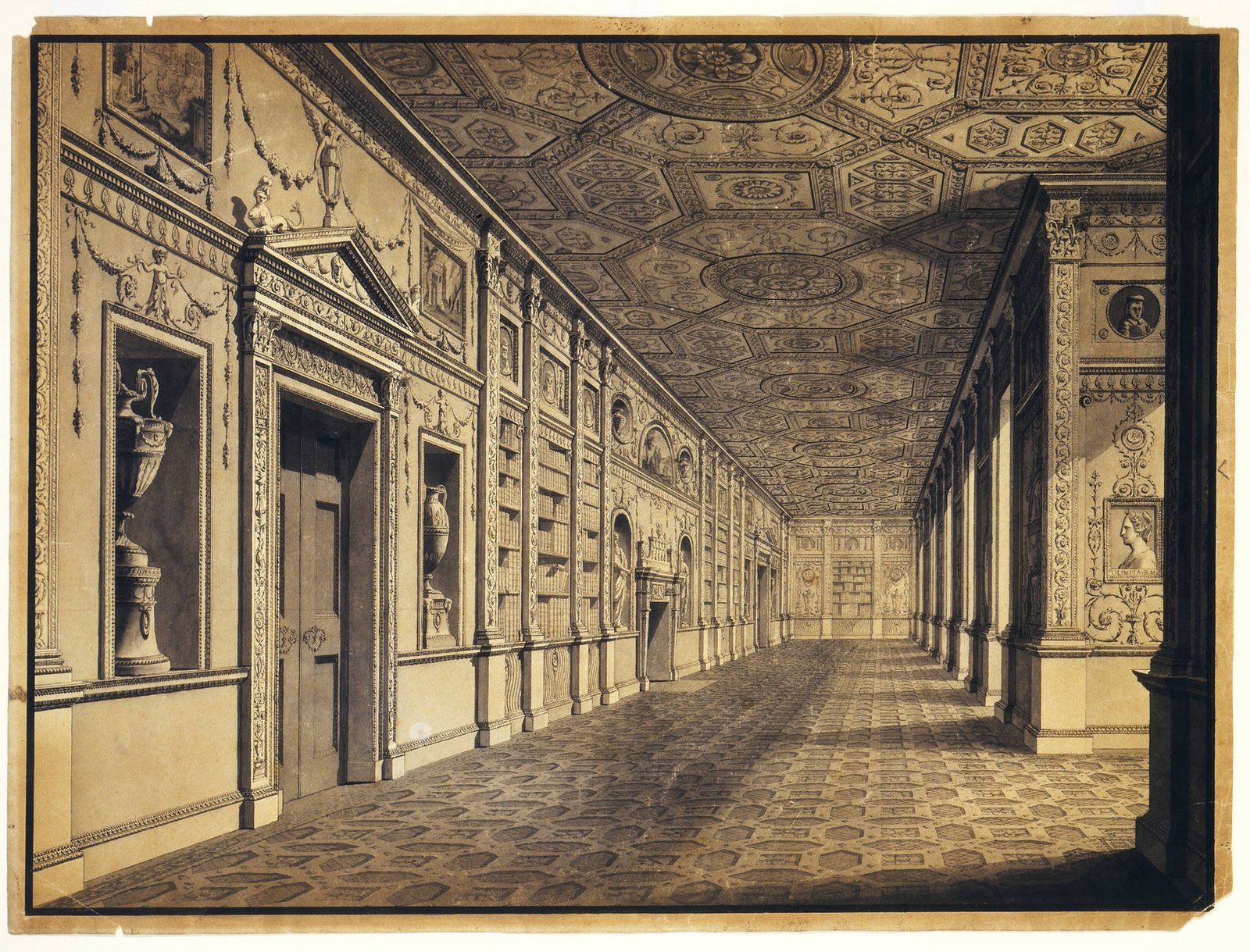
Robert Adam (1728–1792) adapted classical and Renaissance sources across walls, ceilings, floors, furniture and fittings. His approach could be delicate, richly decorated and colourful. It should not be confused with a rule that Neoclassical architecture must be empty or entirely white.
| Architect / example | What to recognise | Important distinction |
|---|---|---|
| Robert Adam — British houses and interiors | A coordinated decorative language adapted to modern domestic use. | The Adam style is one form of Neoclassical design, not the whole movement. |
| Jacques-Germain Soufflot — Panthéon, Paris | A monumental classical exterior and an architectural project tied to changing civic meaning. | The building’s original church function and later civic identity are different historical stages. |
| Étienne-Louis Boullée and Claude-Nicolas Ledoux | Geometry, monumental scale and experimental architectural propositions. | Not every famous project was constructed. |
| Robert Smirke — British Museum, London | Greek Revival public architecture, notably the Ionic colonnade. | Greek Revival is a related architectural strand; not every Neoclassical building is Doric. |
Wedgwood: antiquity becomes a manufactured object
Wedgwood’s c. 1790 Portland Vase translates an admired Roman glass vessel into ceramic. The Cleveland example is jasperware with applied decoration. The relief figures, contrasting surfaces and antique reference show how Neoclassicism reached the decorative arts and the market for reproducible luxury objects.
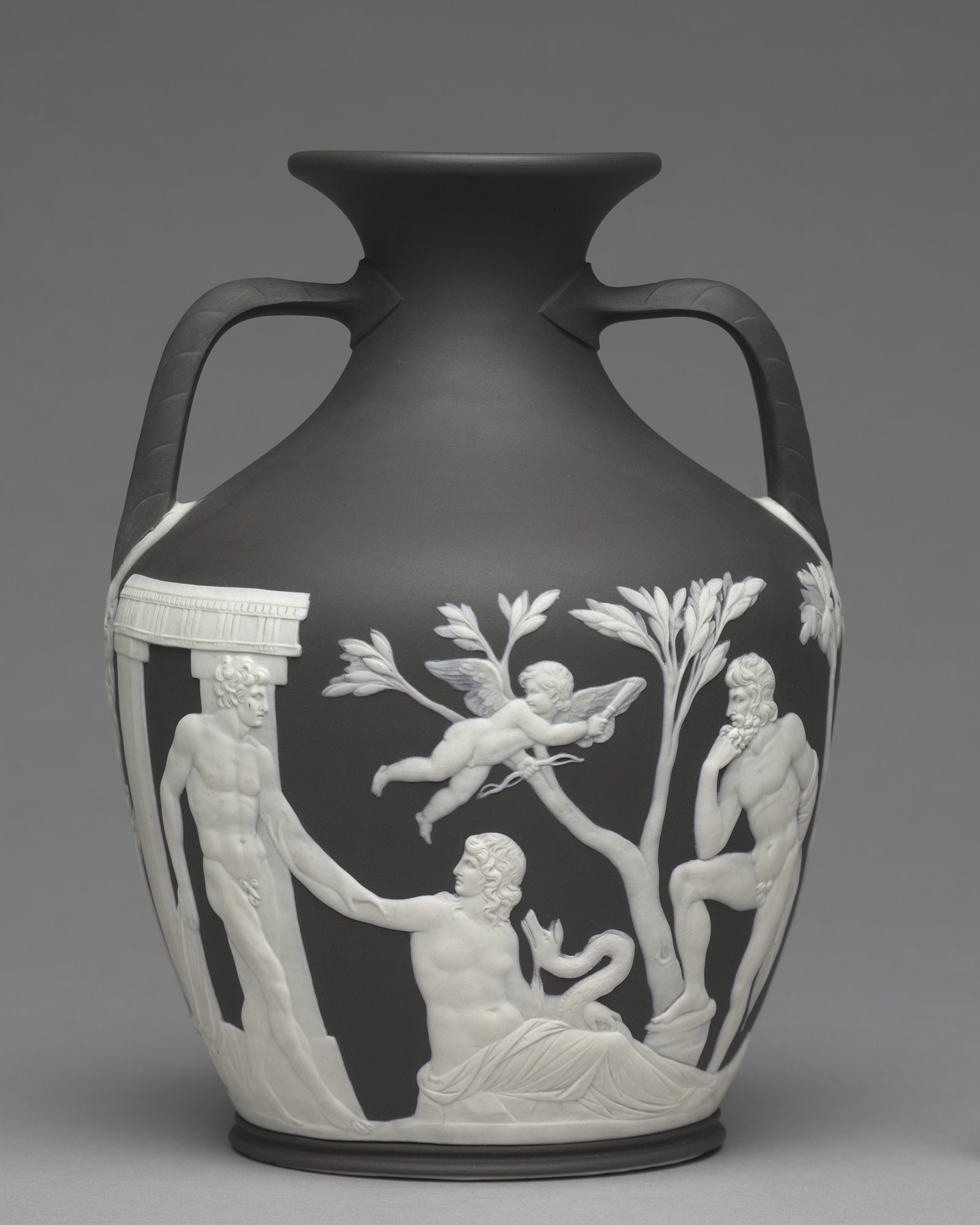
A practical materials distinction: oil on canvas is not fresco; marble is not plaster; jasperware is a ceramic, not glass. The date of a model, the carving of a marble and the manufacture of a later edition can also differ. Keep the medium attached to the particular object you are studying.
Source: Centre des monuments nationaux: Soufflot and the Panthéon.
Source: British Museum: Greek Revival and Smirke’s Ionic colonnade.
14. Rococo vs Neoclassicism vs Romanticism
Use the table to compare typical priorities, then test it against actual artworks. These are tendencies, not rigid boxes. A chronological overlap or a work combining different qualities is not an error in art history.
| Question | Rococo tendency | Neoclassical tendency | Romantic tendency |
|---|---|---|---|
| Main emphasis | Pleasure, elegance, intimacy and sociability. | Exemplary conduct, ideal form, order and public meaning. | Imagination, powerful experience, feeling and the sublime. |
| Composition | Playful curves and frequently asymmetrical arrangements. | Legible grouping, controlled contour and an organised narrative. | Frequently dynamic action, dramatic space or expressive atmosphere. |
| Subjects | Love, leisure, myth and elite social worlds. | Antiquity, moral history, modern heroes, portraits and allegory. | Nature, conflict, disaster, contemporary history and imagined worlds. |
| Colour and handling | Often light, decorative effects. | Often polished finish and colour subordinated to clear design. | Often heightened colour or visible handling for expressive effect. |
| Useful caution | Rococo can have intellectual and social complexity. | Canova and Ingres can be sensuous and emotional. | Romantic artists can also draw precisely and use historical subjects. |

15. Impact and legacy: what continued, and what was challenged?
Neoclassicism helped make drawing, ideal form, historical knowledge and exemplary narrative central to academic art. David’s teaching and Ingres’s long career transmitted these values to later painters, even as artists disagreed about their application. Classical languages also remained important in public monuments, museums and civic buildings.
Its legacy includes a productive tension: an artist could preserve contour and formal discipline while changing subject, emotional register or political purpose. Romanticism developed alongside and in debate with these practices, rather than appearing only after every Neoclassical tendency had disappeared. Later modern artists could reject academic authority while still finding possibilities in classical form.
The movement also invites critical questions. Who was authorised to represent public virtue? Whose past was selected as universal? How did aristocratic collecting, imperial power and unequal access to institutions shape the classical ideal? Kauffmann’s career and West’s imperial narrative make these questions concrete without erasing the works’ formal achievements.
16. Chronology and artist–artwork matching
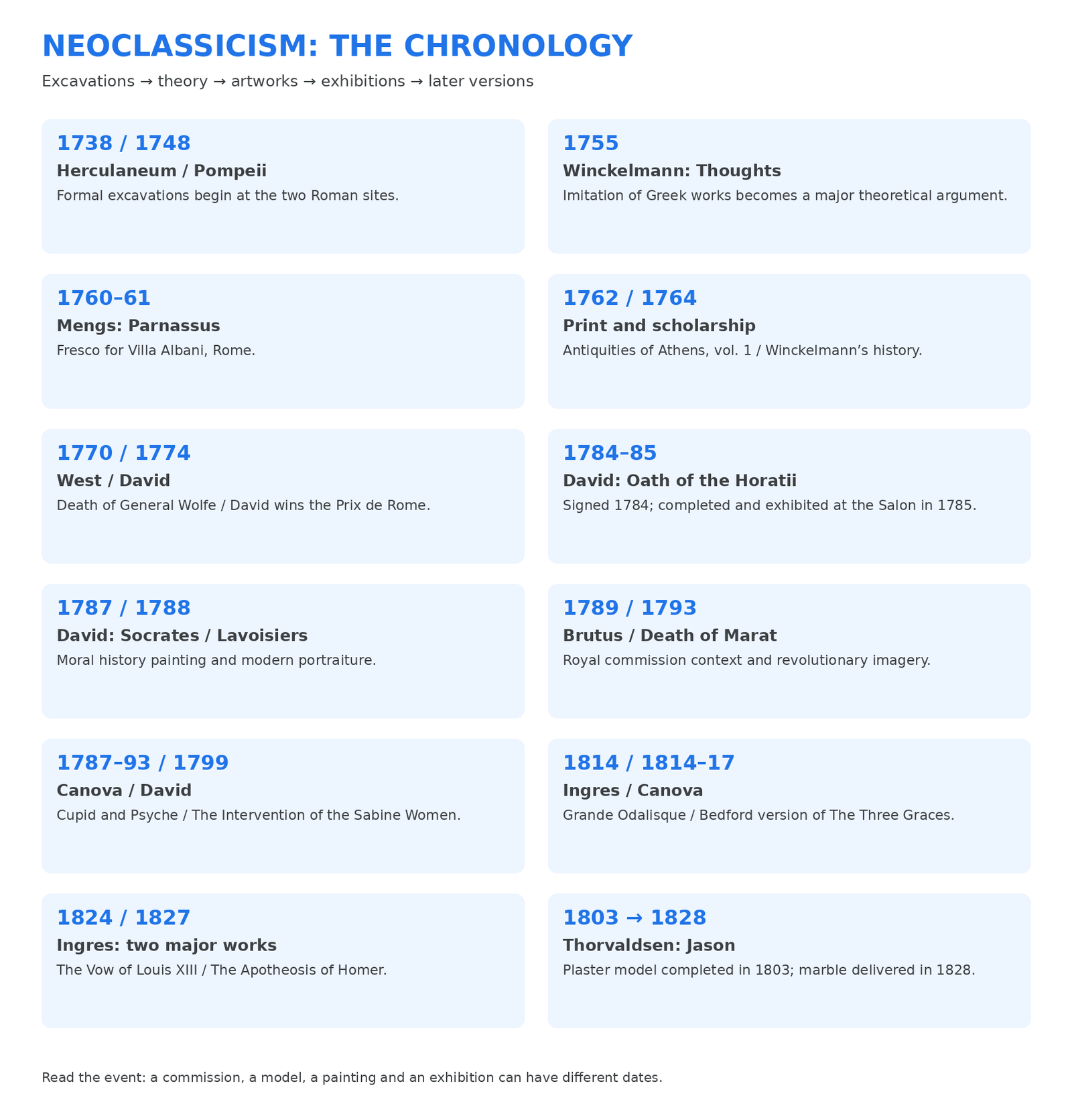
| Artist | Essential work | Date | Medium / collection |
|---|---|---|---|
| Mengs | Parnassus | 1760–61 | Fresco; Villa Albani, Rome. |
| West | The Death of General Wolfe | 1770 | Oil on canvas; National Gallery of Canada. |
| Kauffmann | Cornelia, Mother of the Gracchi | c. 1785 | Oil on canvas; Virginia Museum of Fine Arts. |
| David | Oath of the Horatii | 1784 signed; completed 1785 | Oil on canvas; Louvre. |
| David | The Death of Socrates | 1787 | Oil on canvas; The Met. |
| David | The Lavoisiers | 1788 | Oil on canvas; The Met. |
| David | Brutus | 1789 | Oil on canvas; Louvre. |
| David | The Death of Marat | 1793 | Oil on canvas; Royal Museums of Fine Arts of Belgium. |
| Canova | Psyche Revived by Cupid’s Kiss | 1787–1793 | Marble, with metal recorded; Louvre. |
| David | The Intervention of the Sabine Women | 1799 | Oil on canvas; Louvre. |
| Houdon | George Washington | Completed 1792; installed 1796 | Marble; Virginia State Capitol. |
| Wedgwood and Sons | Portland Vase, Cleveland example | c. 1790 | Jasperware with applied decoration; Cleveland Museum of Art. |
| Ingres | Grande Odalisque | 1814 | Oil on canvas; Louvre. Salon 1819. |
| Canova | The Three Graces, Bedford version | 1814–1817 | Marble; jointly V&A / National Galleries of Scotland. |
| Ingres | The Vow of Louis XIII | 1824 | Oil on canvas; Montauban Cathedral. |
| Ingres | The Apotheosis of Homer | 1827 | Oil on canvas; Louvre. |
| Thorvaldsen | Jason with the Golden Fleece, A822 | 1803–1828 | Marble; Thorvaldsens Museum. Plaster model completed 1803. |
17. Exam revision: terms, traps and questions
| Term | Meaning for revision |
|---|---|
| Classicism | A broader commitment to classical models and ideals, recurring in different periods. |
| Neoclassicism | The modern revival especially associated with the later 18th and early 19th centuries. |
| Grand Tour | Educational travel, especially to Italy, linked to studying and collecting art. |
| History painting | An elevated narrative category drawing on history, literature, religion or myth; not simply any old painting. |
| Exemplum virtutis | An example of virtue used to prompt moral reflection. |
| Idealisation | Selecting and organising forms according to an ideal, rather than straightforward visual transcription. |
| Salon | A major public exhibition institution in France; distinguish a work’s making from its exhibition. |
| Prix de Rome | A prestigious competition associated with advanced study in Rome; David won in 1774. |
| Polychromy | The use of multiple colours; important when correcting the assumption that ancient sculpture was all white. |
| Jasperware | A ceramic material used by Wedgwood; not a type of Roman glass. |
Ten commonly confused facts
- Neoclassicism developed before the 1789 French Revolution.
- Winckelmann was a theorist; Mengs painted Parnassus.
- Winckelmann’s key publication dates are 1755 and 1764.
- Herculaneum: formal excavations 1738. Pompeii: excavations 1748.
- Horatii: signed 1784; completed and exhibited 1785.
- Wolfe: event 1759; painting 1770.
- Grande Odalisque: painting 1814; Salon 1819.
- Jason: distinguish the 1803 plaster from the marble delivered in 1828.
- Canova’s Bedford Three Graces is not the Hermitage version.
- Clear line and ideal form do not mean absence of colour, feeling or political complexity.
Practice questions — original revision exercises
Which artist is associated with Cornelia’s children as her true treasures?
Angelica Kauffmann. Explain how the gesture and contrast with jewellery make the moral argument visible.
Put these paintings in order: Marat, Socrates, Grande Odalisque, Wolfe.
Wolfe (1770) → Socrates (1787) → Marat (1793) → Grande Odalisque (1814).
A question gives 1803 for Jason, while a marble catalogue says 1828. What must you check?
Whether the question refers to the plaster model, the commission, or the completed marble. A822 is the marble whose production extended to 1828.
Who painted the 1787 Socrates, and where is it held?
Jacques-Louis David; The Metropolitan Museum of Art, New York.
Is Wedgwood’s Portland Vase an ancient Roman glass object?
No. The illustrated Cleveland work is a c. 1790 ceramic interpretation in jasperware with applied decoration.
Name two women who were founding members of the Royal Academy in 1768.
Angelica Kauffmann and Mary Moser.
Can every Neoclassical painting be identified by a Roman costume?
No. West’s modern soldiers, David’s Marat and the Lavoisier portrait show why composition, purpose and context also matter.
Which visual qualities distinguish the selected Canova group from the selected Thorvaldsen Jason?
Canova’s interlocking bodies and open curves contrast with the standing hero and balanced individual pose of Jason. This comparison describes these works, not every work by either artist.
Image exercise: cover the captions and revisit Horatii, Cornelia, Marat and Grande Odalisque. For each, write the artist, date, one visible feature and one sentence explaining its relevance. These exercises are not presented as NTA previous-year questions.
18. Frequently asked questions about Neoclassicism
What is Neoclassicism in art?
A revival and reinterpretation of classical Greek and Roman models, especially in the later 18th and early 19th centuries, across painting, sculpture, architecture and design.
When did Neoclassicism begin?
It developed from around the mid-18th century, especially the 1750s onward. A 1750s–1830s framework is useful for study, but dates vary by region, medium and artist.
Who founded Neoclassicism?
No single founder accounts for the entire movement. Winckelmann was an influential theorist; Mengs, Hamilton, Kauffmann, David, Canova and others developed different artistic practices.
What are its main characteristics?
Clear contour, ordered composition, studied figures, classical reference and an interest in ideal beauty or exemplary conduct are common. They are tendencies rather than compulsory features of every work.
How is Neoclassicism different from Romanticism?
Neoclassicism typically stresses ordered form and exemplary ideals, while Romanticism often emphasises imagination and intense experience. Their histories overlap, and individual works complicate the contrast.
Was there a Neoclassical manifesto?
There was no single movement-wide signed manifesto comparable to those of some later avant-garde groups. Writings, archaeological publications, institutions and artworks supplied its ideas.
Is Neoclassicism only French?
No. Rome was an important international centre, and related practices developed in Britain, France, Italy, German-speaking regions, Scandinavia and elsewhere.
Are these original artworks or generated illustrations?
The artworks are photographic reproductions from the credited museums and image repositories. The chronology, observation guide and cover are ashacademy editorial layouts; they are not historical artworks.
19. Sources, image credits and further reading
This independent ashacademy guide prioritises collection records and institutional scholarship. Object dates, media and collections refer to the named versions, rather than all works sharing the same title. Approximate dates remain approximate. Captions separate museum metadata from our visual interpretation.
Core historical and interpretive references
- Cybele Gontar, Neoclassicism, The Metropolitan Museum of Art
- Kathryn Calley Galitz, The Legacy of Jacques Louis David, The Met
- National Gallery, London: Neoclassical glossary
- National Galleries of Scotland: Neoclassicism
- documenta 14: Winckelmann’s 1755 and 1764 publications
- Getty: History of the Site of Herculaneum
- Archaeological Park of Pompeii: excavation history
- Angelika Kauffmann Research Project: scholarly biography
- V&A: Robert Adam, Neoclassical architect and designer
- V&A: The Three Graces by Antonio Canova
- Thorvaldsens Museum Archives: Jason and the Hope Commission
- Fondation Napoléon: Bonaparte crossing the Great St Bernard Pass
- The Met: Chroma, ancient sculpture in colour
Artwork records and photographic credits
- Giovanni Paolo Panini, Ancient Rome, 1757. The Metropolitan Museum of Art, New York, 52.63.1. Gwynne Andrews Fund, 1952; The Met Open Access, public domain.
- Anton Raphael Mengs, Johann Joachim Winckelmann (1717–1768), c. 1777. The Metropolitan Museum of Art, New York, 48.141. Harris Brisbane Dick Fund, 1948; The Met Open Access, public domain.
- Angelica Kauffmann, Cornelia, Mother of the Gracchi, Pointing to Her Children as Her Treasures, c. 1785. Virginia Museum of Fine Arts, Richmond, 75.22. Adolph D. and Wilkins C. Williams Fund; image via Wikimedia Commons, public-domain reproduction.
- Benjamin West, The Death of General Wolfe, 1770. National Gallery of Canada, Ottawa, 8007. Gift of the 2nd Duke of Westminster to the Canadian War Memorials, 1918; transfer, 1921; image via Wikimedia Commons, public-domain reproduction.
- Jacques-Louis David, Oath of the Horatii, 1784 (signed date); completed 1785. Musée du Louvre, Paris, INV 3692. © 2018 GrandPalaisRmn (musée du Louvre) / Michel Urtado.
- Jacques-Louis David, The Death of Socrates, 1787. The Metropolitan Museum of Art, New York, 31.45. Catharine Lorillard Wolfe Collection, Wolfe Fund, 1931; The Met Open Access, public domain.
- Jacques-Louis David, Antoine Laurent Lavoisier and Marie Anne Lavoisier, 1788. The Metropolitan Museum of Art, New York, 1977.10. Purchase, Mr. and Mrs. Charles Wrightsman Gift, in honor of Everett Fahy, 1977; The Met Open Access, public domain.
- Jacques-Louis David, The Death of Marat (Marat assassiné), 1793. Royal Museums of Fine Arts of Belgium, Brussels, 3260. Bequest Jules-David Chassagnol; entered museum 1893; image via Wikimedia Commons, public-domain reproduction.
- Antonio Canova, Psyche Revived by Cupid’s Kiss, 1787–1793. Musée du Louvre, Paris, MR 1777. © 2011 GrandPalaisRmn (musée du Louvre) / René-Gabriel Ojéda.
- Antonio Canova, The Three Graces — Bedford version, 1814–1817. Jointly owned by the Victoria and Albert Museum and National Galleries of Scotland, V&A A.4-1994. © Victoria and Albert Museum, London; institutional composite showing front and back.
- Bertel Thorvaldsen, Jason with the Golden Fleece — marble, 1803–1828; plaster model completed 1803. Thorvaldsens Museum, Copenhagen, A822. Photo: Thorvaldsens Museum; image supplied by the museum catalogue.
- Jean-Auguste-Dominique Ingres, Grande Odalisque, 1814. Musée du Louvre, Paris, RF 1158. © 2017 GrandPalaisRmn (musée du Louvre) / Franck Raux.
- Robert Adam, View of the Gallery, or Library, Syon House, 1763–1773. Victoria and Albert Museum, London, E.1063-1940. © Victoria and Albert Museum, London; title and date follow the museum article.
- Josiah Wedgwood and Sons, Portland Vase, c. 1790. Cleveland Museum of Art, 1918.823. Gift of Mrs. L. E. Holden; Cleveland Museum of Art Open Access, CC0.
Photographic rights vary by source; no blanket public-domain claim is made. Artwork images retain their source colours and proportions and can be opened at a larger size. No missing parts, anatomy or historical objects have been generated or reconstructed for this guide. The V&A’s two-view photograph of The Three Graces is retained as supplied.
Continue your revision with our Western Art History Timeline, Renaissance vs Baroque notes, and UGC NET Visual Arts syllabus guide. Explore Buddhist mudras through original sculptures for another visual-identification exercise.

You may also like
Fauvism: History, Characteristics, Artists and Important Artworks
Symbolism in Art: History, Characteristics, Artists and Artworks