Indian Sculpture: Identify the Mudras in Buddhist Art
Indian sculpture • Buddhist iconography • visual revision
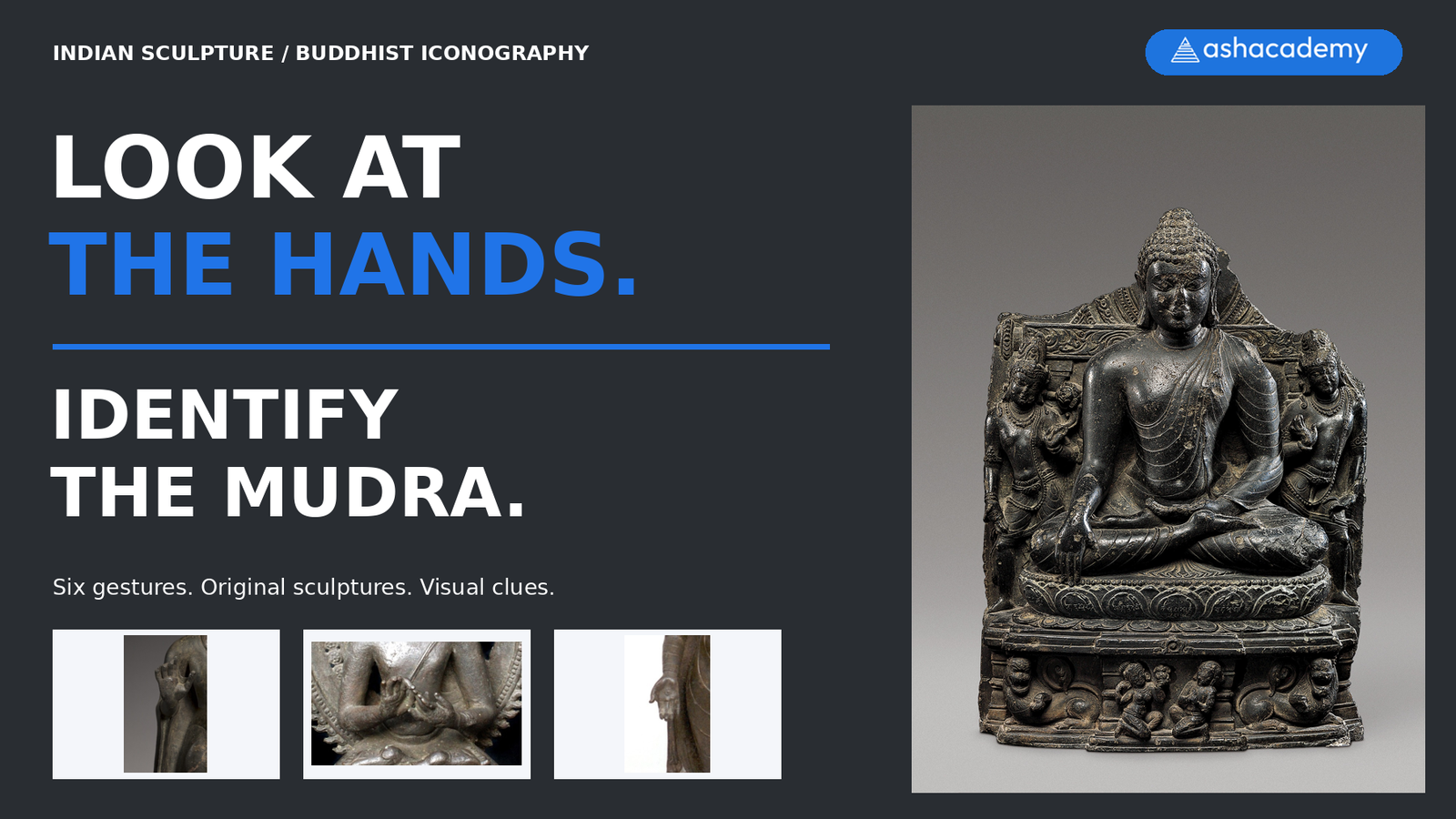
Look at the hands. Identify the mudra. Then check the whole sculpture.
Abhaya expresses reassurance and fearlessness; Varada signifies boon-giving or generosity; Bhumisparsha is the earth-touching gesture; Dharmachakra evokes turning the Wheel of Dharma; Dhyana denotes meditation; and Vitarka conveys discussion or exposition. To identify them in Buddhist sculpture, compare palm direction, finger arrangement, hand height and the relationship between both hands.
This guide pairs full museum photographs with close-ups of the actual hands. It is designed for UGC NET Visual Arts students who want to build visual-identification notes, rather than memorise an isolated list of meanings. Each sculpture has an independently checked origin, date, material, collection and accession number.
1. Six Buddhist mudras at a glance
| Mudra | First hand-position clue | Meaning / context | Avoid this shortcut |
|---|---|---|---|
| Abhaya | Raised open palm facing outward, fingers upright. | Reassurance, fearlessness, protection. | Every raised hand is not necessarily Abhaya. |
| Varada | Hand lowered; palm offered outward, fingers generally down. | Boon-giving, generosity, compassion. | A lowered hand is not automatically earth-touching. |
| Bhumisparsha | Seated figure’s right hand reaches down over the knee towards the seat / earth. | Calling the earth to witness awakening. | Do not name it from a downward arm alone. |
| Dharmachakra | Hands coordinated in front of the chest in a teaching arrangement. | Turning the Wheel of Dharma; associated with the first sermon. | Two raised hands do not always mean Dharmachakra. |
| Dhyana | Upturned hands supported in the lap, often one resting over the other. | Meditation and concentration. | Crossed legs alone do not establish the hand mudra. |
| Vitarka | A thumb and index finger meet in a ring; other fingers raised. | Discussion, explanation and transmission of teaching. | The number of raised hands is not a universal test. |
Use these cues as a first reading. A strong answer gives a visible reason and then checks the catalogue: “The palm is offered outward and downward; the museum identifies the gesture as Varada.” The gesture does not, on its own, date the sculpture or establish the identity of every Buddhist figure.
2. How to identify a mudra from a sculpture
| Look at | Question to ask | Why it helps |
|---|---|---|
| Palm | Does it face outward, upward or towards the figure? | This separates an offered palm from a hand resting on a knee. |
| Fingers | Are they extended, linked in a ring, overlapping or damaged? | A thumb–index connection matters for Vitarka and some teaching gestures. |
| Height | Is the hand at the shoulder, chest, waist, lap or below the knee? | The position relates the gesture to the body. |
| Both hands | Are they independent, paired at the chest or resting together? | A crop of one hand can hide the decisive arrangement. |
| Whole object | Is the figure seated or standing? Are there a wheel, deer, attendants or a narrative setting? | Supporting iconography can confirm the reading. |
| Record and condition | Does a museum identify the gesture? Are parts missing or restored? | Distinguish evidence from reconstruction. |
A mudra is a symbolic hand gesture. An asana is a bodily or seated posture. A figure can sit cross-legged while making Bhumisparsha, Dharmachakra or Dhyana. Likewise, a palm-up left hand in the lap may accompany a different, active right-hand gesture. Read the complete configuration before naming the image.
Reference: Vidya Dehejia, The Met: Recognizing the Gods.
3. Abhaya mudra: reassurance and fearlessness
Hand position and meaning
The familiar form presents an open palm towards the viewer, with fingers directed upward and the arm bent. It conveys protection or reassurance: the memorable revision cue is “have no fear.” The right hand is common, but left-handed and two-handed variants exist. The precise height and spread of fingers vary between sculptures.
Inspect the open palm before relying on the raised arm. A lifted hand with a deliberate thumb–index ring may belong to a teaching gesture. Abhaya may also appear with the other hand holding the robe or performing another gesture. The meaning should be understood within the object’s Buddhist context, not as an everyday waving action.
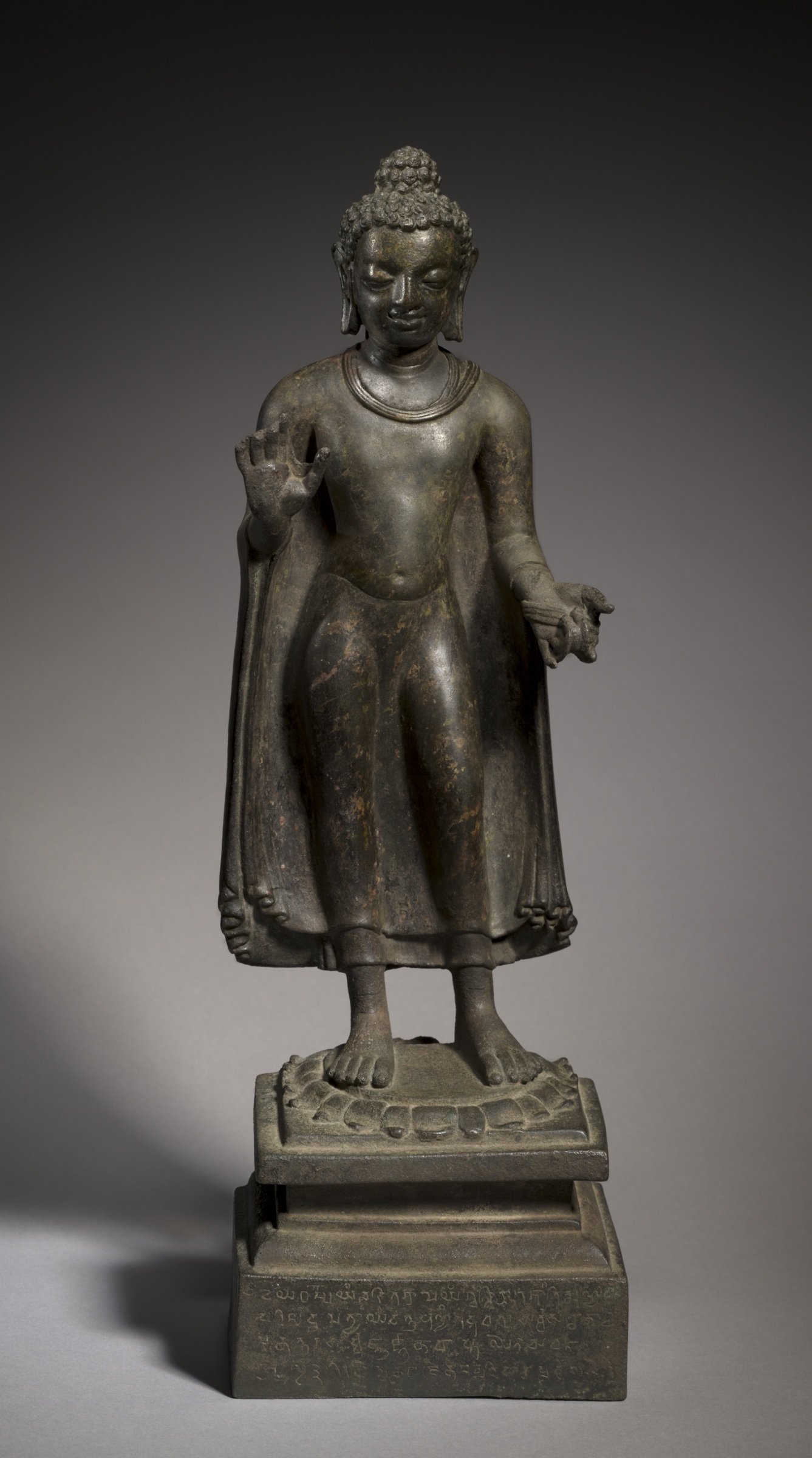

Examination distinction: 591 CE is the date of this particular bronze, not the date when Abhaya was invented. Do not assign a Gupta date to every sculpture with a calm face and thin robe. Keep the museum’s object date and geographical attribution separate from your gesture identification.
Reference: Impart Encyclopedia of Art: Abhaya Mudra.
4. Varada mudra: boon-giving and generosity
Varada presents the hand lower than the raised Abhaya position, with the palm open towards the devotee and the fingers commonly directed downward. Its conventional meanings include generosity, granting boons and compassion. It can occur on a standing or seated figure.
In the Nalanda bronze below, the museum explicitly identifies the right hand as Varada and the left as holding the hem of the sanghati, the monastic robe. This is a useful exercise in reading two different actions on one object. A hand that holds fabric should not automatically be treated as an independent symbolic gesture.
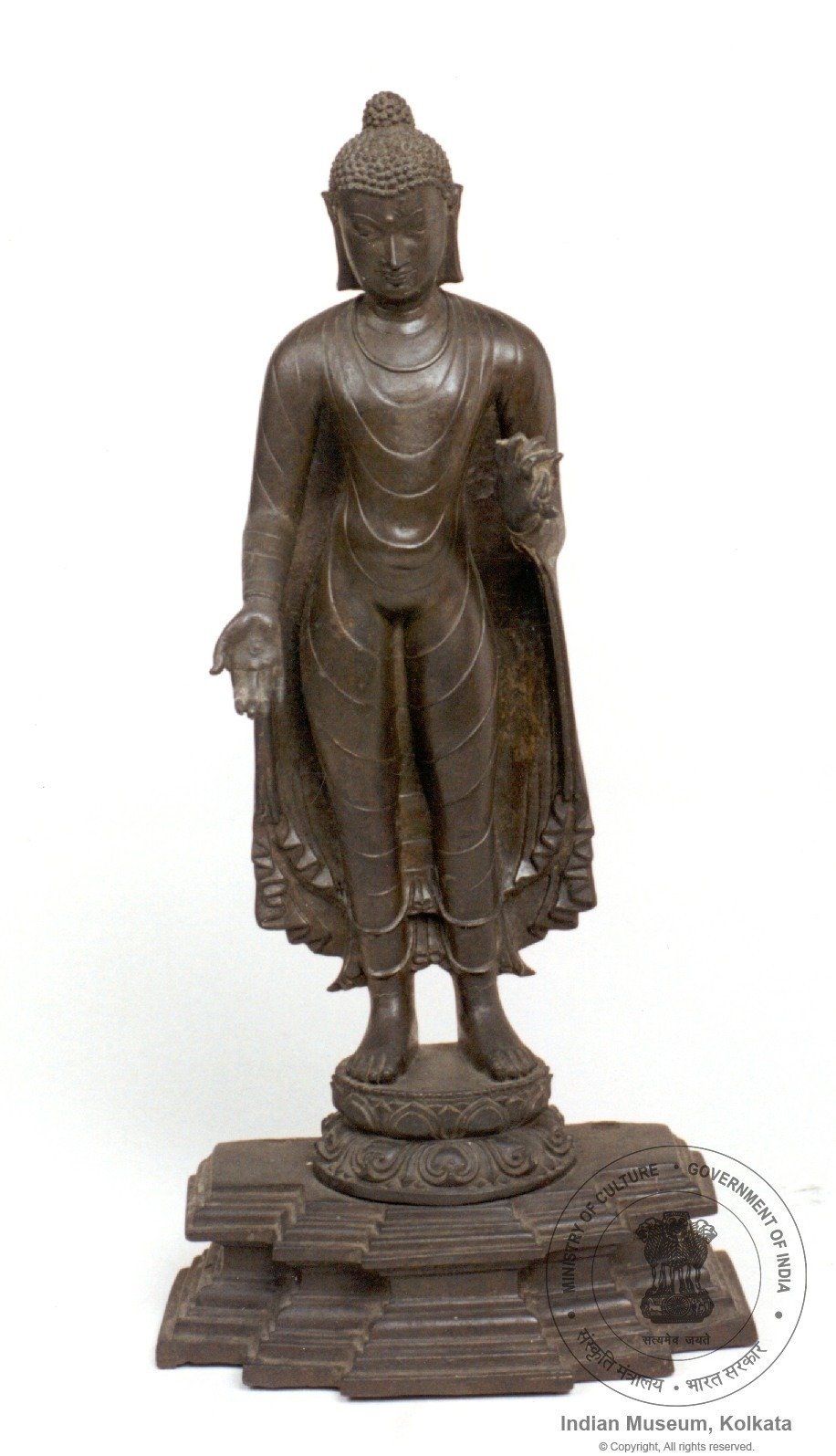
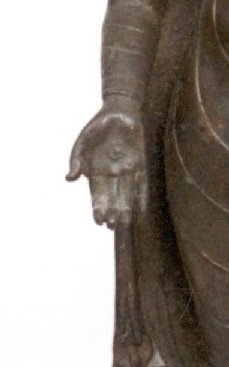
Varada versus Bhumisparsha: both can direct the fingers down, but their configuration and context differ. Varada offers an open palm; the earth-touching gesture brings the seated Buddha’s right hand over the knee towards the seat or ground. Palm direction and the whole pose resolve the confusion.
Reference: Impart Encyclopedia of Art: Varada Mudra.
5. Bhumisparsha mudra: calling the earth to witness
In the common form, the seated Buddha’s right hand descends over the right knee, with the fingers reaching towards the earth or the surface of the seat. The left hand generally rests palm-up in the lap. Bhumisparsha means “earth-touching”; it invokes the earth as witness in the account of Shakyamuni’s awakening and his encounter with Mara.
The downward movement is the decisive visible action. On a carved image, the fingertips may meet the lotus pedestal rather than literal soil. That does not turn the gesture into Varada. Read it as a meaningful sculptural convention, supported by the seated figure and the museum’s identification.
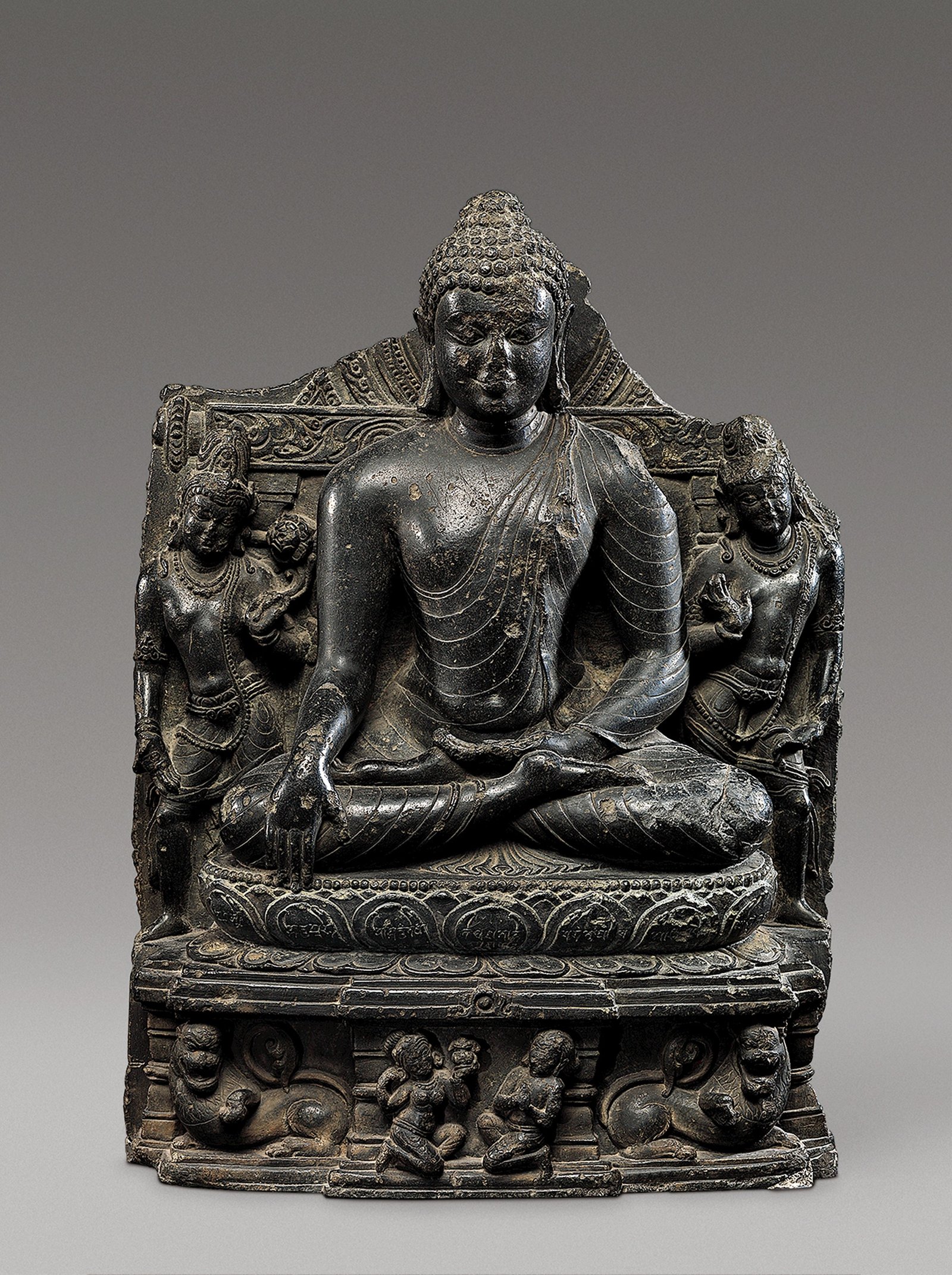

Do not confuse mental state with the named hand arrangement. The Buddha is represented in meditation at awakening, yet the complete configuration is commonly identified as Bhumisparsha because of the active right hand. An upturned left palm by itself is not enough to label the whole image Dhyana.
Reference: Kurt Behrendt, The Met: Buddhist sites in North India.
6. Dharmachakra mudra: turning the Wheel of Dharma
Dharmachakra, also written Dharmacakra, is associated with the Buddha’s teaching and especially the first sermon at Sarnath, understood as setting the Wheel of Dharma in motion. A familiar sculptural form coordinates both hands in front of the chest. Fingers and thumbs form linked or related teaching configurations; exact arrangements vary.
Look at the relationship between the hands, not only at a circle formed by a thumb and finger. In the Nalanda image, the museum identifies Dharmachakra, and the wheel-and-deer motif on the pedestal supplies supporting teaching iconography. The wheel need not be a physical object held in the hands.
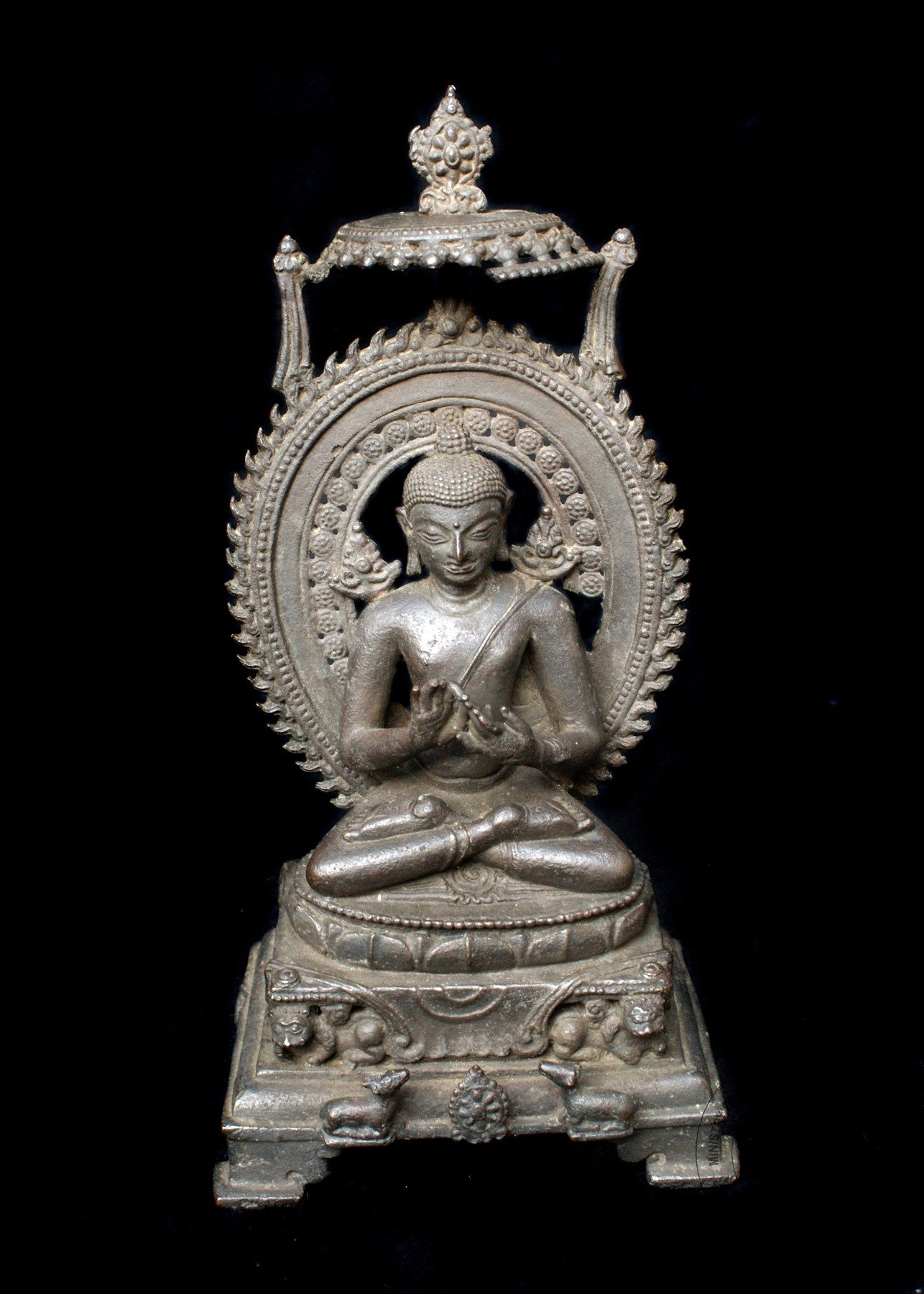
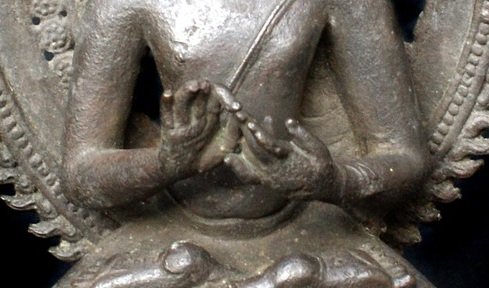
Period and collection: this is a Pala bronze from Nalanda, catalogued at approximately the 10th century CE in the Indian Museum, Kolkata. It is not the celebrated Gupta-period first-sermon Buddha at Sarnath. The shared gesture does not make two sculptures the same object or the same date.
Reference: Impart Encyclopedia of Art: Dharmachakra Mudra.
7. Dhyana mudra: meditation
Dhyana is recognised by the upturned hands supported in the lap. In a common two-handed form, one palm rests over the other, conventionally the right over the left. The thumbs may meet or remain differently aligned according to the tradition and object. Thumb contact should not be imposed as a compulsory feature on every example.
The Nagapattinam Buddha below provides an Indian sculptural example identified as Dhyana in the LACMA curatorial record. Read the hands and the stable seated posture together. The sculpture’s material, origin and date are catalogue information; they cannot be deduced simply from the fact that the figure meditates.
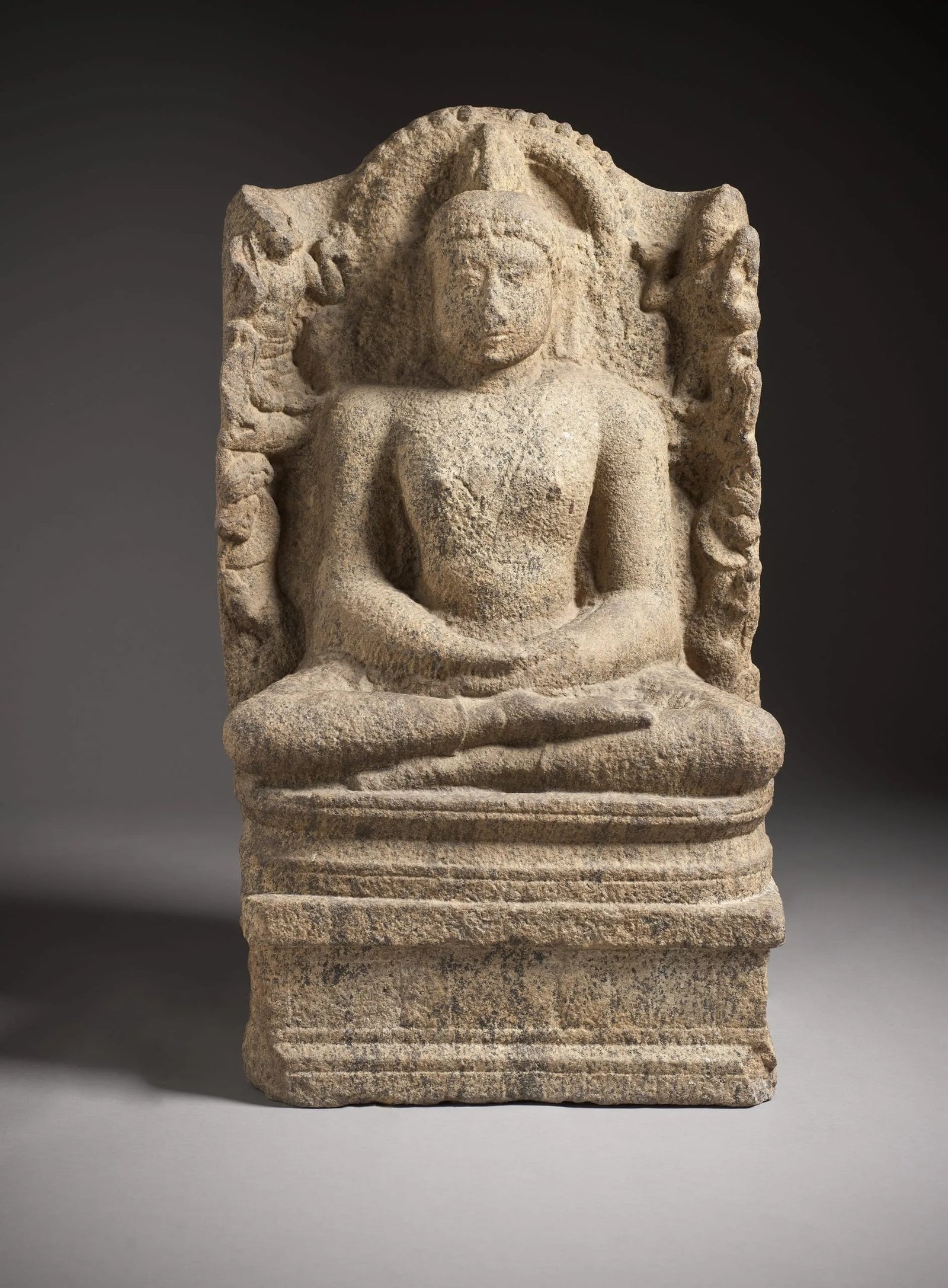
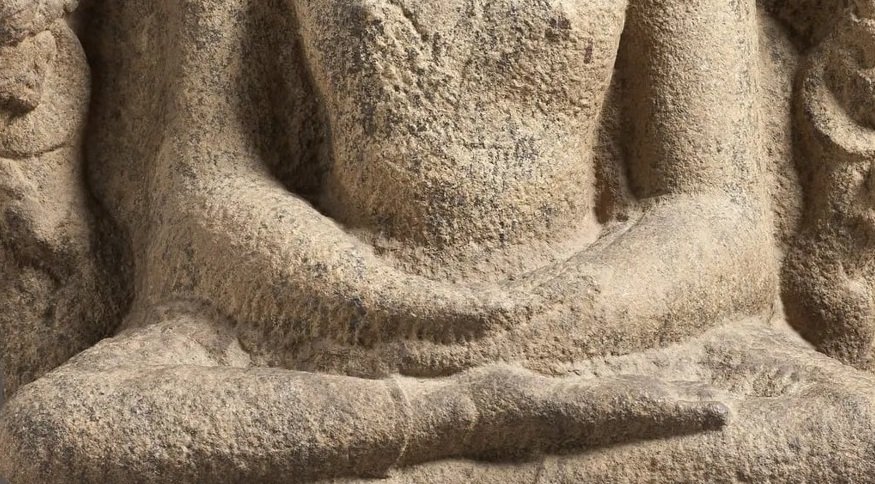
Dhyana versus Bhumisparsha: in the first, the two hands are gathered in the lap; in the second, the active right hand reaches down over the knee. A cross-legged posture is shared and therefore cannot settle the identification.
Reference: LACMA: Buddha Shakyamuni, Nagapattinam, M.80.227.
Reference: Impart Encyclopedia of Art: hand arrangement and thumb variants.
8. Vitarka mudra: discussion and exposition
Vitarka is a teaching or explanation gesture in which the thumb and index finger meet, while the remaining fingers are raised. “Discussion,” “exposition” and “transmission of teaching” are useful contextual terms. In descriptions of South Asian art, the related term vyakhyana also refers to explanation; catalogue terminology should be retained.
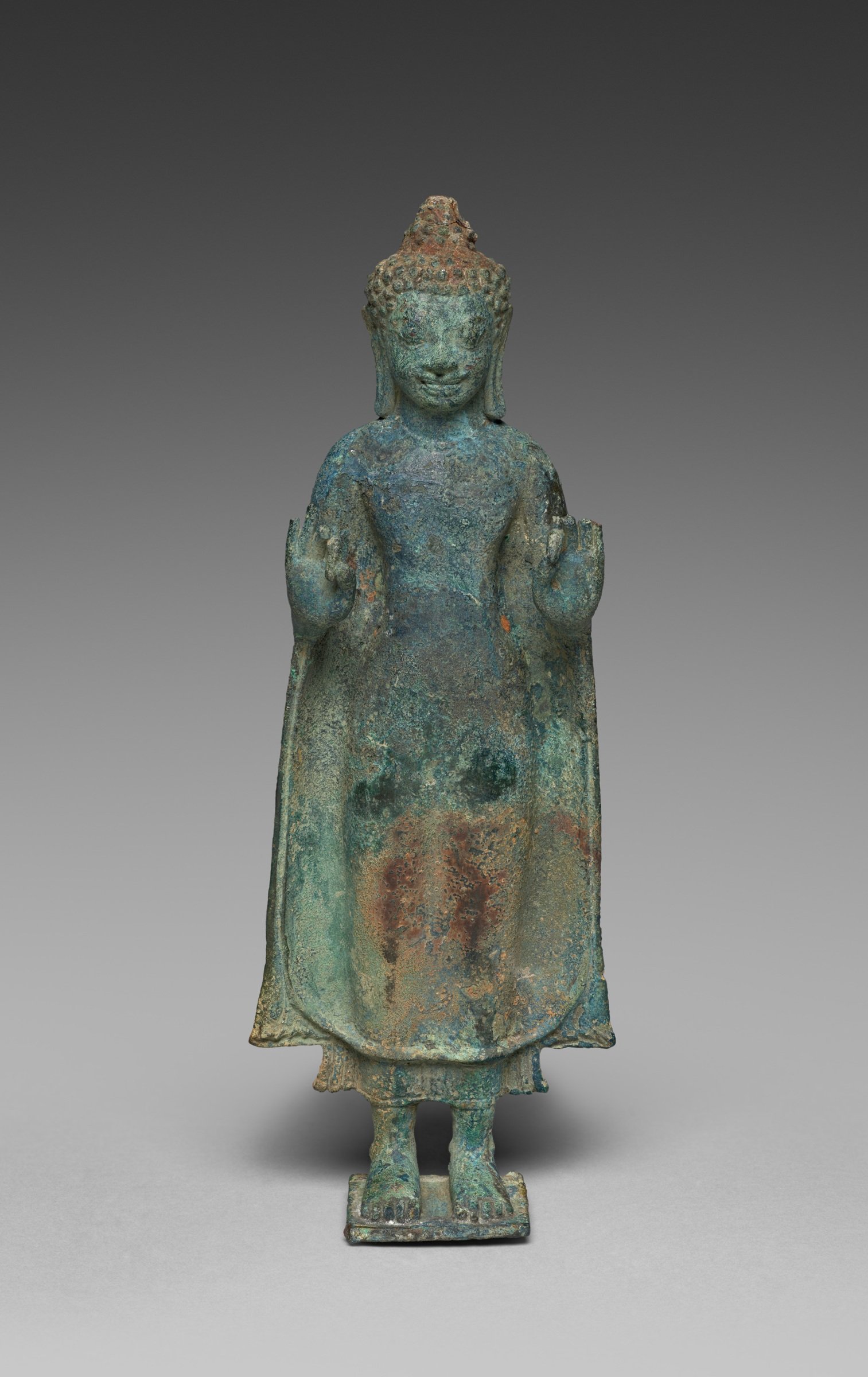
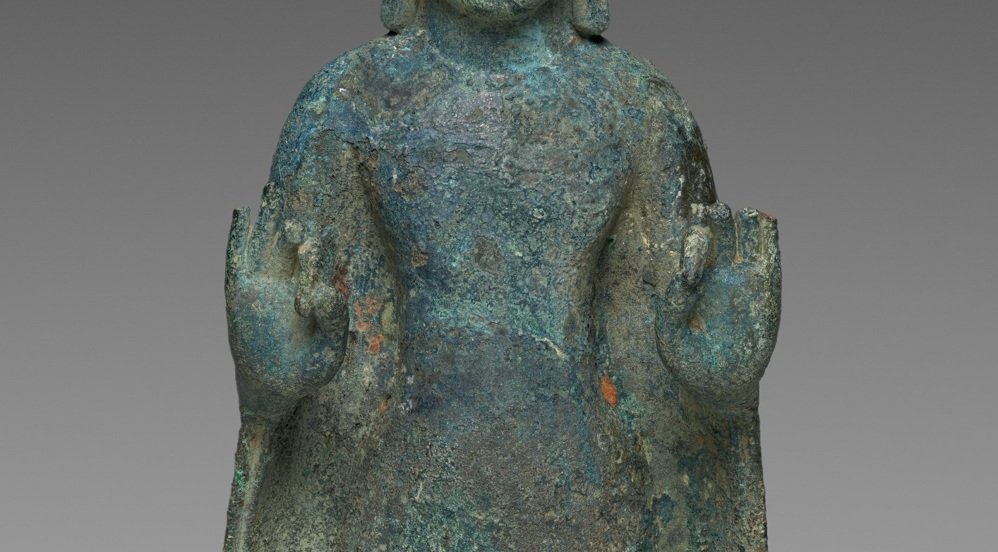
Vitarka versus Dharmachakra: both belong to teaching imagery, and thumb–finger rings may appear in either. Compare the complete arrangement and the museum identification. “One hand versus two” is only a beginner’s cue for selected examples; the Mon-Dvaravati sculpture demonstrates its limit.
Reference: Cleveland Museum of Art: object title, geography and teaching gesture.
Reference: Impart Encyclopedia of Art: Vitarka / Vyakhyana.
9. Compare the six mudras: a visual revision chart
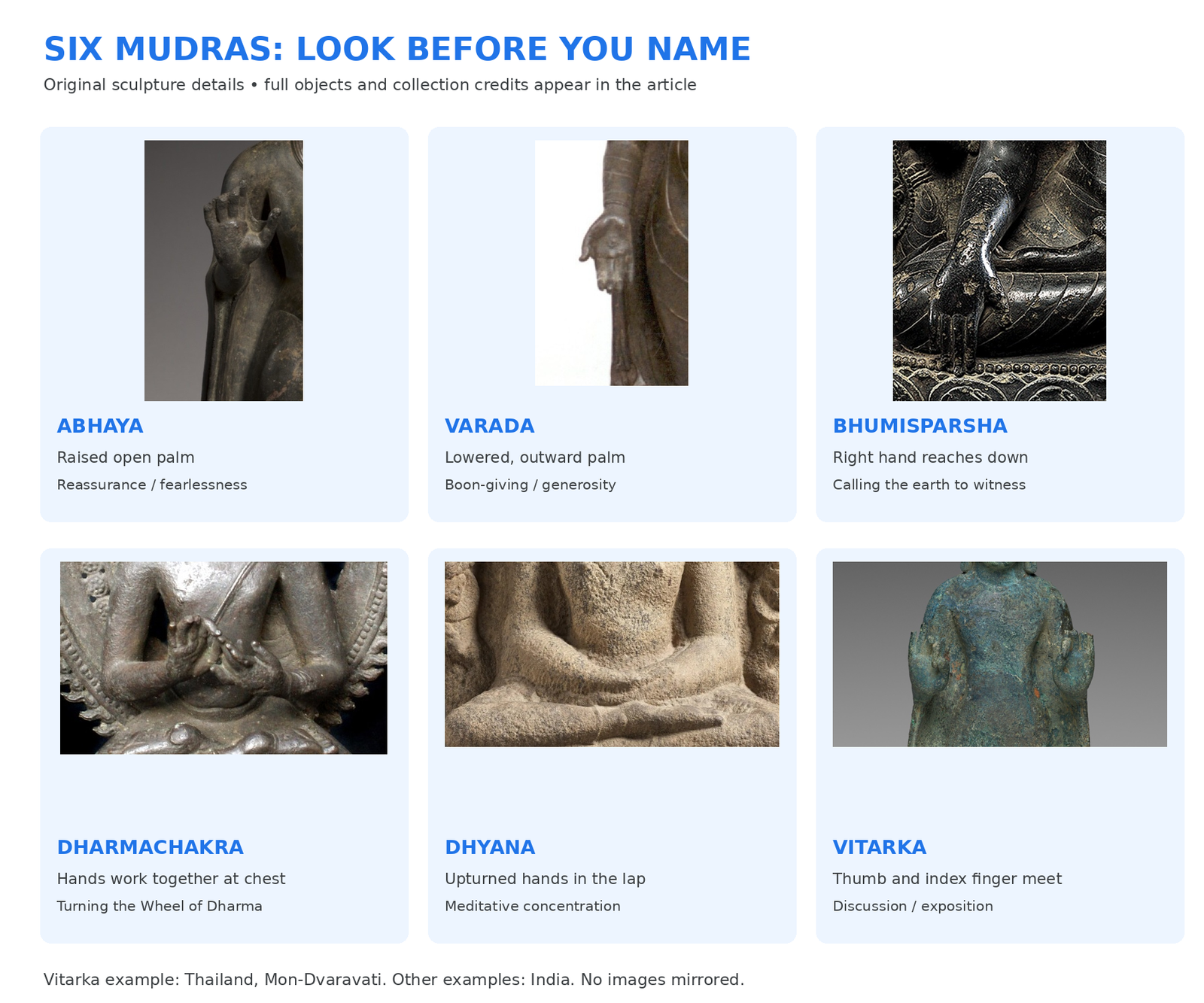
| Comparison | Ask this first | Stronger identification |
|---|---|---|
| Abhaya / Varada | Is the open palm raised or offered downward? | Use palm direction, height and the complete arm; identify the other hand separately. |
| Varada / Bhumisparsha | Is an outward palm offered, or does the hand extend across a seated knee? | The whole posture and narrative setting help distinguish generosity from earth-witness imagery. |
| Dhyana / Bhumisparsha | Where is the right hand? | In the lap with the other hand, or reaching down over the knee? |
| Dharmachakra / Vitarka | How do the hands relate? | A coordinated chest-level teaching arrangement differs from the separated gestures in this Vitarka example; verify the particular object. |
| Mudra / Asana | Am I describing the hands or the legs and body? | Name the hand gesture and seated posture separately. |
| Gesture / identity | Can this mudra occur on more than one figure? | Do not assign every meditating figure to Amitabha, or every earth-touching figure to one identity, without additional evidence. |
For note-making, record seven entries: gesture, hand position, meaning, sculpture title, origin, date and collection/accession. Add one caution based on the actual photograph. This prepares you for matching, statement-based, chronology and visual questions without pretending that any one mudra belongs to a single century.
10. Damaged hands: distinguish identification from reconstruction
Museum sculptures can retain an identifiable arrangement while losing fingertips. The National Museum’s Nalanda Buddha, accession 47.47, is explicitly described as Abhaya; its record also states that the right thumb and little finger are damaged. That is different from inventing the gesture of a completely missing hand.
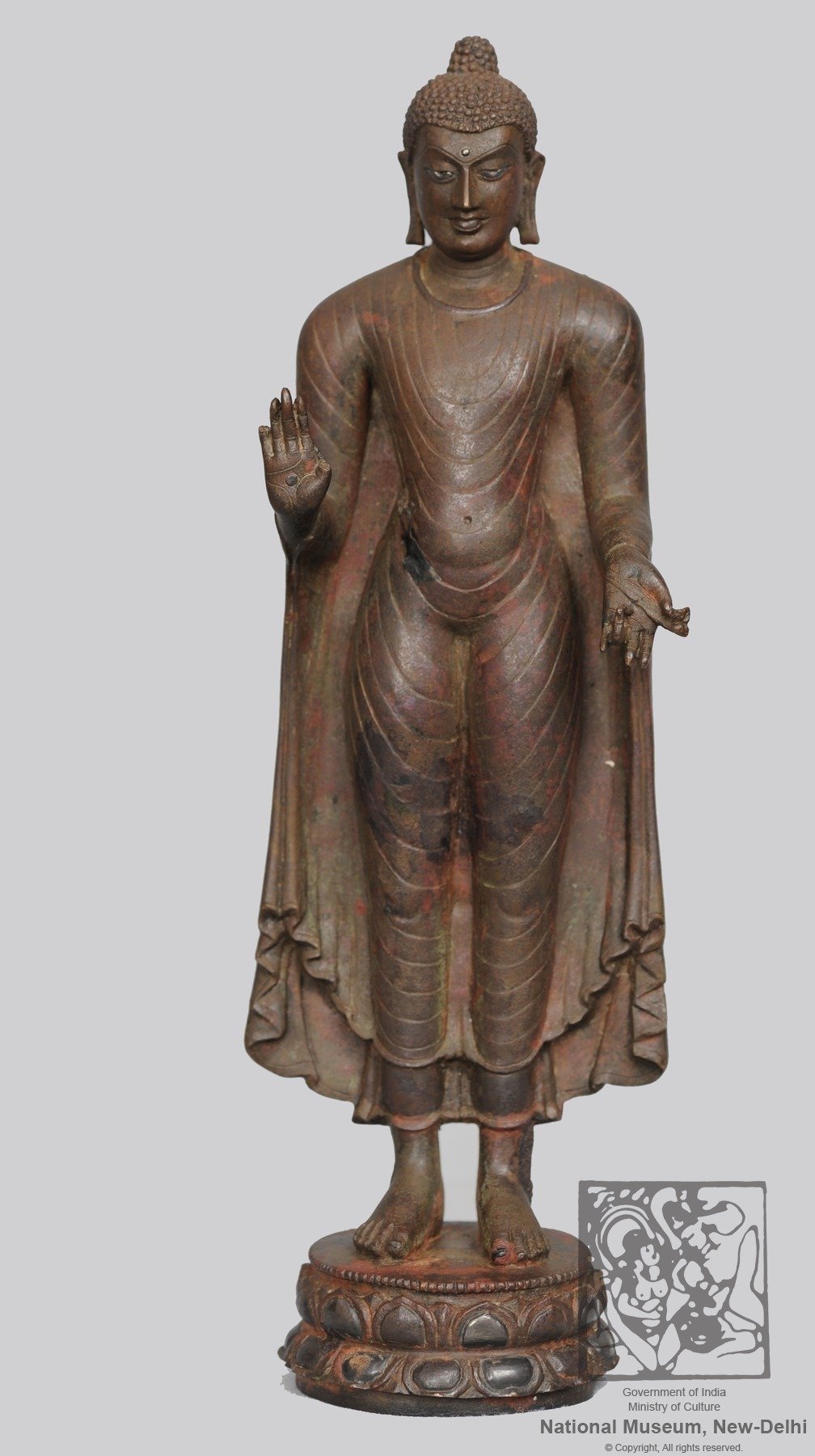
When writing an answer, distinguish “the catalogue identifies” from “I can see every finger.” If the evidence is insufficient, say so. An empty wrist, a broken arm or a modern replacement needs an object-specific explanation. Colour, patina and surface smoothness alone do not prove that a hand is ancient, restored or complete.
11. Image-based quiz: identify the mudra and justify it
Use the six detail photographs below. Write one name and one visible reason for each, before opening the answers. These are original revision exercises, not claimed previous-year questions. The image includes the explicitly discussed regional comparison.
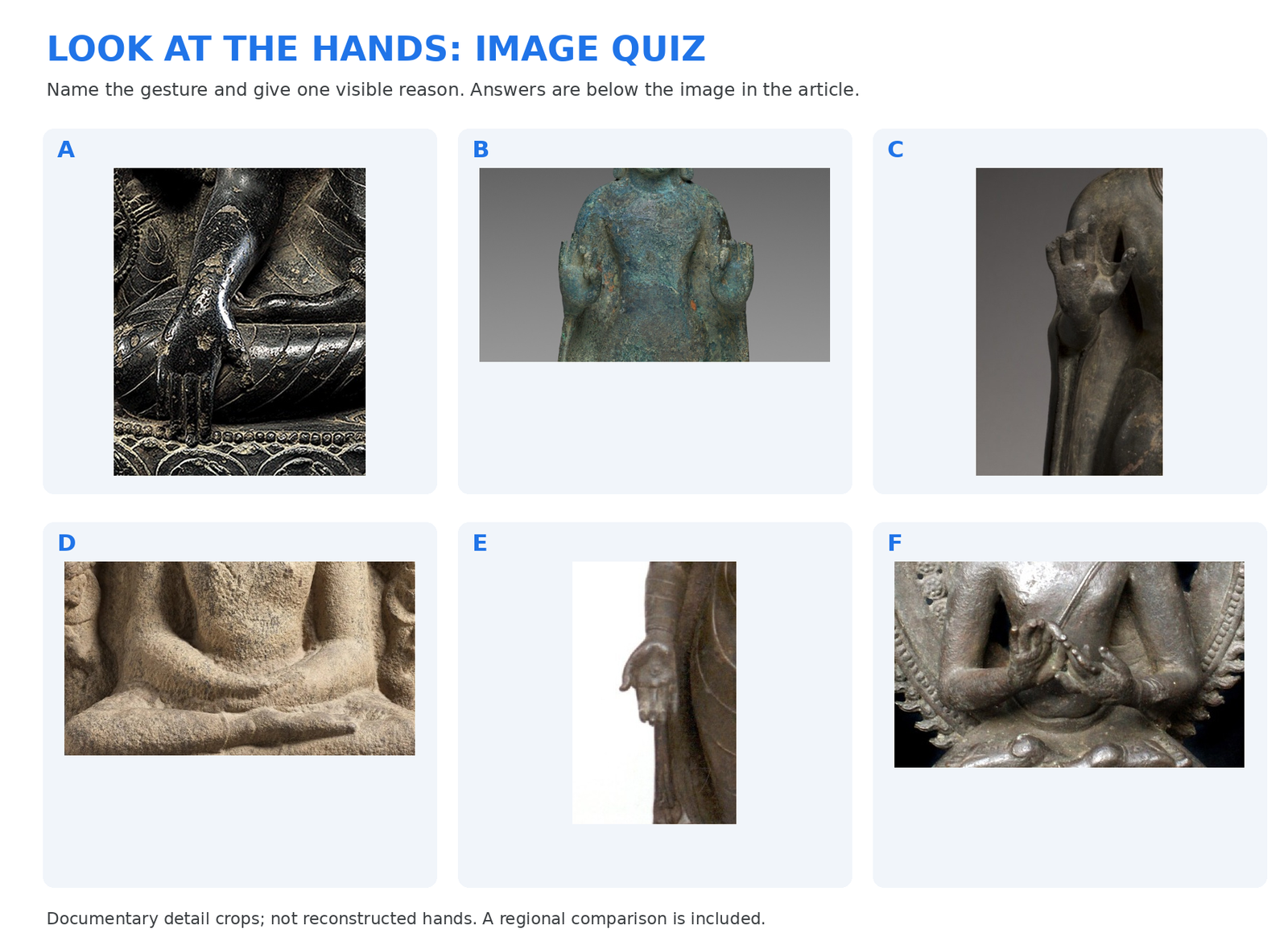
Reveal answer A
Bhumisparsha. The seated figure’s right hand extends down across the knee towards the lotus seat. The full object is the Nalanda sculpture at The Met, 20.58.16.
Reveal answer B
Vitarka. Both separated raised hands have a thumb–index teaching configuration. This is the Thai Mon-Dvaravati example, Cleveland 1958.334.
Reveal answer C
Abhaya. The raised open palm faces outward, with fingers upright. The full figure is the Indian bronze dated 591, Cleveland 1968.40.
Reveal answer D
Dhyana. The hands are gathered and supported in the lap. This is the Nagapattinam Buddha at LACMA, M.80.227.
Reveal answer E
Varada. The lowered right palm is offered outward with fingers directed down. The full standing Nalanda Buddha is Indian Museum 9436/A24276.
Reveal answer F
Dharmachakra. The hands are coordinated together in front of the chest. The full Nalanda bronze also bears a wheel-and-deer motif; Indian Museum 9440/A24784.
Bonus: a seated Buddha has an upturned left hand in the lap, but the right hand reaches over the knee. Is the whole arrangement Dhyana?
Not on that evidence. The active right hand suggests Bhumisparsha, to be checked against the full object and catalogue. Meditation as a state and Dhyana as a named hand arrangement are not identical descriptions.
Bonus: does the Vitarka example prove that every sculpture with two raised hands is Vitarka?
No. It shows why hand count alone is insufficient. Inspect palms, fingers, the relationship of the hands and the source identification.
12. Frequently asked questions
What are the six mudras explained in this sculpture guide?
Abhaya, Varada, Bhumisparsha, Dharmachakra, Dhyana and Vitarka. This is a selected study set, not an exhaustive list of Buddhist gestures.
What is the difference between Abhaya and Varada?
Abhaya commonly presents an open palm raised towards the viewer, expressing reassurance. Varada offers a lowered open palm, associated with generosity and boon-giving. Read the actual sculpture, including the other hand.
How do I distinguish Bhumisparsha from Varada?
In the common Bhumisparsha arrangement, a seated Buddha’s right hand reaches down over the knee towards the earth or seat. Varada presents an offered palm. Finger direction alone does not settle the distinction.
Are Dharmachakra and Vitarka both teaching mudras?
Yes. Meanings overlap, while hand arrangements and usage vary. Compare the complete configuration and the museum’s object identification rather than relying on a strict one-hand/two-hand formula.
Is the Vitarka statue in the article Indian?
No. It is explicitly labelled Thailand, Mon-Dvaravati period, 600s, Cleveland Museum of Art 1958.334. It is included as a regional comparison in a guide centred on Indian examples.
Can I identify a Buddha’s date from a mudra?
Not by the mudra alone. The same gesture occurs across periods and regions. Dates and attributions in this guide come from the linked collection records.
Are the hands and sculptures AI-generated?
No. The sculptures and hand close-ups use original institutional photographs. The comparison chart, quiz layout and cover are ashacademy editorial graphics built around those photographic sources.
13. Sources, credits and further study
This independent ashacademy educational article uses collection records as the authority for each object’s title, origin, material and date. Approximate dates remain approximate. Geographical and dynastic labels are retained where the record supplies them; a regional influence is not treated as proof of manufacture in India.
Original sculptures and photographic sources
- Cleveland Museum of Art: Standing Buddha. 591 CE; Northern India, Uttar Pradesh; Bronze; accession 1968.40. Purchase from the J. H. Wade Fund. CC0.
- Indian Museum, Kolkata: Standing Buddha. c. 10th century CE; Nalanda, Bihar, India; Bronze; accession 9436/A24276. Image: Indian Museum, Kolkata, through Museums of India. Rights remain with the institution / image provider.
- The Metropolitan Museum of Art: Seated Buddha Reaching Enlightenment, Flanked by Avalokiteshvara and Maitreya. late 10th–11th century; Nalanda monastery, Bihar, India; Black schist; accession 20.58.16. Rogers Fund, 1920. Public Domain / The Met Open Access.
- Indian Museum, Kolkata: Buddha in dharmachakra mudra. c. 10th century CE; Nalanda, Bihar, India; Bronze; accession 9440/A24784. Image: Indian Museum, Kolkata, through Museums of India. Rights remain with the institution / image provider.
- Los Angeles County Museum of Art: Buddha Shakyamuni. 11th century; Nagapattinam, Tamil Nadu, India; Granulite; accession M.80.227. Gift of Mr. Anthony A. Manheim; photo © Museum Associates/LACMA. Photo © Museum Associates/LACMA.
- Cleveland Museum of Art: Buddha with Hands in Gesture of Teaching, Vitarka Mudra. 600s / 7th century CE; Thailand; Bronze; accession 1958.334. Norman O. Stone and Ella A. Stone Memorial Fund. CC0.
- National Museum, New Delhi: Standing Buddha. 10th century CE; Nalanda, Bihar, India; Bronze; lost-wax casting recorded by the museum; accession 47.47. National Museum, New Delhi, through Museums of India. Rights remain with the institution / image provider.
Iconographic references
- Vidya Dehejia, Recognizing the Gods, The Met
- Kurt Behrendt, Buddhist Sites in North India, The Met
- Impart: Abhaya Mudra
- Impart: Varada Mudra
- Impart: Dharmachakra Mudra
- Impart: Dhyana Mudra
- Impart: Vitarka Mudra
Image rights differ by collection. Cleveland marks its selected images CC0; The Met marks its selected image public domain. Other institutional photographs retain their stated credits and rights. No blanket public-domain claim is made. Full images preserve proportions; cropped details are labelled. Charts are learning aids, not ancient objects or evidence for a reconstructed finger position.
For the wider historical sequence, continue with our Indian Art History Timeline. For another visual-identification exercise, read Indian Painting Schools: Identify the Difference. For artist-and-institution revision, use Modern Indian Art Groups: Dates, Founders and Key Artists.

You may also like
Fauvism: History, Characteristics, Artists and Important Artworks
Symbolism in Art: History, Characteristics, Artists and Artworks