Indian Art History Timeline: Illustrated Notes for UGC NET Visual Arts
ILLUSTRATED REVISION NOTES · ARTWORKS, SITES & CHRONOLOGY
Learn the Indian art history timeline through the works that define its major phases: the Dancing Girl and Priest-King, Ashokan capitals, Buddhist stupas, Gupta Buddhas, Ajanta murals, temple traditions and later painting schools.
These notes combine a chronological framework with work-by-work identification. For each phase, read the period, connect it to a location and patronage context, recognise the materials and forms, and then check the distinctions that commonly cause confusion.
The historical framework has been checked against relevant Indian-art sections of Edith Tomory’s A History of Fine Arts in India and the West, using a 1989 reprint. Object identifications and selected dates are cross-checked with museum, ASI and UNESCO records. This is an independently written selective revision guide, not a reproduction of the book or a substitute for its full chapters. Later and contemporary material requires additional sources.
“c.” means approximately. BCE / CE use the same year numbers as BC / AD. Dynasty dates, artwork dates and later additions are kept separate. Artistic traditions overlap; the numbered phases are study units, not a claim that one style ended everywhere when another began.
Jump to a phase or revision section
- Prehistoric rock art: Bhimbetka
- Indus Valley / Harappan art
- Mauryan art: pillars, capitals and caves
- Early Buddhist art: Bharhut, Sanchi and the western caves
- Kushan-era sculpture: Gandhara and Mathura
- Amaravati, Nagarjunakonda and the Andhra Buddhist tradition
- Gupta art: Buddha images and structural temples
- Ajanta and the mural tradition
- Elephanta and early medieval Shaiva rock-cut art
- Early Chalukya art: Badami, Aihole and Pattadakal
- Pallava art: Mamallapuram and Kanchipuram
- Rashtrakuta art: Kailasa at Ellora
- Pala-Sena art and manuscript traditions
- Regional temple traditions: Odisha, Chandella and western India
- Later Chalukya and Hoysala art
- Chola art: temples, bronzes and ritual movement
- Vijayanagara, Nayaka and later southern traditions
- Sultanate architecture and regional Islamic courts
- Mughal art: manuscripts, portraiture and architecture
- Deccani painting: Ahmadnagar, Bijapur and Golconda
- Rajasthani painting: distinguish the court workshops
- Pahari painting: Basohli, Guler and Kangra
- Company painting and Indian modernisms
- Post-independence and contemporary Indian art
Comparison charts · Self-test · References and image credits
Indian art timeline: quick revision chart
Use these as broad study ranges. For a particular artwork, follow the dated entry in its phase rather than the entire span of a dynasty.
| Study phase | Approximate range / anchor |
|---|---|
| Prehistoric rock art: Bhimbetka | Multiple painting phases, including Mesolithic and later historical activity |
| Indus Valley / Harappan art | Mature Harappan phase: c. 2600–1900 BCE; earlier and later phases also exist |
| Mauryan art: pillars, capitals and caves | Mauryan context: late 4th–2nd century BCE; Ashokan monuments mainly 3rd century BCE |
| Early Buddhist art: Bharhut, Sanchi and the western caves | Main study span: c. 2nd century BCE–2nd century CE, with earlier foundations and later additions |
| Kushan-era sculpture: Gandhara and Mathura | Especially 1st–3rd centuries CE; regional traditions extend beyond this range |
| Amaravati, Nagarjunakonda and the Andhra Buddhist tradition | Main sculptural developments: c. 2nd century BCE–3rd century CE |
| Gupta art: Buddha images and structural temples | Broad study context: 4th–6th centuries CE |
| Ajanta and the mural tradition | Early caves: c. 2nd–1st century BCE; major later phase: 5th–6th centuries CE |
| Elephanta and early medieval Shaiva rock-cut art | Elephanta’s principal caves: broadly 5th–6th centuries CE |
| Early Chalukya art: Badami, Aihole and Pattadakal | Main study span: 6th–8th centuries CE |
| Pallava art: Mamallapuram and Kanchipuram | Main monument sequence: 7th–early 8th centuries CE; wider dynasty spans longer |
| Rashtrakuta art: Kailasa at Ellora | Kailasa, Cave 16: principally 8th-century campaign; wider Ellora sequence c. 600–1000 CE |
| Pala-Sena art and manuscript traditions | Eastern India: broadly 8th–12th centuries CE, with continuities into the 13th |
| Regional temple traditions: Odisha, Chandella and western India | Selected major monuments: 10th–13th centuries CE, within longer regional histories |
| Later Chalukya and Hoysala art | Later Western Chalukya: mainly 10th–12th centuries; major Hoysala temples: 12th–13th centuries |
| Chola art: temples, bronzes and ritual movement | Main study span: 9th–13th centuries CE; major imperial temples especially 11th–12th centuries |
| Vijayanagara, Nayaka and later southern traditions | Vijayanagara foundations from 14th century; Hampi’s major surviving campaigns 14th–16th centuries; Nayaka expansion later |
| Sultanate architecture and regional Islamic courts | Delhi Sultanate: 13th–16th centuries; regional traditions have their own chronologies |
| Mughal art: manuscripts, portraiture and architecture | Mughal political foundation: 1526; major artistic campaigns from the mid-16th through 17th centuries |
| Deccani painting: Ahmadnagar, Bijapur and Golconda | Especially 16th–17th centuries, with later continuities |
| Rajasthani painting: distinguish the court workshops | Major surviving traditions: 16th–19th centuries; each centre has a separate history |
| Pahari painting: Basohli, Guler and Kangra | Main study span: late 17th–19th centuries |
| Company painting and Indian modernisms | Late 18th–20th centuries; overlapping practices rather than one clean stylistic break |
| Post-independence and contemporary Indian art | Mid-20th century–present; the modern / contemporary boundary is debated |
Prehistoric rock art: Bhimbetka
Multiple painting phases, including Mesolithic and later historical activity
Start with painted rock shelters rather than a dynasty. Bhimbetka, in Madhya Pradesh, preserves different layers of image-making. Occupation of a shelter and the painting of a particular figure are separate archaeological questions. The dates of all paintings cannot be inferred from the age of the site.
| Work / site | Date or context | What makes it important |
|---|---|---|
| Bhimbetka rock shelters | Mesolithic to historical painting traditions | Animals, human figures, hunting, movement and superimposed images |
| Rock painting as a medium | Pigment applied to natural rock surfaces | Connect subject matter with surface, placement, scale and surviving layers |

Image: Bernard Gagnon · CC BY-SA 3.0 · Original photograph / credit. Displayed to fit the page; no historical details reconstructed.
Visual identification and study points
- Recognise animal silhouettes, linear human figures and scenes of collective activity; subjects and techniques vary between shelters and phases.
- Superimposition means one painted image lies over another. It helps establish relative sequence, but does not by itself supply a calendar date.
- Do not assume every red, white or green figure belongs to a fixed period solely because of its colour.
Bhimbetka is not one painting made on one date. Community-based and tribal art traditions also continue into the present; they should not be placed only at the beginning of a timeline.
Reference trail: Edith Tomory, A History of Fine Arts in India and the West, Indian Art, general survey. UNESCO: Rock Shelters of Bhimbetka
Indus Valley / Harappan art
Mature Harappan phase: c. 2600–1900 BCE; earlier and later phases also exist
Read this phase through three connected areas: urban planning, small sculpture and specialised crafts. Harappa and Mohenjo-daro are now in Pakistan; Lothal, Dholavira and Kalibangan are in present-day India. Art history here concerns the wider historical subcontinent, not only modern national boundaries.
| Work / site | Date or context | What makes it important |
|---|---|---|
| Dancing Girl, Mohenjo-daro | National Museum record: c. 2500 BCE; bronze, lost-wax casting | Small figure, right hand on hip, extensive bangles on the left arm; height about 10.5 cm |
| Bearded male bust, conventionally “Priest-King” | Harappan; low-fired steatite; National Museum of Pakistan, Karachi | Headband, carefully treated beard and trefoil-patterned garment |
| Seals | Mature Harappan; commonly steatite | Animal motifs, compact carving and inscriptions in the undeciphered Indus script |
| Great Bath, Mohenjo-daro | Mature Harappan urban context | Brick-built tank, steps and concern with water management |
| Lothal basin | Harappan settlement in Gujarat | Often interpreted as a dockyard; its function has been debated |

Image: Amrit Sufi · CC BY 3.0 · Original photograph / credit. Displayed to fit the page; no historical details reconstructed.

Image: Archaeological Survey of India · Public domain · Original photograph / credit. Displayed to fit the page; no historical details reconstructed.

Image: Saqib Qayyum · CC BY-SA 3.0 · Original photograph / credit. Displayed to fit the page; no historical details reconstructed.
Visual identification and study points
- Dancing Girl is a conventional modern title. The pose does not prove the individual’s profession.
- The Priest-King’s garment covers one shoulder; its trefoil motifs, fillet and beard are key visual cues. “Priest” and “king” are not securely established identities.
- Seals, beads, terracottas, ceramics and metal objects show different materials and production methods. Do not describe the entire assemblage as bronze sculpture.
- Distinguish a seal from its impression, and an original sculpture from a modern museum replica.
Tomory’s 1989 reprint calls the bearded bust limestone; archaeological scholarship cited here identifies low-fired steatite. This guide follows the latter identification. Object dates also vary between catalogues: the Dancing Girl date above is explicitly the National Museum’s date, not a claim of universal agreement.
Reference trail: Edith Tomory, A History of Fine Arts in India and the West, “The Harappa Civilisation”, architecture and sculpture. The Met: Harappan seal, 49.40.1
National Museum: Dancing Girl · Harappa archaeological record: Priest-King
Mauryan art: pillars, capitals and caves
Mauryan context: late 4th–2nd century BCE; Ashokan monuments mainly 3rd century BCE
Ashoka’s monuments connect imperial communication, religious patronage and a new scale of stone working. Study the pillar shaft, capital and inscription separately. Monumental yaksha and yakshi figures belong to another important line of early sculpture, but their individual dates require care.
| Work / site | Date or context | What makes it important |
|---|---|---|
| Lion Capital, Sarnath | Ashokan, 3rd century BCE; polished sandstone | Four back-to-back lions; abacus with animals and wheels; inverted lotus below |
| Rampurva bull capital | Mauryan, 3rd century BCE | Powerful naturalistic animal modelling contrasted with formal capital design |
| Dhauli elephant, Odisha | Ashokan context, 3rd century BCE | Animal carved from the living rock |
| Barabar caves: Sudama and Lomas Rishi | Mauryan-period rock-cut tradition | Polished interiors and early stone translation of architectural forms associated with wood |
| Didarganj chauri-bearer | Dating debated | Polished surface alone is insufficient to prove a Mauryan date |

Image: Chrisi1964 · CC BY-SA 4.0 · Original photograph / credit. Displayed to fit the page; no historical details reconstructed.

Image: Neil Satyam · CC BY-SA 3.0 · Original photograph / credit. Displayed to fit the page; no historical details reconstructed.
Visual identification and study points
- Use “Mauryan polish” for the highly finished stone surface; do not confuse surface finish with a sculptural material.
- At Lomas Rishi, observe the curved façade and elephant frieze. It is not an assembled masonry temple.
- The Barabar group is associated with Ajivika patronage in inscriptions; not every cave carries the same dedication or inscription.
Do not date all polished yaksha/yakshi sculptures identically. The Didarganj figure has been assigned different dates in scholarship. Nor should every visible part of an Ashokan-site complex be assumed to be Ashokan.
Reference trail: Edith Tomory, A History of Fine Arts in India and the West, architecture: “Stambha”; sculpture: “The Mauryas”. ASI Sarnath Circle: Lion Capital
Early Buddhist art: Bharhut, Sanchi and the western caves
Main study span: c. 2nd century BCE–2nd century CE, with earlier foundations and later additions
Stupas, railings, gateways and rock-cut halls developed through contributions from rulers, monastic communities and other donors. Buddhist narrative relief belongs to its architectural setting: notice where a scene appears and how a viewer encounters it while moving around a monument.
| Work / site | Date or context | What makes it important |
|---|---|---|
| Bharhut railing sculpture | Mainly 2nd–1st century BCE | Narrative medallions, labelled scenes, yakshas/yakshis and detailed ornament |
| Great Stupa, Sanchi | Ashokan foundation; major later enlargement and gateways | Anda, harmika, chhatras, pradakshina paths, railings and toranas |
| Bhaja and Bedsa | Early western Deccan Buddhist cave tradition | Rock-cut chaitya and monastic settings |
| Great Chaitya, Karla | Around the late 1st century BCE–early centuries CE | Apsidal hall, central stupa, colonnades, vaulted roof and preserved wooden ribs |

Image: Woudloper · CC BY-SA 4.0 · Original photograph / credit. Displayed to fit the page; no historical details reconstructed.

Image: Rangan Datta Wiki · CC BY-SA 4.0 · Original photograph / credit. Displayed to fit the page; no historical details reconstructed.
Visual identification and study points
- A chaitya-griha is a worship hall, typically with a stupa in early examples; a vihara is a monastic dwelling arrangement.
- Recognise symbolic references such as a wheel, empty throne, tree or footprints in early Buddhist imagery. Interpret the particular scene rather than assuming one rule applies to every Buddhist object.
- Continuous narrative can show several moments from a story in a single field. Architectural members may organise those moments.
Sanchi is a multi-period site. Its early core, stone casing, railings, toranas and later Buddha images do not all share one date. A stupa, a chaitya hall and a vihara are different architectural forms.
Reference trail: Edith Tomory, A History of Fine Arts in India and the West, architecture: “Stupa”, “Chaitya” and “Vihara”; sculpture: “The Sungas” and “The Early Satavahanas”. UNESCO: Buddhist Monuments at Sanchi
Kushan-era sculpture: Gandhara and Mathura
Especially 1st–3rd centuries CE; regional traditions extend beyond this range
The early centuries CE are essential for the study of anthropomorphic Buddha and bodhisattva images. Gandhara and Mathura developed overlapping regional languages. Compare specific works through material, garment, bodily modelling and iconographic attributes.
| Work / site | Date or context | What makes it important |
|---|---|---|
| Gandharan Buddha images | Early centuries CE; stone examples often schist | Layered drapery, wavy hair in many examples, articulated folds and regional adaptations of classical forms |
| Gandharan bodhisattvas | Kushan-era and later contexts | Princely ornaments; Maitreya may be identified through attributes such as a water vessel |
| Katra seated Buddha / Bodhisattva, Mathura | Kushan-period; Katra Keshav Dev | Raised protective hand, frontal seated body, attendant figures and halo |
| Mathura Jain and Brahmanical sculpture | Kushan-era production alongside Buddhist images | The workshop tradition is not exclusively Buddhist |

Image: Biswarup Ganguly · CC BY 3.0 · Original photograph / credit. Displayed to fit the page; no historical details reconstructed.
Visual identification and study points
- Schist is a useful Gandharan cue, but Gandharan workshops also used stucco and other materials.
- Mathura is associated with mottled red sandstone and robust figure-making; inspect the actual carving rather than using skin colour or pose as a shortcut.
- Buddha images generally use monastic garments; bodhisattvas often appear in princely dress and jewellery. The precise identification still depends on attributes.
Gandhara does not simply precede Mathura. Avoid presenting the first anthropomorphic Buddha image as an undisputed invention of one workshop on one exact date. Also distinguish the Kushan Mathura style from later Gupta Mathura sculpture.
Reference trail: Edith Tomory, A History of Fine Arts in India and the West, sculpture: “The Kushans: Gandhara Phase” and “Mathura Phase”. NGV: A Kushan bodhisattva and early Indian sculpture
Amaravati, Nagarjunakonda and the Andhra Buddhist tradition
Main sculptural developments: c. 2nd century BCE–3rd century CE
Keep the southeastern Buddhist centres separate from Gandhara and Mathura. Amaravati developed over successive campaigns, while Nagarjunakonda is especially important for the Ikshvaku period. Study the relation between limestone reliefs and the architecture of stupas and monasteries.
| Work / site | Date or context | What makes it important |
|---|---|---|
| Amaravati Great Stupa reliefs | Several phases before and during the early centuries CE | Limestone; densely organised narrative, animated poses, elaborate ornament and movement |
| Nagarjunakonda | Especially 3rd century CE, Ikshvaku context | Buddhist monastic architecture, inscriptions and sculptural programmes |
| Buddha symbols and anthropomorphic figures | Dependent on the work and phase | Both must be placed within the site’s changing production history |
Visual identification and study points
- Amaravati is a site and a sculptural tradition; “Andhra” is also a regional designation. Neither is a single ruler’s name.
- Observe supple bodily movement, crowded figural interaction and rhythmic compositions in selected Amaravati reliefs.
- Use the particular panel’s museum date when arranging reliefs, rather than assigning all Amaravati sculpture to one century.
Satavahana and Ikshvaku patronage are not interchangeable. Do not apply a Gandharan schist description to Amaravati limestone reliefs.
Reference trail: Edith Tomory, A History of Fine Arts in India and the West, sculpture: “The Later Andhras or Satavahanas and the Ikshvakus”.
The Met: dated early Buddhist objects from Amaravati and related sites
Gupta art: Buddha images and structural temples
Broad study context: 4th–6th centuries CE
In Gupta-period sculpture, compare centres rather than memorising one formula. Mathura and Sarnath offer different treatments of the monastic garment and body. The growth of structural temples and the development of Brahmanical iconography belong beside Buddhist sculpture.
| Work / site | Date or context | What makes it important |
|---|---|---|
| Seated Buddha preaching the First Sermon, Sarnath | 5th century CE; often dated c. 475 CE | Dharmachakra mudra; deer and wheel at the base; refined modelling and decorated halo |
| Mathura standing Buddhas | 5th-century examples | Red sandstone; robe folds may remain visibly articulated |
| Udayagiri Varaha relief, near Vidisha | Early 5th century CE | Vishnu’s boar incarnation rescuing the earth goddess |
| Dashavatara / Vishnu temple, Deogarh | Around the early 6th century CE | Structural temple and major Vishnu reliefs, including Anantashayana |
| Bhitargaon temple | Gupta-period brick temple tradition | Brick construction and terracotta architectural decoration |

Image: Photographer credited on the linked source page · CC BY-SA 3.0 · Original photograph / credit. Displayed to fit the page; no historical details reconstructed.

Image: Ismoon (talk) 15:43, 30 December 2020 (UTC) · CC BY-SA 4.0 · Original photograph / credit. Displayed to fit the page; no historical details reconstructed.
Visual identification and study points
- Sarnath Buddhas characteristically minimise robe-fold patterning; a fine garment edge can indicate the robe.
- Dharmachakra mudra refers to teaching / turning the wheel of Dharma; abhaya is the gesture of reassurance.
- A structural temple is built from assembled materials. It is not excavated from a cliff like a cave.
The Buddha’s historical First Sermon took place centuries before the Gupta sculpture depicting it. The represented event and the date of the artwork are different facts.
Reference trail: Edith Tomory, A History of Fine Arts in India and the West, architecture: “Gupta Architecture”; sculpture: “The Guptas”. National Museum: Gupta Art · The Met: Standing Buddha, 1979.6
Ajanta and the mural tradition
Early caves: c. 2nd–1st century BCE; major later phase: 5th–6th centuries CE
Ajanta combines architecture, sculpture and painting. Its two broad phases must be distinguished. The major later excavations and mural programmes are associated with Vakataka-period patrons, including Harisena’s circle, ministers and feudatories. “Gupta age” is a broad chronological context, not proof of Gupta commissioning.
| Work / site | Date or context | What makes it important |
|---|---|---|
| Padmapani, Cave 1 | Later Ajanta phase | Lotus-bearing bodhisattva; lowered gaze, ornaments and supple contours |
| Vajrapani, Cave 1 | Later Ajanta phase | Important counterpart to Padmapani; identify through the complete image and context |
| Jataka narratives, including Mahajanaka | Later mural programmes | Several episodes may be organised across a continuous visual field |
| Caves 9 and 10 | Early chaitya context, with later interventions | Useful for distinguishing phases and alterations |
| Bagh murals, Madhya Pradesh | Broadly 5th–6th centuries CE | Another mural centre; do not label every surviving copy as an original ancient painting |

Image: Unknown author · Public domain · Original photograph / credit. Displayed to fit the page; no historical details reconstructed.
Visual identification and study points
- Study contour, tonal modelling, gesture, spatial grouping and the relation of figures to architectural space.
- The paintings were made on prepared surfaces over the rock. Calling all Ajanta painting “true fresco” is technically misleading.
- Padmapani means lotus-bearing. A bodhisattva is not simply another name for the historical Buddha.
Tomory’s broad dates for the later murals reflect the scholarship of the edition. Here, the broad phase follows UNESCO; individual caves and paintings may have narrower or debated dates. Do not date the entire site from one mural.
Reference trail: Edith Tomory, A History of Fine Arts in India and the West, painting: “Murals”, especially Ajanta and Bagh. UNESCO: Ajanta Caves
Elephanta and early medieval Shaiva rock-cut art
Elephanta’s principal caves: broadly 5th–6th centuries CE
Elephanta, near Mumbai, is an important anchor for monumental Shaiva imagery. Study the main cave as an integrated architectural and sculptural environment: the central shrine and the reliefs establish relationships between movement, worship and different manifestations of Shiva.
| Work / site | Date or context | What makes it important |
|---|---|---|
| Maheshmurti / Sadashiva, Elephanta | Main cave, early medieval context | Monumental three-faced representation of Shiva |
| Ardhanarishvara | Elephanta sculptural programme | Combined male-female form associated with Shiva and Parvati |
| Gangadhara | Elephanta sculptural programme | Shiva receiving / bearing the descent of the Ganga |

Image: Ingo Mehling · CC BY-SA 4.0 · Original photograph / credit. Displayed to fit the page; no historical details reconstructed.
Visual identification and study points
- The famous three-faced image is often called “Trimurti”, but identify it as a representation of Shiva rather than simply three separate gods placed together.
- Compare frontal stillness in the great bust with movement and narrative in surrounding reliefs.
- Notice that sculpture and pillars are part of the excavated rock-cut space.
The original patrons and precise dates of Elephanta have been debated. Avoid attaching every Elephanta relief confidently to one named dynasty without evidence.
Reference trail: Edith Tomory, A History of Fine Arts in India and the West, architecture: “Hindu and Jaina Rock-cut Architecture”.
Early Chalukya art: Badami, Aihole and Pattadakal
Main study span: 6th–8th centuries CE
These centres show experimentation across rock-cut and structural architecture. Keep the Early Western Chalukyas of Badami distinct from the later Western Chalukyas of Kalyani. A dynasty’s entire political duration is not the construction date of every monument.
| Work / site | Date or context | What makes it important |
|---|---|---|
| Badami caves | 6th-century core; Cave 3 has an inscription dated 578 CE | Hindu and Jain rock-cut programmes, including major Vishnu and Shiva forms |
| Aihole: Durga temple | Early Chalukya period | Apsidal-ended plan and surrounding colonnade; its conventional name does not by itself establish dedication to the goddess Durga |
| Pattadakal: Virupaksha temple | 8th century CE; associated with Queen Lokamahadevi | Major structural Shaiva temple, with architectural and sculptural programmes |
| Pattadakal group | 7th–8th centuries CE | Different northern and southern architectural forms share the same complex |

Image: Mukul Banerjee · CC BY-SA 3.0 · Original photograph / credit. Displayed to fit the page; no historical details reconstructed.
Visual identification and study points
- Compare a cave façade, an apsidal plan and a structural temple tower; they answer different architectural questions.
- Aihole, Badami and Pattadakal are three places, not three names for the same monument.
- Treat “Vesara” cautiously: it is used differently in architectural literature and should not replace description of a specific plan and elevation.
Virupaksha at Pattadakal is not the same temple as Virupaksha at Hampi. Likewise, the Badami Chalukyas and Kalyani Chalukyas must not be merged into one undifferentiated phase.
Reference trail: Edith Tomory, A History of Fine Arts in India and the West, architecture: “Early Western Chalukyas”; sculpture: Badami Chalukyas. UNESCO: Pattadakal
Pallava art: Mamallapuram and Kanchipuram
Main monument sequence: 7th–early 8th centuries CE; wider dynasty spans longer
Pallava sites make it possible to compare excavated halls, monolithic monuments and masonry temples. Patron names help structure the sequence, but the label “Pallava” alone is too broad for a precise object-date question.
| Work / site | Date or context | What makes it important |
|---|---|---|
| Mamallapuram cave mandapas | 7th century CE | Rock-cut halls with mythological reliefs |
| Pancha Rathas | 7th century CE | Monolithic forms carved from rock; not actual moving chariots |
| Descent of the Ganges / Arjuna’s Penance | 7th century CE | Great open-air relief organised around a natural cleft; alternative interpretations of the central theme |
| Shore Temple, Mamallapuram | Early 8th century CE; Rajasimha context | Structural temple group beside the sea |
| Kailasanatha, Kanchipuram | Early 8th century CE; Rajasimha context | Structural Shaiva temple with subsidiary shrines and sculptural decoration |

Image: Bernard Gagnon · CC BY-SA 3.0 · Original photograph / credit. Displayed to fit the page; no historical details reconstructed.
Visual identification and study points
- Narasimhavarman I is also known as Mamalla; Narasimhavarman II is known as Rajasimha. Keep the two rulers distinct.
- The elephants and natural cleft help identify the great open-air relief. Its alternative titles reflect an interpretive problem, not a spelling variation.
- A monolithic ratha and a structural temple can resemble each other while using different construction methods.
Kailasanatha at Kanchipuram is Pallava and structural; Kailasa at Ellora is Rashtrakuta-associated and rock-cut. The similar names are a common source of confusion.
Reference trail: Edith Tomory, A History of Fine Arts in India and the West, architecture and sculpture: “The Pallavas”. UNESCO: Mahabalipuram
Rashtrakuta art: Kailasa at Ellora
Kailasa, Cave 16: principally 8th-century campaign; wider Ellora sequence c. 600–1000 CE
Ellora contains Buddhist, Hindu and Jain excavations made across several centuries. Kailasa, Cave 16, is the principal anchor for Rashtrakuta patronage and is associated especially with Krishna I. The freestanding-looking temple remains a rock-cut monument.
| Work / site | Date or context | What makes it important |
|---|---|---|
| Kailasa temple, Ellora, Cave 16 | 8th century CE, Rashtrakuta context | Excavation isolates a temple mass from the surrounding rock |
| Ravana shaking Mount Kailasa relief | Kailasa complex | Dynamic multi-figure narrative with contrasting divine composure and forceful action |
| Buddhist caves at Ellora | Earlier parts of the wider site sequence | Monastic and devotional architecture |
| Jain caves, including Indra Sabha | Later parts of the site sequence | Separate religious and chronological contexts |

Image: Vyacheslav Argenberg · CC BY 4.0 · Original photograph / credit. Displayed to fit the page; no historical details reconstructed.
Visual identification and study points
- “Monolithic” refers to carving from a single rock mass; it does not mean the building is small or architecturally simple.
- Look at courtyard, bridge / connections, shrine, sculptural panels and surrounding excavations as an ensemble.
- Use the cave number when identifying Ellora monuments.
Do not attribute all 34 Ellora caves to Krishna I or give every cave an eighth-century date. Nor is Kailasa a temple assembled from transported stone blocks.
Reference trail: Edith Tomory, A History of Fine Arts in India and the West, architecture: Hindu rock-cut monuments; sculpture: “The Rashtrakutas”.
Pala-Sena art and manuscript traditions
Eastern India: broadly 8th–12th centuries CE, with continuities into the 13th
The Pala and Sena contexts are important for Buddhist, Brahmanical and Jain sculpture, monastic centres and illustrated manuscripts. Artistic exchange connects eastern India with Nepal, Tibet and other regions; influence does not make the objects geographically interchangeable.
| Work / site | Date or context | What makes it important |
|---|---|---|
| Nalanda and related eastern Indian centres | Pala-period contexts | Monastic learning, stone and metal images, and networks of patronage |
| Buddha, Tara and Avalokiteshvara images | Dated individually within the eastern Indian corpus | Detailed iconography, attendants and often elaborately organised stelae |
| Palm-leaf Buddhist manuscripts | Especially surviving medieval examples | Long, narrow leaves; small painted fields integrated with text |
| Western Indian Jain manuscripts | A parallel tradition, especially from the later medieval period | Kalpasutra and related texts; palm-leaf and later paper formats |
Visual identification and study points
- Dark stone is a clue, not a sufficient attribution. Identify deity, attributes, pedestal, inscription and workshop context.
- Palm-leaf format constrains the height of painted compositions. Paper allows different layouts and expands the possibilities of the page.
- Keep eastern Buddhist manuscript traditions distinct from western Jain manuscript production.
“Pala manuscript” and “Jain manuscript” are not synonyms. A religious subject alone cannot establish date, region or dynasty.
Reference trail: Edith Tomory, A History of Fine Arts in India and the West, sculpture: “The Palas and the Senas”; painting: early miniatures. The Met: South Asia, North, 500–1000
Regional temple traditions: Odisha, Chandella and western India
Selected major monuments: 10th–13th centuries CE, within longer regional histories
Study these as parallel regional developments, not one dynasty replacing another across India. Compare the overall elevation, the relationship between sanctum and halls, sculptural placement and the organisation of subsidiary shrines.
| Work / site | Date or context | What makes it important |
|---|---|---|
| Mukteshvara and Lingaraja, Bhubaneswar | Broadly 10th and 11th centuries CE respectively | Important stages in Odisha temple architecture |
| Konark Sun Temple | 13th century CE; Eastern Ganga ruler Narasimhadeva I | Chariot conception, carved wheels and monumental architectural sculpture |
| Khajuraho: Lakshmana and Kandariya Mahadeva | 10th–11th centuries CE; Chandella context | Raised platforms, ascending masses and abundant sculptural programmes |
| Modhera Sun Temple | 11th century CE; Solanki / Chaulukya context | Temple, assembly hall and stepped water tank |
| Mount Abu Jain temples | Major campaigns from the 11th century onward | Marble carving, ceilings and elaborate interior detail |

Image: Taru23 · CC BY-SA 4.0 · Original photograph / credit. Displayed to fit the page; no historical details reconstructed.

Image: Joydeep · CC BY-SA 4.0 · Original photograph / credit. Displayed to fit the page; no historical details reconstructed.
Visual identification and study points
- For Odisha, learn the terms rekha deul and pidha deul through actual elevations rather than treating them as interchangeable labels.
- Khajuraho includes Hindu and Jain monuments; its sculpture extends far beyond erotic imagery.
- For Konark, distinguish surviving elements from the lost or damaged original parts. A photograph is evidence of present survival, not a complete ancient elevation.
The Eastern Gangas of Odisha are different from the Western Gangas associated with Karnataka. Do not confuse the Chaulukyas / Solankis of Gujarat with every Deccan Chalukya dynasty.
Reference trail: Edith Tomory, A History of Fine Arts in India and the West, architecture: Northern temples, Odisha, Central India and Gujarat. UNESCO: Khajuraho · Ministry of Culture: Konark
Later Chalukya and Hoysala art
Later Western Chalukya: mainly 10th–12th centuries; major Hoysala temples: 12th–13th centuries
The Deccan and Karnataka require more than a brief entry under “medieval temples”. Follow the transition from later Chalukya centres to Hoysala programmes through plan, material, articulated surfaces, mouldings and sculptural detail.
| Work / site | Date or context | What makes it important |
|---|---|---|
| Kashivishveshvara, Lakkundi; Mahadeva, Ittagi | Later Western Chalukya context | Important structural temples with developed architectural detailing |
| Chennakeshava, Belur | Founded 1117 CE; Vishnuvardhana context | Vaishnava temple with highly accomplished figural carving |
| Hoysaleshvara, Halebidu | 12th century CE | Paired Shaiva shrines, articulated exterior and continuous sculptural friezes |
| Keshava, Somanathapura | 1268 CE | Triple-shrined temple with a coordinated plan and dense carved surfaces |

Image: Rohit Sharma · CC BY-SA 4.0 · Original photograph / credit. Displayed to fit the page; no historical details reconstructed.
Visual identification and study points
- Hoysala buildings frequently use soapstone / chloritic schist, permitting fine detail, though material and finish should be checked for the specific building.
- Recognise stellate or multiply projecting plans, horizontal friezes, elaborate bracket figures and carefully worked pillars. Not every Hoysala temple has the same number of shrines.
- Distinguish architectural form, material and iconographic subject in your notes.
A star-like plan is a useful visual cue, not a universal definition of every Hoysala monument. Belur, Halebidu and Somanathapura are separate complexes.
Reference trail: Edith Tomory, A History of Fine Arts in India and the West, architecture and sculpture: Later Western Chalukyas and Hoysalas.
Chola art: temples, bronzes and ritual movement
Main study span: 9th–13th centuries CE; major imperial temples especially 11th–12th centuries
Chola art joins monumental architecture, sculpture, inscriptions, mural painting and ritual practice. Keep large stone temples and portable copper-alloy icons on parallel tracks. A processional bronze was not made only to be viewed as an isolated museum object.
| Work / site | Date or context | What makes it important |
|---|---|---|
| Brihadisvara, Thanjavur | Consecrated 1010 CE; Rajaraja I | Monumental pyramidal vimana and extensive sculptural / inscriptional programme |
| Brihadisvara, Gangaikondacholapuram | 11th century CE; Rajendra I | Distinct royal foundation; not another name for Thanjavur |
| Airavatesvara, Darasuram | 12th century CE; Rajaraja II | Elaborate temple architecture and sculptural detail |
| Shiva Nataraja and other copper-alloy icons | Dated individually, often medieval Chola contexts | Lost-wax casting; ritual and processional use; iconographic precision |
| Thanjavur murals | Chola paintings with later layers in the monument | Architecture and wall painting belong to related but separately dated programmes |

Image: Marcllendr · CC BY-SA 4.0 · Original photograph / credit. Displayed to fit the page; no historical details reconstructed.

Visual identification and study points
- In Nataraja, identify damaru, fire, abhaya gesture, raised foot, flaming aureole and the figure below the supporting foot.
- The famous ring-of-flames form is especially associated with Chola production, but not every dancing Shiva sculpture is Chola.
- At Thanjavur, distinguish the high tower above the sanctuary, the vimana, from the entrance gopura.
The three UNESCO Great Living Chola Temples were not all built by Rajaraja I in 1010. Their patrons and dates differ.
Reference trail: Edith Tomory, A History of Fine Arts in India and the West, architecture: Cholas; sculpture: “South Indian Bronzes”. UNESCO: Great Living Chola Temples · The Met: Shiva Nataraja, 1987.80.1
Vijayanagara, Nayaka and later southern traditions
Vijayanagara foundations from 14th century; Hampi’s major surviving campaigns 14th–16th centuries; Nayaka expansion later
Hampi combines sacred, royal, urban and hydraulic structures. Its architecture belongs beside sculpture and mural painting, especially at Lepakshi. Later southern temple expansion often emphasised entrance towers, corridors and mandapas; do not assign the whole visible complex to its earliest foundation.
| Work / site | Date or context | What makes it important |
|---|---|---|
| Vitthala temple and stone chariot, Hampi | Vijayanagara context, especially 16th century | Temple complex, sculptural pillars and a chariot-form shrine |
| Virupaksha temple, Hampi | Earlier sacred history and major Vijayanagara additions | A multi-period temple; distinct from Pattadakal’s Virupaksha |
| Veerabhadra temple murals, Lepakshi | 16th century CE, Vijayanagara context | Large narrative painting programmes, costume, gesture and rhythmic line |
| Madurai and other expanded southern temple complexes | Important Nayaka-period campaigns | Mandapas, long corridors and prominent gopuras |

Image: Abhinandan Patil · CC BY-SA 4.0 · Original photograph / credit. Displayed to fit the page; no historical details reconstructed.

Image: NithishKWiki · CC BY-SA 4.0 · Original photograph / credit. Displayed to fit the page; no historical details reconstructed.
Visual identification and study points
- Hampi’s “stone chariot” is an architectural shrine in chariot form, not a wooden festival vehicle.
- At Lepakshi, observe sweeping outlines, profile figures, costume and narrative grouping within a painted architectural setting.
- The date of a present entrance tower may be much later than the establishment of a sacred site.
1565 is a major political and historical anchor, not a date when all southern artistic production stopped. Regional courts, temple activity and Nayaka patronage continued.
Reference trail: Edith Tomory, A History of Fine Arts in India and the West, architecture: Vijayanagar and Nayaks; painting: Hampi and Lepakshi. UNESCO: Hampi
Sultanate architecture and regional Islamic courts
Delhi Sultanate: 13th–16th centuries; regional traditions have their own chronologies
Study mosques, minarets, tombs, gateways, madrasas and manuscript production through their patrons and locations. Delhi is only one centre. Gujarat, Bengal, Jaunpur, Malwa and the Deccan developed distinctive regional architectural practices.
| Work / site | Date or context | What makes it important |
|---|---|---|
| Qutb complex, Delhi | Construction and additions from the late 12th century onward | Quwwat-ul-Islam mosque, minaret and later buildings represent different campaigns |
| Alai Darwaza | 1311 CE; Alauddin Khalji | Major gateway with developed arches, dome construction and decorative articulation |
| Tughlaq monuments | 14th century CE | Study fortified appearance, wall profiles and construction in specific examples |
| Mandu and regional sultanate centres | Especially 15th–16th-century contexts | Palatial, religious and manuscript cultures |
| Bahmani and successor Deccan courts | From the 14th century; successor sultanates later | Separate histories of architecture, painting, textiles and metalwork |

Image: Sfu · CC BY-SA 4.0 · Original photograph / credit. Displayed to fit the page; no historical details reconstructed.
Visual identification and study points
- Trabeate construction uses post-and-lintel systems; arcuate construction uses arches and related vaulting. Many buildings combine inherited practices and new structural solutions.
- Distinguish a mosque, tomb and minaret by function as well as appearance.
- Do not equate all Indo-Islamic art with Mughal art. The Sultanate precedes the Mughal empire and regional traditions overlap it.
Qutb Minar was not completed in a single uninterrupted act by one patron. Date the particular building or addition named in the question.
Reference trail: Edith Tomory, A History of Fine Arts in India and the West, architecture: Delhi / Imperial and Provincial Islamic styles.
Mughal art: manuscripts, portraiture and architecture
Mughal political foundation: 1526; major artistic campaigns from the mid-16th through 17th centuries
Organise this phase by patron and project, then compare workshop practice and medium. Humayun’s Persian connections, Akbar’s large manuscript enterprise, Jahangir’s connoisseurship and Shah Jahan’s architectural programmes are useful anchors without implying that each reign produced only one kind of art.
| Work / site | Date or context | What makes it important |
|---|---|---|
| Humayun’s Tomb, Delhi | Main campaign in the 1560s–1570; commissioned after Humayun’s death | Dynastic garden-tomb; distinguish the deceased ruler from the commissioning patron |
| Hamzanama; Akbarnama; Razmnama projects | Akbar, 1556–1605 | Collaborative manuscript production, narrative and cross-cultural workshop practice |
| Jahangir-period albums and natural-history studies | Jahangir, 1605–1627 | Portraiture, observation of birds / animals / plants, individual artists and album pages |
| Taj Mahal, Agra | Shah Jahan; mausoleum: 1632–1648; associated works completed by 1653 | White marble, garden-tomb complex, inlay, calligraphy and coordinated design |
| Artists to connect with specific works | Basawan, Daswanth, Miskin, Mansur, Abu’l Hasan and Bichitr | Do not assign an artist to a manuscript or ruler without checking the work |

Image: Yann; edited by King of Hearts · CC BY-SA 4.0 · Original photograph / credit. Displayed to fit the page; no historical details reconstructed.
Visual identification and study points
- Compare narrative manuscript pages with single portraits and album assemblies; format shapes artistic decisions.
- A Hindu subject can appear in a Mughal manuscript. The Harivamsa folio illustrated below is a clear example.
- Persian, Indian and European sources were adapted in workshop settings; “influence” should not replace analysis of the actual image.
Avoid the blanket claim that art disappeared under Aurangzeb. Imperial patronage changed, while artists, regional courts and other patrons sustained production. Mughal art also did not simply end in 1707.
Reference trail: Edith Tomory, A History of Fine Arts in India and the West, architecture: Mughal style; painting: Mughal, Popular and Provincial schools. The Met: Mughals before 1600 · The Met: Mughals after 1600
Deccani painting: Ahmadnagar, Bijapur and Golconda
Especially 16th–17th centuries, with later continuities
Deccani court art deserves its own entry. Its patrons, manuscript projects, poetic interests and luxury materials connect local artistic practices with wider Persianate and international networks. Do not describe it merely as provincial Mughal painting.
| Work / site | Date or context | What makes it important |
|---|---|---|
| Tarif-i-Husain Shahi | Ahmadnagar, 16th century | An important early illustrated courtly manuscript |
| Nujum al-Ulum | Bijapur, 1570 | Encyclopaedic / cosmological manuscript associated with the Bijapur court |
| Ibrahim Adil Shah II and music-related imagery | Bijapur, late 16th–early 17th century | Courtly identity, poetry and musical interests |
| Golconda paintings | 16th–17th-century contexts | Distinctive courtly production and ornamental settings |
Visual identification and study points
- Observe elongated figures, rich textiles, architectural settings and imaginative landscapes in particular examples. These are tendencies, not universal diagnostic rules.
- Distinguish the Bahmani kingdom from the later successor sultanates.
- Manuscript titles, patrons and centres form a useful matching table.
Do not place every Deccani manuscript under the same sultan or treat Bijapur and Golconda as interchangeable locations.
Reference trail: Edith Tomory, A History of Fine Arts in India and the West, painting: “Deccani Islamic Painting”. The Met: Sultans of Deccan India
Rajasthani painting: distinguish the court workshops
Major surviving traditions: 16th–19th centuries; each centre has a separate history
Rajput and Rajasthani are broad terms. Study Mewar, Bundi, Kota, Bikaner, Kishangarh, Jaipur and Marwar through dated works, patronage and artist families. Literary and musical themes recur across workshops, so subject alone rarely identifies the centre.
| Work / site | Date or context | What makes it important |
|---|---|---|
| Mewar | 16th–18th-century core sequences | Chawand Ragamala, 1605, associated with Nasiruddin; Sahibdin’s 17th-century work |
| Bundi and Kota | Especially 17th–18th centuries | Courtly settings, vegetation, hunting and animal subjects, varying by workshop |
| Bikaner | Especially 17th century onward | Courtly refinement and exchanges with Mughal and Deccani worlds |
| Kishangarh | 18th century | Nihal Chand and Savant Singh / Nagari Das; idealised Radha-Krishna imagery |
| Jaipur and Marwar | Major 18th–19th-century developments | Portraiture, literary series, rituals and distinct local practices |
Visual identification and study points
- Compare facial profile, eye shape, palette, landscape treatment, architectural space and page format.
- Ragamala means a pictorial interpretation of musical modes; it is not the name of one regional school.
- Connect a named artist with a dated series where possible. This is stronger than memorising a list of cities.
Do not identify all elongated eyes as Kishangarh or every Krishna scene as Mewar. Use multiple visual and documentary clues.
Reference trail: Edith Tomory, A History of Fine Arts in India and the West, painting: Rajput / Rajasthani centres. The Met: Rajput and Pahari painting · The Met: Indian Court Painting, 16th–19th Century
Pahari painting: Basohli, Guler and Kangra
Main study span: late 17th–19th centuries
Pahari painting emerged through several hill courts and artist families. Basohli, Guler, Jasrota, Jammu, Kangra and Garhwal are not simply consecutive names for one style. Family mobility and changing patrons complicate any straight-line sequence.
| Work / site | Date or context | What makes it important |
|---|---|---|
| Basohli Rasamanjari | 1694–95 series; Devidasa under Kirpal Pal | A major dated anchor for early Pahari painting |
| Pandit Seu, Manaku and Nainsukh | 18th century | Artist-family relationships are important to attribution |
| Nainsukh and Balwant Singh of Jasrota | Mid-18th century | Observational courtly and personal subjects; avoid calling Jasrota simply Guler |
| Kangra under Sansar Chand | Late 18th–early 19th century | Krishna-related poetry, lyrical landscape and refined figuration |
| Garhwal and Mola Ram | 18th–19th-century context | Regional variation and literary connections |
Visual identification and study points
- Compare Basohli’s forceful colour and stylisation with the softer modelling and landscape often associated with later Guler-Kangra work.
- Gita Govinda, Bhagavata Purana, Rasamanjari and nayika themes belong to different texts and programmes.
- Separate artist, patron, region and text into four columns when revising.
The term “Kangra” should not absorb all hill painting. Nor should every eighteenth-century work be attributed to Nainsukh or his immediate family without evidence.
Reference trail: Edith Tomory, A History of Fine Arts in India and the West, painting: Pahari centres, especially Basohli, Guler and Kangra. The Met: Rajput and Pahari painting · The Met: Indian Court Painting, 16th–19th Century
Company painting and Indian modernisms
Late 18th–20th centuries; overlapping practices rather than one clean stylistic break
The colonial period changed training, patrons, markets and the circulation of images. Company painting, academic oil painting, print culture, nationalist revival and experimental modernisms existed in overlapping histories. Keep institutions, artists and individual works separately dated.
| Work / site | Date or context | What makes it important |
|---|---|---|
| Company painting | Late 18th–19th centuries | Indian artists working for changing patrons; natural history, monuments, occupations and social subjects |
| Raja Ravi Varma | 1848–1906 | Academic naturalism, oil painting, mythological subjects and print circulation |
| Abanindranath Tagore and Bengal School | Early 20th century | Bharat Mata, 1905, is a major anchor; revival and adaptation rather than a return to one unchanged ancient style |
| Kala Bhavana, Santiniketan | Founded 1919 | Nandalal Bose, Benode Behari Mukherjee and Ramkinkar Baij; distinct pedagogic and artistic practices |
| Amrita Sher-Gil | Returned to India in 1934 | Figuration and engagements with Indian life within an international artistic formation |
| Progressive Artists’ Group, Bombay | Founded 1947 | Six founders: Souza, Husain, Raza, Ara, Gade and Bakre |
Visual identification and study points
- A Company painting is not necessarily made by a British artist: many were produced by Indian painters.
- “Bengal School” and “Santiniketan” are related histories, but not interchangeable labels.
- Modern Indian sculpture and printmaking belong beside painting. Ramkinkar Baij’s Santhal Family, 1938, is an important sculptural anchor.
- Do not list every artist associated with the PAG’s later circle among the six founders.
Tomory’s book is an older survey. Its discussion cannot cover later twentieth- and twenty-first-century developments comprehensively; use NGMA records and later specialist scholarship for those areas.
Reference trail: Edith Tomory, A History of Fine Arts in India and the West, painting: “Modern Indian Painting”. The Met: Company Painting · NGMA: Bengal School · NGMA: Santiniketan · NGMA: Amrita Sher-Gil · NGMA: Progressive Artists’ Group, Bombay
Post-independence and contemporary Indian art
Mid-20th century–present; the modern / contemporary boundary is debated
After Independence, artists worked across regional institutions, international networks and different aesthetic positions. Abstraction, narrative figuration, printmaking, sculpture, photography, installation, performance and moving image cannot be reduced to a single movement.
| Work / site | Date or context | What makes it important |
|---|---|---|
| Baroda and other institutional centres | From the mid-20th century | Study teaching, narrative practices and individual artists rather than assuming one shared style |
| Artists’ collectives and groups | Dated individually | The PAG is one major formation, not the only collective in Indian modern art |
| Installation, video and performance | Especially important in later 20th- and 21st-century practice | Record medium, site, duration and documentation as well as title and artist |
| Kochi-Muziris Biennale | First edition 2012 | An exhibition platform, not the starting date of contemporary art in India |
| Folk, tribal and craft practices | Continuing and changing histories | Include named practitioners, communities, contexts and contemporary transformations |
Visual identification and study points
- An installation may depend on its site, materials and arrangement; a photograph may document the work rather than constitute the whole work.
- Do not define contemporary art only by the use of technology. Painting and sculpture remain active contemporary media.
- A chronological survey should recognise regional, Dalit, Adivasi, women’s and other histories rather than treating a short canon as exhaustive.
There is no universally accepted single date when all Indian art became contemporary. Use a date for a specific work, exhibition or institution whenever possible.
Reference trail: Edith Tomory, A History of Fine Arts in India and the West, Modern Indian Painting as a starting point; later sources required. Kochi-Muziris Biennale: About · Official UGC Visual Arts syllabus
Comparison charts for visual identification
| Compare | First tradition | Second tradition | What to avoid |
|---|---|---|---|
| Gandhara / Mathura | Gandhara: layered drapery; schist and stucco among its materials | Mathura: red sandstone, regional modelling and Buddhist, Jain and Brahmanical production | Do not make them non-overlapping periods |
| Mathura Gupta / Sarnath Gupta | Mathura examples can retain visible robe folds | Sarnath examples often reduce folds to the garment edge | Do not identify every smooth Buddha as Sarnath without provenance |
| Chaitya / Vihara | Chaitya-griha: worship hall, often with a stupa in early examples | Vihara: monastic residence / assembly arrangement, developing over time | Do not treat either word as a synonym for all caves |
| Kanchipuram / Ellora Kailasa | Kailasanatha, Kanchipuram: Pallava, structural | Kailasa, Ellora Cave 16: Rashtrakuta-associated, rock-cut | Similar names do not mean the same patron or construction method |
| Vimana / Gopura | Vimana: sanctuary / tower above the principal shrine in southern terminology | Gopura: entrance gateway tower | Do not call the main tower at Thanjavur an entrance gopura |
| Bengal School / Santiniketan | Bengal School: revival and cultural-nationalist debates | Santiniketan: institution, pedagogy and diverse practices | Do not compress Nandalal, Benode Behari and Ramkinkar into one identical style |
A six-column method for making your own notes
For every important work, record: title → site / collection → date → patron / school → material / technique → two visual cues. Add a seventh column when a date or attribution is disputed. Test yourself with the image hidden, then with the caption hidden.
Mohenjo-daro → National Museum, New Delhi → museum date c. 2500 BCE → Harappan → bronze, lost-wax → right hand on hip and bangled left arm. Keep the modern title separate from any claim about the person’s actual occupation.
How to use this for UGC NET Visual Arts
Unit VII provides the main Indian-art-history framework up to the nineteenth century; Unit VIII includes twentieth- and twenty-first-century Indian art and other areas; Unit X covers folk, tribal and craft traditions. Chronology also supports iconographic, materials and techniques questions. This article makes no claim of fixed unit weightage or guaranteed questions.
Download the decoded syllabus guideChoose your reference books
Test your chronology and identification
These are original revision questions by ashacademy, not authenticated previous-year questions.
1. Arrange: Sarnath teaching Buddha; Dancing Girl; Ashokan Lion Capital; Chola Nataraja.
Answer: Dancing Girl → Ashokan Lion Capital → Gupta Sarnath teaching Buddha → Chola Nataraja. Use the individual object dates, not only labels such as “ancient”.
2. Which is structural: Kailasanatha at Kanchipuram or Kailasa at Ellora?
Answer: Kailasanatha at Kanchipuram is structural. Kailasa at Ellora is rock-cut, despite its freestanding-looking temple form.
3. Does “Gupta-era Ajanta” prove that Gupta emperors commissioned the murals?
Answer: No. It supplies a chronological context. The later Ajanta programmes are associated with Vakataka-period patrons.
4. Which monument belongs to Rajendra I: Brihadisvara at Thanjavur or Gangaikondacholapuram?
Answer: Gangaikondacholapuram. Thanjavur is associated with Rajaraja I; Darasuram with Rajaraja II.
5. Why can a Krishna painting belong to a Mughal manuscript?
Answer: Subjects crossed patronage contexts. The illustrated Harivamsa was produced in a Mughal workshop; religious subject alone does not determine school.
6. Are “Priest-King” and “Dancing Girl” established biographical identities?
Answer: No. They are conventional titles. The sculptures’ original functions and the persons represented are not securely known.
7. Place Kala Bhavana, PAG and the first Kochi-Muziris Biennale in order.
Answer: Kala Bhavana, 1919 → Progressive Artists’ Group, 1947 → first Kochi-Muziris Biennale, 2012. These are institutional / exhibition dates, not dates for all modern or contemporary art.
References, dating notes and image credits
Principal survey reference: Edith Tomory, A History of Fine Arts in India and the West, Orient Longman, first published 1982; edition consulted: 1989 reprint. Relevant sections consulted include Harappan civilisation; Buddhist and Jain architecture; regional temple architecture; sculpture from Mauryan through southern bronzes; murals; miniature traditions; and modern Indian painting. Section references appear beside the notes; printed-page numbers are not supplied where scan pagination could not be reconciled confidently.
Why some entries differ from an older textbook: period boundaries and object identifications can be revised. This guide identifies the Priest-King as steatite following archaeological scholarship, does not assert a single settled Didarganj date, separates the Vakataka context at Ajanta from “Gupta-era” chronology, and avoids describing the post-Aurangzeb period as the disappearance of Indian painting.
Institutional checks: National Museum / Museums of India for the Dancing Girl; ASI Sarnath for the Lion Capital; UNESCO World Heritage records for Bhimbetka, Sanchi, Ajanta, Elephanta, Ellora, Mamallapuram, Pattadakal, Khajuraho, Chola and Hoysala complexes and Hampi; NGMA and museum records for later painting and modern art. Links are supplied at the relevant entries.
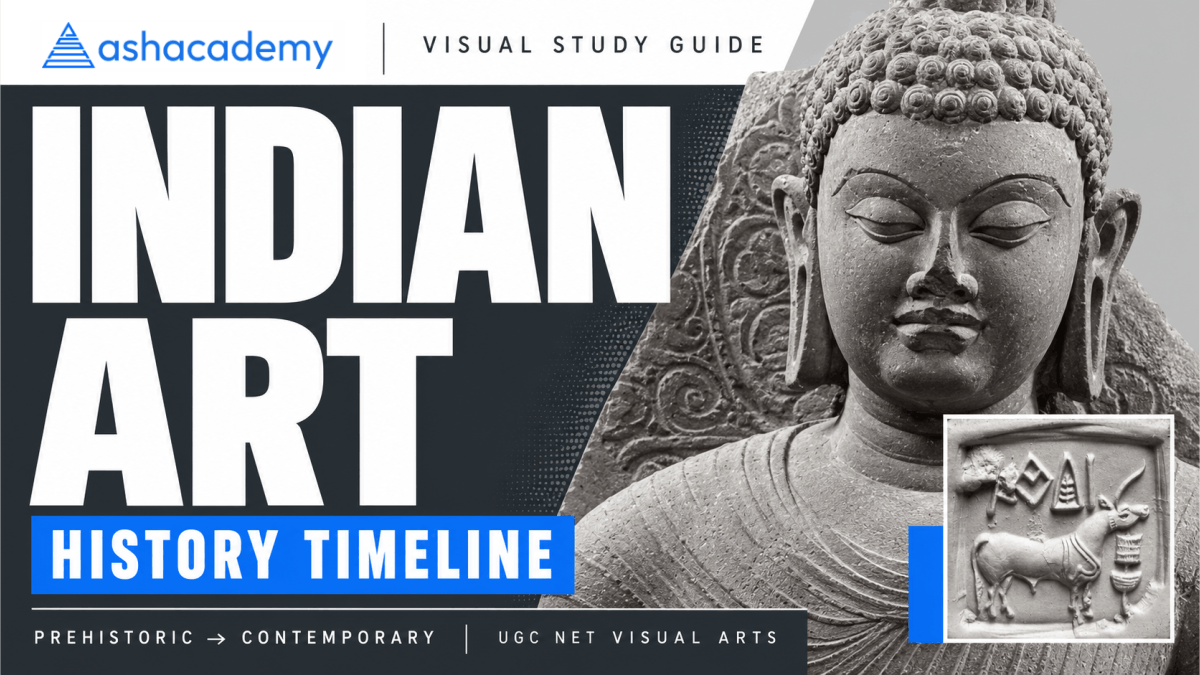
Photographs: authentic photographs and an identified archival plate illustrate the study examples. Credit and licence links accompany each image. Photographs are not AI reconstructions. The editorial thumbnail is a separate designed visual and should not be used as evidence for an object’s exact appearance. A photograph’s capture date is not the artwork’s date.
Frequently asked questions
Does this cover the complete UGC NET Visual Arts syllabus?
No. It provides a substantial Indian-art-history revision framework. Aesthetics, Western and Asian art histories, applied art, art education, materials, techniques and elective requirements need separate study. The examples within each phase are selective.
Should I memorise an exact date for every object?
Use exact dates for securely documented monuments, inscriptions, institutions and works. Where catalogues give a century or approximate range, preserve that level of precision. Do not invent a single year to make a chart look neat.
Is Edith Tomory enough as the only reference?
It is a useful survey for building the framework. Supplement it with specialist art-history scholarship and current collection records, especially for contested attributions and later developments.

You may also like
Cubism: History, Characteristics, Artists and Important Artworks
Surrealism: History, Characteristics, Artists and Important Artworks