Dada (Dadaism): History, Characteristics, Artists and Important Artworks
Dada changed the question from “How beautifully can an artist make something?” to “What makes something art in the first place?” A manufactured urinal, a newspaper fragment, a nonsense poem or a live provocation could become the starting point for an artistic experiment. This was a radical challenge to familiar ideas about skill, originality, meaning and cultural authority.
This illustrated guide explains Dada art, also called Dadaism: its history, characteristics, major artists, important artworks and techniques. It is also designed for UGC NET Visual Arts revision and close looking, with museum collection references, a chronology, comparison tables and twelve original practice questions. Therefore, read the objects as arguments, rather than treating “strange” as a complete explanation.
Dada at a glance
| Question | Revision answer |
|---|---|
| What was Dada? | An international artistic and literary movement that questioned established cultural values and conventions. |
| Where and when? | Zurich, 1916, is a central reference; parallel New York experiments and later European centres complicate any single-origin story. |
| Historical background | The First World War, nationalism, modern mass media and distrust of the institutions associated with those forces. |
| Important meeting place | Cabaret Voltaire, Zurich, founded by Hugo Ball and Emmy Hennings. |
| Main strategies | Readymades, collage, photomontage, assemblage, chance, sound poetry, performance and disruptive typography. |
| Important names | Ball, Hennings, Tzara, Arp, Taeuber-Arp, Duchamp, Picabia, Man Ray, Höch, Hausmann, Heartfield, Grosz, Ernst and Schwitters. |
| Key exam warning | A later museum replica may carry a different date from the original artistic conception. |
| Approximate historical span | Most concentrated activity: the mid-1910s to the early 1920s. Its influence continued far beyond this period. |
1. Origins: why Dada emerged
During the First World War, artists and writers gathered in neutral Switzerland. They confronted a disturbing contradiction. Societies celebrated reason, progress and high culture; yet they took part in industrialised destruction. As a result, Dada’s disruption of logic and decorum could expose that contradiction. Nonsense was therefore capable of carrying a serious challenge, even when the immediate experience was comic or deliberately irritating.
Against this background, the Cabaret Voltaire opened in Zurich in February 1916. Hugo Ball and Emmy Hennings helped create a space where poetry, music, masks, dance and visual art crossed disciplinary boundaries. In addition, Tristan Tzara, Marcel Janco, Jean (Hans) Arp and others contributed to the emerging network. In other words, the important point is the collaborative setting: Dada was not invented by a solitary painter who announced a new way of applying colour.
Source: The Met: Hugo Ball and Emmy Hennings.
The word Dada resists a single reliable definition. Accounts connect it to a dictionary selected by chance; the French word can mean a hobbyhorse, while its sounds suggest different things in different languages. However, these stories should not become a settled account of who discovered the name. They fit the movement’s wordplay, but the details remain uncertain. Therefore, an exam answer can identify the dictionary story as a commonly reported account without presenting every detail as proven.
Likewise, anti-art needs explanation. Dada challenged inherited definitions of art, institutional authority and expectations of artistic seriousness. Nevertheless, its participants continued composing, designing, performing or making visually compelling objects. For example, a carefully arranged collage can still be Dada. Rejecting established values can itself require artistic decisions.
Source: MoMA: Dada.
2. Dada centres: one network, different priorities
| Centre | People to connect | What to remember |
|---|---|---|
| Zurich | Ball, Hennings, Tzara, Arp, Taeuber-Arp, Janco | Cabaret performance, sound poetry, abstraction, masks, dance and chance. |
| New York | Duchamp, Picabia, Man Ray; Beatrice Wood and the Arensberg circle | Readymades, machine imagery, authorship and the institutions that decide what counts as art. |
| Berlin | Höch, Hausmann, Heartfield, Grosz, Huelsenbeck, Baader | Political photomontage, mass-media fragments, antimilitarism and public confrontation. |
| Cologne | Max Ernst, Johannes Baargeld and collaborators | Collage and provocative combinations of familiar imagery. |
| Hanover | Kurt Schwitters | Merz: discarded materials transformed into constructions, poetry, design and environments. |
| Paris | Tzara, Picabia, Breton and changing literary alliances | Manifestos, magazines and public interventions; some participants subsequently developed Surrealism. |
In practice, use this table as a map of emphases, not a list of sealed compartments. After all, artists travelled, publications circulated and friendships changed. A work made in Paris is not automatically Surrealist, and a Berlin artist’s entire career cannot be reduced to the short period of Berlin Dada. Consequently, read the artist, location, date and specific work together.
Berlin offers a particularly useful example of political engagement. At the First International Dada Fair in 1920, images and installations challenged militarism and cultural authority. For instance, Heartfield and Grosz were central figures; Höch’s work was also exhibited. Her presence matters because a history told only through male performers and manifestos leaves out a major contributor to Dada’s visual language.
Source: Akademie der Künste: John Heartfield biography.
3. Dada characteristics and techniques, explained simply
| Term | What the artist does | Useful distinction |
|---|---|---|
| Readymade | Selects an existing manufactured object and reframes its status through a title, presentation or designation. | Selection and context can matter more than hand fabrication. |
| Assisted readymade | Combines or alters existing objects. | The object is not necessarily left untouched; labels can overlap with assemblage. |
| Collage | Attaches paper or other flat fragments to a support. | A technique also used outside Dada, including Cubism. |
| Photomontage | Recombines photographic fragments, often from mass-produced printed sources. | A particular kind of image construction; not simply any mixed-media artwork. |
| Assemblage | Builds with three-dimensional objects and materials. | The physical depth of the components matters. |
| Chance procedure | Allows a rule, accident or uncontrolled event to affect the outcome. | The artist can still choose the rules, materials and final presentation. |
| Sound poetry | Works with vocal sound, rhythm and syllables beyond ordinary sentence meaning. | It must be understood through performance as well as a printed page. |
| Typographic experiment | Uses size, direction, spacing and conflicting type styles as expressive material. | The reader sees a composition while also trying to read language. |
How Dada techniques change meaning
A useful way to distinguish the first three material strategies is to ask what has changed. A readymade changes the status of an object. A collage changes the relationships between fragments on a surface. An assemblage changes the relationships between objects in space. However, one work may do more than one of these things. Use the terms to sharpen your description, rather than force each work into one box.
Photomontage is especially powerful because photographs often arrive with the appearance of factual authority. For example, cut a political face from a newspaper and attach it to a machine. As a result, the image’s message changes. Moreover, the visible join can expose how that message was constructed. In an examination, identify the source material and the new relationship, then explain the effect; “it looks random” is usually too weak.
Chance can also be studied through a simple classroom exercise. First, cut ten paper shapes, release them onto a sheet, and photograph where they land. Next, compare that photograph with a deliberately rearranged version. For example, which decisions existed before the fall? Which were made afterwards? Thus, the exercise explores artistic control. It is an original learning activity, rather than a reconstruction of a documented historical performance.
4. Dada artworks, objects and performance, decoded
1. Dada readymades: Marcel Duchamp — Bicycle Wheel
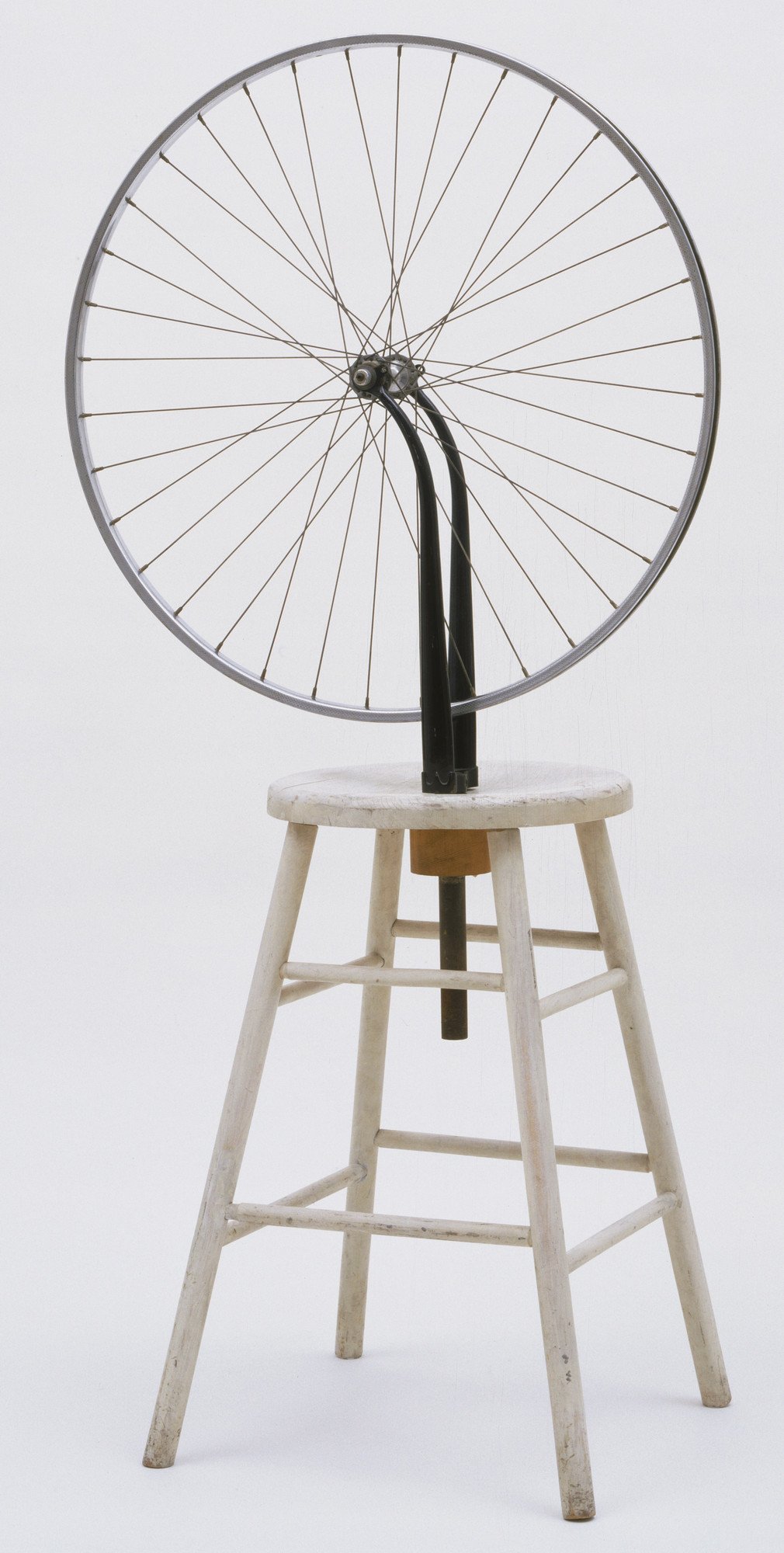
Look closely: The wheel is supported by a stool; normal transport and seating functions are interrupted.
The everyday wheel and stool retain their recognisable forms, but their practical relationship has been disrupted. Instead of transporting a cyclist, the wheel becomes something to watch, think about and classify. Therefore, the work raises a useful question: must the artist carve or model a sculpture? Alternatively, can bringing existing things together create a new proposition?
The original dates to 1913, before the 1916 Zurich reference point. In contrast, the version reproduced here was made in 1951, the third version after the lost original. Therefore, keep both dates in your revision notes. Identifying a museum photograph as a surviving 1913 object would be inaccurate.
2. Marcel Duchamp — 3 Standard Stoppages
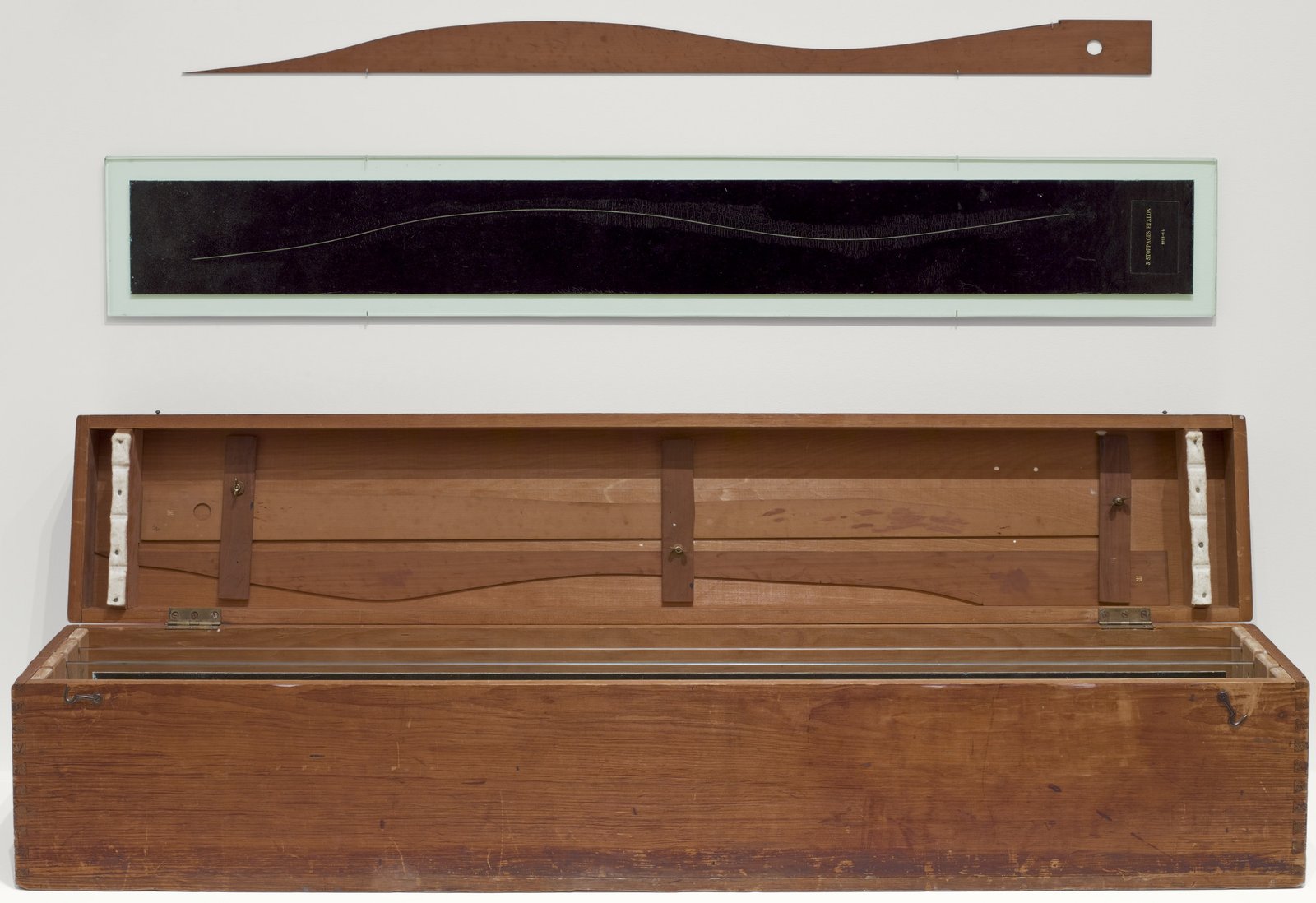
Look closely: Compare the irregular contours with the expectation of a straight standard measure.
Duchamp described a procedure in which metre-long threads fell and formed unpredictable curves. Afterwards, those curves could become templates. Thus, the work brings chance into contact with a standard unit of measurement: an apparently stable system is made to generate different outcomes. In addition, notice the carefully preserved components; the presentation gives irregularity an almost scientific authority.
For visual identification, look for elongated strips, curved profiles and the storage box. However, do not describe this simply as a readymade ruler. Its significance lies in the relation between a procedure, an accidental contour and a repeatable template.
3. Marcel Duchamp — Fountain
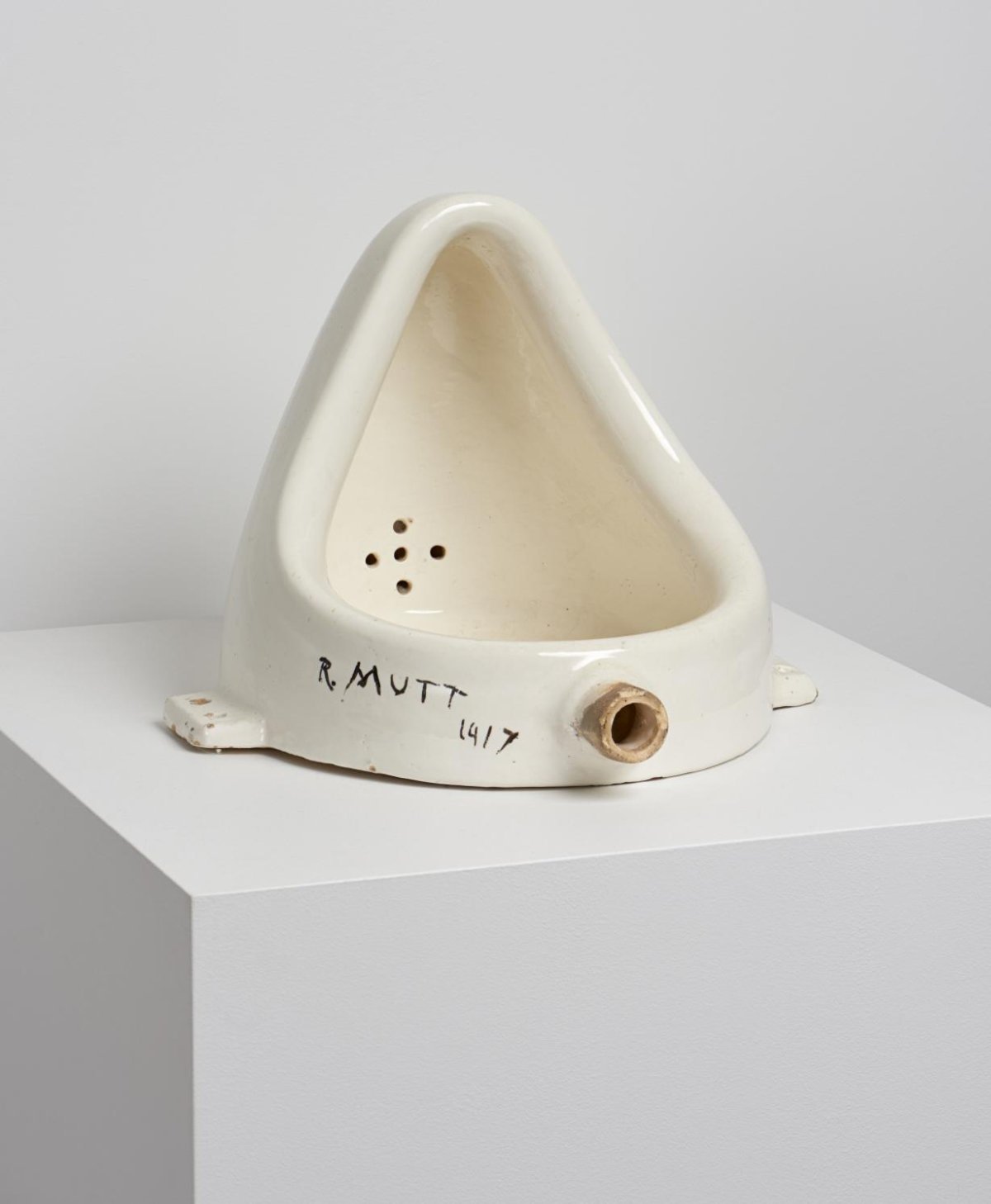
Look closely: Read the signature and consider how the title and display change an ordinary manufactured object.
Fountain was submitted under the name R. Mutt to the Society of Independent Artists’ exhibition in New York in 1917 and was not displayed. As a result, the dispute exposed a gap between an exhibition’s openness in principle and its willingness to accept a radically unfamiliar submission. Subsequently, the original was lost. The image here shows the Philadelphia Museum of Art’s 1950 replica of the 1917 original.
Instead of inventing a new plumbing fixture, Duchamp reframed an existing object. Rather, the action lies in selecting, naming and repositioning a manufactured object. Therefore, ask what the signature, title and exhibition context do. A response focused only on the object’s unusual appearance misses the challenge to authorship and institutional judgement.
4. Dada and chance: Jean (Hans) Arp — Untitled (Collage with Squares Arranged according to the Law of Chance)
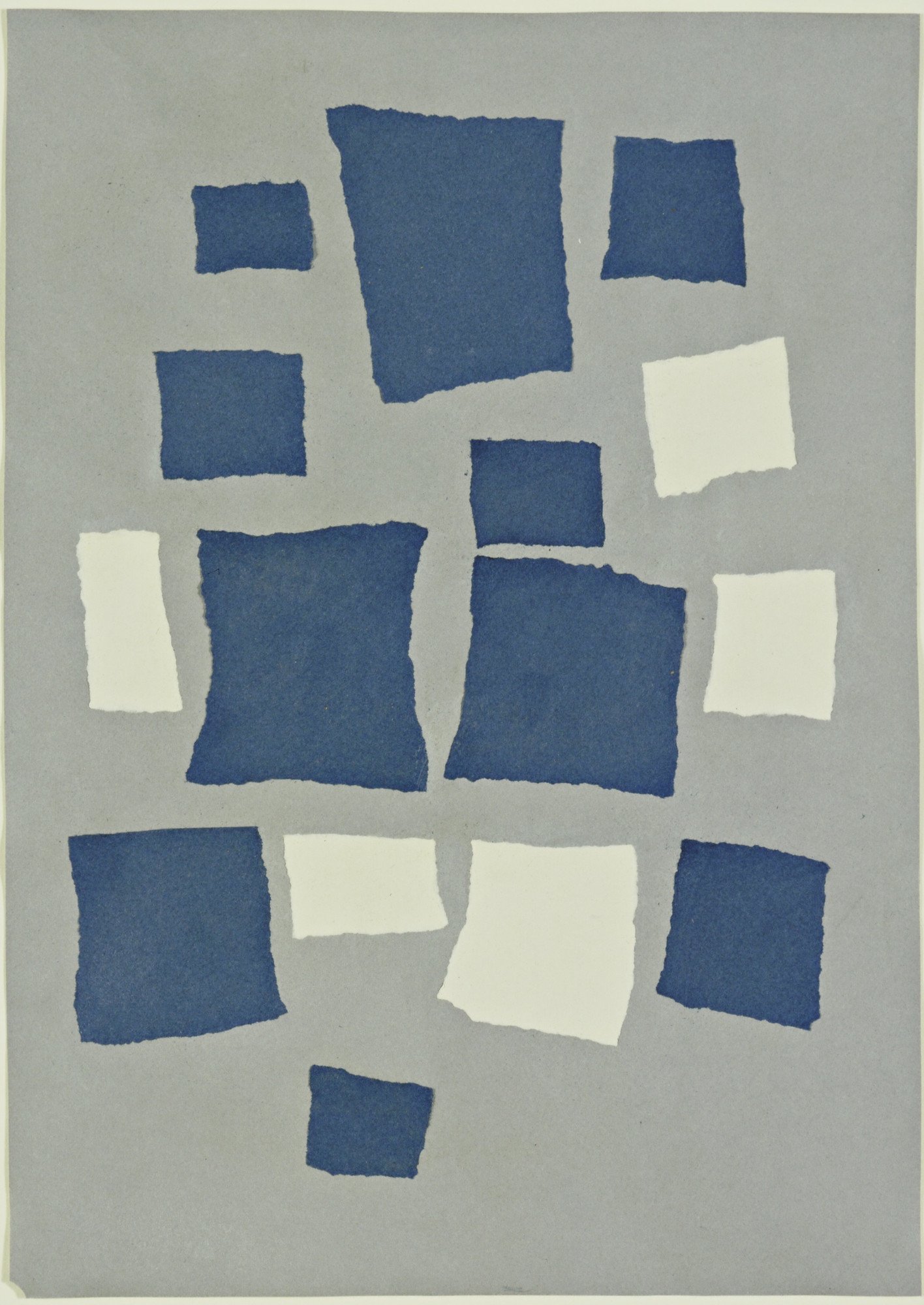
Look closely: Compare torn edges, uneven shapes and the apparently balanced intervals between them.
Compare the torn edges with the overall distribution of the shapes. However, some intervals feel balanced even though the title emphasises chance. MoMA notes that the ordered appearance complicates the idea that the artist surrendered every decision. As a result, the collage becomes useful for an exam answer about the difference between using chance and eliminating authorship altogether.
Although the materials are modest, the question is substantial: can a composition begin from something other than the artist’s planned design? Therefore, avoid turning an account of dropped paper into a claim that every position in the final work has been independently verified as accidental.
5. Francis Picabia — Here, This Is Stieglitz Here
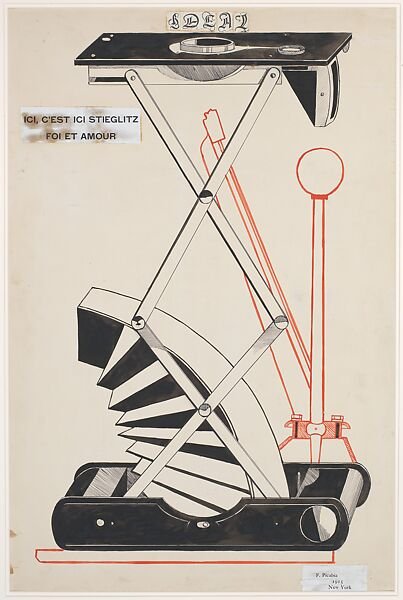
Look closely: A camera-derived machine image operates as a portrait without depicting a human face.
Picabia replaces a conventional likeness with a camera-derived mechanical image. In other words, read the work as a portrait through association: Stieglitz’s identity as a photographer and advocate of modern art is translated into equipment and diagrams. The Met identifies the drawing as the mock-up for the July–August 1915 cover of 291.
For identification, connect the diagram-like machine, the printed words and the portrait function. However, a machine image need not celebrate technological progress; it can be witty, critical or ambiguous. Consequently, this work challenges the assumption that Dada has one predictable attitude towards machinery.
6. Dada photomontage: Hannah Höch — Cut with the Kitchen Knife Dada…
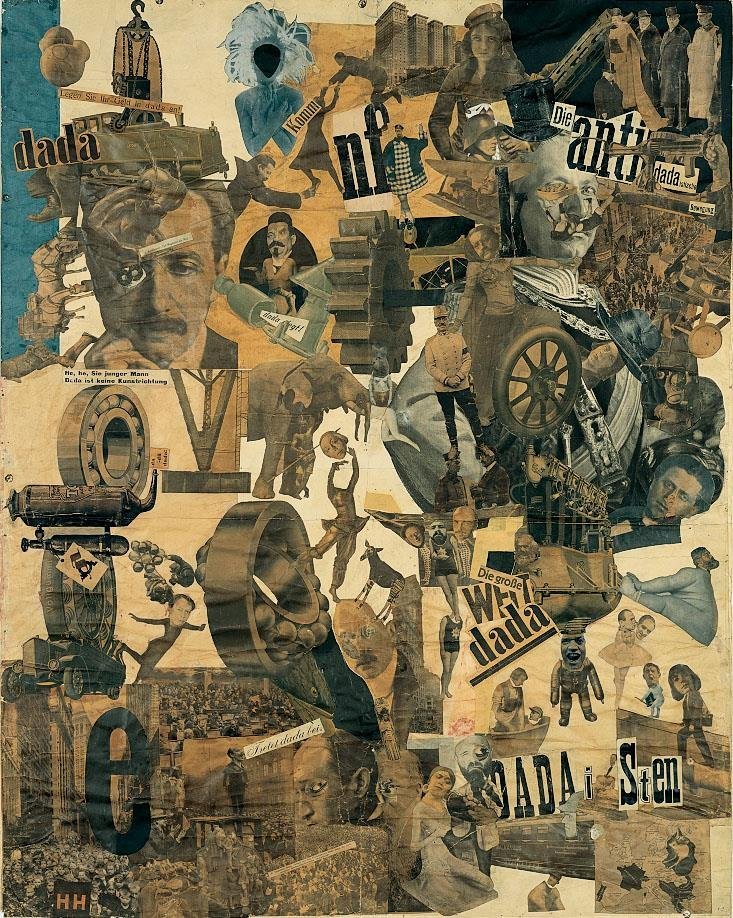
Look closely: Follow the changes of scale between heads, bodies, machinery and fragments of printed language.
Höch combines press photographs, text, bodies and machinery into a fractured picture of public culture. For example, follow one head or body across the joins and ask how scale and context have changed. The fragmentation can connect political authority with the manufacture of public images, while also bringing gender and women’s changing social roles into the discussion.
Dating varies by reference: the Berlin collection record gives 1919; the National Museum of Women in the Arts discusses it as 1919–1920. Later, it appeared at the 1920 Dada Fair. Record the source’s wording when precision matters. Therefore, do not confuse its exhibition date with an uncontested single date of production.
Source: NMWA: Hannah Höch.
7. Raoul Hausmann — Mechanical Head (The Spirit of Our Time)
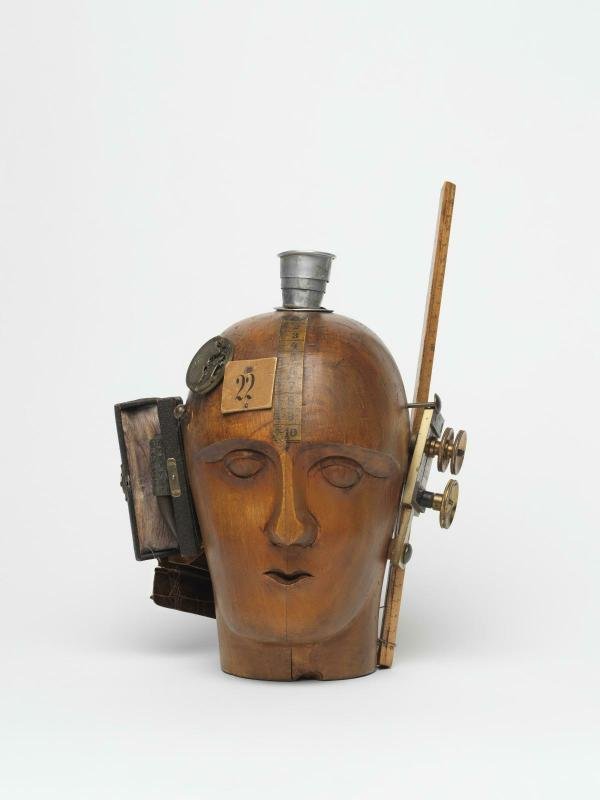
Look closely: The measuring devices and numbered card become external additions to a human-shaped head.
A wooden mannequin head carries measuring devices and other attached objects. Instead of presenting personality through expressive features, the work turns attention towards external systems, quantities and mechanical additions. As a result, it invites a question about modern identity: what happens when a person is imagined through the information and apparatus attached to them?
The Centre Pompidou catalogues the work as [1919] and as an assemblage. In an image-based question, the numbered card, measuring elements and wooden head are useful clues. First, explain the construction; then interpret it; “a robot” is an imprecise substitute for the actual materials.
8. Sophie Taeuber-Arp — Head
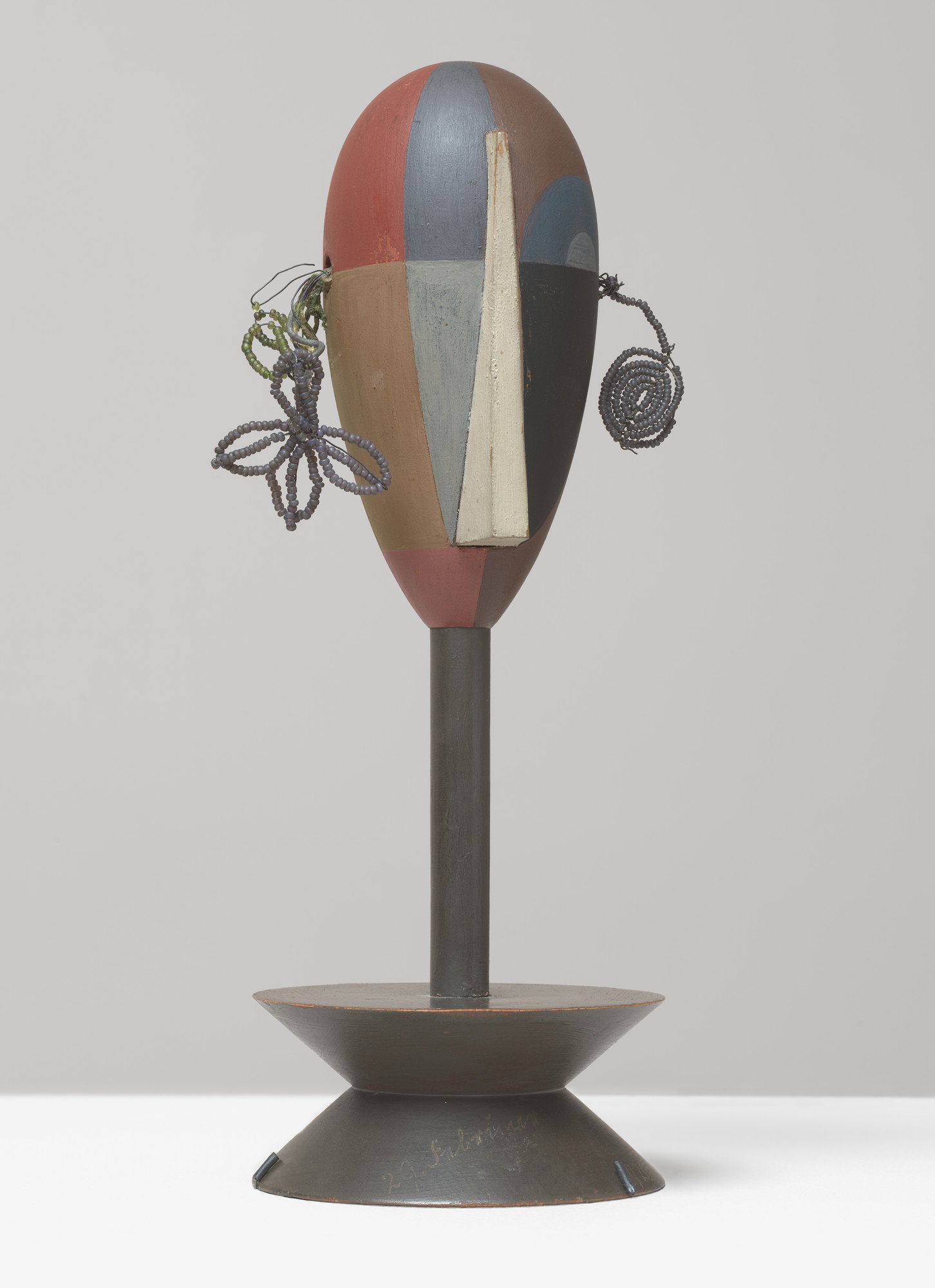
Look closely: Notice the turned wooden forms, geometric paint and beadwork; this is MoMA’s Head, not the Pompidou Dada Head.
Turned wooden forms, painted geometry and beadwork cross the conventional boundary between sculpture and craft. Moreover, Taeuber-Arp’s example prevents a narrow account of Dada as nothing more than aggressive gestures by male artists. Thus, abstraction, applied arts and play could also challenge cultural hierarchies.
This is MoMA’s Head of 1920, made with oil on wood and glass beads on wire. However, it should not be captioned as the distinct, similarly dated Dada Head in the Centre Pompidou. Therefore, similar titles and forms require careful, collection-specific identification.
9. Dada collage: Max Ernst — The Hat Makes the Man
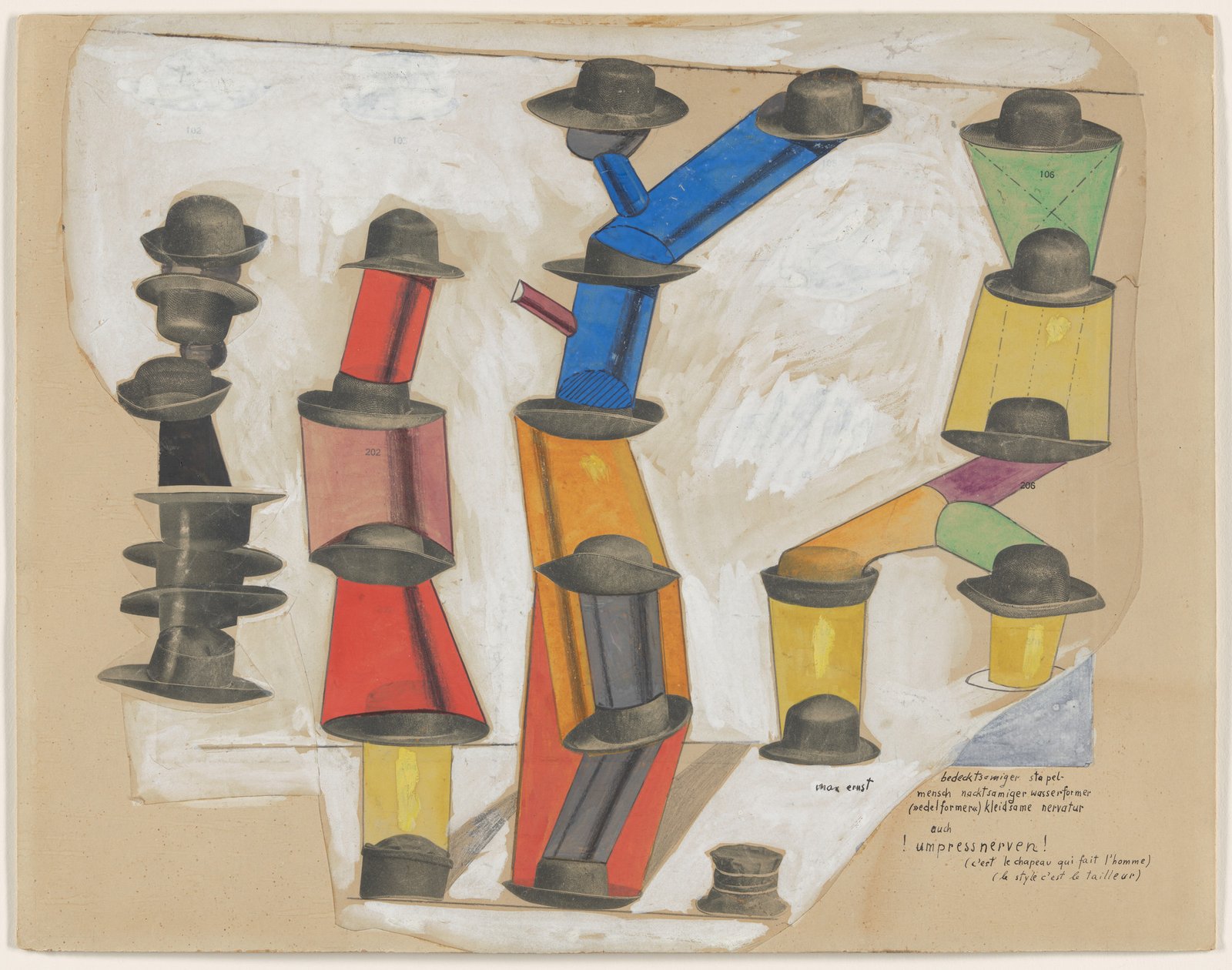
Look closely: Repeated printed hats are transformed into stacked, figure-like constructions.
Repeated hats become stacked, body-like constructions. The source imagery comes from commercial print culture, but Ernst’s additions turn it into an ambiguous arrangement of figures, language and visual jokes. For instance, look at how repetition establishes a system, while the unexpected combinations disturb it.
The work dates to 1920. However, this is more than a straightforward painting of hats: cut-and-pasted printed material is integral to the process. Subsequently, Ernst became important to Surrealism, but that later association should not erase the Dada context of this work.
10. Kurt Schwitters — Merz Picture 32 A. The Cherry Picture
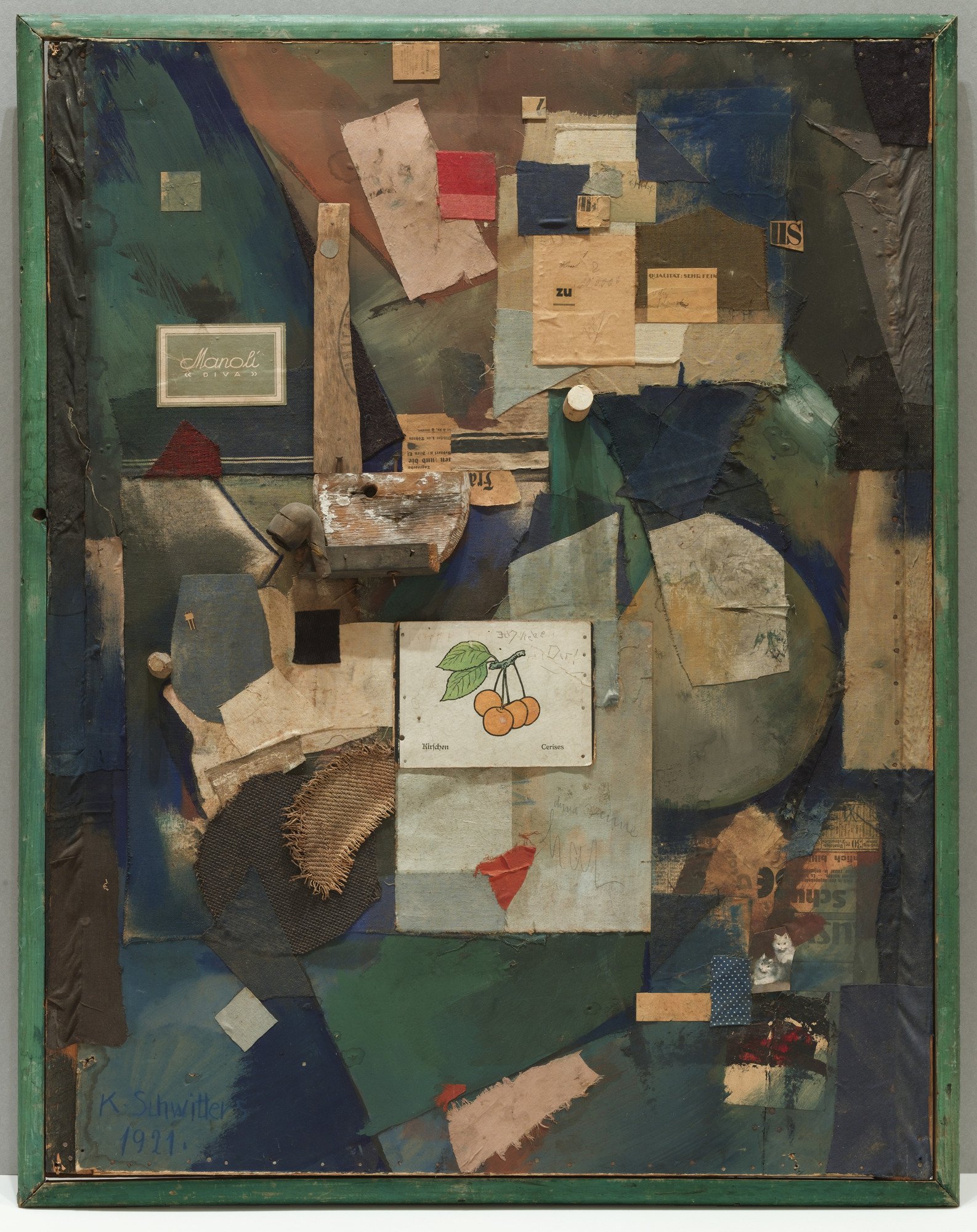
Look closely: Find the small cherry image, then distinguish printed scraps from protruding objects.
Schwitters gathers discarded materials into a layered construction. For example, printed scraps and the small cherry image retain traces of earlier uses. Yet they also form a new composition. Therefore, try to distinguish printed illusion, painted space and components that actually protrude from the surface.
Merz is Schwitters’s own term for his expanding practice, associated with Hanover. Similarly, it challenges established artistic materials but has its own identity. Furthermore, the carefully composed arrangement shows why discarded material and chance should not be treated as interchangeable concepts.
11. Man Ray — The Rope Dancer Accompanies Herself with Her Shadows
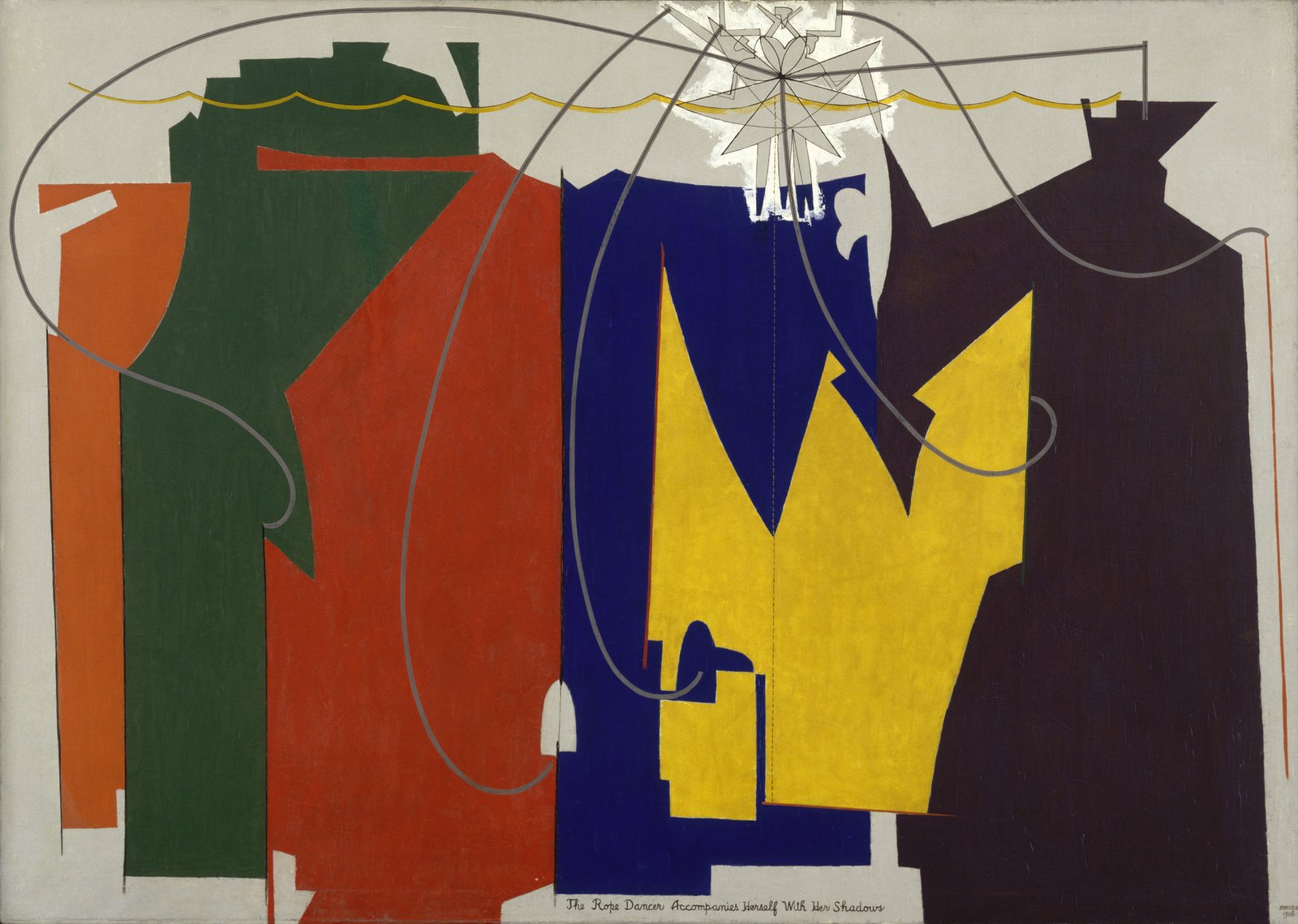
Look closely: The silhouette-like shapes recall collage, although the finished work is painted.
This work looks like an arrangement of flat cut shapes, and its development involved collage experiments, but the finished work is oil on canvas. Therefore, the distinction offers a useful lesson in visual analysis: an image can imitate the effect of another technique without literally using that technique in its final materials.
Connect the 1916 painting with movement, shadow, theatrical experience and the reorganisation of shapes. For this reason, do not identify a medium solely from a small reproduction. Use the collection record when available, and explain what the visual evidence does and does not establish.
12. Man Ray — Gift (Cadeau)
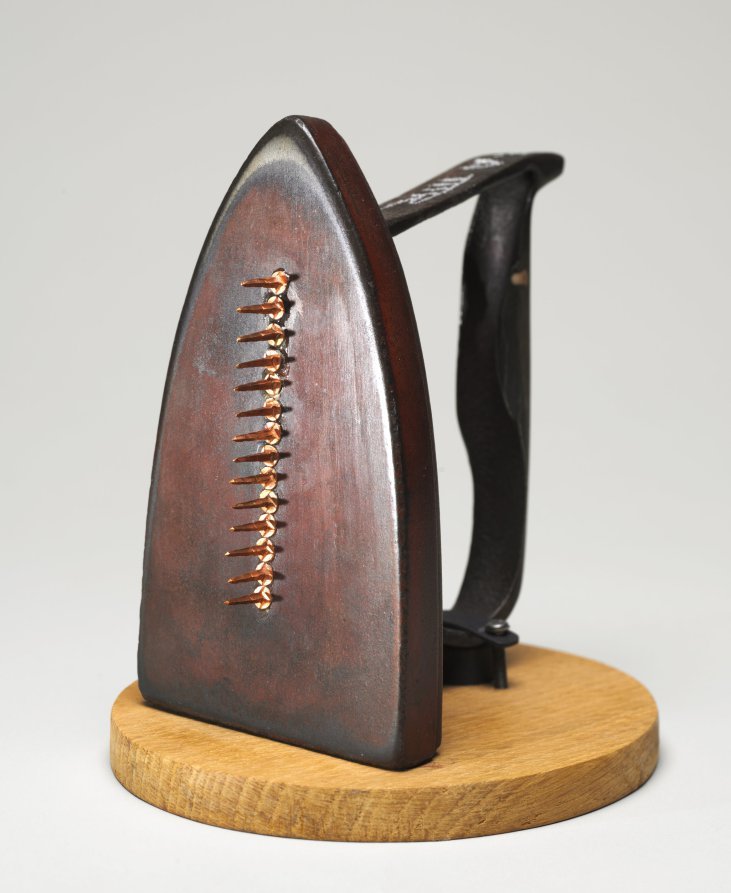
Look closely: The row of projecting tacks reverses the normal smoothing function of an iron.
An iron is designed to smooth cloth. However, add projecting tacks to its working face and that ordinary function becomes threatening or impossible. The combination makes the familiar object newly difficult to handle or even imagine using. Thus, a small material intervention can reverse an object’s expected role.
The original concept dates to 1921; the Cleveland example reproduced here was recreated in 1963. Therefore, keep it separate from other authorised versions. It is useful for discussing altered everyday objects and for comparing the quiet shift of context in a readymade with a more visible physical modification.
13. Marcel Duchamp — L.H.O.O.Q.
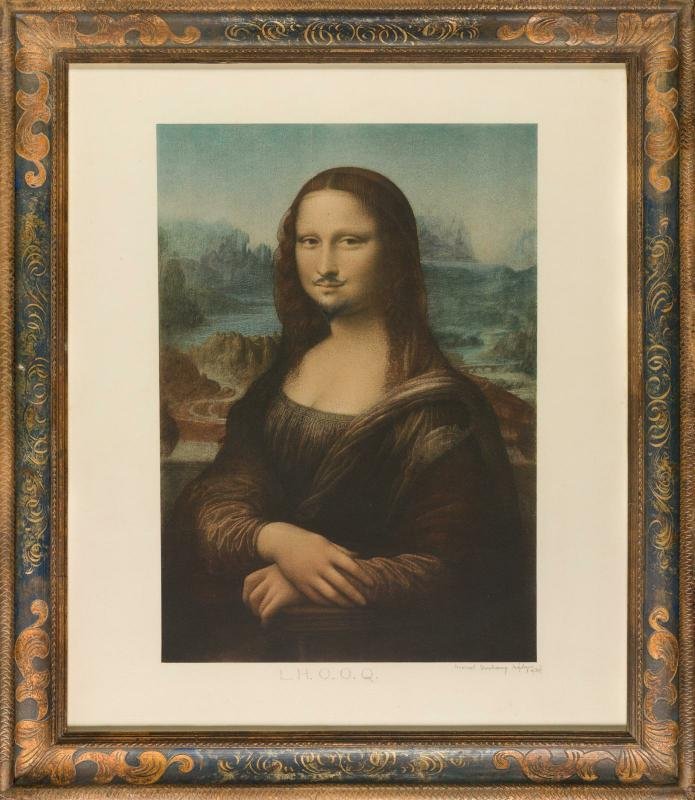
Look closely: A reproduction of the Mona Lisa receives a drawn moustache, goatee and lettered title.
A reproduction of Leonardo’s Mona Lisa receives a drawn moustache and goatee. In addition, its lettered title creates a provocative French sound-pun when spoken aloud. Duchamp acts on a reproduction, not on Leonardo’s original painting. However, that difference is essential: the intervention challenges the cultural prestige and repeated circulation of an iconic image.
The first version dates to 1919; the Centre Pompidou version shown here is a 1930 replica. Accordingly, the museum describes it as a rectified readymade. For example, compare it with Fountain: one reframes a manufactured fixture, while the other modifies the reproduction of an already celebrated artwork. In both cases, selection and context become central to the discussion.
14. Dada performance: Hugo Ball — Karawane
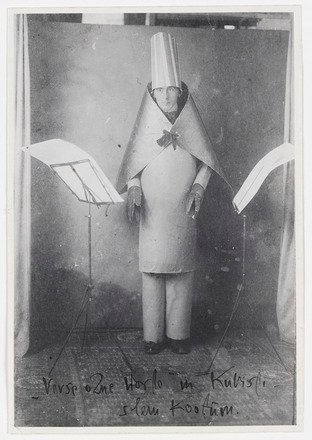
Look closely: Distinguish the angular costume visible in the photograph from the sound and duration of the live performance.
The Getty Research Institute identifies this 1916 photograph as Hugo Ball performing Karawane at the Cabaret Voltaire. Moreover, the angular costume is as important to the encounter as the poet’s voice. Sound poetry draws attention to breath, rhythm and syllables beyond ordinary sentence meaning. Therefore, performance can unsettle both language and the performer’s usual bodily appearance.
However, distinguish the photograph from the event. For instance, the image records a moment and helps us study the costume. However, it cannot deliver the complete sound, duration or audience response. In visual identification, name Ball, the performance context and 1916; in analysis, explain what the photograph can show and what remains outside it.
5. Major Dada artists: revise the connections
| Artist / writer | Connection to remember | Avoid this confusion |
|---|---|---|
| Hugo Ball and Emmy Hennings | Cabaret Voltaire; the importance of performance and organisation. | Do not credit every Zurich activity to Tzara alone. |
| Tristan Tzara | Dada writing, manifestos and literary provocation. | Not the author of Breton’s 1924 Surrealist manifesto. |
| Jean (Hans) Arp | Chance collages and abstraction. | Hans and Jean refer to the same artist. |
| Sophie Taeuber-Arp | Dance, design, applied arts and geometric objects. | An independent artist; not merely Arp’s assistant. |
| Marcel Duchamp | Readymades; Bicycle Wheel; Fountain. | The original conception and later version dates differ. |
| Francis Picabia | Machine imagery, publications and shifting artistic alliances. | A mechanical image is not automatically Futurist. |
| Hannah Höch | Photomontage, gender and mass-media critique. | Not the maker of Hausmann’s Mechanical Head. |
| Raoul Hausmann | Berlin Dada, photomontage and assemblage. | Distinguish him from John Heartfield. |
| John Heartfield and George Grosz | Political critique, publication and Berlin Dada. | Heartfield’s later anti-Nazi photomontages extend beyond the initial Dada years. |
| Max Ernst | Cologne Dada; collage; later Surrealism. | An artist’s later movement does not classify every earlier work. |
| Kurt Schwitters | Hanover; Merz; found fragments. | Not every found-material construction is a Duchamp readymade. |
| Man Ray | Objects, painting and experimental photography; New York and Paris. | A rayograph is a camera-less photograph, not a painted ray of light. |
6. Dada timeline: events, publications and dates
| Date | Event or work | Why it matters |
|---|---|---|
| 1913 | Original Bicycle Wheel | An important precursor to the later Dada network. |
| 1913–14 | 3 Standard Stoppages | Chance and measurement brought into a material experiment. |
| 1915 | Picabia’s Stieglitz image for 291 | Machine portraiture and print culture in New York-related networks. |
| 1916 | Cabaret Voltaire, Zurich | A central Dada reference point for collaborative performance. |
| 1916–17 | Arp’s chance collage | Chance, abstraction and the question of control. |
| 1917 | Fountain submitted in New York; The Blind Man | A work and a publication participate in a debate about artistic selection. |
| 1918 | Tzara’s Dada Manifesto 1918 | A key text for the literary history of Dada. |
| 1919 / 1919–20 | Höch’s Cut with the Kitchen Knife | Photomontage linked with the political and social world of Berlin. |
| 1920 | First International Dada Fair, Berlin | A major public exhibition; Ernst’s Hat and Taeuber-Arp’s Head also date to 1920. |
| 1921 | Man Ray’s original Gift; Schwitters’s Cherry Picture | Everyday objects and fragments take different artistic paths. |
| 1924 | André Breton’s Manifesto of Surrealism | A useful subsequent milestone; not a universal “closing date” for Dada. |
Tzara’s Dada Manifesto 1918 uses contradiction and provocation to question the certainty that manifestos normally claim. Therefore, read it as an intervention in language, not as a consistent checklist that every Dada artist was obliged to follow. Read the text hosted by the University of Pennsylvania.
Dates are easiest to retain when they answer distinct questions. “When was the idea first realised?”, “When was this particular museum object made?” and “When was it exhibited?” may produce three different answers. Consequently, make separate columns for those facts instead of memorising a single unexplained number.
7. Dada versus Cubism and Surrealism
| Comparison | Cubism | Dada | Surrealism |
|---|---|---|---|
| Useful central question | How can objects and space be reorganised pictorially? | Who defines art, and how can accepted conventions be challenged? | How can dreams, desire and the unconscious reshape experience? |
| Typical strategies | Faceting, compressed space, contrasting viewpoints, collage. | Readymades, photomontage, chance, performance, wordplay. | Automatism, unexpected encounters, dream imagery and transformed objects. |
| Chronological anchor | Picasso and Braque’s experiments from 1907–08. | Zurich in 1916; related earlier and parallel experiments. | Breton’s manifesto in 1924. |
| Important qualification | Cubism is more than paintings of literal cubes. | Dada is more than random nonsense. | Surrealism is more than realistic paintings of impossible scenes. |
However, these are revision contrasts, not complete definitions. Collage can occur in all three contexts, and artists such as Ernst moved between movements. Therefore, classify a work through its date, setting, materials and concerns. An unexpected juxtaposition alone cannot prove that a work is Surrealist, just as geometric shapes alone cannot prove it is Cubist.
Continue with our illustrated guides to Cubism and Surrealism. For the wider sequence, use the Western Art History Timeline.
Dada’s legacy: why these experiments still matter
Dada makes several questions available to later art: Can choosing be a creative act? Can discarded materials carry meaning? Can an event or instruction matter as much as a permanent object? These questions help explain its relevance when studying conceptual practices, performance and the use of everyday materials. Nevertheless, influence does not make a later artwork a historical Dada work; a 1960s object needs its own context.
Its methods also offer a practical way to read contemporary media. For example, cropping a photograph can change its argument. Similarly, a caption can change an image’s apparent meaning. Meanwhile, an official-looking arrangement can lend authority to an absurd proposition. These are useful comparisons for learners, rather than claims that every modern meme or collage belongs to Dada. Therefore, always separate a shared operation from a direct historical connection.
8. How to analyse an unfamiliar Dada work
Start with a literal description. Identify what is physically present: printed photographs, a wooden support, a manufactured object, letters or a record of performance. Next, state whether you are looking at the object itself or at documentation. After all, a photograph of an event is not the same medium as the event it records.
Describe the intervention. Has the artist selected, cut, attached, renamed, rearranged or performed something? Next, identify the new relationship. For example, an object may lose its function, or incompatible bodies may be combined. Alternatively, language or a supposedly neutral system may stop behaving as expected.
Connect the intervention to a question. Does the work trouble artistic skill, originality, political authority, gender, mass media or rational control? In each case, support your claim with visible evidence. Avoid explaining every Dada work through the same sentence about war; specific constructions deserve specific readings.
Check the historical record. Verify the artist, title, medium, date and collection, particularly for replicas and similarly titled works. Consequently, your final answer should move from what can be seen to what can reasonably be argued. For revision, practise a three-sentence response: description, operation, significance.
9. Twelve original Dada practice questions
These questions are written for revision; they are not presented as previous-year UGC NET questions. Try them before opening the answers.
1. Which place is most closely associated with Zurich Dada’s early performance activity?
A) Café Guerbois · B) Cabaret Voltaire · C) Bauhaus Dessau · D) Académie Julian
Show answer and explanation
B) Cabaret Voltaire, because the venue connects Ball and Hennings with collaborative performance.
2. A museum labels Bicycle Wheel “1951, after lost original of 1913”. Which statement is accurate?
A) Cubism began in 1951 · B) The museum object survives from 1913 · C) The concept predates the 1916 Zurich milestone · D) The wheel was made by Hugo Ball
Show answer and explanation
C) The concept predates Zurich Dada because the original dates to 1913. In contrast, MoMA’s version is from 1951.
3. Which pairing is correct?
A) Höch—Fountain · B) Hausmann—Mechanical Head · C) Tzara—The Cherry Picture · D) Schwitters—Head, MoMA, 1920
Show answer and explanation
B) Hausmann—Mechanical Head, because the wooden head and attached objects match his assemblage.
4. What most specifically distinguishes photomontage?
A) All materials must be three-dimensional · B) Photographic fragments are recombined · C) The work must use oil paint · D) It cannot contain words
Show answer and explanation
B) Photographic fragments are recombined. In addition, text and other materials may be present.
5. Which claim about Arp’s chance collage is the most careful?
A) Chance removes every decision · B) Chance and artistic selection can coexist · C) All shapes are photographs · D) It is a surviving Cabaret mask
Show answer and explanation
B) Chance and selection can coexist because a chance-based start does not remove every other artistic decision.
6. Which term is particularly associated with Kurt Schwitters?
A) Merz · B) Divisionism · C) Cloisonnism · D) Suprematism
Show answer and explanation
A) Merz, because Schwitters used this term for his practice. Also connect him with Hanover and found fragments.
7. What is the final medium of The Rope Dancer Accompanies Herself with Her Shadows?
A) Photomontage · B) Oil on canvas · C) Bronze · D) Wood engraving
Show answer and explanation
B) Oil on canvas. Although collage informed its development, the finished work is a painting.
8. Which order is chronological?
A) Fountain → Bicycle Wheel → Cabaret Voltaire · B) Bicycle Wheel → Cabaret Voltaire → Fountain · C) Cabaret Voltaire → Fountain → Bicycle Wheel · D) All three began in 1924
Show answer and explanation
B) First comes the original Bicycle Wheel in 1913. Next comes Cabaret Voltaire in 1916, followed by Fountain in 1917.
9. What is the strongest description of a readymade?
A) Any rapidly painted landscape · B) A manufactured object selected and reframed as an artwork · C) A mandatory bronze replica · D) Every photograph of a machine
Show answer and explanation
B) Selection and changed context are central. Therefore, hand fabrication is no longer the only criterion.
10. Which exhibition is a major Berlin Dada reference?
A) First International Dada Fair, 1920 · B) First Impressionist Exhibition, 1874 · C) Salon des Refusés, 1863 · D) Armory Show, 1913
Show answer and explanation
A) The First International Dada Fair, because this exhibition took place in Berlin in 1920.
11. An iron with projecting tacks is most closely associated with which work?
A) Gift by Man Ray · B) Fountain by Duchamp · C) Head by Taeuber-Arp · D) The Hat Makes the Man by Ernst
Show answer and explanation
A) Gift, because the added tacks disrupt the iron’s expected function.
12. Which distinction is most useful when comparing Dada and Surrealism?
A) Dada always paints dreams · B) Surrealism bans chance · C) Examine historical context and aims, since techniques and participants overlap · D) Every collage is Dada
Show answer and explanation
C) Examine context and aims, because a shared technique alone cannot classify a work.
10. Frequently asked questions about Dada
What is Dadaism in simple words?
Dadaism is a movement in art and literature that challenged accepted conventions through unexpected objects, fragments, language and performances. Thus, its apparent absurdity could question serious cultural and political assumptions.
Who founded Dada?
It was a collaborative, international development. Zurich’s 1916 activities involved Ball, Hennings, Tzara, Arp, Janco and others, while Duchamp, Picabia and Man Ray belong to the crucial New York-related history. Therefore, a single-founder answer is incomplete.
Is Dada the same as Surrealism?
No. Although they share some artists and techniques, the movements have different histories and emphases. Surrealism’s exploration of dreams and the unconscious is associated with Breton’s 1924 manifesto; Dada’s challenges to cultural conventions emerged earlier.
Did Dada invent collage?
No. Cubist collage preceded the Zurich Dada activities of 1916. Instead, Dada artists adapted collage and photomontage to their own concerns, including mass-media critique, chance and political satire.
Why is Fountain important?
It tests the role of selection, title, presentation and institutional acceptance in defining art. Consequently, the controversy surrounding its 1917 submission is part of its significance.
How should I study Dada for UGC NET Visual Arts?
First, build artist–work–technique connections. Next, learn the main centres and chronology, and practise visual identification. Finally, verify version dates and explain the artistic operation. Use the official current syllabus and papers to guide the wider scope of preparation; this article does not predict examination questions.
Sources and further study
Artwork captions link to collection records for the reproduced version. Dates and materials follow those records; the Höch date variation is explained in the article. The cover is an editorial illustration and is not a historical artwork reproduction.
- The Met: Hugo Ball and Emmy Hennings
- Centre Pompidou: Dada educational dossier
- Tristan Tzara: Dada Manifesto 1918, University of Pennsylvania
- Getty Research Institute: Hugo Ball performing Karawane
- Centre Pompidou: L.H.O.O.Q.
- MoMA: Dada
- MoMA: Artistic Collaboration
- MoMA: Chance Creations
- MoMA: Marcel Duchamp and the Readymade
- Philadelphia Museum of Art: Fountain
- Philadelphia Museum of Art: Fountain and The Blind Man
- National Museum of Women in the Arts: Hannah Höch
- Staatliche Museen zu Berlin: Cut with the Kitchen Knife
- Akademie der Künste: John Heartfield
- Centre Pompidou: Mechanical Head
- The Met: Here, This Is Stieglitz Here
- Cleveland Museum of Art: Gift
For structured preparation, explore our decoded UGC NET Visual Arts syllabus and recommended Visual Arts books. To discuss the current live online batch, contact ashacademy.

You may also like
Cubism: History, Characteristics, Artists and Important Artworks
Surrealism: History, Characteristics, Artists and Important Artworks