Indian Painting Schools: Identify the Difference with Original Artworks
Indian Art History • Illustrated Study Guide
Mughal, Mewar, Bundi, Kishangarh, Basohli and Kangra: learn to see the difference.
To identify Indian painting schools, compare the face, line, colour, space, landscape and handling of detail together. A single feature, such as a red background or a scene of Radha and Krishna, is not enough. Several schools share subjects and techniques, while painters and styles travelled between courts.
This illustrated guide compares Mughal, Mewar, Bundi, Kishangarh, Basohli and Kangra through original museum artworks. It combines historical anchors, artist–patron relationships, visual analysis and revision tables for UGC NET Visual Arts preparation. The aim is to help you explain why an image belongs with a particular tradition, rather than guess from a memorised slogan.
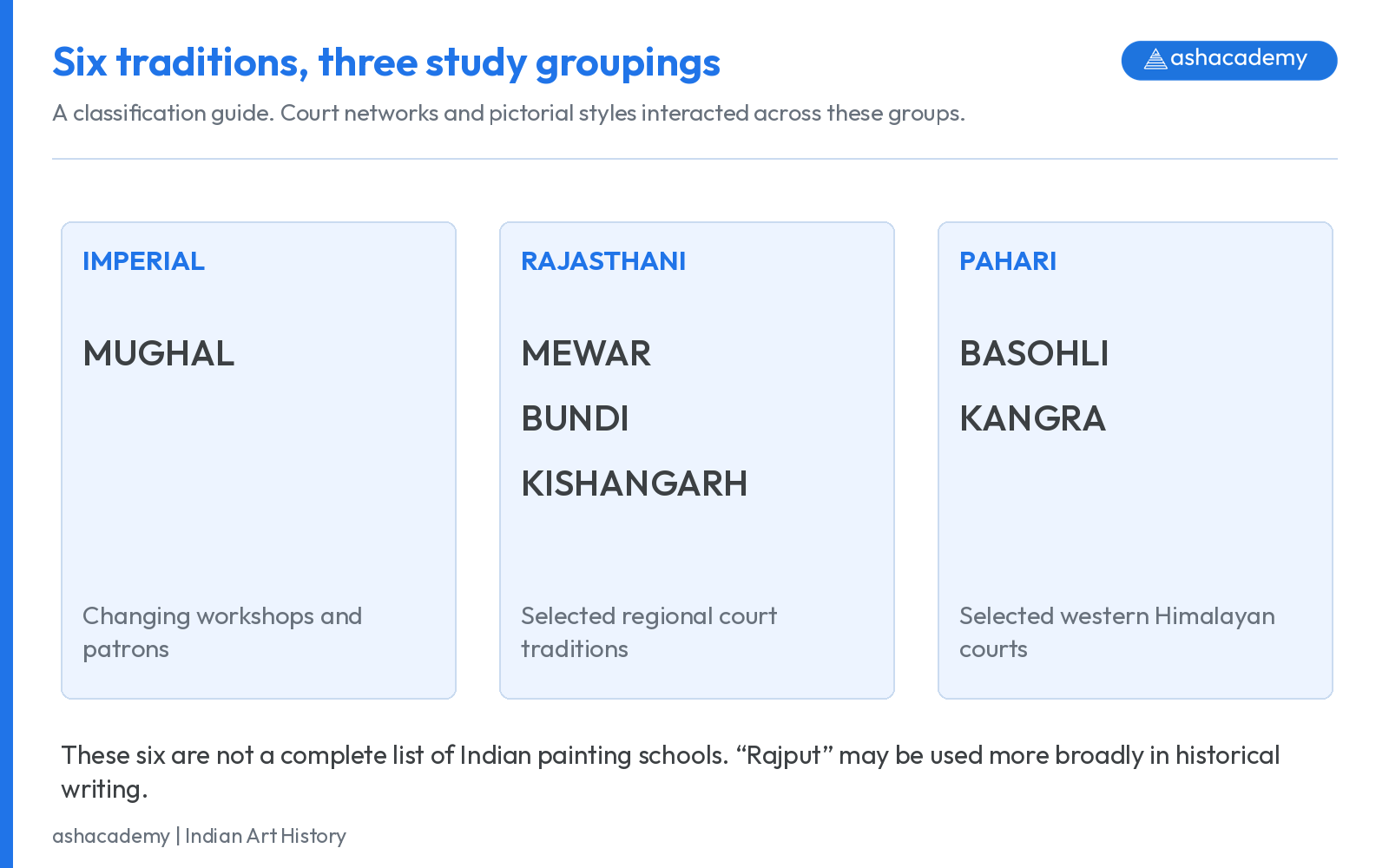
1. Six painting schools at a glance
| School | Region / context | First visual clues | Important associations |
|---|---|---|---|
| Mughal | Imperial workshops centred at different times on Agra, Fatehpur Sikri, Lahore and Delhi. | Individualised portraits; fine observation; controlled detail; narrative manuscripts and album pages. | Akbar, Jahangir, Shah Jahan; Basawan, Daswanth, Mansur, Abu’l Hasan, Bishandas and others. |
| Mewar | Southern Rajasthan: Chawand, Udaipur and related centres. | Bold colour divisions; strong contours; expressive figures; narrative organisation, with substantial change over time. | Chawand Ragamala, 1605; Sahibdin; Maharana Jagat Singh I; Mewar Ramayana. |
| Bundi | Hadoti region of southeastern Rajasthan. | Often animated foliage, dramatic weather, flowing movement and richly patterned settings. | Chunar Ragamala, 1591, as an early formative anchor; Ragamala and Barahmasa traditions. |
| Kishangarh | Rajasthan; especially associated with mid-18th-century court culture. | In the celebrated idiom: very elongated eyes, curved brows, aquiline profiles, tapering chins and slender figures. | Savant Singh / Nagaridas, Nihal Chand, Bani Thani, Radha–Krishna imagery. |
| Basohli | Western Himalayan foothills; historic Basohli court, now in Jammu and Kashmir. | Powerful contour; intense colour relationships; emphatic eyes and facial types; compressed or abstracted space. | Raja Kirpal Pal; Devidasa of Nurpur; Rasamanjari, 1694–95. |
| Kangra | Western Himalayan / Pahari field, in present-day Himachal Pradesh. | Often fluid contour, delicately modelled figures and landscapes organised for lyrical or emotional effect. | Raja Sansar Chand; Guler connections; later generations of the Seu–Manaku–Nainsukh family tradition. |
Treat these as starting hypotheses. A later Mewar work may incorporate Mughal spatial conventions. A Bundi painting may have a flat red ground. A Kangra scene may be crowded and storm-filled rather than quiet and green. The paintings below deliberately include such variations.
2. How to identify a miniature painting: a six-step method
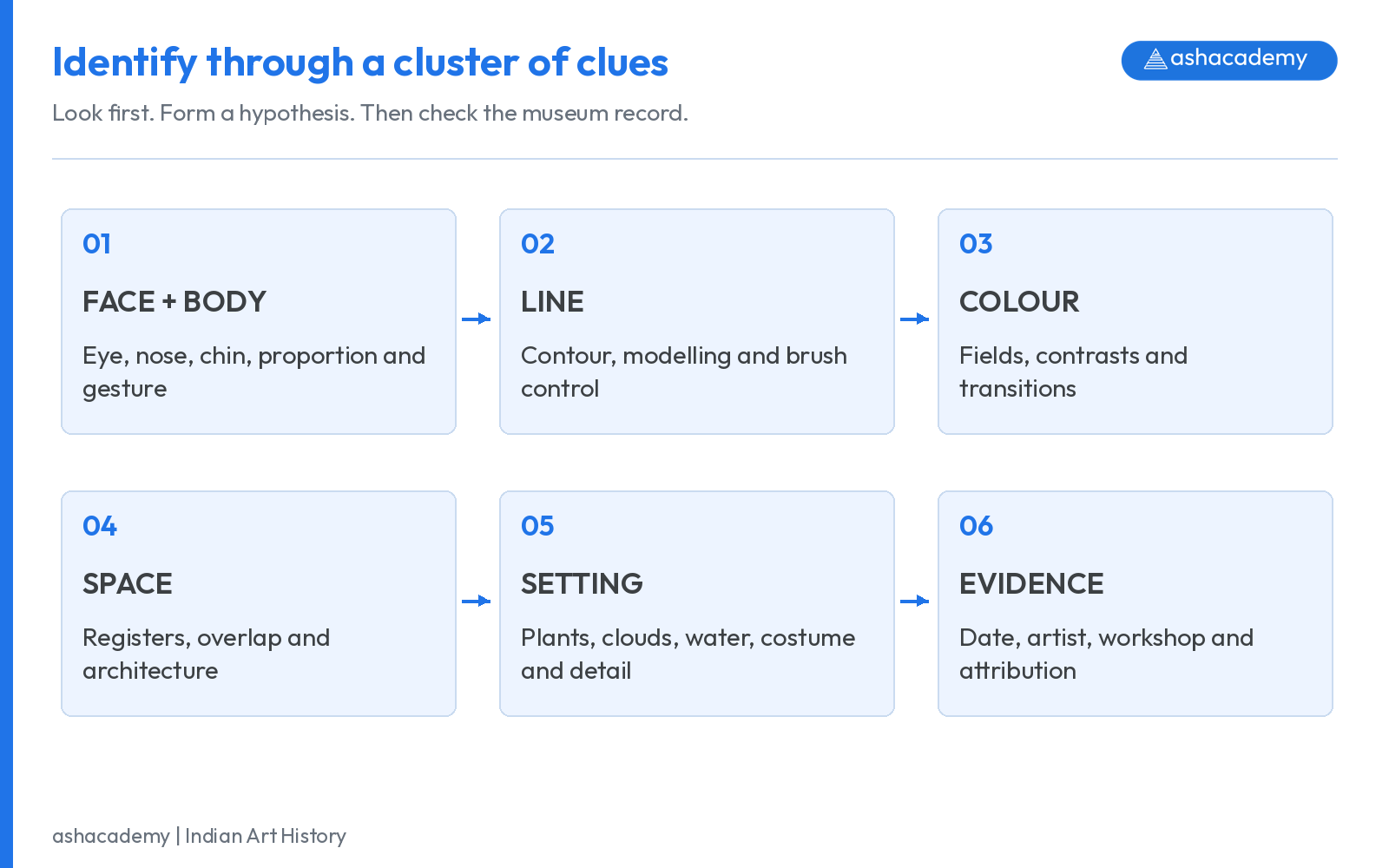
| Inspect | What to ask | What to record in your notes |
|---|---|---|
| Face and body | Are the eyes exaggerated? Is the face individualised or idealised? Are the proportions elongated? | Eye shape, nose, chin, profile, body proportions and gesture. |
| Line | Is the contour forceful and emphatic, fine and controlled, or flowing and delicate? | A description tied to a visible edge, not just “beautiful line.” |
| Colour | Do large colour fields structure the page? Are transitions modelled or sharply bounded? | Relationships between colours; distinguish pigment choices from the digital photograph’s lighting. |
| Space | Are scenes arranged in registers? Does a terrace recede? Are several moments shown together? | Overlap, vertical stacking, architectural compartments, scale and multiple viewpoints. |
| Setting and detail | How are trees, clouds, water, textiles, jewellery and borders treated? | Repeated forms, specific observation, pattern, weather and landscape organisation. |
| Evidence | What does a reliable catalogue say about date, place, artist and workshop? | Keep “attributed to,” “possibly” and approximate dates intact. |
3. Mughal painting: observation, imperial identity and the book
Historical framework and patrons
Mughal painting developed through imperial patronage and the collaboration of artists from different backgrounds. Humayun’s connections with Persian painting provided an important foundation. Under Akbar, a large atelier brought Persian-trained masters and Indian painters into sustained collaboration. The resulting painting was neither simply imported Persian art nor a single unchanged national style.
| Patron / period | Major emphasis | Useful distinctions |
|---|---|---|
| Humayun | Persian connections and the foundation for an imperial painting establishment. | Mir Sayyid Ali and Abd al-Samad are central names in accounts of this formation. |
| Akbar, r. 1556–1605 | Large illustrated narrative projects, histories, epics, lively action and workshop collaboration. | Hamzanama, Akbarnama and other illustrated texts; Basawan, Daswanth and Miskin among important painters. |
| Jahangir, r. 1605–1627 | Discriminating connoisseurship, portraiture, natural-history studies and allegorical compositions. | Mansur, Abu’l Hasan and Bishandas; observational precision can coexist with symbolic invention. |
| Shah Jahan, r. 1628–1658 | Highly finished portraiture, courtly ceremony, dynastic prestige and luxurious albums. | Bichitr, Payag, Balchand, Govardhan and Hashim worked within the wider courtly field; careers can span reigns. |
The imperial workshop was also a production system. A manuscript painting might involve a designer, colourists, portrait specialists, calligraphers, illuminators and binders. Do not assume that every folio was made entirely by one hand. For context see The Met: The Art of the Mughals before 1600 and V&A: The arts of the Mughal Empire.
Visual characteristics
- Faces: portraits can communicate an individual’s age, features and status, even when idealised or given a halo.
- Detail: textiles, jewellery, weapons, plants and animals may receive close descriptive attention.
- Space: overlap, architectural recession, landscape and modelling can create depth; this is not always consistent European single-point perspective.
- Subjects: historical narratives, court life, battles, hunts, literature, Hindu epics, portraiture, devotional subjects and natural history.
- Page format: a painting may be part of a manuscript or mounted in an album, a muraqqa, alongside calligraphy and decorated borders.
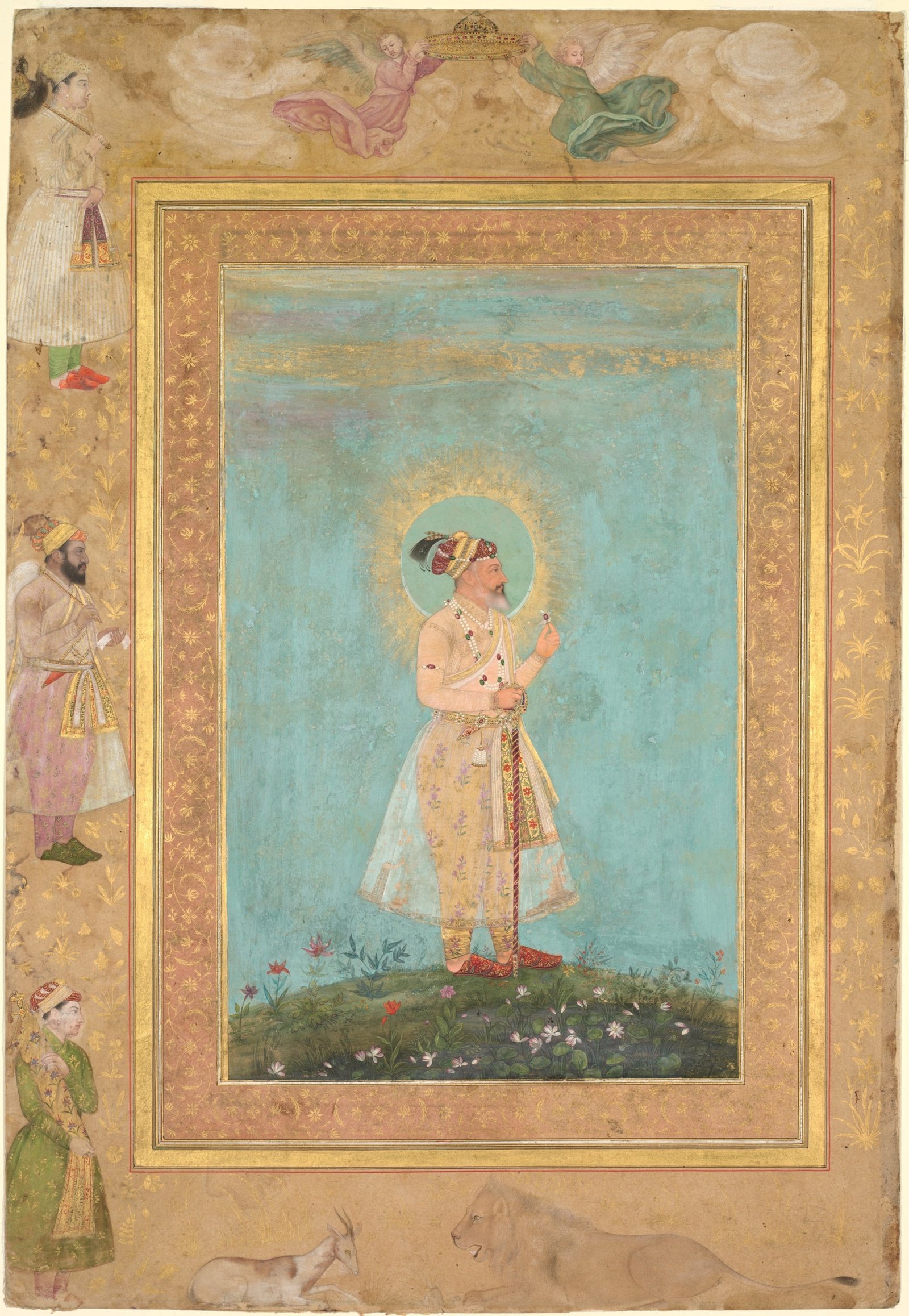

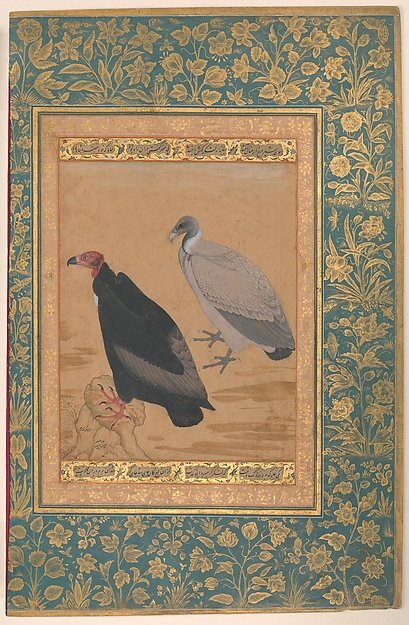
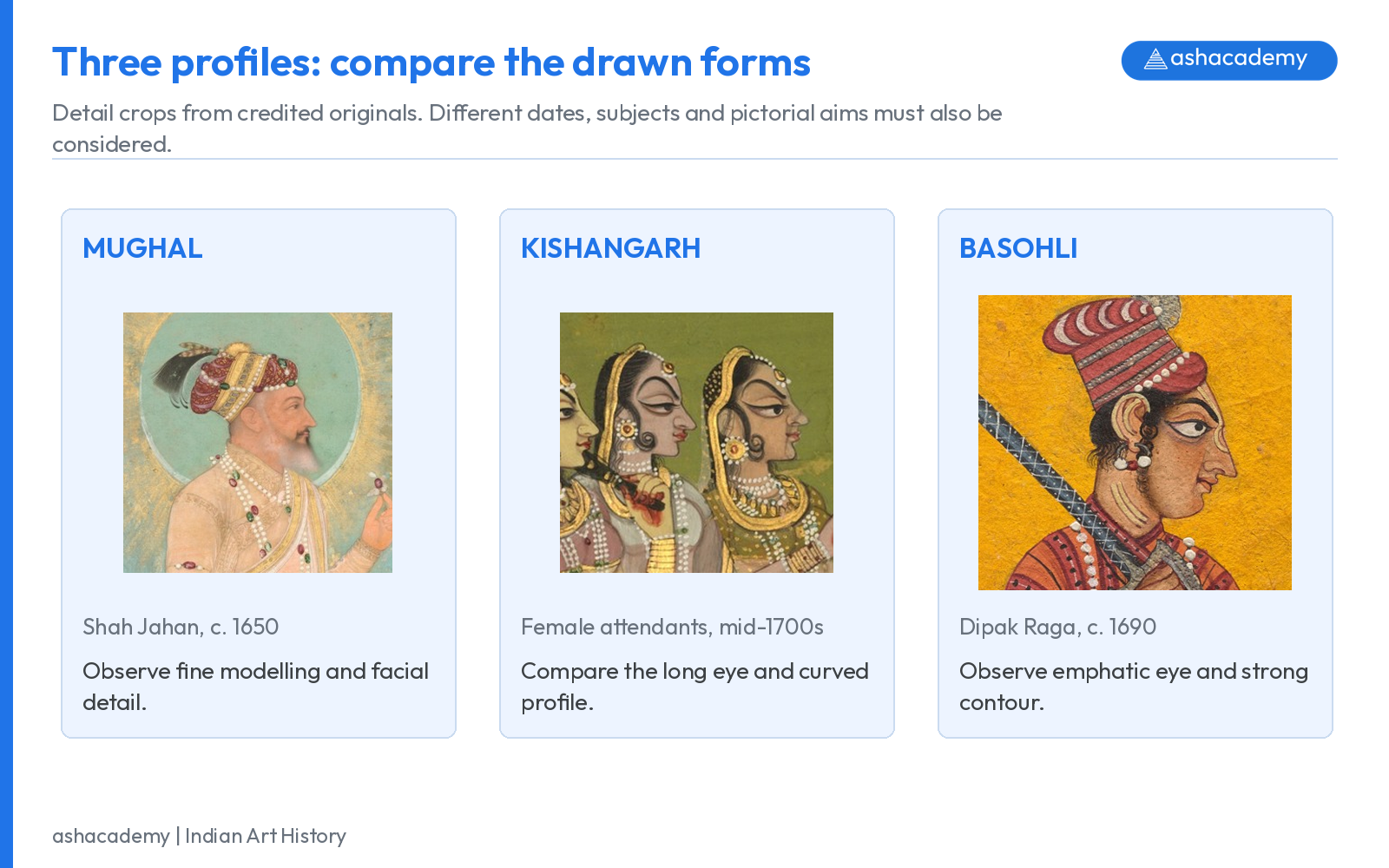
Identification caution: a profile portrait and gold border are not exclusively Mughal. Rajput and Pahari courts also painted rulers and borrowed imperial conventions. Look at the specific handling of the face, modelling, costume and setting. Album context: The Met: The Shah Jahan Album.
4. Mewar painting: strong colour, narrative structure and changing court culture
Region, artists and chronology
Mewar is associated particularly with Chawand and Udaipur in southern Rajasthan. Early seventeenth-century examples are central to the study of Rajasthani painting. The dated Chawand Ragamala of 1605 is associated in the wider literature with Nasiruddin, also written Nisardin. That series-level association should not automatically become a signed attribution for every dispersed leaf.
Sahibdin, documented through works from 1628 to 1655, is a major Mewar master. His career closely overlaps the patronage of Maharana Jagat Singh I, who ruled from 1628 to 1652. His Ragamala of 1628 and work on devotional and literary manuscripts are important anchors. The Mewar Ramayana project of 1649–1653 involved several artists and workshop groups; it should not be reduced to the work of one painter alone. Manohar of Mewar is another important name, to be distinguished from other painters called Manohar.
What to look for
- Colour and contour: in many early examples, strong reds, yellows and other clearly separated fields combine with emphatic drawing.
- Space: architecture may divide a scene into distinct compartments; horizontal registers and successive narrative episodes can organise time.
- Figures: expressive profiles and gestures communicate relationships and actions directly.
- Themes: Ragamala, Krishna devotion, literary love, epics, court portraiture, festivals, hunts and views of royal life.
- Change over time: later artists expanded portraiture and large courtly or urban scenes, while incorporating selective Mughal conventions.
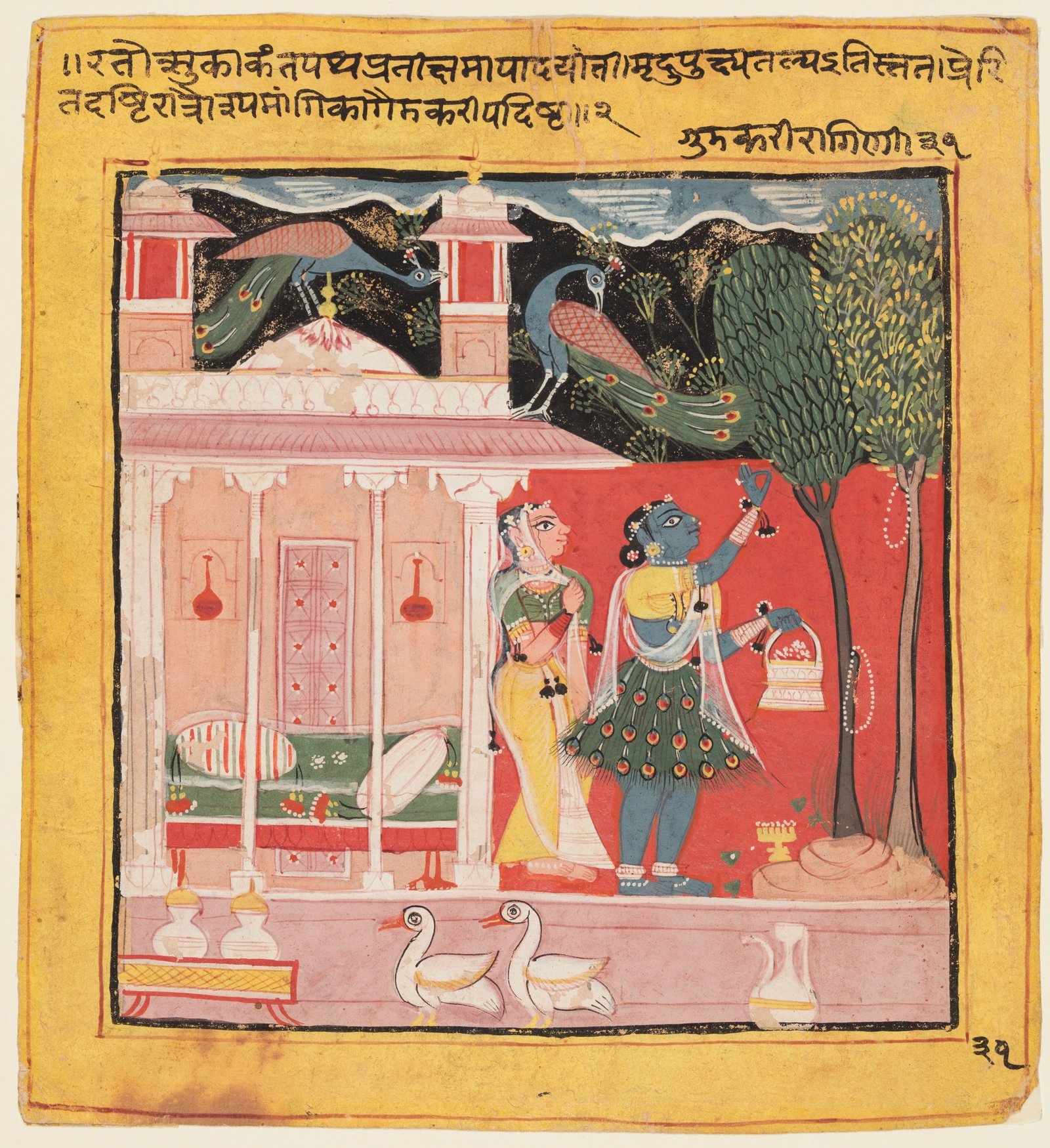
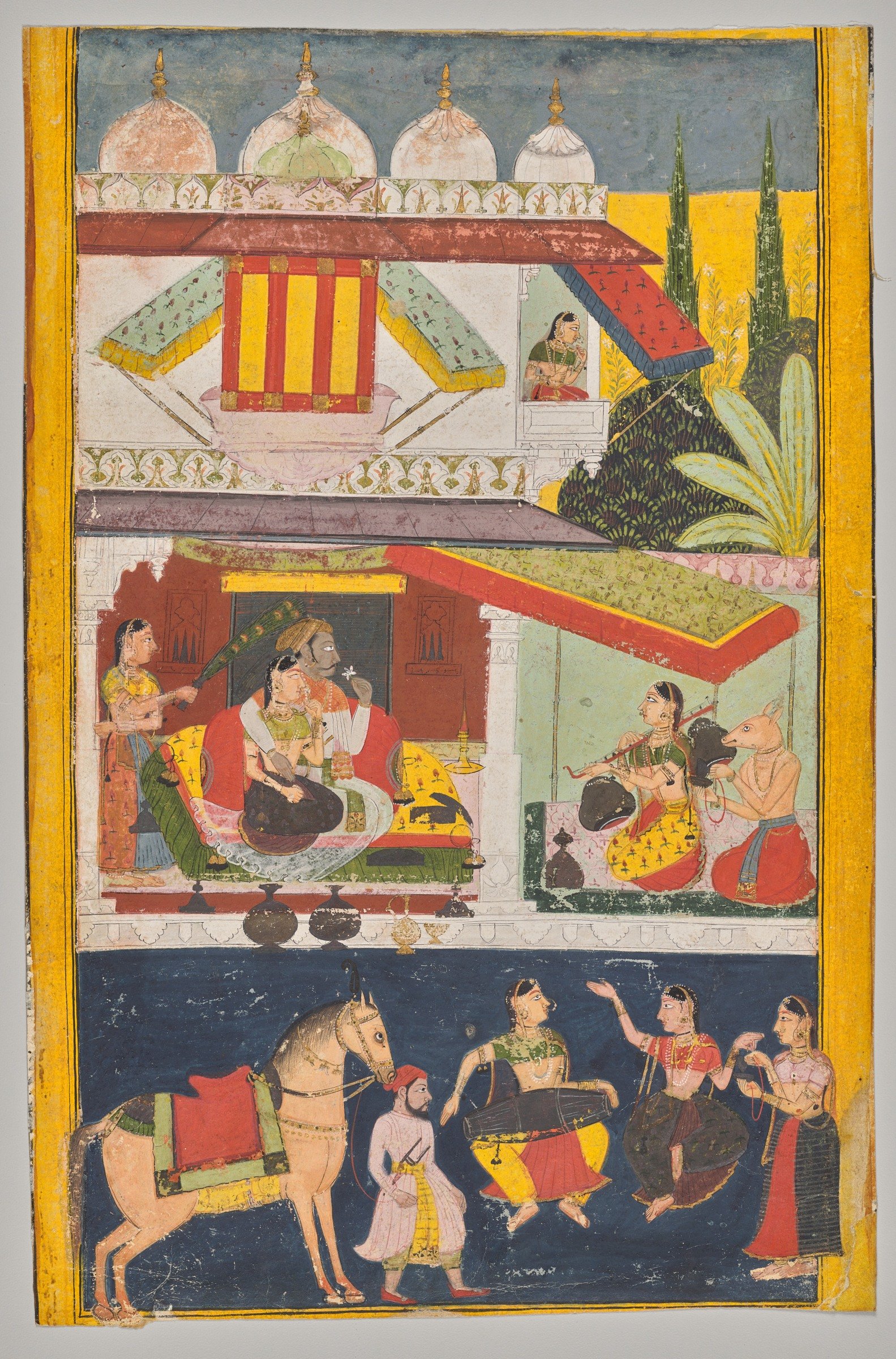
Do not confuse: Mewar and Marwar are different regional labels. Udaipur is a principal Mewar centre; Jodhpur belongs to Marwar. Also, “Mewar painting” covers a long development, not only the appearance of one seventeenth-century manuscript. Further reading: Impart Encyclopedia of Art: Mewar school; The Met: Wonder of the Age, master painters and workshops.
5. Bundi painting: movement, weather and expressive settings
Bundi belongs to the Hadoti region of southeastern Rajasthan. Its painting developed in a courtly environment connected with the Hada Rajputs and with the movement of painters and pictorial models between regional and Mughal centres. The Chunar Ragamala, dated 1591, is a key formative reference associated with the Bundi tradition; it was produced at Chunar rather than being evidence that every early Bundi work was painted inside Bundi itself. See Smithsonian: Kedar Ragini from the Chunar Ragamala, 1591.
Bundi and Kota are closely related regional traditions, but should not be collapsed into a single permanent label. Kota became a distinct court and is especially celebrated for energetic hunting imagery. Hunting, however, also appears at other courts, including Bundi, Mewar and the Mughals.
Visual features to compare
- Landscape: many works use luxuriant vegetation, curving growth, patterned leaves, rocks and water to animate the scene.
- Weather: clouds, lightning, rain and monsoon atmosphere can become expressive agents in love imagery.
- Movement: bending figures, turned heads, lively animals and rhythmic contours connect the forms.
- Architecture: terraces and pavilions create stages for encounters, music and courtly leisure.
- Subjects: Ragamala, Barahmasa, Krishna themes, lovers, court life and hunts.
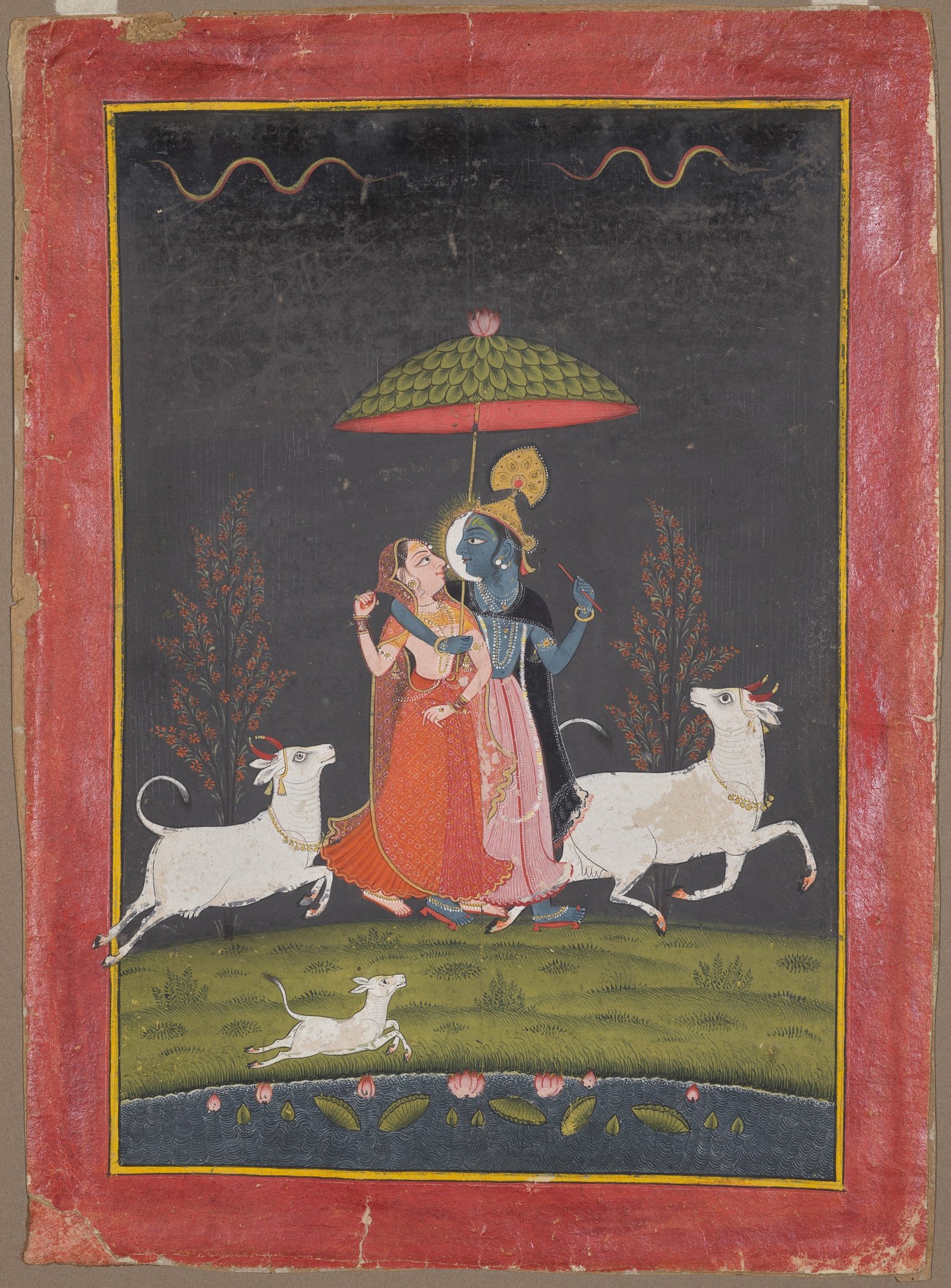
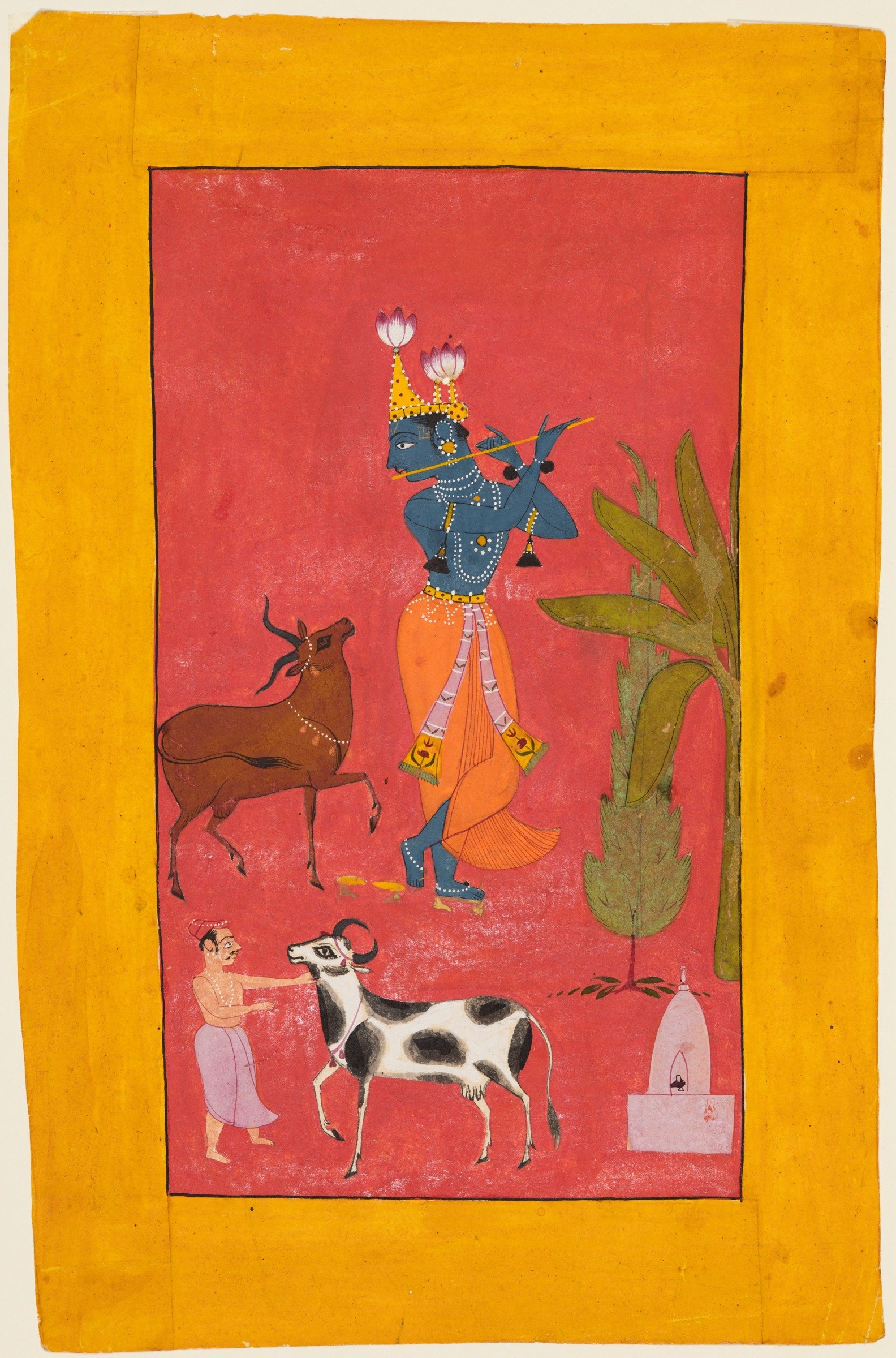
Identification caution: a storm does not identify Bundi by itself. Kangra artists also painted Govardhan storms and monsoon subjects. Ask how the figures, clouds, vegetation and surface rhythm work together. Do not attach a famous painter’s name to an anonymous museum work simply to complete a notes table.
6. Kishangarh painting: a distinctive ideal of beauty
Savant Singh, Nagaridas, Nihal Chand and Bani Thani
Kishangarh’s best-known painting idiom flourished in the eighteenth century, particularly around the court of Savant Singh, also spelled Sawant Singh. He is commonly listed as ruling from 1748 to 1757 and wrote Krishna-devotional poetry under the name Nagaridas. Nihal Chand is the painter most strongly associated with this celebrated courtly vision. Bhavani Das is another important figure in the earlier eighteenth-century development of the atelier.
Bani Thani was associated with the court’s poetic, musical and devotional culture; she is linked with the name Rasik Bihari. In celebrated paintings, courtly lovers may be represented or understood through the divine pair Radha and Krishna. This is more subtle than identifying every blue male figure as an ordinary portrait or every female figure as Bani Thani. The interpretation depends on the particular painting and its record. Context: LACMA: Savant Singh and Bani Thani as Krishna and Radha; LACMA: Savant Singh, poetry and Kishangarh patronage.
The characteristic facial type
- Very elongated, often upward-sweeping eyes and arched eyebrows.
- A pronounced, curved or aquiline nose and a finely tapering chin.
- Slender figures, graceful necks and carefully controlled, elegant contours.
- Delicate costumes, veils, jewellery and gestures.
- Expansive lake, terrace, garden or distant landscape settings in many celebrated compositions.
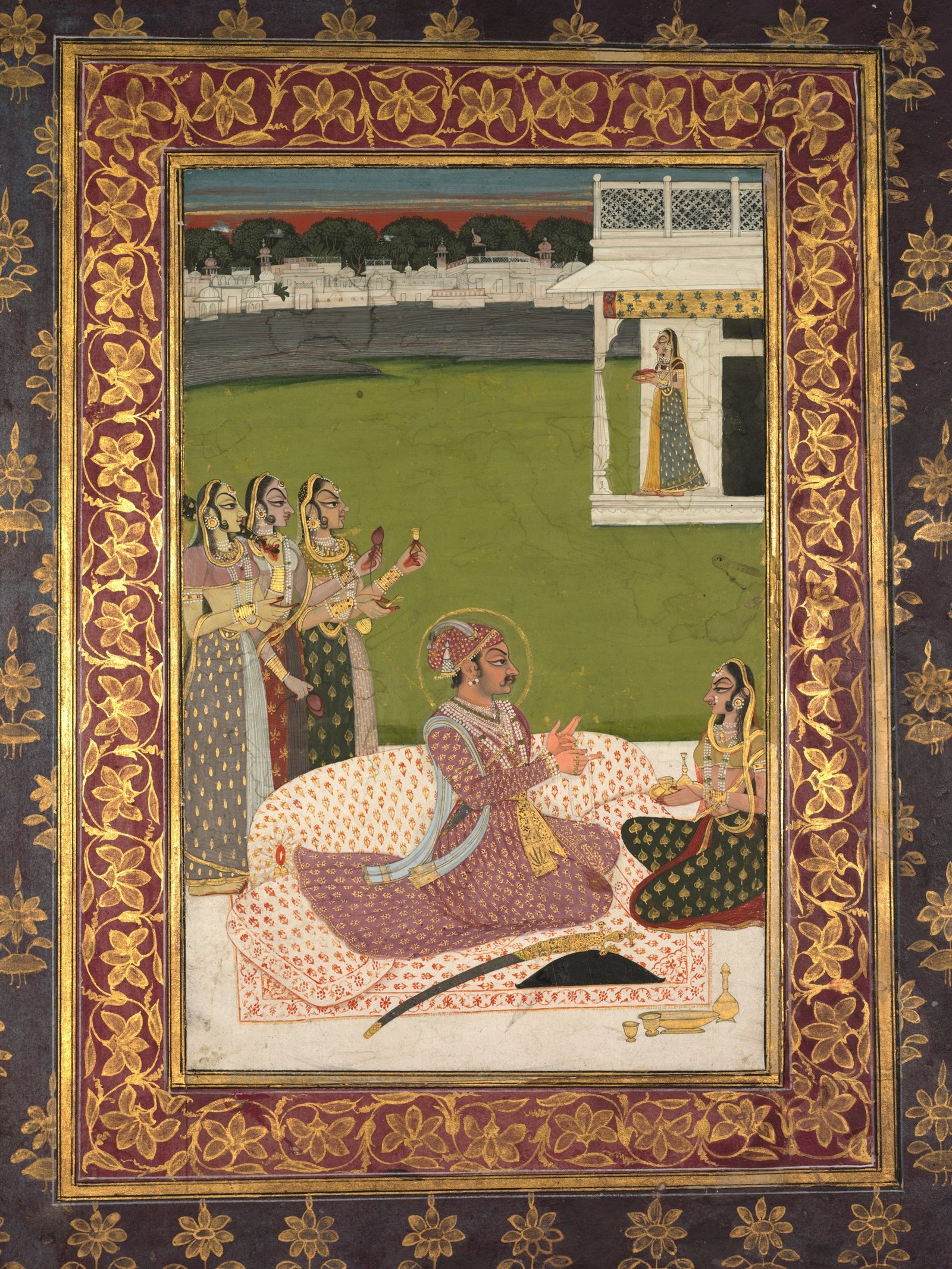
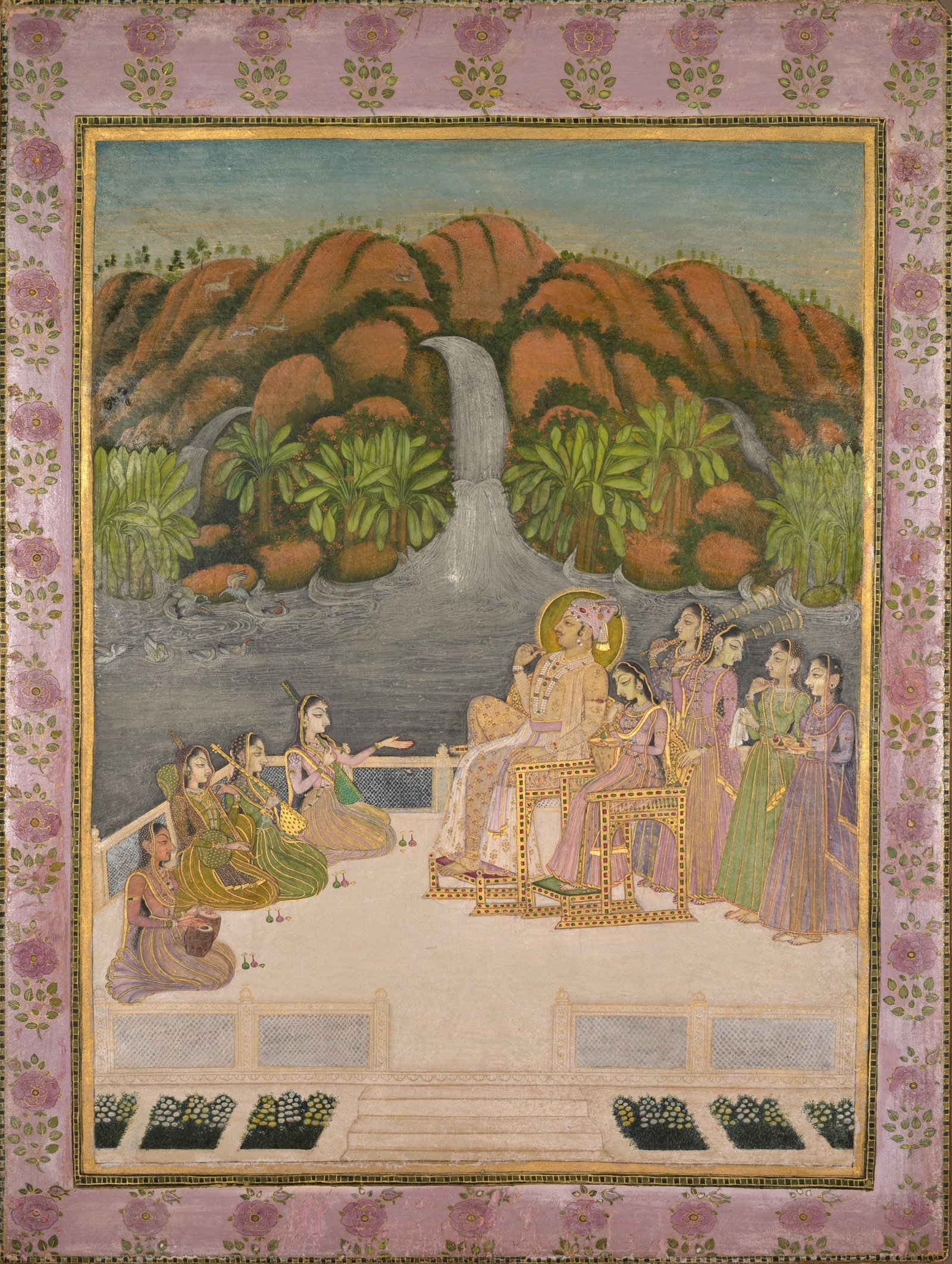
Bani Thani is an anchor, not the whole school. Kishangarh also produced portraits, literary illustrations and other subjects. The famous National Museum title should not become a generic label for every Kishangarh woman. Museum catalogues can also differ in how they name or attribute related images: National Museum / Museums of India: Bani Thani, 63.812.
7. Basohli painting: concentrated colour and forceful form
Historical anchors
Basohli is a historic hill-court tradition in the western Himalayan foothills, now within Jammu and Kashmir. It belongs to Pahari painting, not the Rajasthani schools. The late seventeenth century is a crucial period, especially the patronage associated with Raja Kirpal Pal.
A major dated anchor is the Rasamanjari series of 1694–1695 by Devidasa of Nurpur. The Rasamanjari is a text by Bhanudatta that classifies love situations and types of heroes and heroines. The painter’s connection with Nurpur is an immediate reminder that an artist’s origin and a painting’s courtly or stylistic classification are not the same thing.
Visual features
- Strongly articulated profiles and emphatic, frequently enlarged eyes.
- Powerful contours and tightly organised, emotionally charged figures.
- Intense contrasts between flat colour fields; red and yellow are frequent, but not compulsory.
- Compressed architecture, patterned textiles and a deliberately concentrated sense of space.
- In certain works, raised white ornament and applied beetle-wing material enrich the surface. These details must be verified on the object; a green spot in a web image is not sufficient proof.


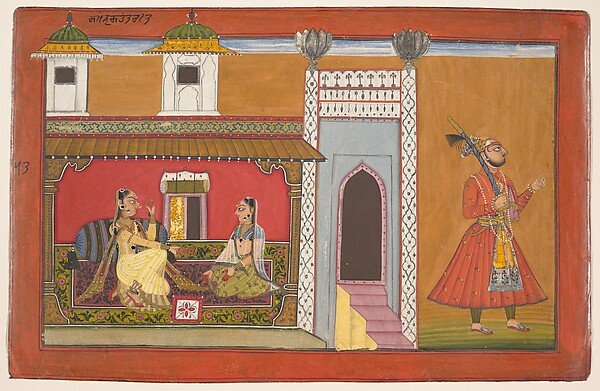
Related but not interchangeable: Manaku’s Gita Govinda of 1730 is often discussed in connection with the Basohli idiom. Manaku belonged to the painter family of Guler, and museum and scholarly classifications of particular works can use different regional terms. Retain the exact attribution and school label attached to the work you are studying, rather than making Manaku synonymous with every Basohli painting. Compare National Museum / Museums of India: Manaku, Gita Govinda, 1730 with The Met: Manaku and his painting family.
8. Kangra painting: lyrical line, figure and landscape
The Guler connection and Sansar Chand’s patronage
Kangra painting emerged within a wider Pahari network. Guler is essential to its formation: the family of Pandit Seu and his sons Manaku and Nainsukh played a major role in changing pictorial practice. Nainsukh’s celebrated work for Balwant Singh is associated particularly with Jasrota. He should not be described simply as a painter who personally made every later Kangra masterpiece.
Kangra court painting flourished under Raja Sansar Chand, whose reign is conventionally given as 1775–1823. Late eighteenth-century workshops included later generations of the artist-family tradition. A catalogue phrase such as “first generation after Nainsukh” is a workshop or generational attribution, not an artist’s personal name. See The Met: Kangra workshop, first generation after Nainsukh and Impart Encyclopedia of Art: Nainsukh.
Visual features
- Fine, flowing contours and figures whose gestures often communicate emotional nuances.
- Faces and bodies that are frequently more softly modelled than in the emphatic late seventeenth-century Basohli idiom.
- Landscapes in which hills, trees, water and paths support the unfolding of a mood or narrative.
- An important place for Krishna devotion, love poetry, seasons and the emotional states of heroines.
- A wide subject range that also includes epics, court portraits, battles, worship and other themes.
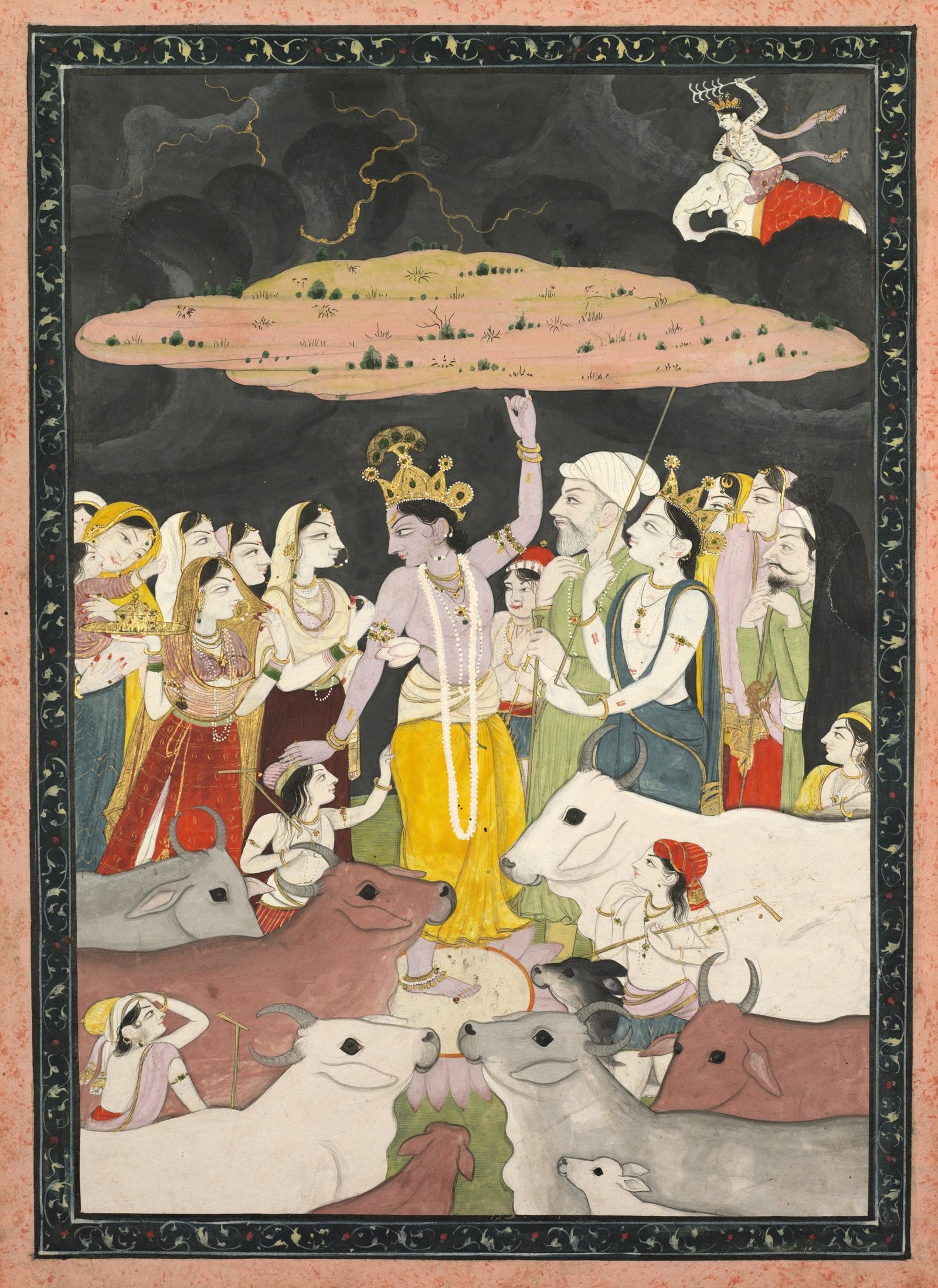
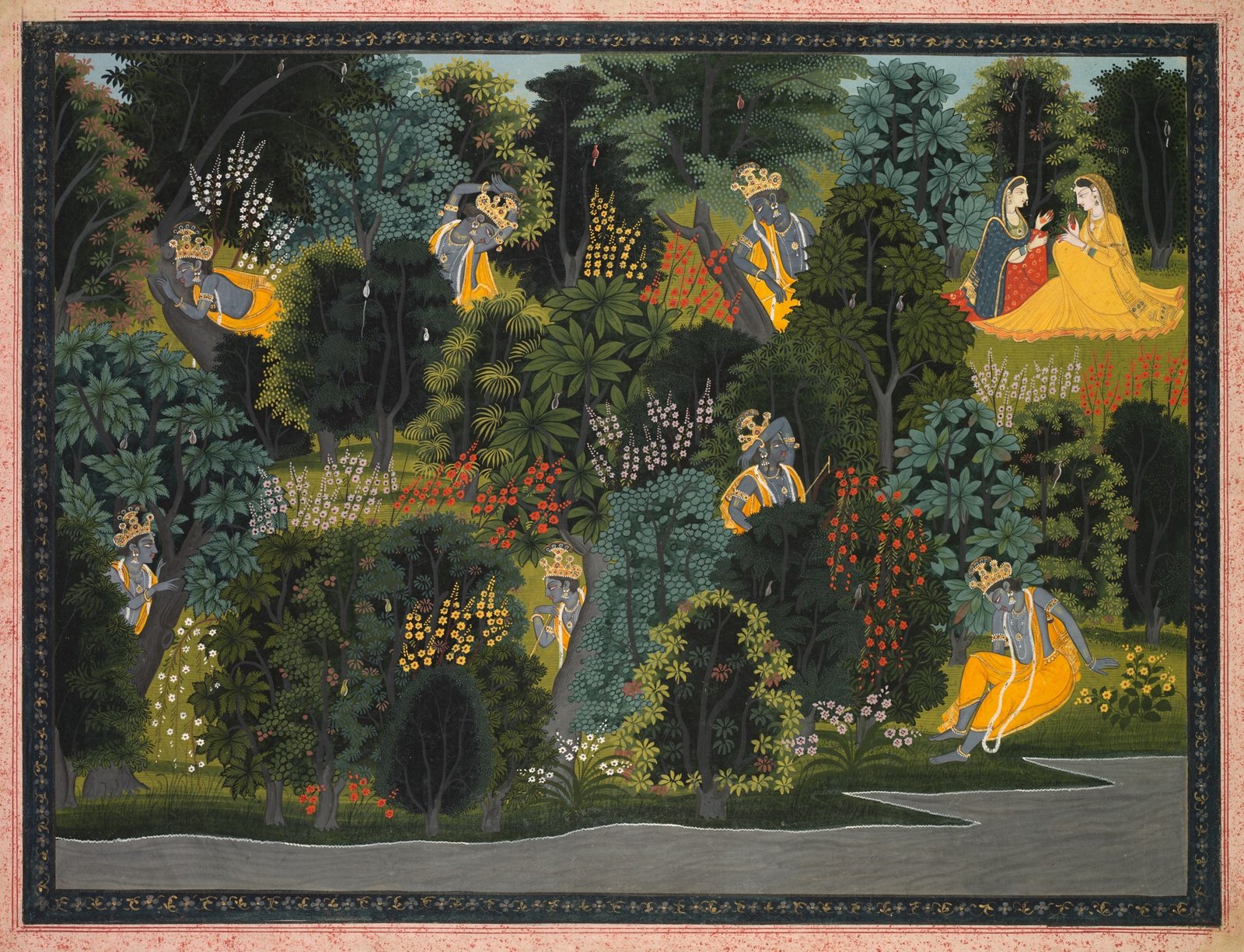
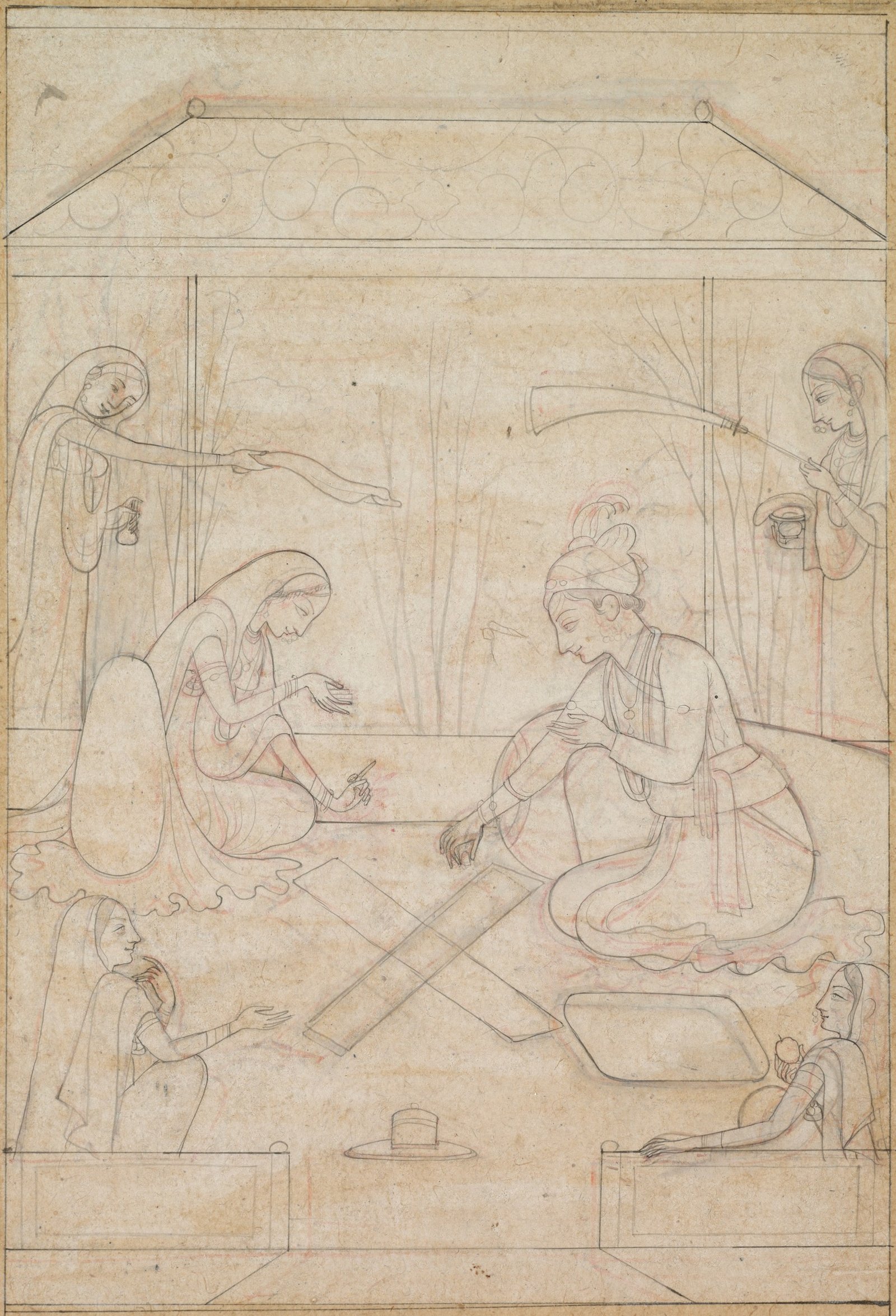
Identification caution: “soft colours and green hills” is too limited. The Govardhan scene is stormy and crowded; the drawing has no finished colour scheme at all. Look for the organisation of line, body, relationships and space, then test the historical attribution.
9. Basohli vs Kangra: the comparison students confuse most
| Feature | Basohli tendency in the selected works | Kangra tendency in the selected works |
|---|---|---|
| Face | Emphatic eyes and sharply articulated profile. | Often softer modelling and delicately related features. |
| Line | Assertive, visibly forceful contour. | Frequently finer and more fluid contour. |
| Colour | Concentrated contrasts and strongly bounded fields. | Often more varied transitions and a coordinated landscape palette; intense colour also occurs. |
| Space | Compressed, schematic or dramatically abstracted. | Often more continuous landscape and spatial relationships, though multiple viewpoints remain. |
| Historical anchors | Late 17th-century works; Devidasa’s Rasamanjari, 1694–95. | Late 18th-century flourishing under Sansar Chand, with continued 19th-century practice. |
| Shared ground | Pahari court culture; literary and devotional imagery. | Pahari court culture; literary and devotional imagery. |
10. Mewar vs Bundi: compare the organisation of the picture
Both images are colourful, both have strong profiles, and both use religious or poetic associations. The useful difference lies in the combination of figure type, gesture, architectural construction, plant treatment and surface rhythm. Compare dated works rather than inventing a rule that Mewar is always flat and Bundi always naturalistic.
In later paintings, Mughal influence can complicate the distinction further. The c. 1695 Mewar Shri Raga already combines strong colour fields with domed architecture and some recession. Bundi’s rain scene uses setting to heighten movement and feeling. Neither school can be reduced to the presence or absence of trees.
11. Kishangarh vs Kangra: two ideals of grace
| Question | Kishangarh | Kangra |
|---|---|---|
| Where is it situated? | Rajasthan. | Pahari / western Himalayan field. |
| What is the strongest famous face clue? | Marked elongation of the eye, aquiline profile and tapering chin in the celebrated Nihal Chand idiom. | Often subtler facial modelling and fluid contour; compare individual works. |
| Which patron should I associate? | Savant Singh, poet Nagaridas. | Sansar Chand, with Guler and artist-family connections. |
| Can both depict Radha and Krishna? | Yes. | Yes. |
| Can both have lakes, gardens and delicate figures? | Yes; none of these alone proves Kishangarh. | Yes; none of these alone proves Kangra. |
When an image is small, avoid guessing only from a face thumbnail. Check the whole composition, then enlarge the face. The sequence matters because similar idealised features can circulate between artists, patrons and later copies.
12. Mughal vs Rajput painting: avoid the secular–religious shortcut
A common classroom simplification says “Mughal = secular; Rajput = religious.” It is misleading. Mughal patrons commissioned illustrations of Hindu epics and devotional or literary subjects. Rajput courts produced portraits, hunts, court ceremonies, landscapes and secular love imagery as well as religious painting.
| Question | A stronger distinction |
|---|---|
| Is the sitter individually observed? | Useful when combined with modelling and details, but many Rajput rulers also received individualised portraits. |
| What is the painting’s function? | An imperial historical manuscript, an album portrait, a seasonal poem and a court festival image may organise information differently. |
| How is space built? | Study overlapping forms, compartments, registers, architecture and landscape. Avoid “Mughal always has correct perspective.” |
| What do the figure and setting reveal together? | Use a cluster of evidence and a catalogue attribution rather than identifying a dynasty from the religion of the subject. |
Mansur’s vultures, Shah Jahan’s imperial portrait and the Chingiz-nama court scene demonstrate three very different Mughal pictorial tasks. Similarly, Mewar’s Ragamala, Kishangarh courtly portraiture and Kangra’s Gita Govinda should not be treated as one undifferentiated “Rajput look.”
13. Shared themes: Ragamala, Rasikapriya, Rasamanjari and Gita Govinda
| Term / text | Author / association | How it appears in painting |
|---|---|---|
| Ragamala | A garland of musical modes; text and image traditions vary. | Ragas and raginis are personified through figures, situations, seasons, times and moods; no single school owns the genre. |
| Rasikapriya | Keshavdas. | Poetic discussion of love, heroes and heroines; often visualised through Krishna and Radha or courtly figures. |
| Rasamanjari | Bhanudatta. | Types and situations of lovers; Devidasa’s 1694–95 Basohli series is an important dated anchor. |
| Gita Govinda | Jayadeva. | The love of Radha and Krishna, with longing, separation, mediation and reunion; painted across several regional traditions. |
| Barahmasa / Baramasa | The twelve months as a poetic and emotional cycle; texts and pictorial treatments differ. | Seasons and climate connect nature, absence, desire and changing human experience. |
| Nayika-bheda | Classification of heroines in literary and aesthetic traditions. | A heroine’s emotional or situational type is shown through gesture, setting, costume and relationships. |
| Bhagavata Purana and Ramayana | Devotional and epic narrative traditions. | Many schools illustrate the same episodes. The shared episode must be separated from the manner of painting it. |
A correct subject identification is the beginning of the answer, not the final attribution. “Krishna lifting Govardhan” tells you what happens. It does not, by itself, tell you whether the painting is Mughal, Mewar, Bundi, Bikaner, Kangra or another tradition. Interpretive context: The Met: Poetic Allusions in Rajput and Pahari Painting.
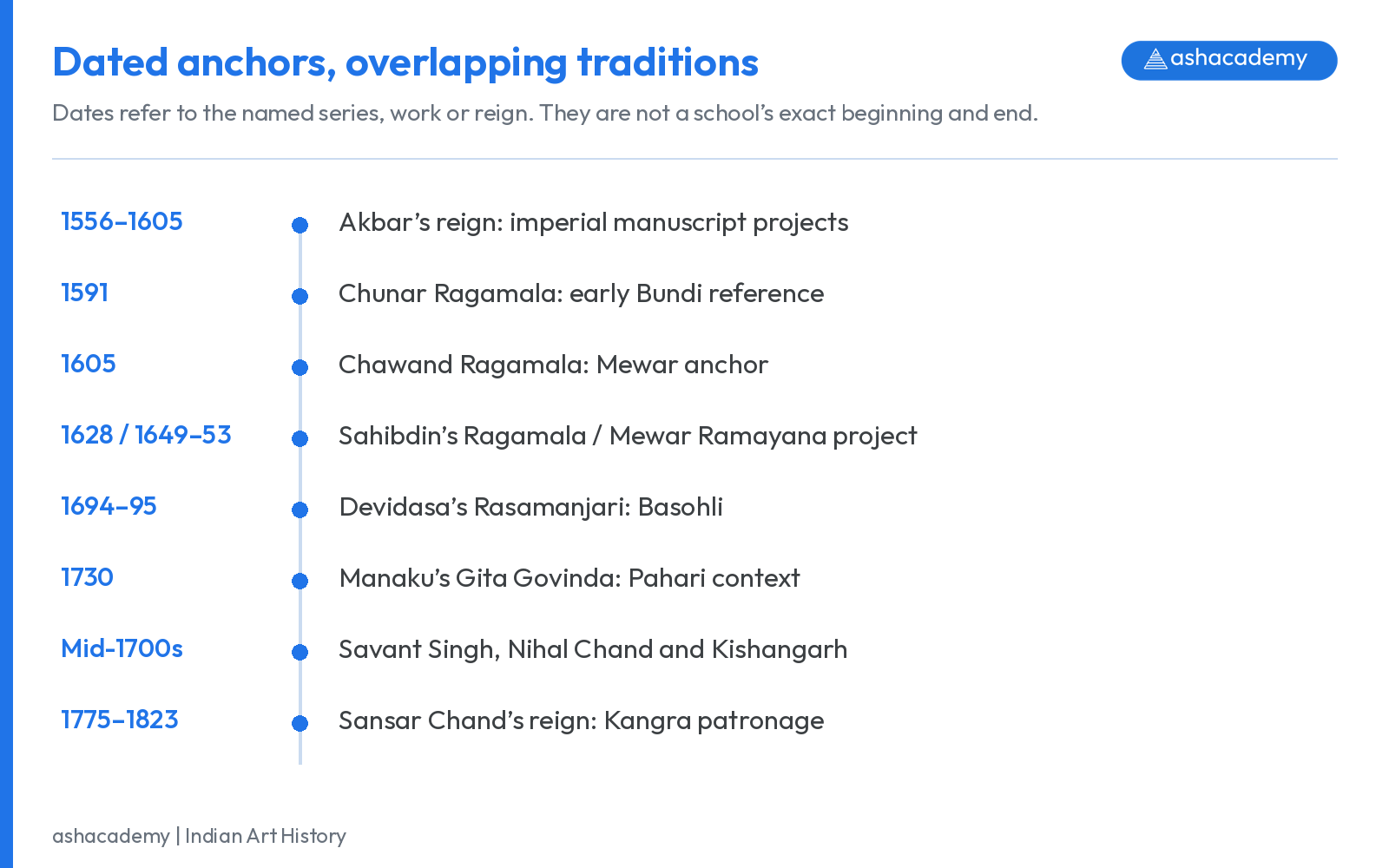
14. Chronology: dates to anchor your revision
| Date / period | Anchor | What the date refers to |
|---|---|---|
| 1556–1605 | Reign of Akbar. | A patron’s reign; not the date of every Mughal painting. |
| 1591 | Chunar Ragamala. | A dated series central to discussions of early Bundi development. |
| 1605 | Chawand Ragamala. | An important dated Mewar series. |
| 1605–1627 | Reign of Jahangir. | Portraiture, natural-history studies and connoisseurship are major associations. |
| 1628 | Sahibdin’s Ragamala; accession of Jagat Singh I. | A Mewar painting anchor and a patronage context. |
| 1649–1653 | Mewar Ramayana manuscript programme. | An extended collaborative project, not one painting made on a single day. |
| 1694–1695 | Devidasa’s Rasamanjari. | A dated Basohli-associated series by an artist from Nurpur. |
| 1730 | Manaku’s Gita Govinda. | A dated Pahari series; preserve the catalogue’s specific regional classification. |
| Mid-18th century | Celebrated Kishangarh idiom around Savant Singh and Nihal Chand. | A historical concentration, not the entire lifespan of Kishangarh painting. |
| 1775–1823 | Reign of Sansar Chand. | A key patronage context for Kangra painting. |
| c. 1820–1825 | Kangra / Lambagraon Gita Govinda example reproduced here. | Evidence that the tradition continued into the nineteenth century. |
For chronological questions, distinguish a ruler’s reign, an artist’s documented activity and a painting’s actual date. Approximate dates such as “c. 1690” should remain approximate in your notes.
15. Materials, technique and the meaning of miniature
Many of the works here use opaque colour, gum tempera or ink on paper, sometimes with gold or silver. Artists prepared supports, drew compositions, applied colour and refined contours and details. The exact support, binder, pigment and sequence should be taken from technical research or the individual object record rather than assumed for every school.
“Miniature” refers to traditions of carefully worked painting often associated with manuscripts, albums and intimate viewing. It does not mean that every work is tiny or that size alone defines a school. Cloth, large manuscript formats, wall paintings and other supports complicate any rigid formula.
- Do not identify pigments by screen colour alone. A blue area does not prove lapis lazuli, and white dots do not automatically establish a particular material.
- Respect the format. Text panels, borders, margins and later mounts can reveal how a work was read or collected.
- Separate the components. A painting, calligraphy panel and decorated border may have different dates and makers.
- Look at unfinished work. The Kangra chaupar drawing makes underdrawing visible; it should not be judged as an incomplete version of a school’s “required colours.”
16. Common mistakes and better answers
| Common mistake | Better answer |
|---|---|
| Every Radha–Krishna painting is Kangra. | The subject appears in many schools. Examine face, line, space and the complete setting. |
| Every painting with large eyes is Kishangarh. | Basohli can also have emphatic eyes. Compare the shape and direction of the eye with the nose, chin and body proportions. |
| A red background proves Mewar. | The Bundi Krishna Fluting here also has a red background. |
| Green hills prove Kangra. | Landscape occurs in several traditions; Kishangarh can have elaborate panoramic settings. |
| Mughal paintings never show Hindu subjects. | Imperial workshops illustrated Hindu epics and Krishna-related texts as well as other subjects. |
| Basohli is in Rajasthan. | Basohli is a Pahari hill-court tradition, now geographically in Jammu and Kashmir. |
| Mewar and Marwar are the same. | They refer to different regional contexts. |
| Nainsukh painted every famous Kangra scene. | Many works are attributed to later generations or anonymous workshops. |
| Nagaridas is a second painter next to Nihal Chand. | Nagaridas is the poetic name of patron Savant Singh. |
| Every folio in a named series has a securely identified painter. | Some attributions are anonymous, qualified or revised; preserve the source’s wording. |
| Basohli developed into Kangra through a simple replacement. | Pahari centres interacted, and older idioms continued alongside newer ones. |
| Every thumbnail image online is an original historical work. | Check the museum record; modern copies and reproductions can circulate under historic titles. |
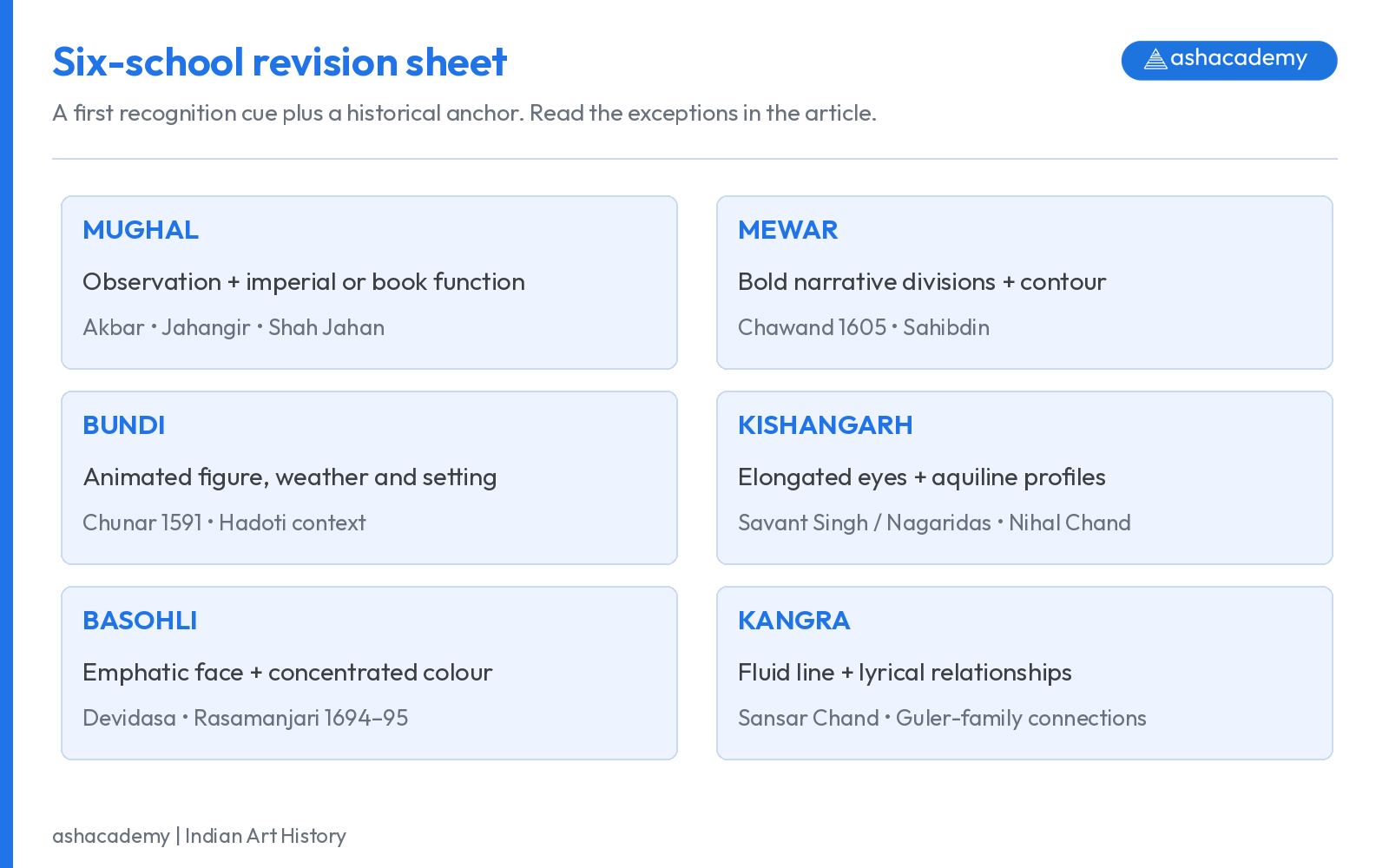
17. A revision sheet for note-making
| School | One-line revision note |
|---|---|
| Mughal | Imperial patronage + careful observation + narrative or album function; remember that refinement and symbolism coexist. |
| Mewar | Strong narrative colour structure + expressive contour; Chawand 1605 and Sahibdin are key anchors, with later stylistic change. |
| Bundi | Animated figure and setting + expressive weather and vegetation in many works; verify the full cluster, not just green scenery. |
| Kishangarh | The celebrated elongated eye and aquiline profile + slender elegance; Savant Singh / Nagaridas and Nihal Chand. |
| Basohli | Forceful contour + emphatic face + concentrated colour; Devidasa’s Rasamanjari, 1694–95. |
| Kangra | Fluid contour + nuanced figure relationships + lyrical setting in many works; Sansar Chand and Guler-family connections. |
Make a small note for each painting with six entries: title, school, date, artist or attribution, patron or context, and three visible clues. Add a seventh entry, “what could mislead me?”, to prevent superficial identification.
For a broader chronological framework, use our Indian Art History Timeline. For letterform and visual-communication analysis, see Typography for UGC NET Visual Arts.
18. Original practice questions with explanations
These questions were prepared for this article. They are original practice questions, not claimed previous-year questions.
1. Which two of these six traditions belong to the Pahari field?
Basohli and Kangra. Mewar, Bundi and Kishangarh are Rajasthani court traditions; Mughal is an imperial tradition.
2. Identify the stronger match: Savant Singh / Nagaridas, Nihal Chand and an exaggerated aquiline profile.
Kishangarh. Combine patron, artist and formal clues; do not depend on an eye shape alone.
3. Who painted the dated Rasamanjari series of 1694–95 discussed here?
Devidasa of Nurpur, associated with Basohli patronage. Preserve the distinction between the painter’s place-name and the school label.
4. Put these in order: Chawand Ragamala; Devidasa’s Rasamanjari; Chunar Ragamala; Manaku’s Gita Govinda.
Chunar Ragamala, 1591 → Chawand Ragamala, 1605 → Devidasa’s Rasamanjari, 1694–95 → Manaku’s Gita Govinda, 1730.
5. Can a painting of Krishna lifting Govardhan be assigned to Kangra from its subject alone?
No. Several schools illustrated the episode. Identify the pictorial treatment and verify catalogue evidence.
6. Why does the name Shah Jahan Album not date Mansur’s vultures to Shah Jahan’s reign?
Albums can combine components of different dates. The painted side of the folio reproduced here is dated c. 1615–20, during Jahangir’s reign.
7. Which terms identify authors rather than painting schools: Keshavdas, Bhanudatta, Jayadeva?
All three are literary authors associated respectively with Rasikapriya, Rasamanjari and Gita Govinda.
8. What is wrong with attributing every late eighteenth-century Kangra work to Nainsukh?
Later generations and workshops continued related practices. A generational attribution is not the same as a painting by Nainsukh himself.
9. A work has a flat red ground but the museum calls it Bundi. Must the museum be wrong?
No. Flat red grounds are not exclusive to Mewar. The Bundi Krishna Fluting shown here is a direct counterexample.
10. What should you do when one source says “attributed to Nihal Chand”?
Keep “attributed to” in your notes. Do not silently turn it into a signed or certain attribution.
19. Frequently asked questions
What are the main differences between Mughal, Rajput and Pahari painting?
Mughal describes an imperial tradition with changing workshop practices. Rajput is a broad historical category covering several court traditions, while Rajasthani and Pahari are useful regional groupings. Compare individual schools and works rather than applying one appearance to every painting in a group.
How do I identify Mewar, Bundi and Kishangarh paintings?
Compare a cluster of clues. Early Mewar often uses emphatic contour and bold narrative divisions; many Bundi works animate vegetation, weather and movement; the celebrated Kishangarh idiom has markedly elongated eyes and aquiline profiles. All three contain substantial variation.
How is Basohli painting different from Kangra painting?
In the selected examples, Basohli uses forceful contour, emphatic facial types and concentrated colour relationships. Kangra often has finer flowing line, softer modelling and more continuous landscape relationships. These are tendencies, with overlap and exceptions.
Which school is associated with Bani Thani?
Kishangarh. The famous imagery is associated with Nihal Chand and the courtly-devotional culture around Savant Singh, also known as Nagaridas. The exact title and attribution of a particular work should follow its museum record.
Is Kangra painting the same as all Pahari painting?
No. Kangra is one tradition within the wider Pahari field, which also includes Basohli, Guler, Chamba, Mandi, Nurpur and other centres.
Are the pictures in this article original historical artworks?
The artwork reproductions come from museum collection records and open-access image sources, with credits, dates and accession numbers. The study charts and cover layout are original ashacademy graphics. One Kangra example is explicitly identified as a drawing.
Is this useful for UGC NET Visual Arts preparation?
Yes. It supports the study of Indian painting chronology, regional traditions, artists, patronage and visual analysis. Use it with the official Code 79 syllabus and verified question practice; it does not predict the examination.
20. Sources, image credits and further study
This is an independent educational resource by ashacademy. It is not an NTA or UGC publication. The six-school selection is deliberately limited, while the wider history includes additional Rajasthani, Pahari, Deccani, manuscript, regional and modern traditions.
- UGC Visual Arts syllabus, Code 79
- The Met: The Art of the Mughals before 1600
- V&A: The arts of the Mughal Empire
- The Met: The Shah Jahan Album
- The Met: Poetic Allusions in Rajput and Pahari Painting
- The Met: Divine Pleasures, regional Rajput and Pahari courts
- The Met: Wonder of the Age, master painters and workshops
- Impart Encyclopedia of Art: Mewar school
- Smithsonian: Kedar Ragini from the Chunar Ragamala, 1591
- LACMA: Savant Singh and Bani Thani as Krishna and Radha
- LACMA: Savant Singh, poetry and Kishangarh patronage
- National Museum / Museums of India: Bani Thani, 63.812
- The Met: Devidasa’s Rasamanjari folio, 1694–95
- National Museum / Museums of India: Manaku, Gita Govinda, 1730
- The Met: Manaku and his painting family
- Impart Encyclopedia of Art: Nainsukh
- The Met: Kangra workshop, first generation after Nainsukh
- NCERT, An Introduction to Indian Art Part II: Rajasthani schools, SATHEE mirror
- NCERT, An Introduction to Indian Art Part II: Pahari schools, SATHEE mirror
- Cleveland Museum of Art: Open Access
Original artworks reproduced in this article
- Shah Jahan holding a spinel and a long Deccan sword, from the Late Shah Jahan Album; c. 1650; Cleveland Museum of Art; accession 2013.328.
- Hulagu Khan giving a feast and dispensing favor upon the amirs and princes, from a Chingiz-nama (Book of Chingiz Khan) of the Jami al-tavarikh (Compendium of Chronicles); c. 1596–1600; Cleveland Museum of Art; accession 2013.304.
- A Woman Plucks Leaves While Awaiting Her Lover: Gunakali Ragini of Malkos, from the “Chawand Ragamala”; 1605; Cleveland Museum of Art; accession 2018.136.
- Shri Raga, from a Ragamala; c. 1695; Cleveland Museum of Art; accession 1931.451.
- Radha and Krishna in the Rain; c. 1780; Cleveland Museum of Art; accession 1988.120.
- Krishna Fluting; c. 1675–1700; Cleveland Museum of Art; accession 2018.157.
- Portrait of Maharaja Savant Singh with Consort, Bani Thani; mid-1700s; Cleveland Museum of Art; accession 2001.172.
- Portrait of Sardar Singh (Son of Savant Singh, 1730–68); c. 1760; Cleveland Museum of Art; accession 2001.122.
- Dipak Raga, One of the Thirty-Six Melodies (Ragamala): Personifying Love; c. 1690; Cleveland Museum of Art; accession 1990.13.
- Markandeya Viewing Krishna in the Cosmic Ocean; c. 1680; Cleveland Museum of Art; accession 1967.241.
- Krishna Lifting Mount Govardhan; c. 1780–90; Cleveland Museum of Art; accession 2001.45.
- Couple Playing Chaupar on a Terrace; c. 1790–1800; Cleveland Museum of Art; accession 1936.683.
- Krishna’s longing for Radha, from a Gita Govinda (Song of the Cowherd) of Jayadeva; c. 1820–25; Cleveland Museum of Art; accession 1989.333.
- A Courtesan and Her Lover Estranged by a Quarrel: Page from a Rasamanjari series; dated 1694–95; The Metropolitan Museum of Art; accession 57.51.14.
- "Red-Headed Vulture and Long-Billed Vulture", Folio from the Shah Jahan Album; verso: ca. 1615–20; recto: ca. 1535–45; The Metropolitan Museum of Art; accession 55.121.10.12.
Image treatment: Original artwork colours and proportions are retained. Study-page borders and labels sit outside the artwork. Images repeated in comparisons are the same credited works, not additional paintings. The profile chart uses labelled detail crops, while full originals are shown separately. The cover contains a selection of credited reproductions; it is an editorial layout, not an original historical object. The flowcharts and revision sheet are teaching aids, not museum evidence.
Attribution policy: “Attributed to,” “possibly,” broad regional descriptions and approximate dates are preserved where supplied. Collections revise their records, so use the linked museum page for a later catalogue update. A work’s place of production, the painter’s origin, a patron’s court and its modern school label may differ.
For deeper reading, consult B. N. Goswamy and Eberhard Fischer, Pahari Masters; B. N. Goswamy, Nainsukh of Guler and Manaku of Guler; and Milo Cleveland Beach, Mughal and Rajput Painting. NCERT’s An Introduction to Indian Art, Part II provides a useful initial framework, while specialist catalogues explain changing attributions and individual workshops.

You may also like
Fauvism: History, Characteristics, Artists and Important Artworks
Symbolism in Art: History, Characteristics, Artists and Artworks