Impressionism: History, Characteristics, Artists and Artworks
WESTERN ART MOVEMENTS · ILLUSTRATED STUDY NOTES · UGC NET VISUAL ARTS
Impressionism was a diverse movement that developed in France during the 1860s and became publicly identified with a series of eight independent exhibitions held in Paris between 1874 and 1886. Its artists explored modern life, changing light, colour relationships and new ways of framing what they saw. Visible brushwork and outdoor observation are important, but neither explains every artist in the group.
Think of the movement through four connected questions: What changed in modern life? How did artists paint it? Who exhibited independently? What makes each artist different? This guide combines original artwork reproductions, visual analysis, historical chronology, artist–artwork matching and original practice questions. It is designed for understanding first and efficient revision afterwards.
| Quick question | Essential answer |
|---|---|
| Where did it emerge? | France, especially Paris and the Seine’s suburban and rural surroundings. |
| When did it develop? | During the 1860s; independent group exhibitions, 1874–1886; individual careers continued afterwards. |
| First exhibition? | Opened 15 April 1874, at Nadar’s former studio, 35 boulevard des Capucines, Paris. |
| Why the name? | Monet’s Impression, Sunrise and Louis Leroy’s satirical review of 25 April 1874. |
| One founder? | No single founder. A network of artists organised the exhibitions and developed different approaches. |
| One manifesto? | No single founding manifesto comparable to those of some later avant-garde movements. |
Jump to: Historical context · Meaning and ideology · Origins and exhibitions · Visual characteristics · Artists · Monet · Comparisons · Exam revision · Visual quiz · Sources
1. Historical context: why Impressionism emerged
Nineteenth-century French artists worked within a powerful system of training, juried exhibitions, official recognition and patronage. The annual Salon could make reputations and attract buyers. Academic history painting enjoyed prestige, although Salon art was more varied than the simple label “old-fashioned” suggests. For younger artists, the problem was not only what to paint, but also who had the authority to judge, exhibit and sell it.
The Salon des Refusés of 1863, authorised under Napoleon III, displayed work rejected by the Salon jury. Manet’s Le Déjeuner sur l’herbe became a controversial example. This event belongs to the background of Impressionism, but it was not the first Impressionist exhibition. The independent group exhibition followed in 1874, eleven years later.
Source: Getty: When Impressionism Was a Dirty Word.
Paris itself was changing. Haussmann’s rebuilding under Napoleon III created broad boulevards and new urban views. Railways connected the capital with suburbs and leisure destinations; boating, cafés, theatres, parks, races and dance halls supplied contemporary subjects. A bridge, railway station or crowded street could carry the visual interest previously reserved for heroic history. These were selective views of modernity, shaped by class, work, leisure and the artist’s access to particular spaces.
The Franco-Prussian War of 1870–71 and the violent upheaval of the Paris Commune in 1871 also form part of the context. The first exhibition opened after these disruptions. Its paintings should not all be read as direct illustrations of the war, but the decision to organise independently belonged to a society renegotiating institutions, authority and public life.
Source: National Gallery of Art: 1874 and its historical circumstances.
Earlier landscape painters had already worked from nature. Corot, the Barbizon painters, Eugène Boudin and Johan Barthold Jongkind helped establish precedents for outdoor observation and atmospheric effects. Impressionists extended these interests into a more conspicuous handling of colour and paint, and into modern urban and suburban subjects. They did not invent the landscape, outdoor painting or the study of light from nothing.
Source: Musée des impressionnismes Giverny: antecedents and the early circle.
2. Meaning and ideology: what did the artists want?
An “impression” is the perceived appearance of something under particular conditions. An object’s colour can seem different in sunlight, shadow, mist or reflected light. Impressionist paintings often make this changing appearance visible rather than presenting every form through an equally sharp contour. The observer’s position and the moment of looking become part of the subject.
This was not simply an invitation to paint vaguely. A convincing effect could require close observation, selection, revision and careful composition. A sketchlike surface may be a deliberate finished statement. The works also make a claim about subject matter: the ordinary activities and environments of contemporary life deserve sustained artistic attention.
The artists’ strongest shared institutional commitment was independent exhibition, rather than obedience to one style or political programme. Monet’s shifting landscapes, Degas’s constructed interiors and Caillebotte’s controlled perspective are visibly different. It is more accurate to treat Impressionism as a network with shared concerns and disagreements than as a school with identical instructions.
Source: The Met: Impressionism, modernity and the independent collective.
3. Origins, naming, publications and eight exhibitions
Artists exchanged ideas in Parisian studios and cafés, including the Café Guerbois. Monet, Renoir, Sisley and Bazille also knew one another through training and working relationships. In 1873 an artists’ cooperative, usually abbreviated as the Société Anonyme des Artistes Peintres, Sculpteurs, Graveurs, etc., took shape. Its first exhibition opened on 15 April 1874 at the former studio of photographer Nadar. “Nadar’s studio” identifies the venue; it does not make Nadar the founder or painter of Impressionism.
The exhibition was stylistically varied. Musée d’Orsay’s reconstruction stresses this diversity. Retrospective accounts can differ in their participant counts, so this guide prioritises the securely established date, venue and named artists rather than turning a disputed total into a memorisation rule.
Source: Musée d’Orsay: Paris 1874, Inventing Impressionism.
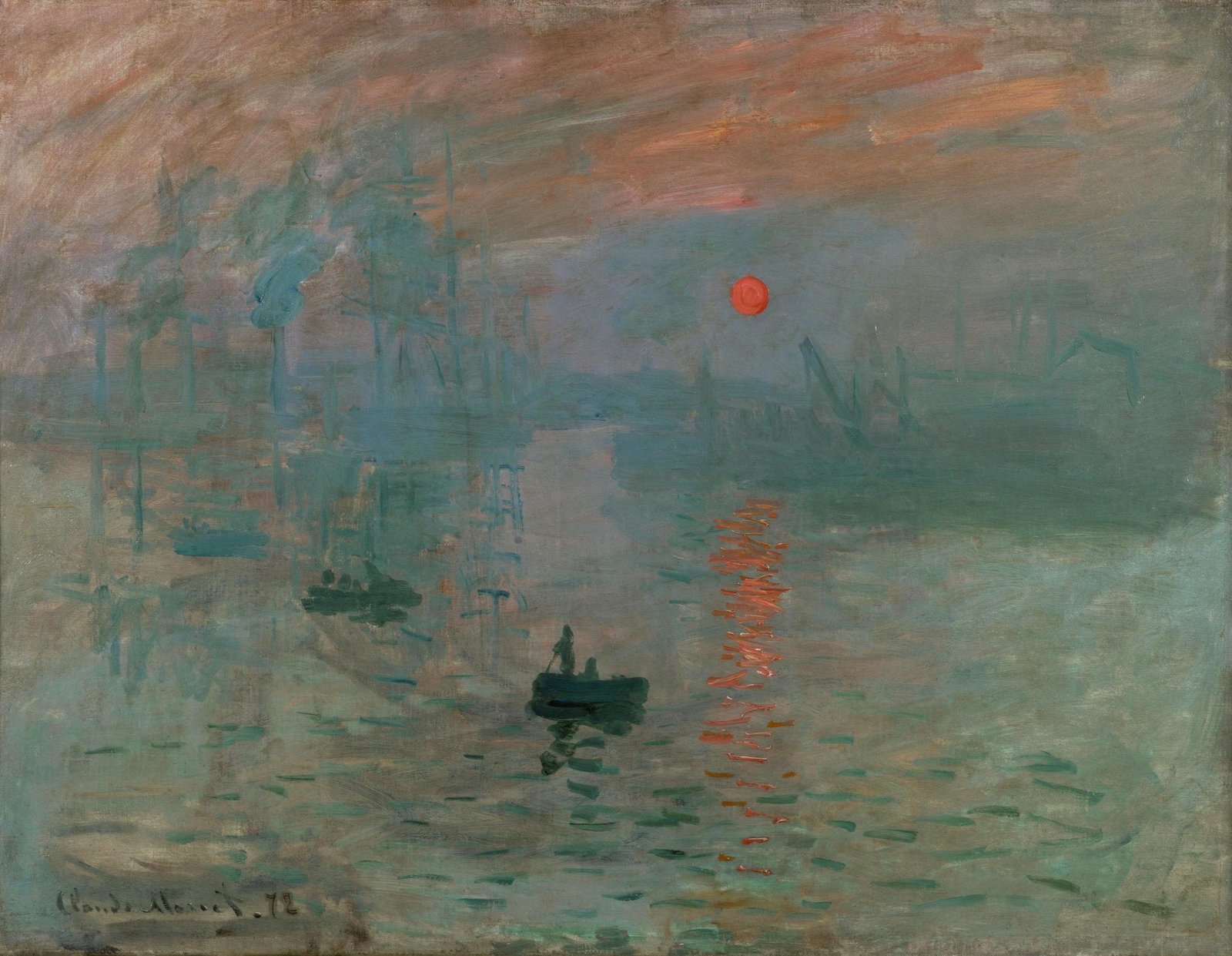
Look closely: An orange sun and its reflection punctuate the blue-grey harbour. Boats, cranes and smoke belong to a working port, not an untouched natural paradise. The contrast between a few strong marks and a hazy setting helps explain the title.
Monet painted Impression, Sunrise in 1872; it was exhibited in 1874. The subject is the port of Le Havre. Louis Leroy used its title in his satirical article L’Exposition des impressionnistes, published in Le Charivari on 25 April 1874. Jules Castagnary soon used the label more positively. The word “impression” already had an artistic history; Leroy did not invent the ordinary word itself.
For revision, preserve the sequence: painting, 1872 → first exhibition, 1874 → Leroy’s review, 25 April 1874. Do not date the canvas 1874 merely because the exhibition occurred then. Its owning collection is Musée Marmottan Monet, not Musée d’Orsay.
Source: Musée Marmottan Monet: the painting, date, subject and critical reception.
| Exhibition | Year | Revision significance |
|---|---|---|
| First | 1874 | Independent exhibition at Nadar’s former studio; Monet’s Impression, Sunrise shown. |
| Second | 1876 | The exhibition project continues; Edmond Duranty publishes La Nouvelle Peinture. |
| Third | 1877 | Major works by Renoir and Caillebotte; a more explicit public Impressionist identity. |
| Fourth | 1879 | Mary Cassatt begins exhibiting with the group. |
| Fifth | 1880 | Continued exhibition despite changing participation. |
| Sixth | 1881 | Further evidence of the group’s diverse membership and approaches. |
| Seventh | 1882 | Monet, Renoir and Sisley participate again. |
| Eighth | 1886 | Final group exhibition; Seurat and Signac signal Neo-Impressionist developments. |
The years are 1874, 1876, 1877, 1879, 1880, 1881, 1882 and 1886. They were not eight consecutive annual exhibitions. Pissarro participated in all eight. Manet participated in none. The end of the exhibition series in 1886 did not end Monet’s painting career or instantly terminate all Impressionist work.
Source: French Ministry of Culture: the eight Impressionist exhibitions.
Important writing: Leroy’s 1874 review helps explain the name; Edmond Duranty’s La Nouvelle Peinture (1876) argues for modern subjects and new pictorial approaches. These are critical writings, not a jointly signed founding manifesto. Charles Baudelaire’s earlier essay The Painter of Modern Life, published in 1863, is useful wider context for thinking about modernity, rather than an official Impressionist rulebook.
Source: National Gallery of Art: Paris 1874 research and publication context.
4. Visual characteristics: how to identify Impressionism
| Feature | What you may see | Avoid the shortcut |
|---|---|---|
| Broken brushwork | Separate strokes, dabs or touches remain visible. | Not every work consists of small dots. |
| Light and atmosphere | Mist, reflections, coloured shadows, seasonal or weather changes. | Not every scene is sunny or outdoors. |
| Colour relationships | Adjacent hues and warm–cool contrasts help establish form. | Artists did not all follow one scientific colour formula. |
| Modern subjects | Boulevards, cafés, transport, dancers, leisure and domestic spaces. | Landscape is important, but it is not the only subject. |
| Composition | Cropping, asymmetry, diagonals and high or unexpected viewpoints. | An informal effect may be carefully planned. |
| Surface and finish | The movement of the brush can become part of the experience. | Visible brushwork does not prove a painting is incomplete. |
| Materials | Oil on canvas is central; pastel, drawings and prints also matter. | Impressionism is not a single-medium movement. |
Use the table as a set of clues, not a mechanical checklist. Ask how the marks, colour relationships and framing operate together. A smooth surface does not automatically exclude an artist from the exhibiting group, and loose brushwork alone cannot establish a painting’s historical identity.
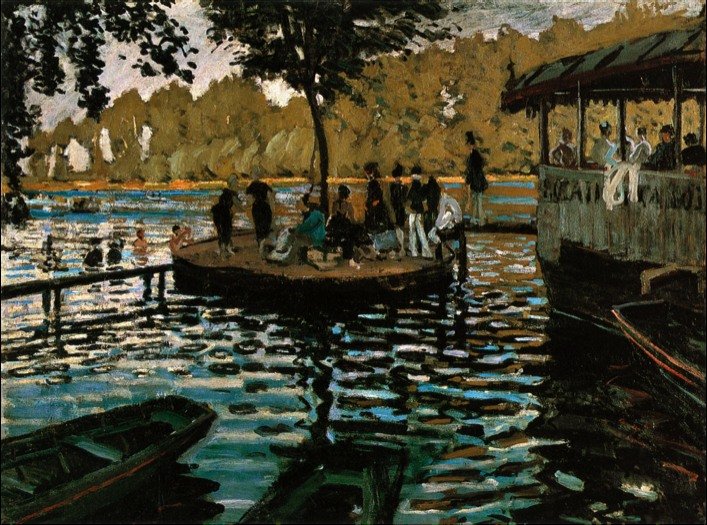
Look closely: Horizontal touches on the river differ from the upright figures and tree forms. The floating platform connects social activity with shifting reflections. Monet and Renoir painted at this resort together in 1869, before the first group exhibition.
The full picture makes one important connection visible: technique and subject reinforce each other. The moving, reflective river encourages broken marks; modern leisure supplies the figures and setting. To analyse the image, first identify the large compositional zones, then examine how individual strokes describe water without outlining every reflected object.
Source: The Met: Monet’s La Grenouillère.
5. Technique, materials and new ways of seeing
En plein air means working in the open air. It helped artists study changing conditions directly. Portable equipment and commercially prepared paints made the practice more convenient. John Goffe Rand patented a collapsible metal paint tube in 1841. This was an enabling technology, not a one-step explanation of the movement, and outdoor painting existed before the patent.
Source: National Portrait Gallery: John Goffe Rand and paint-tube patents.
Broken colour describes visible, separated touches of different hues. Wet-in-wet means putting paint into a layer that is still wet. Impasto is a raised or thick deposit of paint. These terms describe different things: colour placement, the state of the paint layer and surface thickness. A painting can combine them without making them synonyms.
New synthetic pigments expanded available colours, but the useful question is how a specific painter used the palette. Avoid saying Impressionists “never used black” or “never mixed colours.” Such absolute claims do not account for differences between artists, works and periods. Likewise, an outdoor beginning did not prevent later work in the studio.
Source: National Gallery, London: Impressionism and painting practice.
Japanese ukiyo-e prints offered examples of asymmetry, cropped forms, patterned surfaces and unusual spatial arrangements. Their importance is often called Japonisme. This was a cross-cultural process of selection and reinterpretation, not evidence that every Impressionist copied a single Japanese design. Photography belongs to the wider visual environment too, but a painting’s “snapshot” effect should not automatically be treated as proof that it was copied from a photograph.
Source: The Met: Japonisme.
6. Main artists in birth-year chronology
This table distinguishes central exhibitors, an influential precursor and artists who moved in other directions. Life dates organise the sequence; they do not identify when each artist joined the group. Artists born in the same year are grouped without implying an exact order by birthday.
| Artist | Life dates | Contribution or relationship |
|---|---|---|
| Camille Pissarro | 1830–1903 | Rural work, landscape and later urban series; the only participant in all eight group exhibitions. |
| Édouard Manet | 1832–1883 | A crucial influence on the younger circle; never exhibited in the eight group shows. |
| Edgar Degas | 1834–1917 | Modern figures, dance, urban labour, unusual framing, drawing, pastel and printmaking. |
| Alfred Sisley | 1839–1899 | Landscape, rivers, weather and sky; British nationality, born and active mainly in France. |
| Paul Cézanne | 1839–1906 | Exhibited in 1874 and 1877; later developed a distinct structural approach. |
| Claude Monet | 1840–1926 | Light, atmosphere, landscape and sustained series of a repeated motif. |
| Marie Bracquemond | 1840–1916 | An important woman associated with Impressionist exhibitions; distinguish her from Félix Bracquemond. |
| Berthe Morisot | 1841–1895 | Domestic and outdoor modern life; central independent exhibitor and innovative painter. |
| Pierre-Auguste Renoir | 1841–1919 | Figures, sociability, portraiture and light; later changes in contour and modelling. |
| Frédéric Bazille | 1841–1870 | A key early colleague; died before the first group exhibition. |
| Armand Guillaumin | 1841–1927 | Landscape, industrial surroundings and strong colour. |
| Mary Cassatt | 1844–1926 | American artist active in Paris; women, children, looking, domestic life and innovative prints. |
| Gustave Caillebotte | 1848–1894 | Modern city life, perspective, cropping, organising and financial support for fellow artists. |
For museum biographies, see Pissarro, Sisley, Monet, Morisot, Renoir and Cassatt. The wider circle also included artists not represented by a separate section here.
7. Camille Pissarro: continuity, cooperation and change
Pissarro’s importance is both pictorial and organisational. He painted rural surroundings and working life as well as later Parisian streets, and supported the independent exhibition project across all eight shows. His career connects artists of different generations, including Cézanne and the younger Neo-Impressionists. In the 1880s he experimented with their more systematic division of colour before returning to a freer handling.
Source: Museo Thyssen-Bornemisza: Pissarro’s career and cooperative commitment.
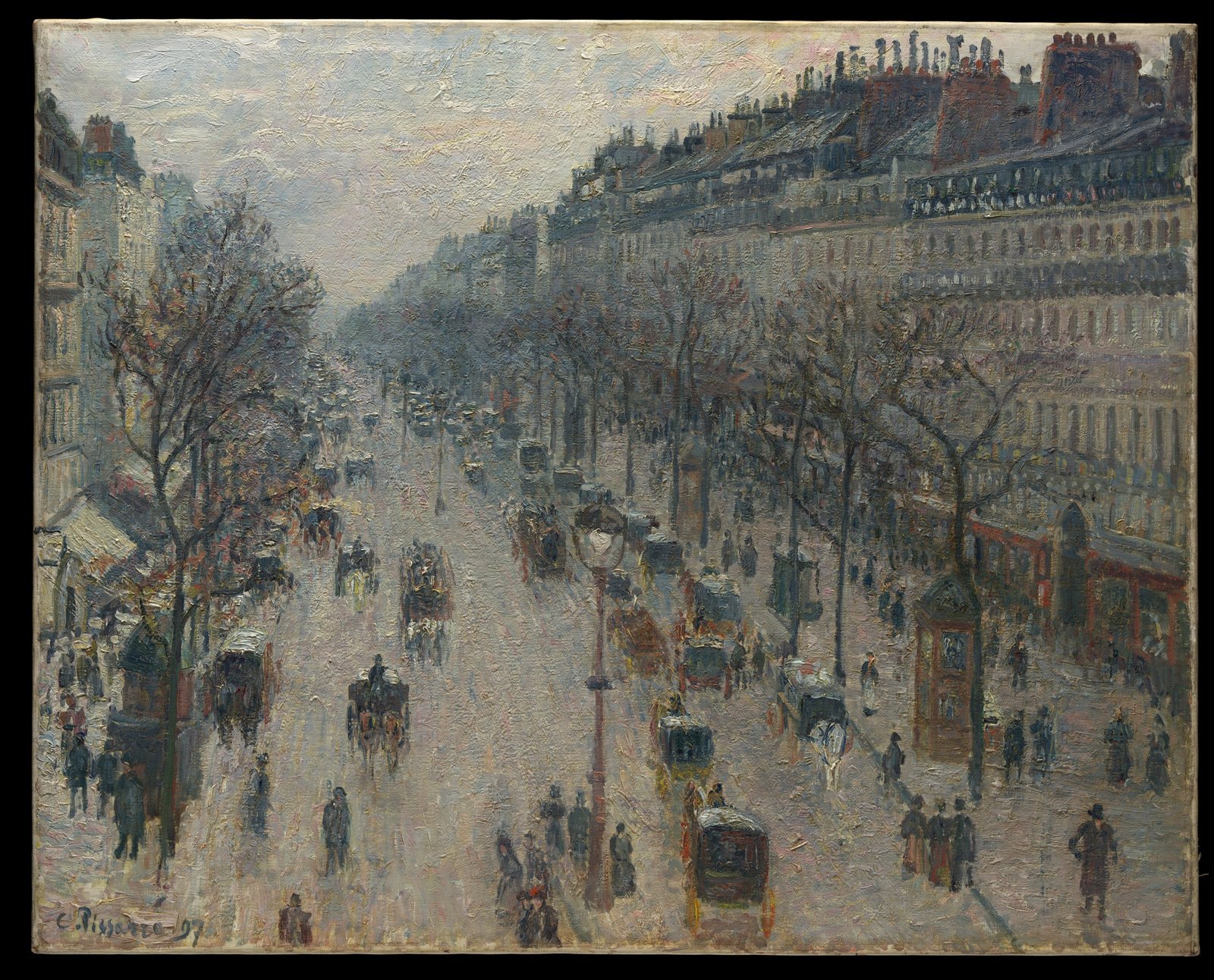
Look closely: The elevated viewpoint organises traffic, pedestrians, trees and buildings into a long urban corridor. The scene was observed from hotel lodgings in 1897. It demonstrates why “Impressionism always means an easel outdoors” is inadequate.
This is The Boulevard Montmartre on a Winter Morning, not a generic title for every boulevard painting by Pissarro. Similar titles belong to different canvases and collections. Learn the full title, date and collection together. The small marks describing distant people also show how detail can be distributed according to distance and atmosphere rather than rendered uniformly.
8. Édouard Manet: influential, but not a group exhibitor
Manet challenged conventional expectations about modern subjects and pictorial finish and became an important point of reference for younger artists. His relationship with them was reciprocal: in the 1870s he also responded to outdoor painting and brighter colour. Institutional participation and stylistic influence are separate questions. Calling him influential does not mean adding him to the list of the eight exhibitions.
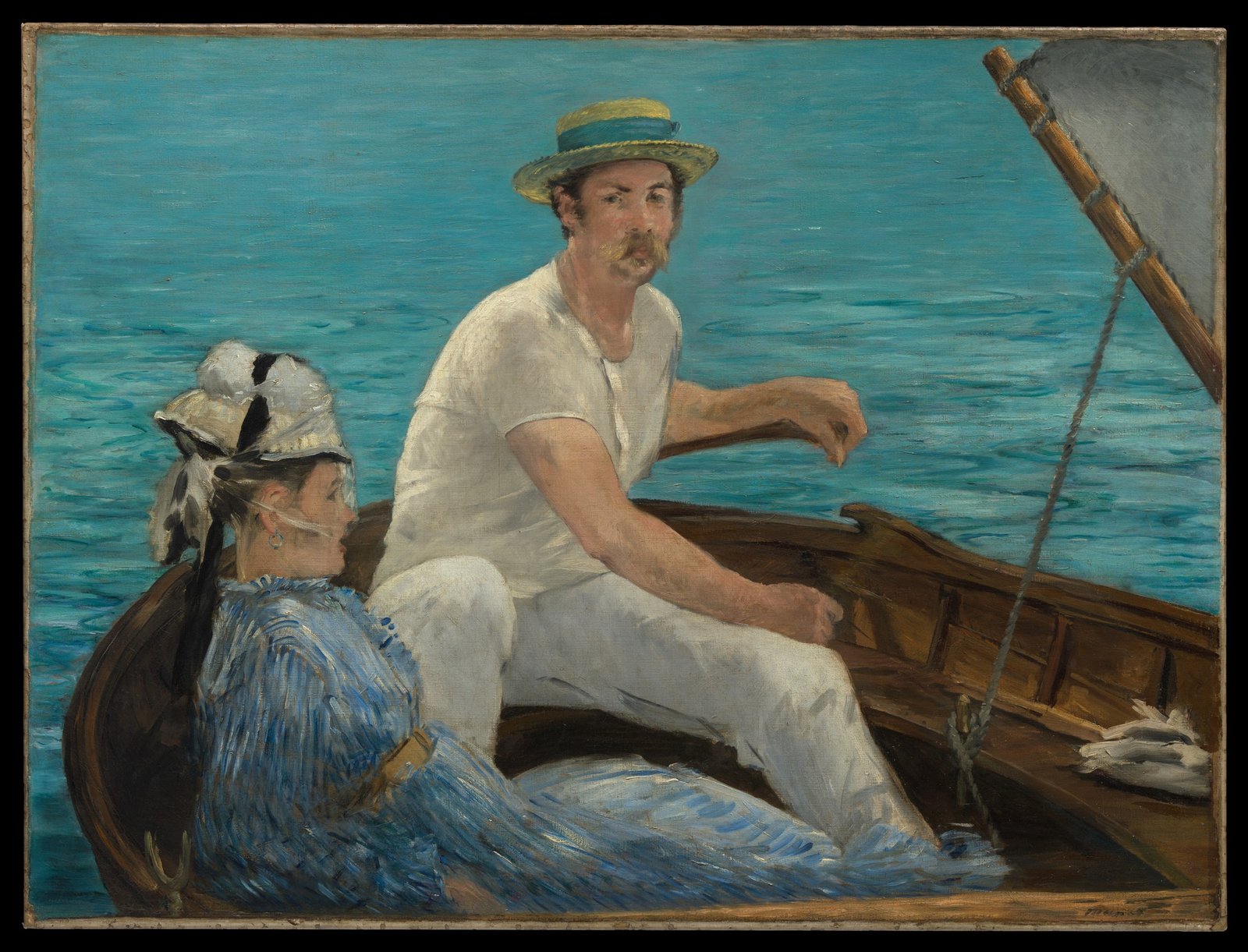
Look closely: The sail and boat are abruptly cropped; a strong diagonal organises the figures against blue water. Modern dress and leisure identify contemporary life. Compare the compressed space with the deeper urban perspective in Caillebotte’s Rainy Day.
Painted in 1874, Boating was shown at the Salon of 1879. Those two dates concern different events. The work helps explain Manet’s close artistic relationship with Monet and Renoir while preserving his separate exhibition choices. Do not confuse Manet with Monet: the similar names belong to different painters.
9. Edgar Degas: movement, labour and constructed viewpoints
Degas makes the limits of a landscape-centred definition especially clear. His subjects include dancers, performers, racecourses and working people. Drawing and studio construction remained central. He used oil, pastel, printmaking and other media, often returning to a pose or compositional problem. An apparently accidental arrangement can be the result of repeated study.
Source: The Met: Degas’s drawing, composition and media.
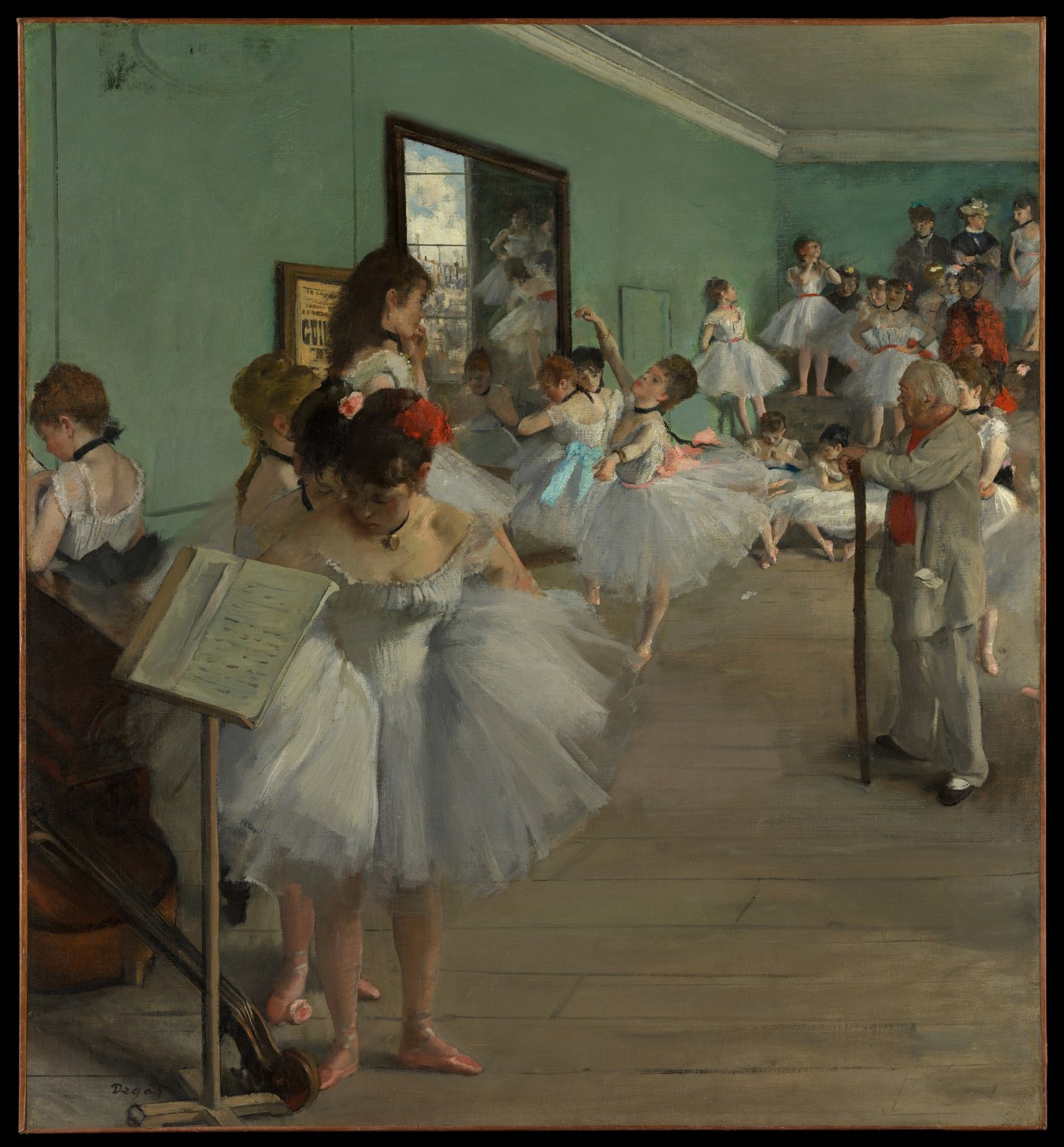
Look closely: The long room, oblique floorboards and spread of figures create depth and pauses. Some dancers wait or adjust themselves rather than perform. Look at the instructor and dispersed attention: this is a scene of training and work as well as ballet.
The Met’s The Dance Class is dated 1874. Degas made related dance-class compositions, including another in Musée d’Orsay. Similar subjects and titles do not make them the same object. Match the image and collection before attaching a date. This work also shows that an Impressionist-associated image need not dissolve every figure into indistinct patches of outdoor light.
10. Alfred Sisley: landscape as a sustained investigation
Sisley devoted much of his career to landscape. Rivers, roads, bridges, settlements and changing skies supplied structure as well as atmosphere. He was born in Paris to British parents and retained British nationality. “French Impressionist movement” identifies a historical setting; it does not mean every participating artist held French nationality.
Source: Museo Thyssen-Bornemisza: Sisley’s biography.
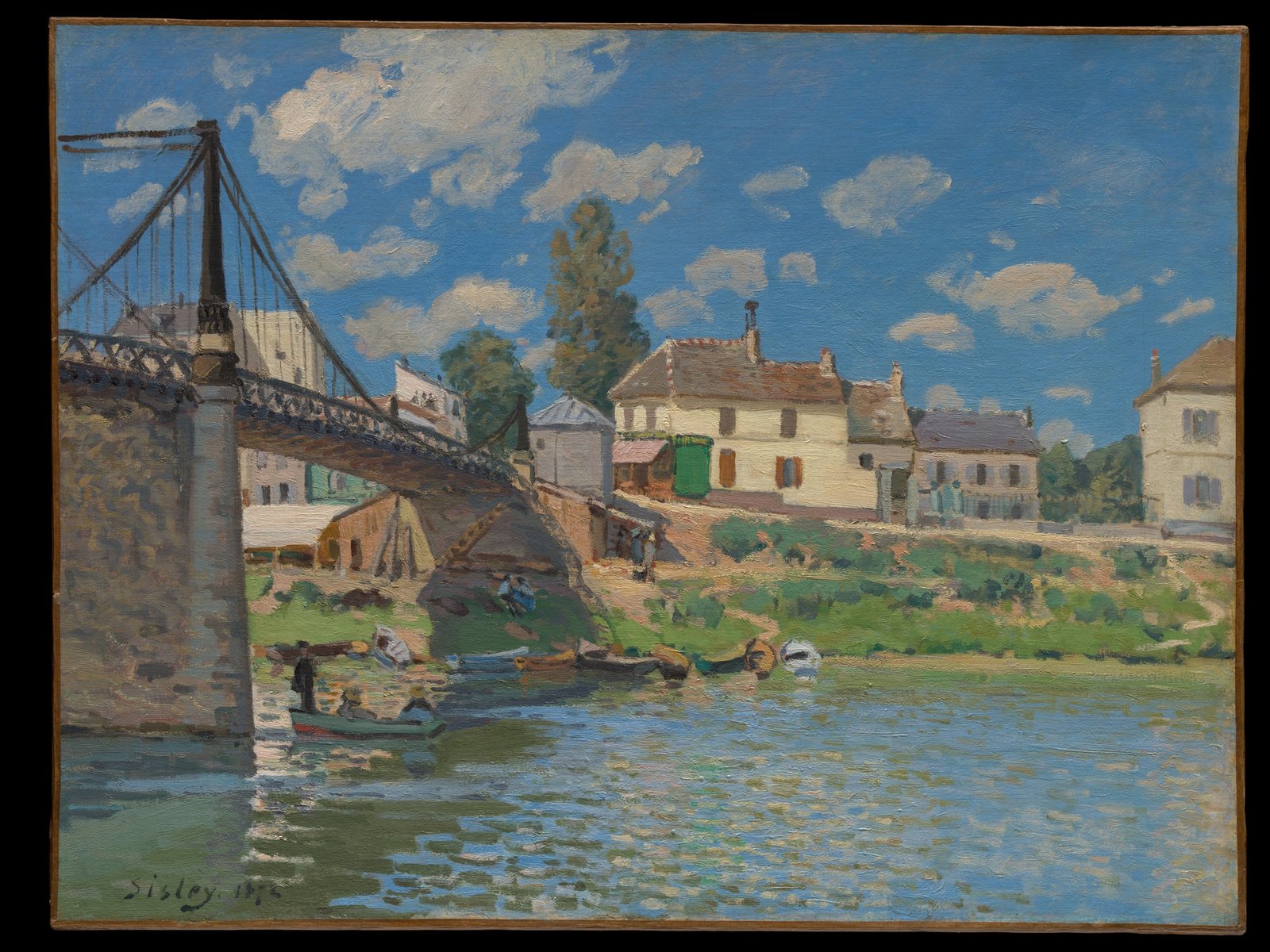
Look closely: The bridge establishes a firm diagonal across the scene; boats and figures animate the riverbank. Separate touches describe the water without removing the bridge’s structural clarity. Compare the sky’s broad field with the activity below.
The 1872 painting combines modern infrastructure and leisure with observed weather and water. It is neither an abstract colour exercise nor a timeless landscape without people. For visual matching, associate Sisley with a sustained landscape practice, but use the specific composition to confirm an identification rather than treating every river scene as his.
11. Claude Monet: the motif changes with the conditions
Monet’s early contact with Boudin helped turn his attention towards painting from nature. His later work makes changing appearance a sustained problem: one motif can produce many different paintings. Rather than memorising “Monet = water lilies” alone, follow the relationship between light, atmosphere, colour and repetition across his career.
Source: National Gallery, London: Monet’s life and development.
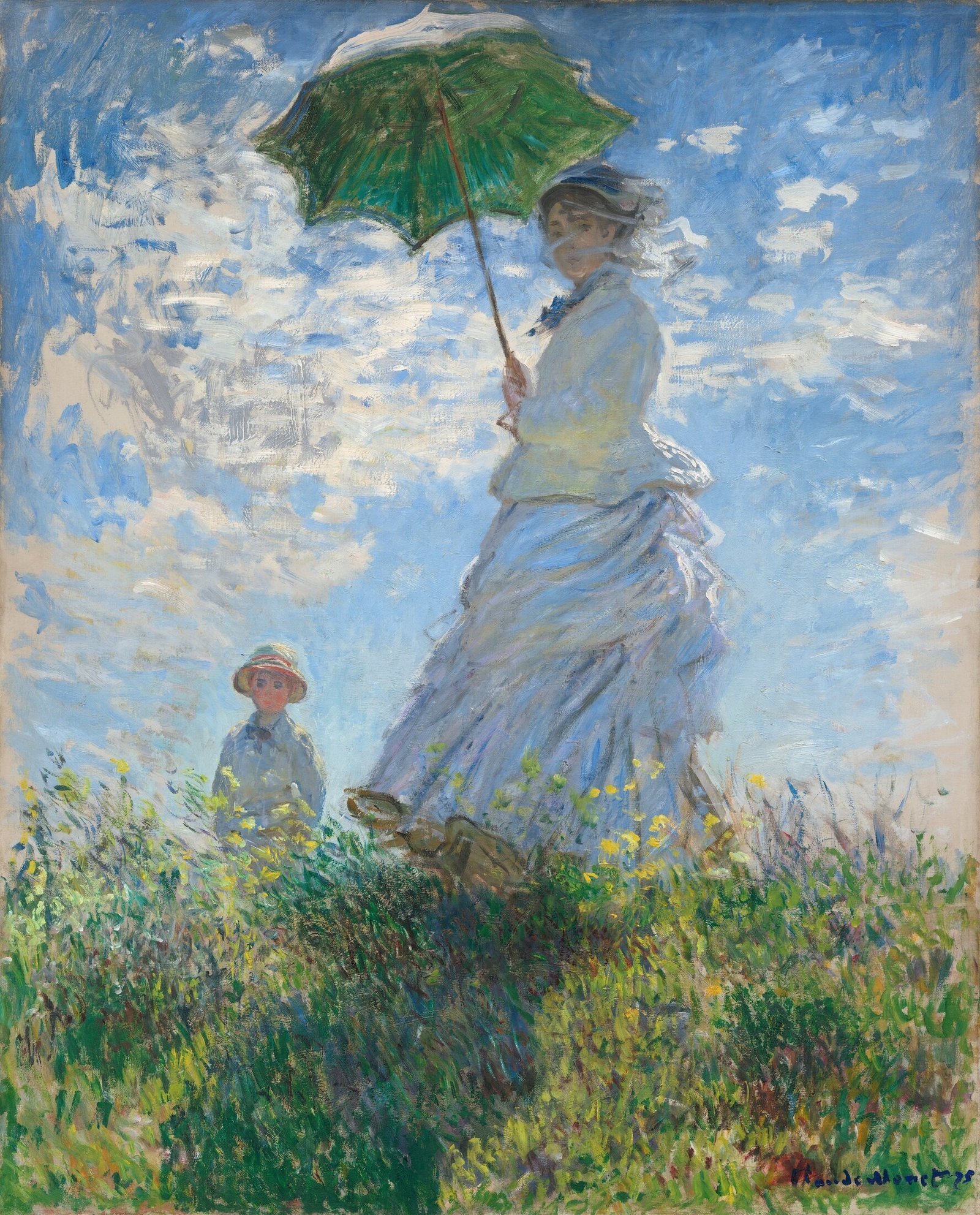
Look closely: A low viewpoint lifts Camille Monet and the parasol against the sky, while the child appears lower on the slope. Wind, angled fabric, grass and separate brushmarks establish an immediate outdoor sensation. White clothing contains reflected and shadow colours rather than one uniform white.
Woman with a Parasol – Madame Monet and Her Son is dated 1875. Its figure subject matters: Monet was not exclusively a painter of uninhabited scenery. The umbrella’s form, the slope and the sky organise a coherent composition beneath the lively handling. As an exercise, locate the brightest and darkest areas before naming individual colours.
Source: National Gallery of Art: Woman with a Parasol.
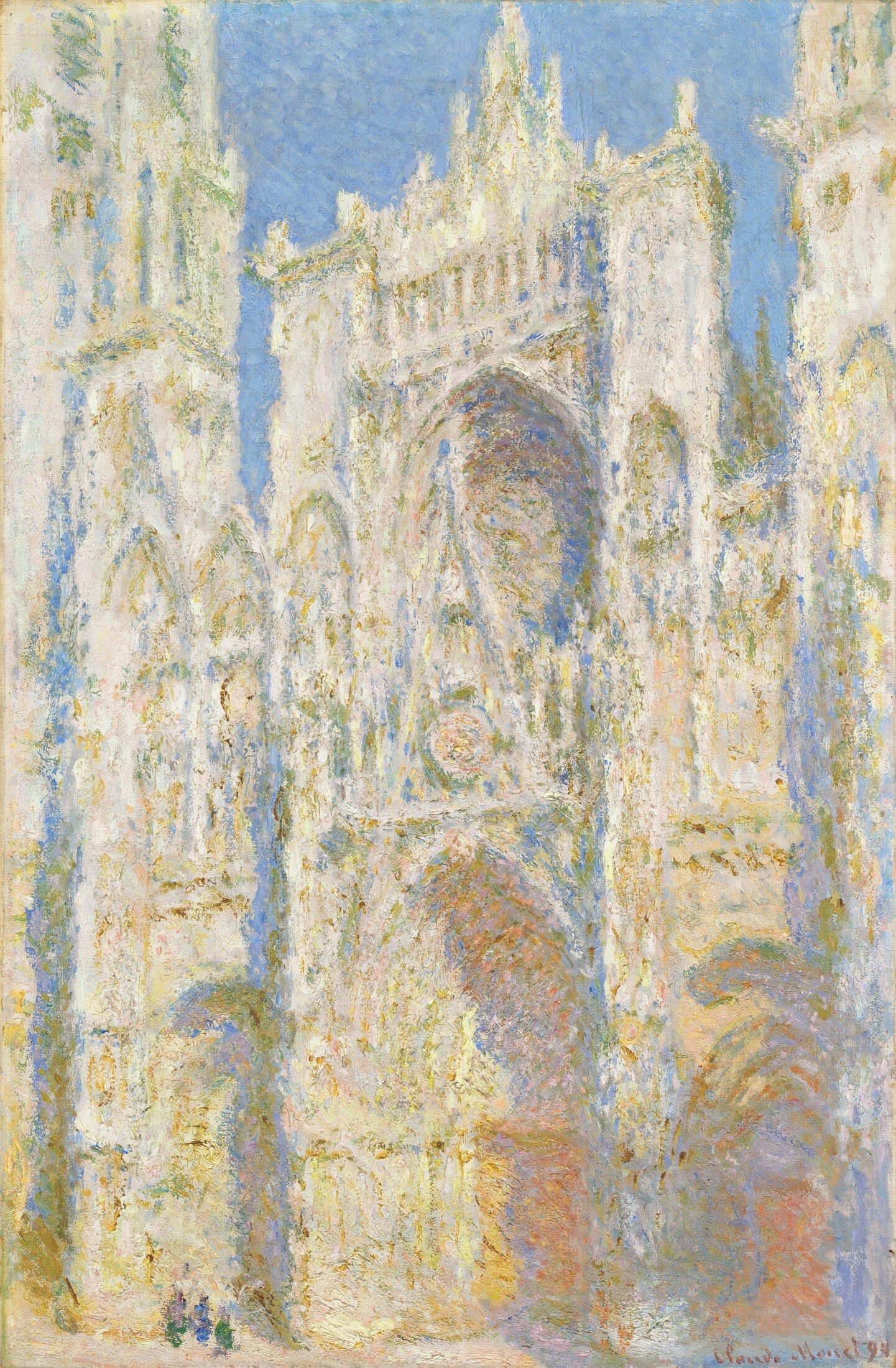
Look closely: The same stone architecture becomes a field of coloured light and shadow. The close framing reduces the surrounding city. Thick, varied touches describe the surface while atmospheric conditions alter its apparent solidity.
The National Gallery of Art dates Rouen Cathedral, West Façade, Sunlight to 1894. Monet studied the cathedral during campaigns in 1892–93 and continued working on the canvases afterwards. This distinguishes the dates of observation from the dated finished painting. Other essential series include the Gare Saint-Lazare, grainstacks, poplars and water lilies. Each is a group of works, not a single painting with one universal date or collection.
Revision note: A series is not evidence that every canvas was finished in one rapid sitting. Repeated observation and studio revision can both belong to the process. Also distinguish “grainstacks” from a casual assumption that every stack contains hay.
12. Berthe Morisot: modern life through a different field of access
Morisot was a central member of the independent group, not simply an artist related to Manet. She exhibited in seven of the eight shows. Her work ranges across portraits, domestic scenes, gardens and outdoor subjects. The social conditions governing women’s training, mobility and access to public spaces help explain differences in subject matter without reducing her artistic decisions to those restrictions.
Source: National Gallery, London: Morisot’s biography and exhibition role.
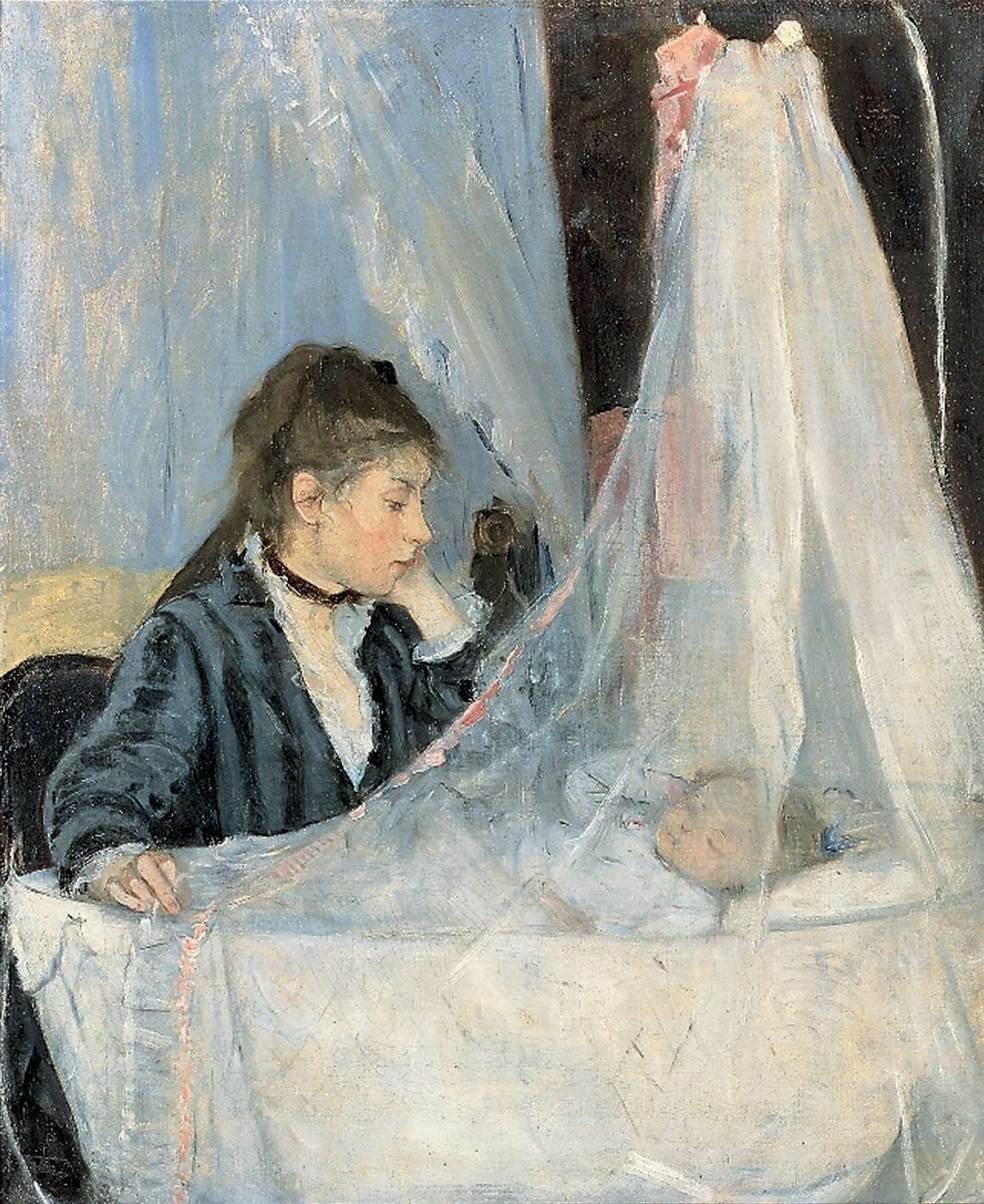
Look closely: A mother’s gaze connects with the sleeping child through the translucent veil. Diagonals, repeated curves and contrasting light and dark areas organise an intimate setting. The veil simultaneously reveals and separates the baby.
Painted in 1872, The Cradle was exhibited with the group in 1874. The sitters are Morisot’s sister Edma and her daughter Blanche. An ordinary moment becomes a carefully organised visual relationship. This is a useful correction to the idea that modernity means only railways and boulevards: family life and women’s experience are also part of the modern world.
13. Pierre-Auguste Renoir: figures, sociability and dappled light
Renoir’s contributions include portraiture, outdoor gatherings, dancers and the human figure. His career also changed: later works can emphasise firmer contour and more deliberate modelling. Learn a particular painting’s visual language rather than expecting one handling to remain identical throughout his life.
Source: National Gallery of Art: Renoir.
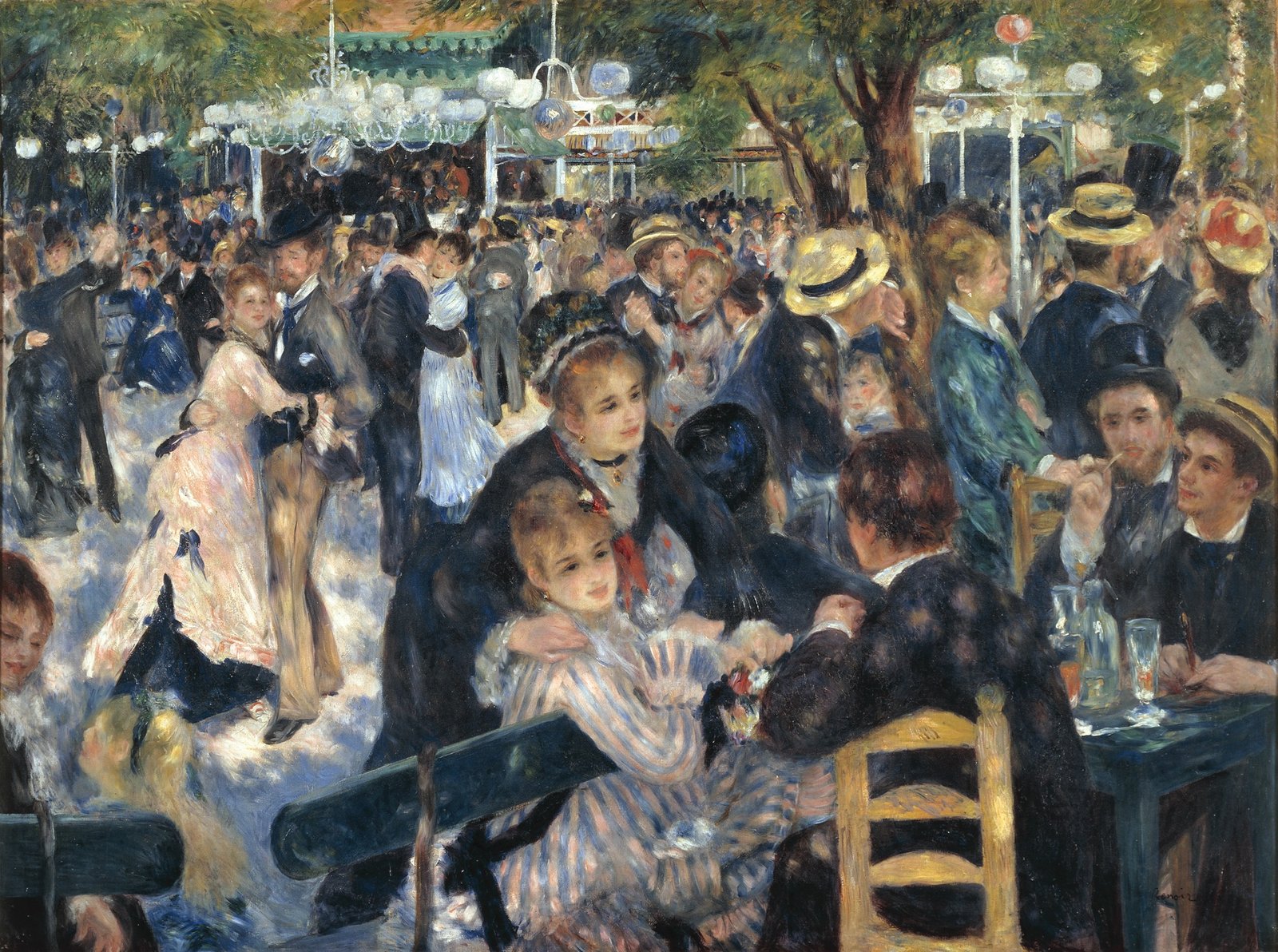
Look closely: Dappled light crosses clothing and faces while pairs and groups create a shifting social rhythm. The foreground table anchors the crowded scene. Look at how highlights connect figures across the canvas rather than isolating each person in a separate portrait.
Dance at the Moulin de la Galette was painted in 1876 and exhibited in 1877, at the third group exhibition. The large Musée d’Orsay painting is the version shown here. Its lively surface does not mean the arrangement is random: foreground figures, dancing couples and the background crowd distribute movement and attention across the picture.
14. Frédéric Bazille: an early colleague, not an 1874 exhibitor
Bazille shared working environments and friendships with Monet and Renoir and belongs to the pre-1874 history of the circle. His death in the Franco-Prussian War in 1870 explains why he could not take part in the first exhibition four years later. “Associated with the origins of Impressionism” and “exhibited in 1874” are not interchangeable statements.
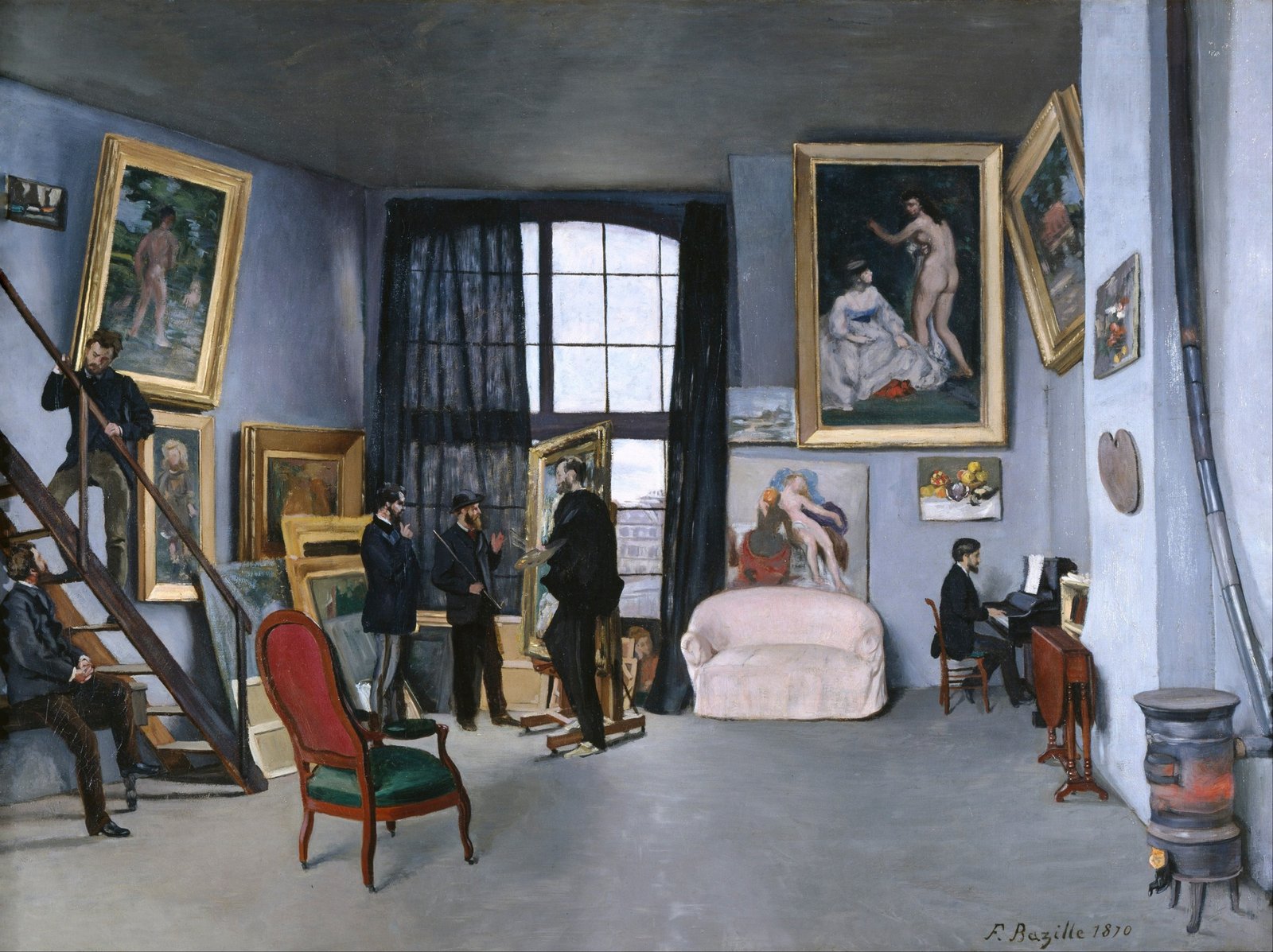
Look closely: Paintings within a painting, gathered artists and studio furniture turn a working interior into an image of artistic sociability. This is a studio scene, not a reconstruction of the first Impressionist exhibition.
The museum identifies the setting as the rue La Condamine studio shared with Renoir. Bazille’s Studio is dated 1870. It is valuable because it makes the movement’s social network visible: art developed through shared rooms, discussion, looking and material support as well as through individual encounters with nature.
15. Mary Cassatt: looking, interiors and the human figure
Cassatt was an American artist who worked in Paris and exhibited with the Impressionists in 1879, 1880, 1881 and 1886. Degas was an important colleague. Her subjects include women’s activities, spectatorship and relationships between adults and children. She also made innovative prints; her contribution is broader than a sentimental stereotype of motherhood.
Source: The Met: Mary Stevenson Cassatt.
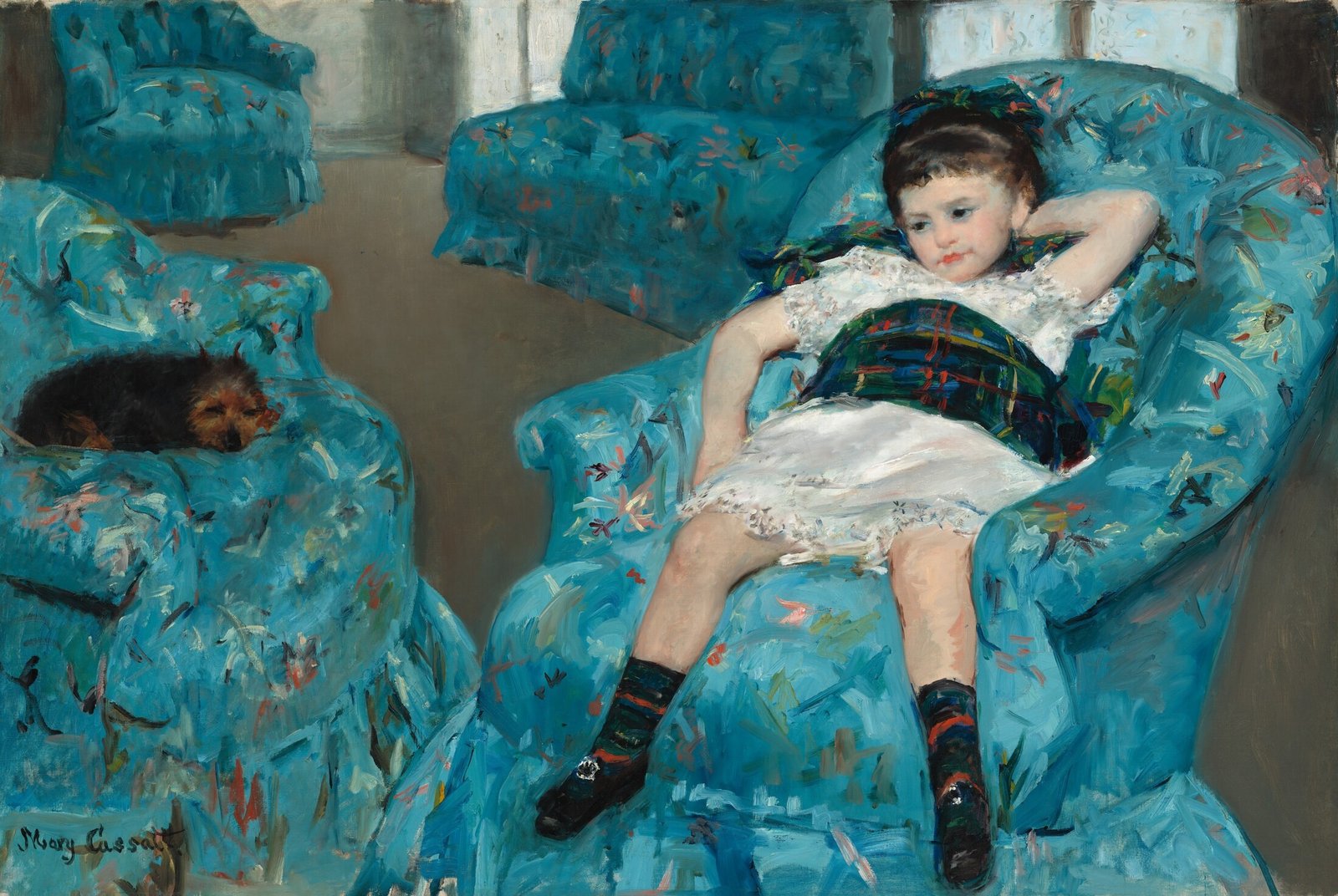
Look closely: The child’s relaxed pose and the large blue armchairs dominate an unusually spacious interior. Furniture, oblique floor space and patterned upholstery create a modern composition. The child is not arranged like a ceremonious formal portrait sitter.
Little Girl in a Blue Armchair is dated 1878, before Cassatt’s first appearance in the group exhibitions in 1879. The National Gallery of Art also discusses Degas’s contribution to the painting’s background. This does not change the work’s attribution to Cassatt; it reveals an exchange between artists. It is a useful example of how attribution, collaboration and exhibition history are related but distinct questions.
Source: National Gallery of Art: Little Girl in a Blue Armchair.
16. Gustave Caillebotte: modern perspective and a different finish
Caillebotte was a painter, collector and important supporter of fellow artists. His work demonstrates that a recognisably modern subject and unexpected framing can coexist with a more controlled surface. Do not exclude him from Impressionism merely because some paintings have clearer contours than a Monet river scene.
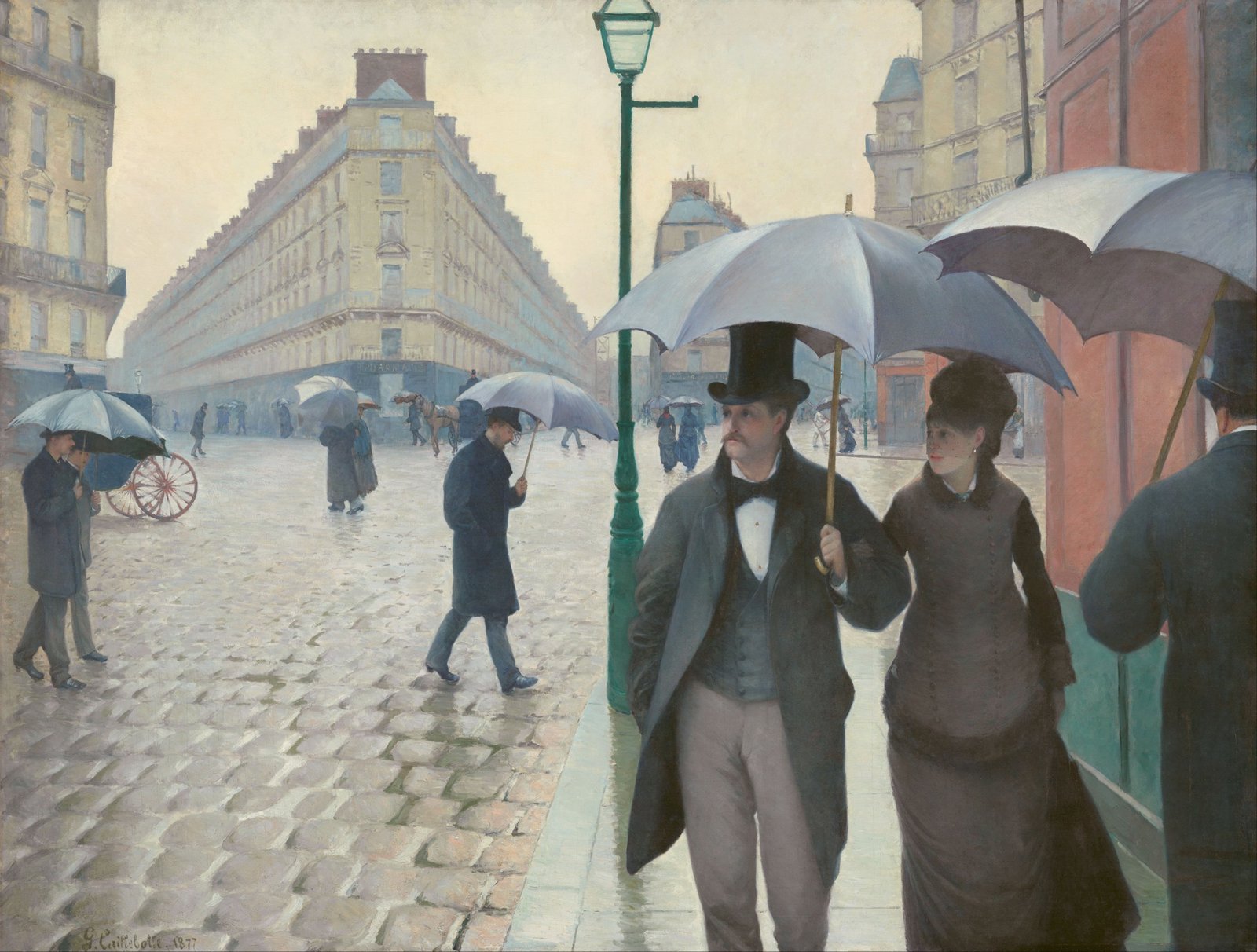
Look closely: The lamppost divides the foreground, while streets and buildings lead towards a distant junction. Cropped figures at the edges make the scene feel larger than the frame. Umbrellas, paving and repeated pedestrians establish rhythm within a carefully controlled perspective.
Paris Street; Rainy Day is dated 1877 and appeared in the third Impressionist exhibition that year. The Art Institute’s scholarly catalogue documents the painting’s construction and surface. Its scale, urban setting and organised geometry make it especially useful for comparing the variety within the group. “Impressionist” describes more than one standard brushstroke.
17. Impressionism, Realism and Neo-Impressionism: compare carefully
| Aspect | Realism | Impressionism | Neo-Impressionism |
|---|---|---|---|
| Central concern | Contemporary experience, material life and ordinary subjects; varied approaches. | Modern life and perceived appearance, including changing light and colour. | A more systematic division of colour, often informed by optical theories. |
| Handling | Can emphasise substantial forms and material surfaces. | Frequently broken, visible touches; considerable differences among artists. | Often regular dots or separated touches; controlled arrangements. |
| Useful names | Gustave Courbet, Jean-François Millet. | Monet, Pissarro, Morisot, Renoir, Sisley; Degas and Cassatt broaden the definition. | Georges Seurat and Paul Signac; Pissarro temporarily adopted the method. |
| Relationship | An important precedent, not an identical movement. | Independent exhibitions from 1874 to 1886. | Entered the final Impressionist exhibition in 1886, but represents a distinct development. |
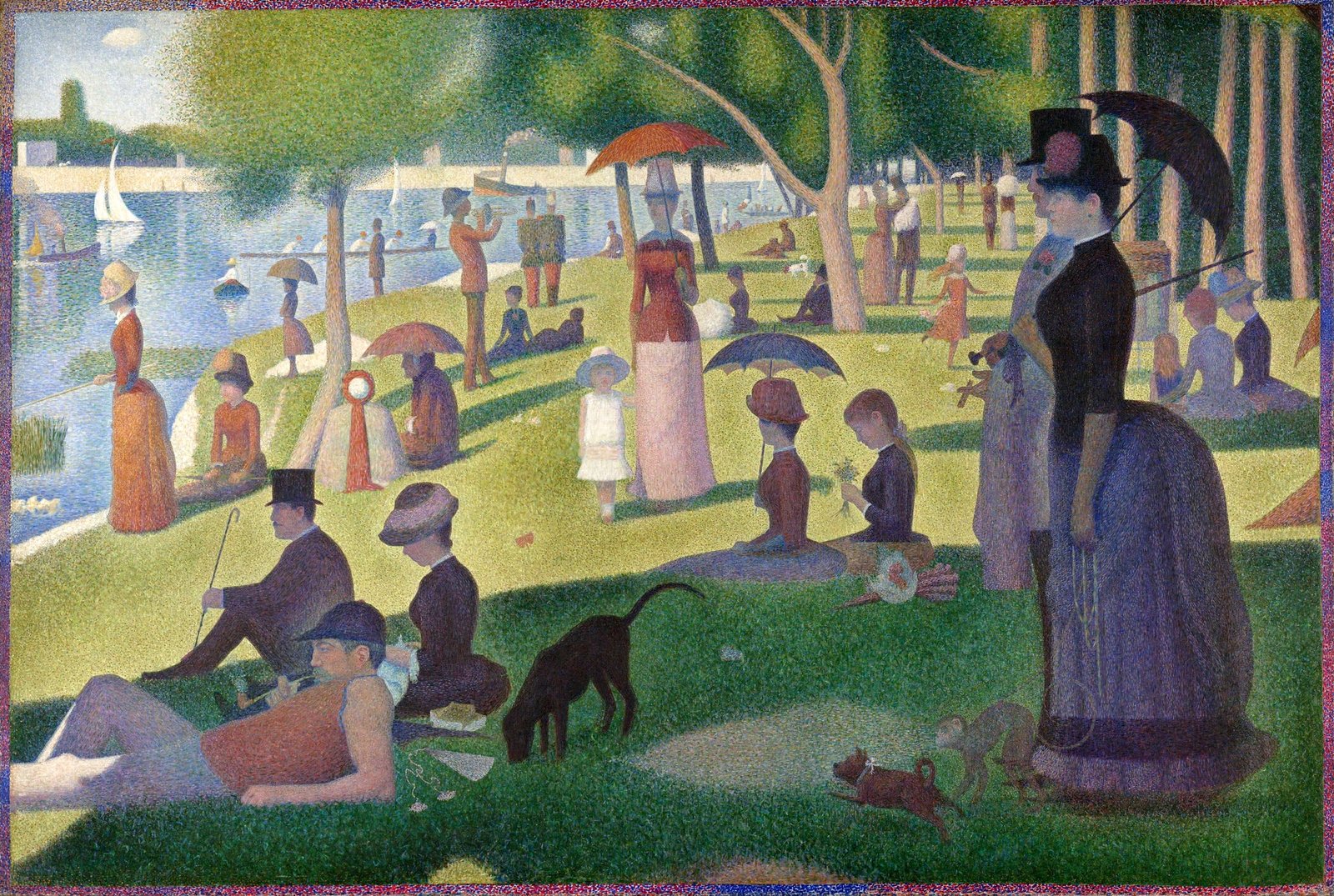
Look closely: The still, carefully distributed figures and small separated marks differ from the shifting crowd in Renoir’s Moulin de la Galette. Both depict leisure, but a shared subject does not make the methods or movements identical.
Seurat’s A Sunday on La Grande Jatte — 1884 was made in 1884–1886; its painted border was added later. It is included here as a Neo-Impressionist comparison, not as an ordinary example of Monet’s technique. The “1884” in the title should not erase the work’s longer production history.
Source: Art Institute of Chicago: Seurat, science and technique.
Pointillism refers particularly to a technique using small points of colour. Divisionism stresses the separation of colour touches rather than mixing them fully on the palette. Neo-Impressionism identifies the historical movement. These terms overlap, but are not perfect substitutes. Ordinary Impressionist broken brushwork should not automatically be labelled Pointillism.
Post-Impressionism is a later umbrella term for distinct developments associated with artists such as Cézanne, Van Gogh, Gauguin and Seurat. They did not all form one stylistically unified group. Cézanne’s participation in early Impressionist exhibitions does not mean every later Cézanne painting belongs to the same phase. Classify the work and period, not only the artist’s name.
18. Impact and legacy
Impressionism helped change what could count as a finished painting and what could count as a significant subject. Visible handling, selective detail and modern settings entered a broader public discussion of art. Independent exhibitions also challenged the assumption that official juries were the only route to recognition.
Its legacy was enabled by circulation as well as invention. Dealers, collectors and exhibitions brought the works to new audiences. Paul Durand-Ruel supported artists financially and organised exhibitions, helping create markets beyond France. This was a long and uneven process, not a story in which every critic rejected every work and the whole group became successful overnight.
Source: Durand-Ruel archives: the dealer’s career and support for the artists.
Later artists could develop colour, surface, form and perception in different directions: systematic colour separation in Neo-Impressionism; more structural pictorial organisation in Cézanne; expressive and symbolic uses of colour in other post-Impressionist work. These are connections, not proof of one inevitable road towards abstraction. Monet’s late paintings also invited later viewers to consider the relationship between a represented scene and an enveloping painted surface.
Source: MoMA: Monet and the later significance of his work.
19. Exam revision: chronology, terms and matching
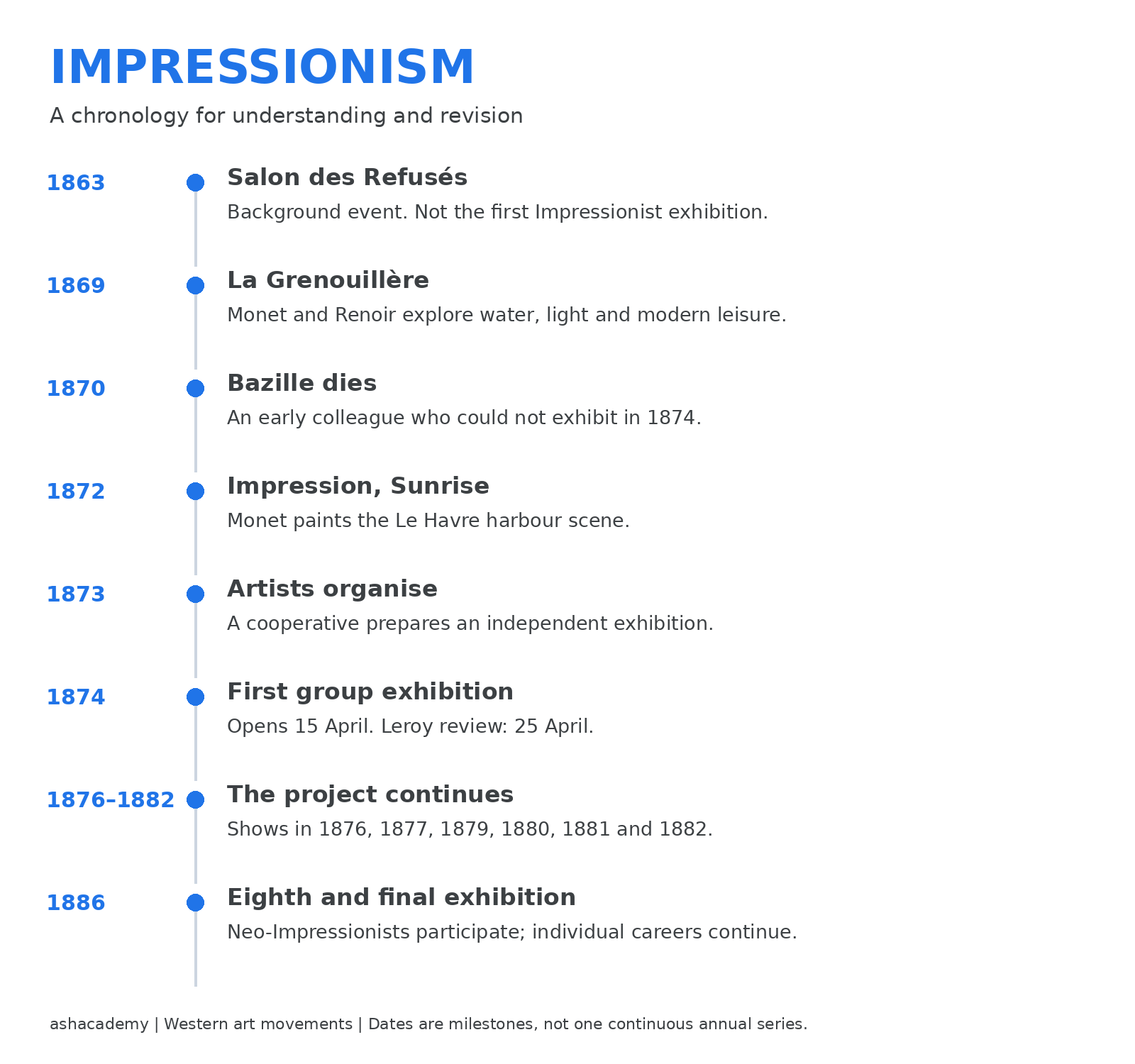
Core sequence: 1863 Salon des Refusés → 1869 Monet and Renoir at La Grenouillère → 1870 Bazille’s death → 1872 Impression, Sunrise → 1873 cooperative organisation → 1874 first exhibition and Leroy review → 1876 Duranty → 1877 third exhibition → 1879 Cassatt joins the exhibitions → 1886 final exhibition.
| Artwork | Artist | Date to retain | Collection |
|---|---|---|---|
| Boating | Edouard Manet | 1874 | The Metropolitan Museum of Art, New York |
| The Bridge at Villeneuve-la-Garenne | Alfred Sisley | 1872 | The Metropolitan Museum of Art, New York |
| The Boulevard Montmartre on a Winter Morning | Camille Pissarro | 1897 | The Metropolitan Museum of Art, New York |
| The Dance Class | Edgar Degas | 1874 | The Metropolitan Museum of Art, New York |
| Rouen Cathedral, West Façade, Sunlight | Claude Monet | 1894 | National Gallery of Art, Washington |
| Impression, Sunrise (Impression, soleil levant) | Claude Monet | 1872 | Musée Marmottan Monet, Paris |
| La Grenouillère | Claude Monet | 1869 | The Metropolitan Museum of Art, New York |
| The Cradle (Le Berceau) | Berthe Morisot | 1872 | Musée d’Orsay, Paris |
| Dance at the Moulin de la Galette | Pierre-Auguste Renoir | 1876 | Musée d’Orsay, Paris |
| Bazille’s Studio (L’Atelier de Bazille) | Frédéric Bazille | 1870 | Musée d’Orsay, Paris |
| Little Girl in a Blue Armchair | Mary Cassatt | 1878 | National Gallery of Art, Washington |
| Woman with a Parasol – Madame Monet and Her Son | Claude Monet | 1875 | National Gallery of Art, Washington |
| Paris Street; Rainy Day | Gustave Caillebotte | 1877 | Art Institute of Chicago |
| A Sunday on La Grande Jatte — 1884 | Georges Seurat | 1884–1886; border added 1888–1889 | Art Institute of Chicago |
| Term | Easy, accurate meaning |
|---|---|
| En plein air | Working outdoors; not proof that every stage took place outdoors. |
| Broken colour | Separate touches of different hues remain visible. |
| Wet-in-wet | Applying paint into a still-wet paint layer. |
| Impasto | A thick or raised paint surface. |
| Japonisme | European engagement with Japanese art and design, including ukiyo-e prints. |
| Series | Multiple works exploring a related motif, often under changing conditions. |
| Salon | The official exhibition system, distinct from the independent group shows. |
| Salon des Refusés | An exhibition of rejected works; the 1863 event predates the first Impressionist show. |
| Optical mixing | The visual integration of adjacent colour touches; particularly important to Neo-Impressionist discussion. |
20. Commonly confused facts
| Confusion | Correction |
|---|---|
| The first exhibition was in 1863. | 1863 = Salon des Refusés; 1874 = first independent Impressionist exhibition. |
| Monet painted Impression, Sunrise in 1874. | The museum dates it 1872; the exhibition was 1874. |
| Nadar founded Impressionism. | His former studio supplied the first exhibition venue. |
| Manet exhibited in all eight shows. | Manet exhibited in none; Pissarro exhibited in all eight. |
| Bazille took part in the 1874 show. | He died in 1870. |
| Impressionists always painted outdoors and never used black. | Both claims are too absolute; artists and methods varied. |
| Degas painted spontaneous outdoor snapshots. | Studio construction, drawing and repeated study are central to his work. |
| Seurat’s dots define all Impressionist technique. | Seurat belongs to the distinct Neo-Impressionist development. |
| The eight shows ran annually from 1874 to 1881. | Their actual sequence ends in 1886 and contains gaps. |
| A series has one date and one collection. | Separate versions have separate dates, objects and owning collections. |
| Every member was a French national. | The movement was centred in France but involved artists of different national backgrounds. |
| 1886 is the year every Impressionist stopped painting. | It is the year of the last group exhibition. |
21. Image-based revision quiz
These are original practice questions, not claimed previous-year UGC NET questions. Study the full artwork above each relevant section, answer, then open the explanation.
1. The orange sun over a hazy harbour: identify the artist, painting and two dates.
Claude Monet, Impression, Sunrise, painted 1872 and shown in the first exhibition of 1874. Leroy’s review appeared on 25 April 1874. The work is at Musée Marmottan Monet.
2. A rainy boulevard with a foreground lamppost and umbrellas: which artist?
Gustave Caillebotte, Paris Street; Rainy Day, 1877, Art Institute of Chicago. Monet and Pissarro also painted city subjects, so the lamppost, cropped pedestrians and specific perspective help identify this composition.
3. An instructor and dispersed ballet students in a deep interior: artist and collection?
Edgar Degas, The Dance Class, 1874, The Metropolitan Museum of Art. Do not confuse it with Degas’s related dance-class painting in Musée d’Orsay.
4. A mother watches a baby through a translucent veil: identify the painter.
Berthe Morisot, The Cradle, 1872, Musée d’Orsay. Cassatt also painted women and children, but subject category alone is insufficient: the veil and paired gazes identify this work.
5. Which came first: Renoir’s Moulin de la Galette or Caillebotte’s Rainy Day?
Renoir’s painting, 1876, came before Caillebotte’s, 1877. Both appeared in the third group exhibition in 1877. Painting dates and exhibition dates are not interchangeable.
6. Who participated in every group exhibition: Monet, Manet, Pissarro or Bazille?
Pissarro. Monet did not take part in all eight; Manet never participated; Bazille died before the first show.
7. Why is Seurat’s La Grande Jatte shown as a comparison?
It illustrates Neo-Impressionism and a more systematic separation of colour. Its appearance at the final group exhibition does not make Pointillism the defining technique of every Impressionist.
8. A stone portal is almost transformed into light and coloured surface. Which Monet series?
The Rouen Cathedral series. The National Gallery of Art painting shown here is dated 1894, following study in Rouen in 1892–93. Do not assign the entire series one universal date.
22. Frequently asked questions about Impressionism
What is Impressionism in simple words?
It is a movement in which artists explored modern life and the changing appearance of what they saw, often through visible brushstrokes and relationships of light and colour. It developed in France and became associated with independent exhibitions beginning in 1874.
Who founded Impressionism?
There was no single founder. Monet, Pissarro, Renoir, Degas, Morisot, Sisley and other artists contributed to the artistic and exhibition network. Monet is central to the naming story, but that does not make him the sole organiser or inventor.
How many Impressionist exhibitions were held?
Eight: 1874, 1876, 1877, 1879, 1880, 1881, 1882 and 1886. Pissarro participated in every one.
Was Manet an Impressionist?
He was closely connected with the circle and deeply important to its development. However, he did not exhibit in any of its eight group exhibitions. State the relationship precisely rather than giving an unqualified yes or no.
Are Impressionism and Pointillism the same?
No. Broken brushwork appears in much Impressionist painting. Pointillism describes small points of colour and is particularly associated with Seurat and Neo-Impressionism. Related interests in colour do not erase the distinction.
How should I revise Impressionism for UGC NET Visual Arts?
Learn the exhibition sequence and naming story, distinguish artists’ individual contributions, and practise identifying original artworks. Connect each title with its artist, date, medium and collection. Treat the quiz here as practice material rather than a prediction of a particular examination question.
Continue your Western art revision
For a contrasting approach to form, subject and finish, read Neoclassicism: history, characteristics, artists and artworks. Compare ordered classical narrative with Impressionism’s attention to modern experience, while remembering that neither movement is visually uniform.
Sources, image credits and scope
This guide draws on collection records and educational research from Musée Marmottan Monet, Musée d’Orsay, Musée des impressionnismes Giverny, The Metropolitan Museum of Art, National Gallery of Art (Washington), National Gallery (London), Art Institute of Chicago, Getty and the French Ministry of Culture. Section links identify the relevant institutional references; artwork captions link to records and image sources. Interpretive “Look closely” prompts are ashacademy teaching commentary.
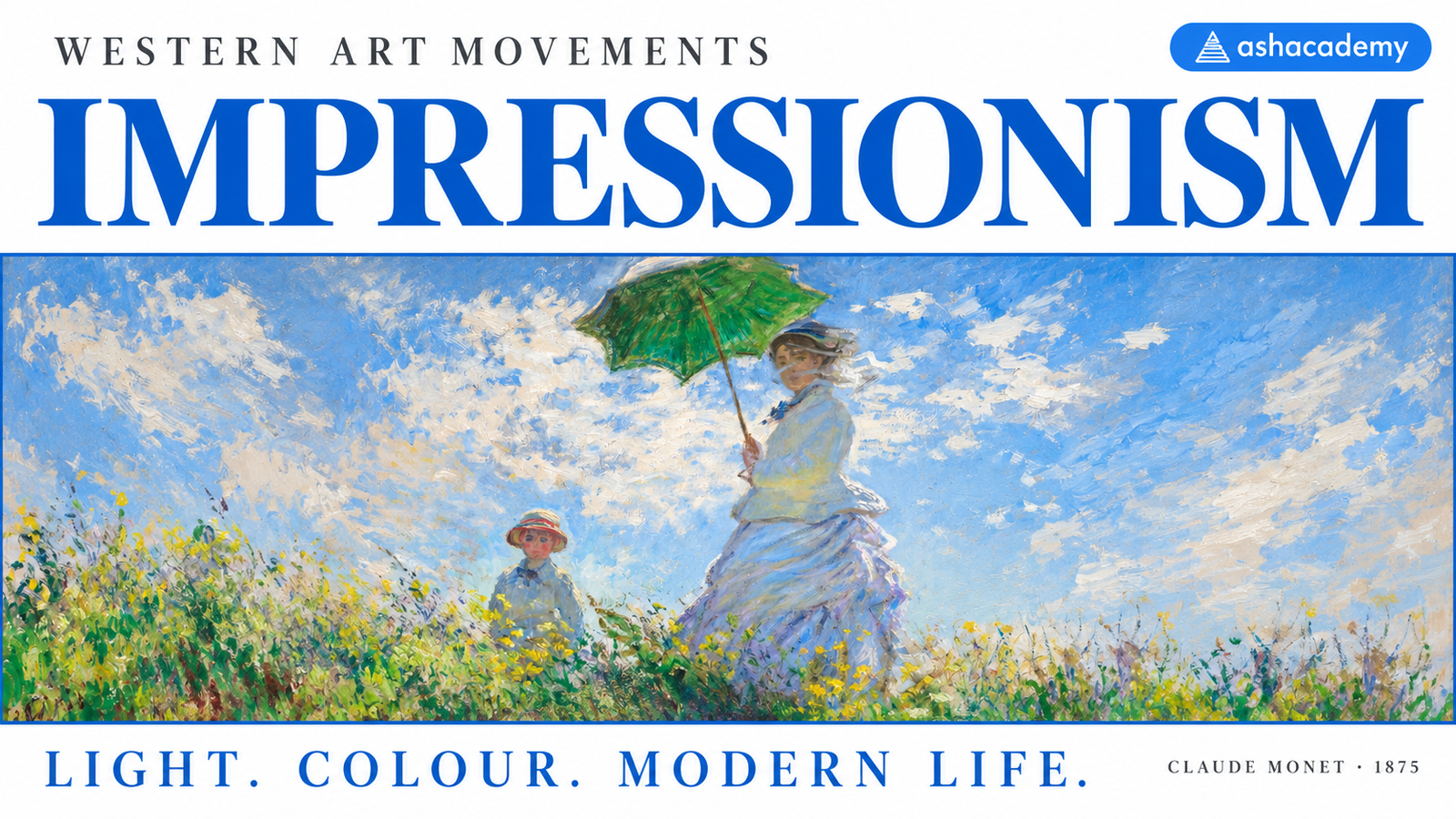
Artwork photographs retain their original compositions and colours. Reproductions vary in resolution and colour rendering. Native revision graphics are educational summaries, not period documents. The featured cover is an editorial design inspired by Monet; use the original full artwork in the article for close visual study. This is a comprehensive introductory and exam-revision guide, not a catalogue of every artist or every work associated with Impressionism.
For further academic reading: John Rewald, The History of Impressionism; T. J. Clark, The Painting of Modern Life: Paris in the Art of Manet and His Followers; and the National Gallery of Art / Musée d’Orsay publication Paris 1874: The Impressionist Moment. These provide different historical and interpretive approaches, rather than one interchangeable account.

You may also like
Fauvism: History, Characteristics, Artists and Important Artworks
Symbolism in Art: History, Characteristics, Artists and Artworks