Renaissance vs Baroque Art: UGC NET Visual Arts Notes
Renaissance vs Baroque art is an important comparison within Western art history for UGC NET Visual Arts (Code 79). These study notes explain the differences in composition, light, sculpture and the viewer’s role through works by Raphael, Leonardo da Vinci, Caravaggio, Michelangelo and Bernini.
What is the difference between Renaissance and Baroque art?
In the selected Italian examples, Renaissance artists coordinate figures and space into clear, ordered relationships, while Baroque artists often intensify action, dramatic light and the spectator’s involvement. Both traditions can be emotional and naturalistic. These are broad tendencies, not rules that identify every artwork.
Why does one David stand in concentrated anticipation while another twists into action? Comparing Michelangelo and Bernini reveals how artists changed the viewer’s experience of the same biblical subject.
Students often remember Renaissance art as “balanced” and Baroque art as “dramatic.” These words offer a starting point, but they cannot explain a painting or sculpture on their own. A useful comparison asks how an artist organises bodies, constructs space, directs light and chooses the moment of a story.
This guide develops those questions through selected Italian examples, then explains why the wider European picture requires qualification. For UGC NET Visual Arts, the topic belongs primarily to Unit VI: Western art history. Its discussion of composition, perspective and foreshortening also connects with Unit I; its attention to materials and techniques connects with Unit III. The official syllabus specifically includes Renaissance, Mannerist and Baroque painting and sculpture.[1]
1. Start with chronology, but avoid rigid boundaries
The Renaissance developed across several centuries and regions. For introductory study of Italy, the fourteenth to sixteenth centuries provide a broad frame, with the fifteenth century usually discussed as the Early Renaissance and the decades around 1500 as the High Renaissance. The study of classical antiquity, the human figure and pictorial space became central concerns, although artists pursued them in different ways.[2]
Do not jump directly from Raphael to Caravaggio. Mannerism, conventionally dated about 1520–1600 in Italy, complicates that transition. Artists such as Pontormo, Rosso Fiorentino and Bronzino explored cultivated artifice, complex poses and compositional tension. These developments show that departures from High Renaissance balance were already underway before the Baroque.[3]
Baroque is commonly used for European art of the seventeenth and early eighteenth centuries, extending roughly to the mid-eighteenth century in broad surveys. Its chronology varies by place and medium. Treat these dates as a framework for study, rather than a rule that assigns every work to a single style.[4]
2. Renaissance art: making the visible world intelligible
Renaissance humanism encouraged engagement with classical learning and human achievement. In art, this intersected with close attention to bodies, observation and spatial representation. It did not mean that religion disappeared: sacred subjects and ecclesiastical patronage remained fundamental.
Perspective offered a method for coordinating represented space. In linear perspective, orthogonals appear to converge towards a vanishing point, establishing relationships between the spectator and the pictured world. Brunelleschi and Alberti are important names in this history; Alberti explained perspective in his treatise On Painting.[5]
The key teaching question is not simply whether a picture contains perspective. Ask what that perspective does. Does it clarify the narrative? Establish a focal point? Connect architecture with the arrangement of figures?
Raphael’s The School of Athens: ideas organised in space
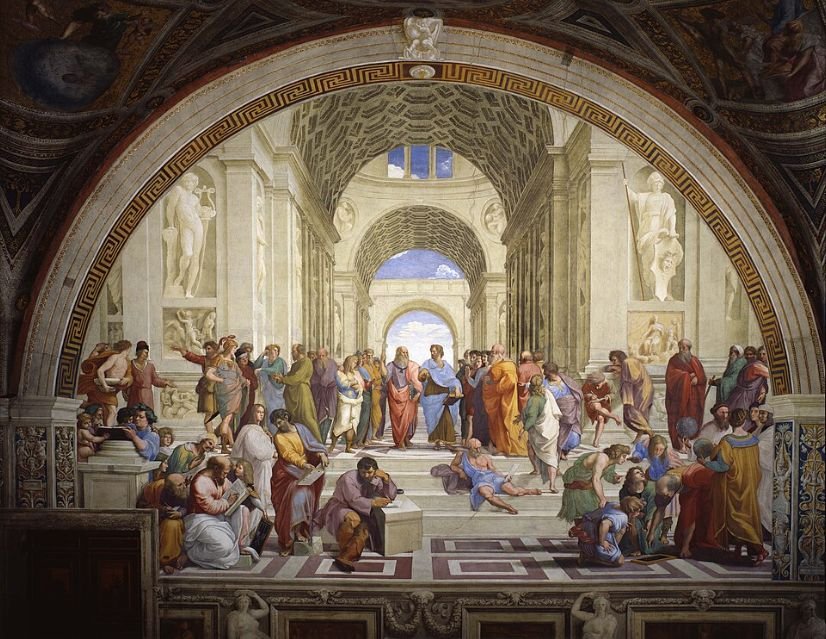
Raphael’s The School of Athens, in the Vatican’s Room of the Segnatura, places ancient philosophers within monumental Renaissance architecture. The room’s fresco programme was executed between 1508 and 1511. At the centre, Plato gestures upwards while Aristotle extends his hand outward. Their gestures distinguish intellectual positions within a shared architectural setting.[6]

Look at the painting as a sequence of relationships: the central pair, the surrounding groups, the steps and the receding architecture. The figures are active, but the larger arrangement makes their activity readable. This is why “order” is more useful than “stillness” when describing the work.
Study prompt: Cover the central figures in a reproduction and trace the architectural lines. Then restore them to view and observe how space reinforces their prominence.
Leonardo’s The Last Supper: emotion within a coherent structure
Leonardo’s The Last Supper, conventionally dated 1495–1498, remains in the refectory of Santa Maria delle Grazie in Milan. Christ’s announcement of betrayal produces varied responses among the apostles. Their hands, expressions and bodily movements communicate a spectrum of reactions within an organised setting.[7]
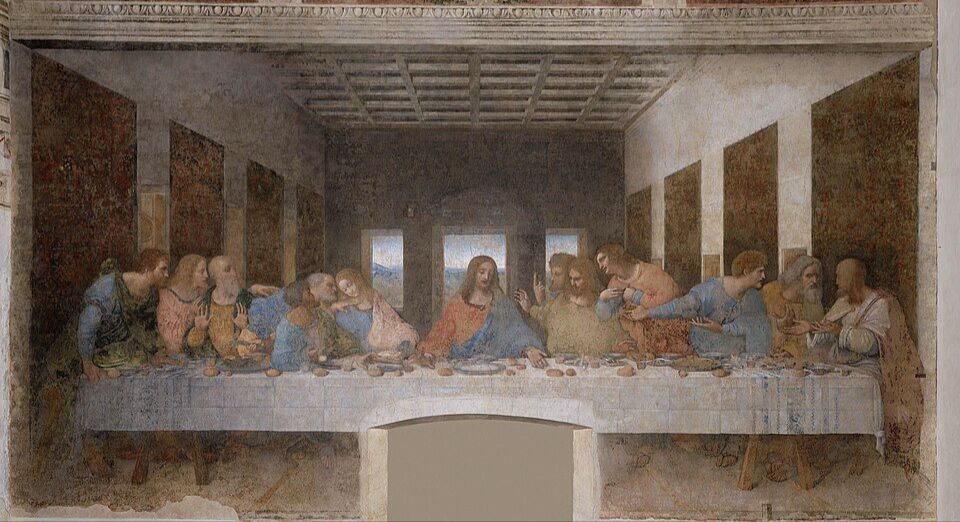

The painting challenges the claim that Renaissance art lacks emotion. Its achievement lies in coordinating psychological variety with a clear visual structure. Compare the activity of the apostles with the centrality of Christ and the recession of the room.
Technique matters: The Last Supper is a mural, but it is not a traditional buon fresco. Leonardo worked on dry plaster using an experimental method. “Mural” describes a work’s relationship to a wall; “fresco” identifies a particular technique.[7]
3. Baroque art: intensifying the viewer’s encounter
Many Baroque artists used light, bodily action and spatial effects to make an event feel immediate. A gesture may project towards us, a figure may turn sharply, or a sculptural action may imply an opponent beyond the object itself. The viewer is encouraged to experience an unfolding event.
Painting, sculpture and architecture could also operate together. The V&A identifies this integration as a defining feature of Baroque design. Meaning emerges through the coordinated encounter with a space, rather than through a single isolated object.[8]
Religious patronage was especially important in Rome. Catholic institutions commissioned works that stimulated devotion and expressed authority. Yet Baroque culture also served courts and other patrons. Reducing the entire period to one religious purpose obscures its geographical and social diversity.[4]
Caravaggio’s The Supper at Emmaus: recognition made immediate
Caravaggio’s The Supper at Emmaus of 1601, in the National Gallery, London, represents the disciples recognising the resurrected Christ at a meal. Sudden gestures animate the scene. An outstretched arm, a chair projecting towards the spectator and a basket near the table’s edge bring attention to the boundary between painted space and our own.[9]
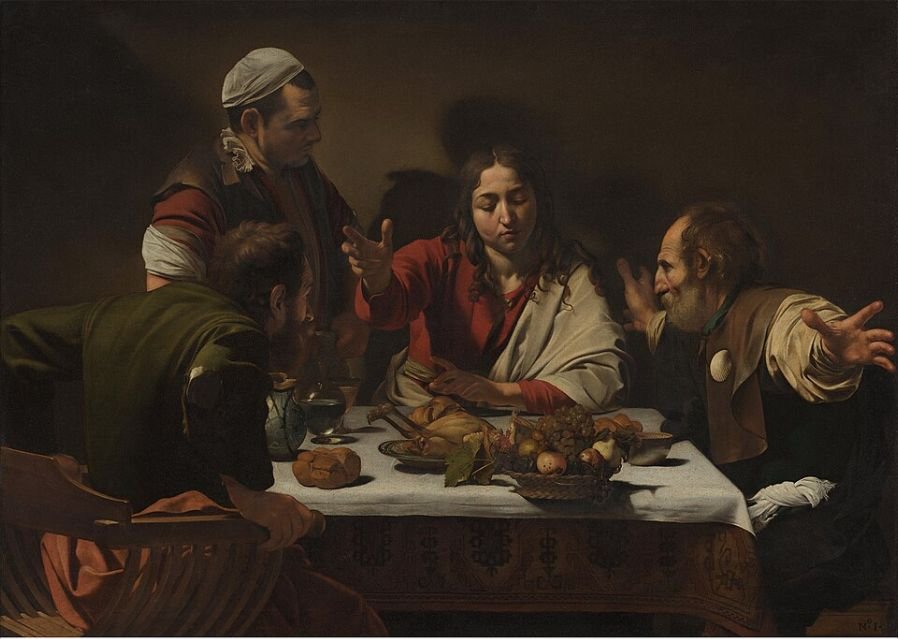

Compare it with Leonardo’s The Last Supper. Both works depict a sacred meal and reveal emotional responses through gesture. Caravaggio’s tightly staged encounter, however, draws the action close to the picture’s surface. The useful difference is how each artist structures our encounter with the narrative.
Study prompt: Identify three devices that make Caravaggio’s scene appear to project towards the viewer. Explain their effects before attaching the label “Baroque.”
4. Michelangelo vs Bernini: two interpretations of David
Comparing the same subject helps separate iconography from style. Both sculptures represent David, but each artist selects a different relationship between anticipation, movement and surrounding space.
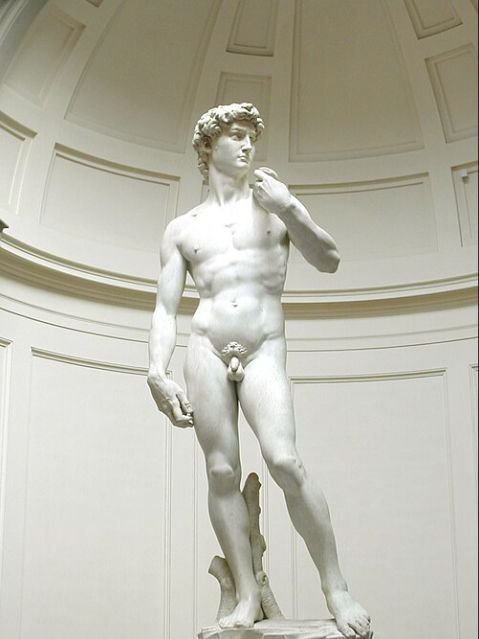

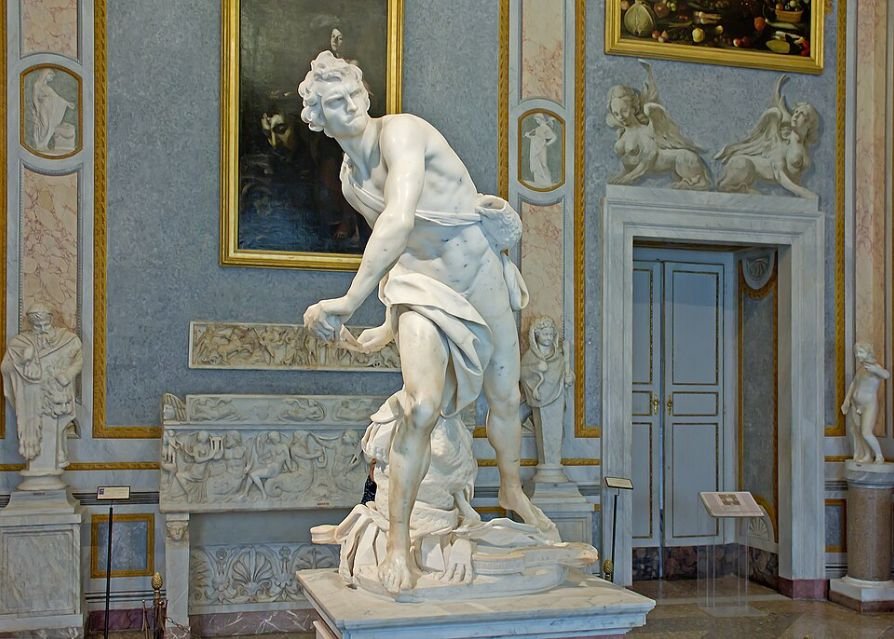

| Feature | Michelangelo, David | Gian Lorenzo Bernini, David |
|---|---|---|
| Date and material | 1501–1504; marble | 1623–1624; marble |
| Present location | Galleria dell’Accademia, Florence | Galleria Borghese, Rome |
| Narrative emphasis | Concentrated preparation before the encounter | The physical action of preparing to release the sling |
| Body | Standing contrapposto; tension held within an upright figure | Torso twists; limbs coordinate an active movement |
| Spatial effect | The standing figure concentrates attention on bodily presence | The action implies an opponent outside the sculpture |
The dates and locations are documented by the respective collections.[10] [11] The comparisons of bodily and spatial effects are formal readings intended to guide observation.
Michelangelo’s figure is not psychologically relaxed. Its gaze and readiness are crucial. Bernini does not merely add movement to an otherwise identical conception: he makes the moment of action organise the whole body. The absent Goliath becomes important because David’s movement directs our attention beyond the marble.
For revision, retain the distinction between contained readiness and action extending into space, then test it against the actual sculptures.
5. Chiaroscuro, tenebrism and sfumato are different terms
| Term | Meaning | Common mistake |
|---|---|---|
| Chiaroscuro | Light–dark contrasts used to model form and create expressive effects. | Calling it exclusively Baroque. Both Leonardo and Caravaggio used it.[12] |
| Tenebrism | Selected illuminated details set against a predominantly dark setting. | Using it as a synonym for every instance of shading.[13] |
| Sfumato | Soft tonal transitions that blur contours and avoid hard outlines. | Confusing soft transitions with dramatic spotlight effects.[14] |
When analysing an image, describe the evidence first. Are shadows modelling a cheek? Is darkness suppressing the setting? Are edges dissolving gradually? The appropriate term follows from those observations.
6. Renaissance vs Baroque: a comparison for revision
The following contrasts are useful for the selected Italian examples. They are tendencies, not universal tests for all European art.
| Question to ask | Renaissance emphasis in these examples | Baroque emphasis in these examples |
|---|---|---|
| How is activity organised? | Readable relationships within a coherent arrangement | A heightened sense of an event unfolding |
| What does the body communicate? | Structure, presence and controlled expressive variation | Effort, directional movement and concentrated action |
| How is space experienced? | Architecture and perspective clarify the pictured world | Projection and implied continuation connect the work with the spectator |
| How should emotion be studied? | Through relationships among expression, gesture and overall order | Through the staging and immediacy of the encounter |
A single diagonal, dark background or expressive face cannot establish a period attribution. Combine visual evidence with chronology, authorship, function and patronage. This is a stronger method than recognising isolated stylistic keywords.
7. Why the Dutch Republic changes the comparison
Seventeenth-century Dutch painting demonstrates why Baroque cannot simply mean monumental Catholic spectacle. In the officially Protestant Dutch Republic, an extensive art market supported portraits, landscapes, still lifes and scenes of everyday life. Rembrandt, Frans Hals and Vermeer worked within this wider environment, although their practices differed substantially.[15]
The Met also stresses religious diversity within the Republic. Protestant public culture did not eliminate Catholic communities or private devotional images. A quiet domestic painting belongs to the seventeenth-century world just as a Roman religious commission does, but their settings, functions and intended audiences require different explanations.
For exam preparation, keep regional categories visible. “Italian Baroque,” “Flemish painting” and “Dutch seventeenth-century painting” should not become interchangeable labels.
8. How to study this topic for UGC NET Visual Arts
- Build an artwork record. For each work, note artist, title, approximate date, material or technique, present location and subject.
- Separate fact from interpretation. “Bernini’s David dates to 1623–1624” is catalogue information. “Its action implicates surrounding space” is a formal interpretation supported by observation.
- Revise through comparisons. Pair the two Davids, then compare the sacred meals by Leonardo and Caravaggio. Explain what remains shared as well as what changes.
- Practise chronology. Place Leonardo’s mural, Michelangelo’s sculpture, Caravaggio’s painting and Bernini’s sculpture in order. Keep Mannerism in the intervening historical discussion.
- Use precise technique labels. Distinguish marble carving from casting, mural painting from fresco, and chiaroscuro from tenebrism.
Self-check: Can you explain why Renaissance art can be emotional, why chiaroscuro is not exclusively Baroque, and why the two Davids create different experiences of time? These are conceptual revision prompts, not authenticated previous-year questions or predictions of examination frequency.
Renaissance and Baroque art: original practice questions
These are original ashacademy practice questions, not authenticated UGC NET previous-year questions. They check concepts explained in this article; no claim of examination frequency is implied.
1. Which statement about chiaroscuro is correct?
- It was used only by Baroque artists.
- It uses light–dark relationships to model form and can also create drama.
- It means painting exclusively on wet plaster.
- It requires the elimination of all shadows.
Answer: B. Chiaroscuro concerns tonal relationships. Leonardo and Caravaggio both used it. A is too restrictive; C describes a painting process rather than tonal modelling; D contradicts the role of light and shade.
2. Which pairing correctly connects an artist with a work discussed here?
- Raphael — The Supper at Emmaus (1601)
- Caravaggio — The School of Athens
- Bernini — David (1623–1624)
- Michelangelo — The Last Supper, Milan
Answer: C. Bernini made the twisting marble David in the Galleria Borghese. The 1601 London Supper at Emmaus is by Caravaggio; The School of Athens is by Raphael; the Milan mural The Last Supper is by Leonardo.
3. Why is “Renaissance art has no emotion” an inadequate statement?
Answer: Leonardo’s The Last Supper gives the apostles distinct emotional responses through gesture and expression. A more useful analysis explains how those responses are organised within the overall composition.
Frequently asked questions
What is the main difference between Renaissance and Baroque art?
In the Italian examples discussed here, Renaissance artists often organise expression through clearly coordinated forms and spaces, while Baroque artists heighten the immediacy of action and the spectator’s involvement. Neither period has a single uniform style.
Was Renaissance art entirely secular?
No. Classical learning and humanist interests coexisted with religious subjects and church patronage. Raphael’s Vatican fresco programme itself brings philosophical and theological subjects into a shared setting.
Is every Baroque painting dark and dramatic?
No. Tenebrist painting is one strand of the period. Regional traditions, individual artists, patrons and subjects produced a much broader range of approaches.
Where does Mannerism fit?
In Italian art, Mannerism conventionally occupies much of the period between the High Renaissance and the Baroque, approximately 1520–1600. Its complex poses and cultivated artifice deserve study in their own right.
Study Western art through artworks, context and comparison
At ashacademy, UGC NET Visual Arts preparation connects historical chronology with visual analysis, materials and techniques. Explore our Visual Arts learning resources and available courses to continue your preparation.
About ashacademy
ashacademy specialises in UGC NET Visual Arts education. Founder and academic head Samraath is a UGC NET–JRF-qualified educator and PhD research scholar in Visual Arts. Explore the Western Art archive, Visual Arts preparation blog and Visual Arts e-library.
Preparation: AI-assisted research and writing using the linked museum and institutional sources. Formal interpretations are distinguished from catalogue facts.
Sources and further reading
Museum and institutional sources consulted for this article. Formal comparisons and study prompts are ashacademy’s editorial synthesis.
- University Grants Commission, Visual Arts syllabus, Code 79: Units I, III and VI; Art History elective.
- National Gallery of Art, Renaissance Art; The Metropolitan Museum of Art, The Art of Renaissance Europe: A Resource for Educators.
- Ross Finocchio, The Metropolitan Museum of Art, Mannerism: Bronzino (1503–1572) and his Contemporaries.
- Victoria and Albert Museum, Religious art and the Baroque.
- The Metropolitan Museum of Art, Architecture in Renaissance Italy; National Gallery, Perspective.
- Vatican Museums, School of Athens and Room of the Segnatura.
- Museo del Cenacolo Vinciano, The Last Supper and Backstage. The artwork table gives 1495–1498; the introductory prose places work between 1494 and early 1498.
- Victoria and Albert Museum, The Baroque style.
- National Gallery, London, Caravaggio, The Supper at Emmaus.
- Galleria dell’Accademia di Firenze, Michelangelo’s David; Italian Ministry of Culture, David, 1501–1504.
- Galleria Borghese, Gian Lorenzo Bernini, David.
- National Gallery, London, Chiaroscuro.
- National Gallery, London, Tenebrism.
- National Gallery, London, Sfumato.
- The Metropolitan Museum of Art, In Praise of Painting: Dutch Masterpieces at The Met, visiting guide.

You may also like
Cubism: History, Characteristics, Artists and Important Artworks
Surrealism: History, Characteristics, Artists and Important Artworks