Cubism: History, Characteristics, Artists and Important Artworks
Cubism transformed how a picture could represent the world. Instead of treating a canvas as a window onto one fixed view, artists constructed images from intersecting planes, partial views, letters and, eventually, pasted materials. The central question became: how can a flat surface communicate the structure of an object without copying the way it looks from a single position?
This illustrated guide explains Cubism’s history, characteristics, Analytic and Synthetic phases, major artists and important artworks. It connects close looking with chronology, materials and terminology so that you can use it as revision notes for UGC NET Visual Arts and other art-history examinations. Fifteen complete artwork reproductions appear below, with collection records and identification clues.
Revision note: Start with this distinction: Picasso and Braque developed Cubism; Gleizes and Metzinger wrote Du “cubisme” in 1912. An artistic partnership, a public exhibition network and a theoretical publication are connected parts of the history, but they are not the same thing.
Cubism at a glance
| Question | Revision answer |
|---|---|
| Where did it develop? | Primarily Paris, through an international network of artists, critics, dealers and exhibitions. |
| Core pioneers | Pablo Picasso and Georges Braque; Juan Gris became another central contributor. |
| Key early period | Experiments from 1907–08; the close Picasso–Braque partnership developed through the years before the First World War. |
| Analytic Cubism | Usually dated approximately 1910–12, with some histories beginning the phase in 1909. Faceting, compressed space and restrained colour are common. |
| Synthetic Cubism | From 1912: constructed signs, broader shapes and experiments with collage and papier collé. |
| Important public network | The Salon Cubists, including Albert Gleizes and Jean Metzinger, with related paths taken by Léger, Delaunay and Duchamp. |
| Essential publications | Gleizes and Metzinger, Du “cubisme” (1912); Apollinaire, Les Peintres cubistes (1913). |
| Central qualification | Cubism is a family of developing pictorial investigations, not a recipe requiring literal cubes in every work. |
1. Historical context: why rethink representation?
Around the beginning of the twentieth century, Paris was a centre for artistic exchange. Academic naturalism, Impressionism, Post-Impressionism and Fauvism offered different answers to what a painting should do. Cubism emerged within this debate. Its artists shifted attention towards the relationship between a depicted object and the surface carrying its image: how could a body, a glass or a landscape remain recognisable when conventional depth and continuous outlines were disrupted?
Earlier European perspective systems commonly organised a scene around a stable viewing position. Cubist artists challenged the necessity of that arrangement. A table might tilt towards us, a profile might meet a frontal feature, or a background plane might cut into the object it supposedly surrounds. These choices make pictorial construction visible. They ask the viewer to assemble relationships rather than simply recognise a convincing illusion.
Cézanne: an important predecessor, not a Cubist member
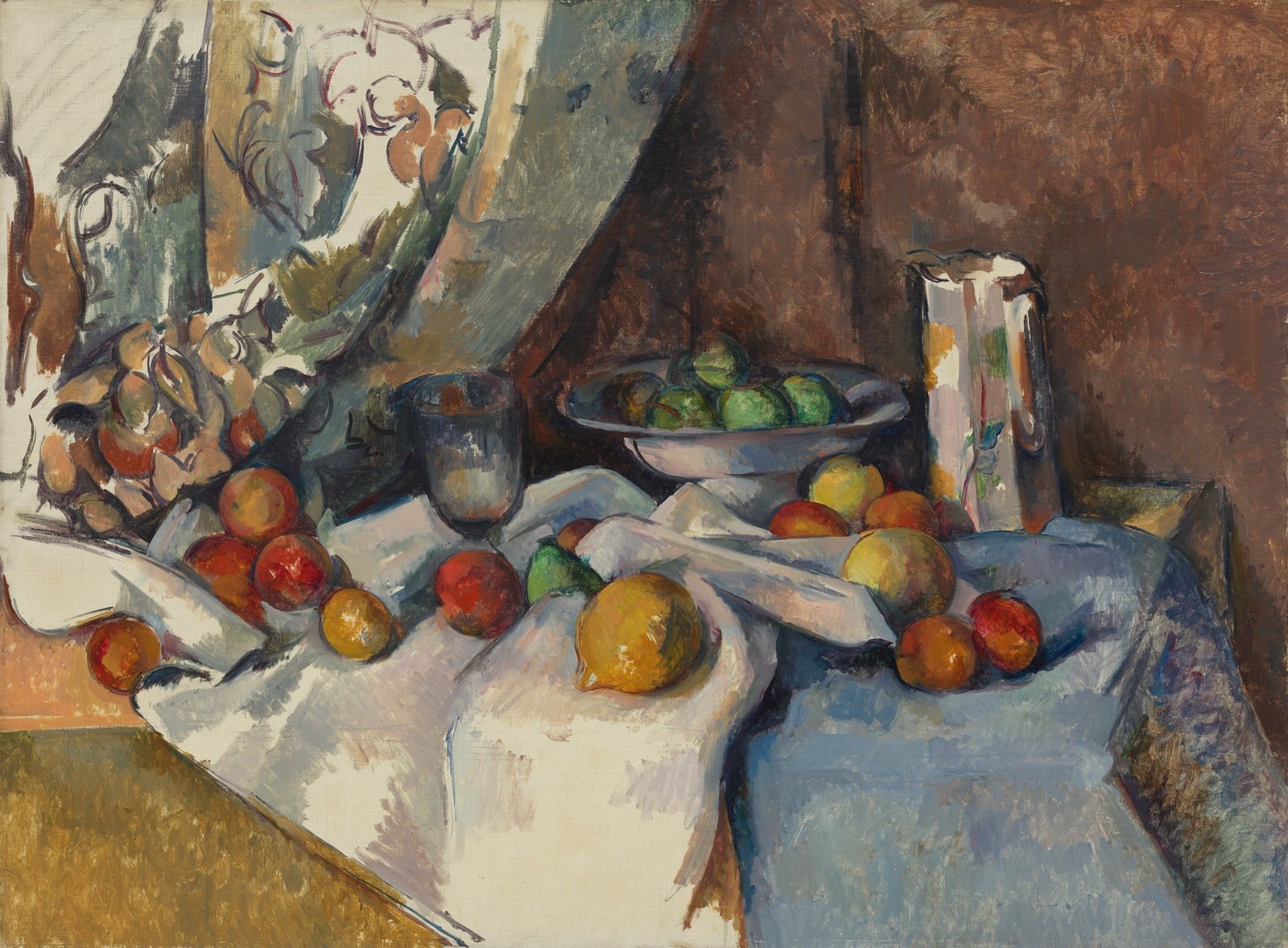
Look closely: Compare the changing slopes of the tabletop, the cloth and the arrangements of fruit. Ask whether every part belongs to a single, perfectly consistent perspectival box.
Cézanne’s still lifes offer a useful starting exercise. Follow the edges of the table, then the cloth and the objects resting on it. Their visual relationships matter more than a perfectly seamless illusion. Cubist artists would pursue their own, more radical reorganisation of volume and space. Cézanne’s major posthumous retrospective at the 1907 Salon d’Automne was an important point of reference in this development.
The connection is not that Cézanne secretly painted mature Cubism. His work helped make it possible to think of painting as a constructed arrangement of colour and form. Still Life with Apples, dated 1895–98, belongs before the Cubist movement. In an examination, distinguish a precursor’s influence from membership of the later movement.
Source: Centre Pompidou, educational dossier on Cubism.
African and Iberian sources: specificity matters
Picasso’s early experiments also involved encounters with Iberian sculpture and African art. These were distinct traditions, with their own functions, histories and forms. European artists encountered many such objects within colonial networks, collections and ethnographic displays. Calling them simply “primitive art” repeats a historical hierarchy rather than explaining their significance. Where an older text uses that term, treat it as historically situated language, not a neutral classification.
In discussing Les Demoiselles d’Avignon, it is more accurate to distinguish different treatments of the faces and bodies than to attribute the entire canvas to one generic “African mask influence”. Modernist borrowing also involved unequal access and representation. Formal innovation in Europe should not erase the makers or cultural contexts of the works that helped stimulate it.
Source: MoMA, Les Demoiselles d’Avignon: historical and conservation research.
2. Origins, the name “Cubism” and public milestones
Three dates answer three different questions. 1907 marks a crucial stage in Picasso’s experiments. 1908 is central to the critical naming of the emerging approach in relation to Braque’s L’Estaque landscapes. 1911 marks a major public Salon breakthrough for a wider group. Do not force all three into a single “founding event”.
The name is associated with critic Louis Vauxcelles and his description of geometrically simplified forms in Braque’s 1908 landscapes. Braque’s exhibition at Daniel-Henry Kahnweiler’s Paris gallery in November 1908 helped establish the new approach. Kahnweiler was a dealer and supporter, not one of the two painters who developed the core partnership.
Source: The Met, Trees at L’Estaque: 1908 context and reception.
Picasso and Braque worked in close dialogue, while the artists often called Salon Cubists became prominent through large public exhibitions. The 1911 Salon des Indépendants and Salon d’Automne are important in this public history. Picasso and Braque generally avoided these major Salon presentations, relying on other exhibition and dealer arrangements. That does not mean that their work was never exhibited.
Source: Musée national Picasso-Paris, Picasso and Cubism.
1912–13: exhibitions and books
Du “cubisme” was published in Paris by Eugène Figuière in 1912. Its authors were Albert Gleizes and Jean Metzinger. This is the essential book-and-author match. It articulated Cubist ideas publicly, but should not be treated as a manifesto written jointly by Picasso and Braque.
Source: Paris Musées, bibliographic record for Du “cubisme”.
The Section d’Or exhibition, held at the Galerie La Boétie in Paris in October 1912, gathered a broad network of artists. It was a major public event, not the moment when Picasso and Braque first invented Cubism. The name also reminds us that Cubist debates extended to proportion, order and the organisation of the picture; it does not prove that every work followed an identical mathematical formula.
Source: FranceArchives, the Section d’Or exhibition of 1912.
In 1913, Guillaume Apollinaire published Les Peintres cubistes, a critical interpretation of the new painting. Keep the two books separate: Gleizes–Metzinger, 1912; Apollinaire, 1913. Critics and artists did not always agree on definitions, boundaries or classifications. The history is richer than one unanimously accepted theory.
Source: Musée national Picasso-Paris, The Cubist Painters.
3. Visual characteristics: how to read a Cubist picture
When you see a difficult Cubist image, begin with evidence rather than guessing the artist from its brown colour. Work through the following features. A single painting need not contain all of them, and similar devices can appear in other movements.
| Visual feature | What to look for | What it does |
|---|---|---|
| Faceting | Small angular or curved planes, often with changing tonal directions. | Reorganises the object into interconnected pictorial units. |
| Compressed or shallow space | Objects and surrounding space press close to the picture surface. | Weakens the effect of a deep, continuous window-like scene. |
| Contrasting viewpoints | A feature seen from one angle sits beside another treated differently. | Challenges dependence on one fixed view. |
| Open or interrupted contours | An edge breaks, merges with another plane or continues into the background. | Makes the boundary between object and setting unstable. |
| Restrained palette | Greys, ochres, browns, muted greens and blacks in many Analytic works. | Concentrates attention on structure and tonal relationships. |
| Letters and signs | Stencilled characters, titles, musical notation or fragments of print. | Anchors recognition and declares the flatness of the support. |
| Collage and constructed shapes | Pasted paper, oilcloth, overlapping shapes or assembled materials. | Introduces real material surfaces into representation. |
| Everyday subjects | Musical instruments, glasses, bottles, newspapers, portraits and café objects. | Lets familiar things become sites of pictorial experiment. |
Multiple viewpoints is useful shorthand, but “every side of an object shown at once” is too literal. Often only selected features are treated from contrasting positions. Nor does the picture necessarily record a person walking around the object in a measurable sequence. Ask how the particular features are related, instead of applying a universal explanation to every canvas.
Flatness and depth coexist. Tonal modelling can suggest a small projecting plane while another mark cancels a clear spatial reading. The eye alternates between seeing an object and seeing a constructed surface. This tension is one reason a Cubist still life can be demanding even when its subject is an ordinary glass or instrument.
Do not confuse difficulty with absence of subject. Many Cubist works remain representational, though their objects are not immediately legible. A few strings may indicate a guitar; a curve may suggest a glass; a letter may identify a café or newspaper. Those clues are not accidental leftovers. They actively help organise recognition.
Source: MoMA, What Is Cubism?.
4. Analytic versus Synthetic Cubism
The familiar phase names are retrospective categories used by historians to explain a changing practice. They should help you see differences without suggesting an overnight switch or an absolute separation. MoMA notes that analysis and synthesis are present across the development, even though the labels identify useful tendencies.
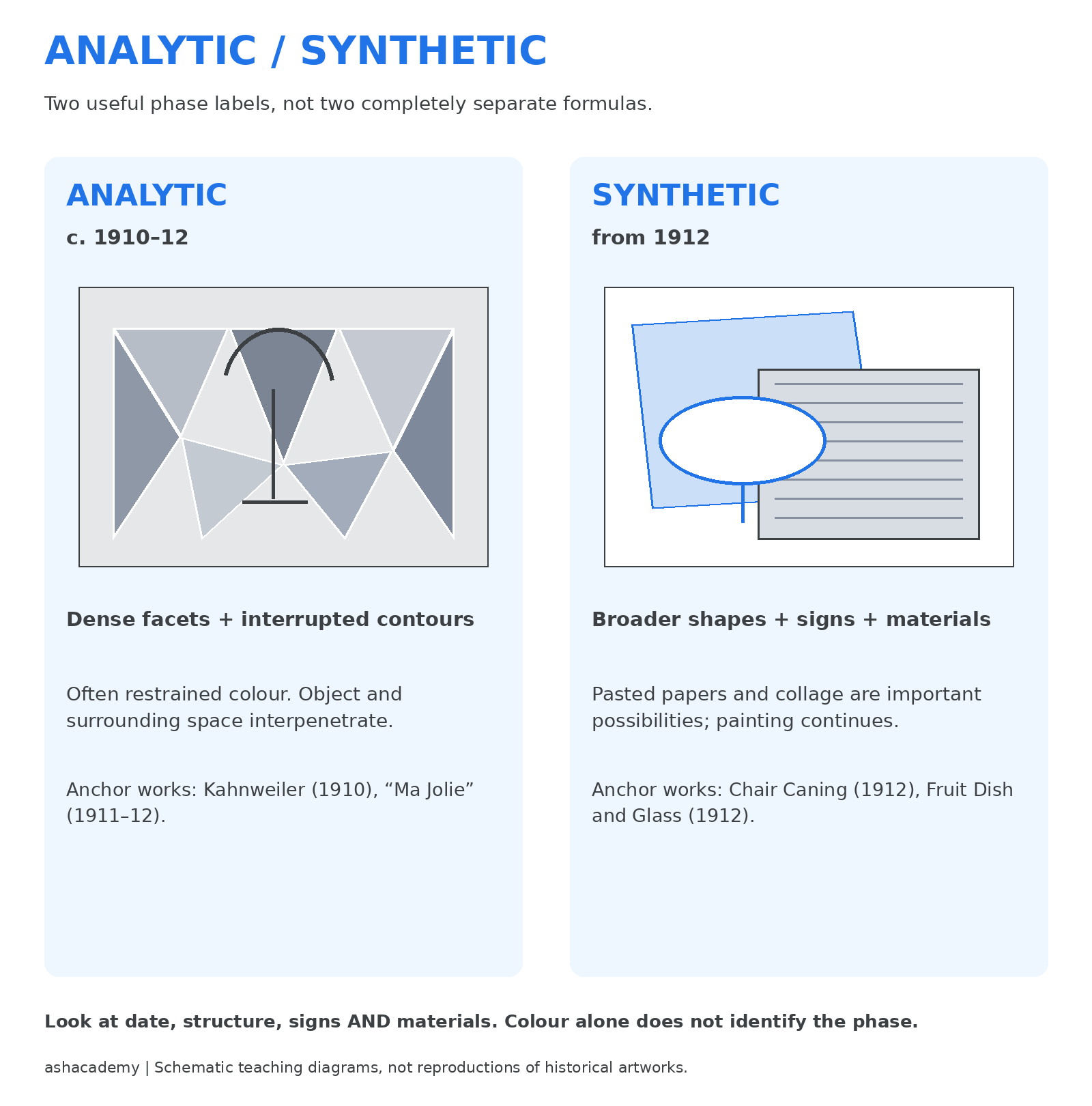
| Aspect | Analytic Cubism | Synthetic Cubism |
|---|---|---|
| Approximate dates | c. 1910–12; some accounts start in 1909. | From 1912, continuing beyond the prewar partnership. |
| Typical construction | An object becomes a dense network of facets and interrupted outlines. | A recognisable image is built through broader shapes, signs and material combinations. |
| Space | Compressed and ambiguous; object and setting interpenetrate. | Overlapping planes often emphasise the picture’s physical surface. |
| Colour | Frequently restrained, especially in the Picasso–Braque partnership. | Often more varied, but bright colour is not a compulsory criterion. |
| Materials | Oil paint, drawing media and sometimes sand or lettering. | Paint and drawing continue; collage and papier collé become crucial possibilities. |
| Useful examples | Picasso, Daniel-Henry Kahnweiler (1910); “Ma Jolie” (1911–12); Braque, Still Life with Banderillas (1911). | Picasso, Still Life with Chair Caning (1912); Braque, Fruit Dish and Glass (1912); Gris, Book and Glass (1914). |
| Identification warning | Not every muted geometric work is Analytic Cubism. | Not every colourful geometric work is Synthetic Cubism. |
Revision note: “Analytic breaks down; Synthetic builds up” is a memory aid, not a complete definition. Both involve constructing pictures. Use the artwork’s date, handling, signs and materials together.
Source: MoMA, Analytic and Synthetic Cubism.
5. Important Cubist artworks, decoded
The sequence below moves from a major early experiment to Analytic painting, public Salon variants, collage, construction and related later developments. All study reproductions preserve the complete composition. Open an image to examine it at the supplied resolution; some museum display files are smaller than others.
Pablo Picasso: Les Demoiselles d’Avignon, 1907
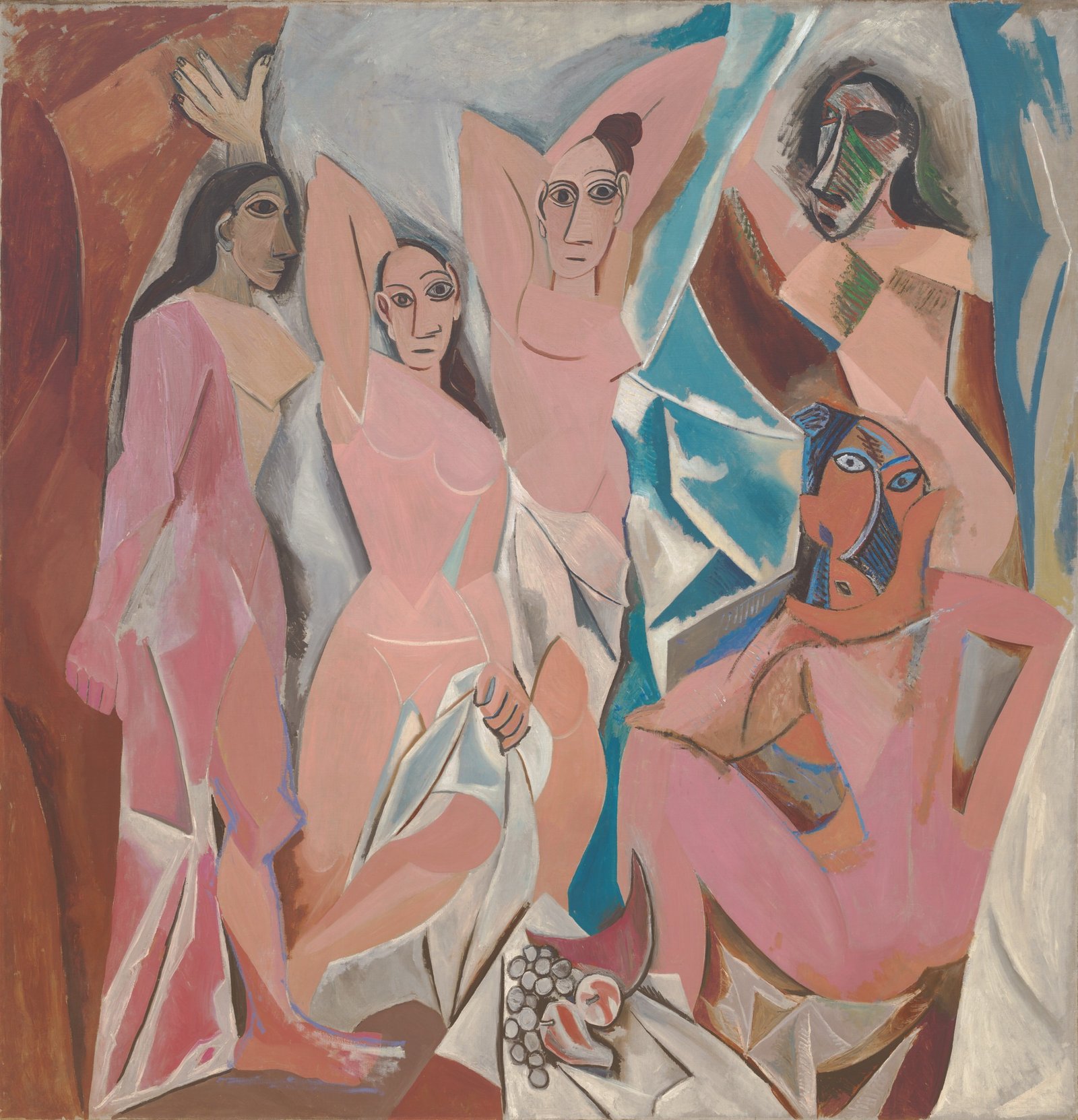
Look closely: Observe the five figures, the sharp fabric-like planes and the different treatments of faces. Compare the crouching figure’s head with the orientation of her body.
The bodies and surrounding space form an angular, confrontational arrangement. Instead of placing smooth figures comfortably within a deep room, Picasso makes them press towards the surface. Different facial treatments and abrupt changes of orientation interrupt the expectation of a consistent naturalistic scene. The painting is an important early breakthrough in the development towards Cubism.
For revision, label it 1907, oil on canvas, MoMA. “Proto-Cubist” or “a foundational early work” is more precise than presenting it as a finished specimen of the densely faceted Analytic phase of 1910–12. A movement can develop from an important work without all its later characteristics already being present in that work.
Pablo Picasso: Daniel-Henry Kahnweiler, 1910
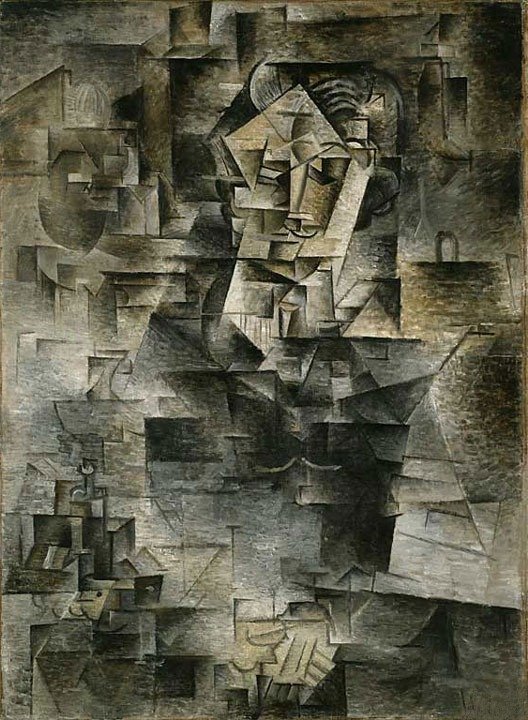
Look closely: Locate the wave of hair, the head, the tie and the hands within the faceted field. The sitter remains present even when continuous contour is difficult to follow.
This portrait offers an effective lesson in recognition through fragments. The sitter does not emerge from one uninterrupted silhouette. Small planes carry the eye across the head, torso and surrounding space. A few comparatively legible features allow the viewer to reconstruct the presence of a seated person. The restrained palette keeps the emphasis on these spatial and structural relationships.
Kahnweiler matters twice in the topic: as Picasso’s sitter and as a dealer closely associated with early Cubism. The work is not a portrait of Braque, Gris or Apollinaire. For identification, combine the sitter’s name with the painting’s date and its collection in Chicago, rather than relying only on a generic brown-and-grey appearance.
Source: Smarthistory, Picasso’s portrait of Kahnweiler.
Pablo Picasso: “Ma Jolie”, 1911–12
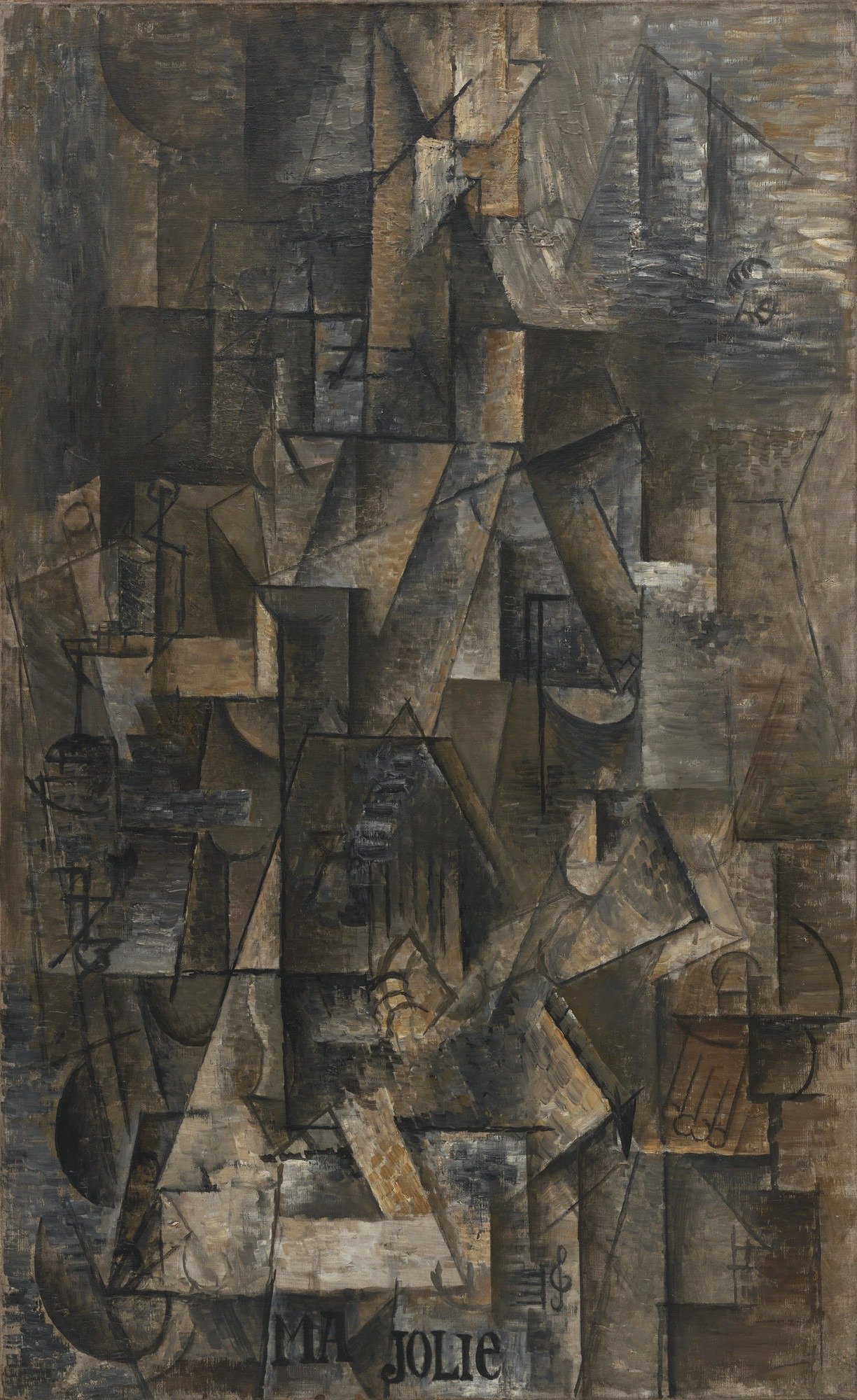
Look closely: Find the words MA JOLIE near the bottom and the musical notation. Then look for traces of a figure and instrument within the angular field.
The subject is difficult to retrieve from the close mesh of planes. The lettering provides a more immediate point of entry. “Ma Jolie” had personal and popular-musical associations: it was a nickname for Picasso’s companion and a phrase associated with a contemporary song. Text and musical signs participate in the picture rather than functioning as a separate explanatory label.
Notice that the words remain plainly readable while the represented body is fragmented. The juxtaposition makes us switch between reading a sign and interpreting an image. For an image-based question, the lettering is a stronger clue than “many triangles”. Remember winter 1911–12, rather than assigning the work to 1907 simply because Picasso was already experimenting then.
Georges Braque: Still Life with Banderillas, 1911
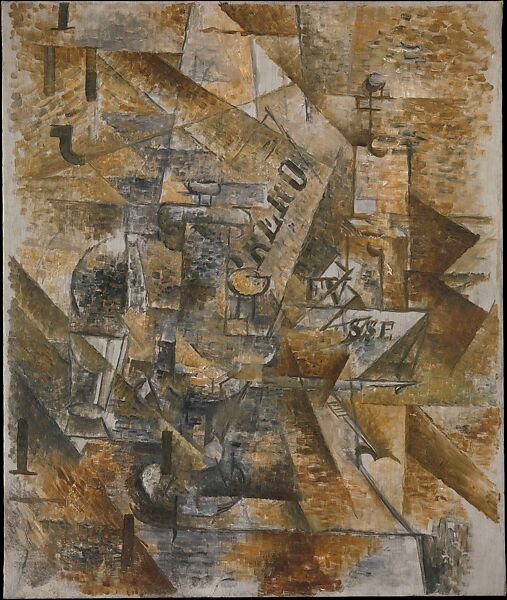
Look closely: Inspect the close-set planes and tonal shifts, then consider the physical surface: this work contains sand as well as oil paint and charcoal.
This is useful evidence that Analytic Cubism was not exclusively a purely optical exercise. The medium itself includes oil and charcoal with sand on canvas. The added material complicates the relationship between the actual surface and the image. A roughened passage is physically present, while tonal fragments invite us to search for the still life.
In revision, separate this example from a pasted-paper work. A material addition does not automatically make an artwork a papier collé. The latter specifically involves pasted paper. The painting’s 1911 date also helps place such surface experiments before the major collage developments of 1912.
Jean Metzinger: Tea Time (Woman with a Teaspoon), 1911
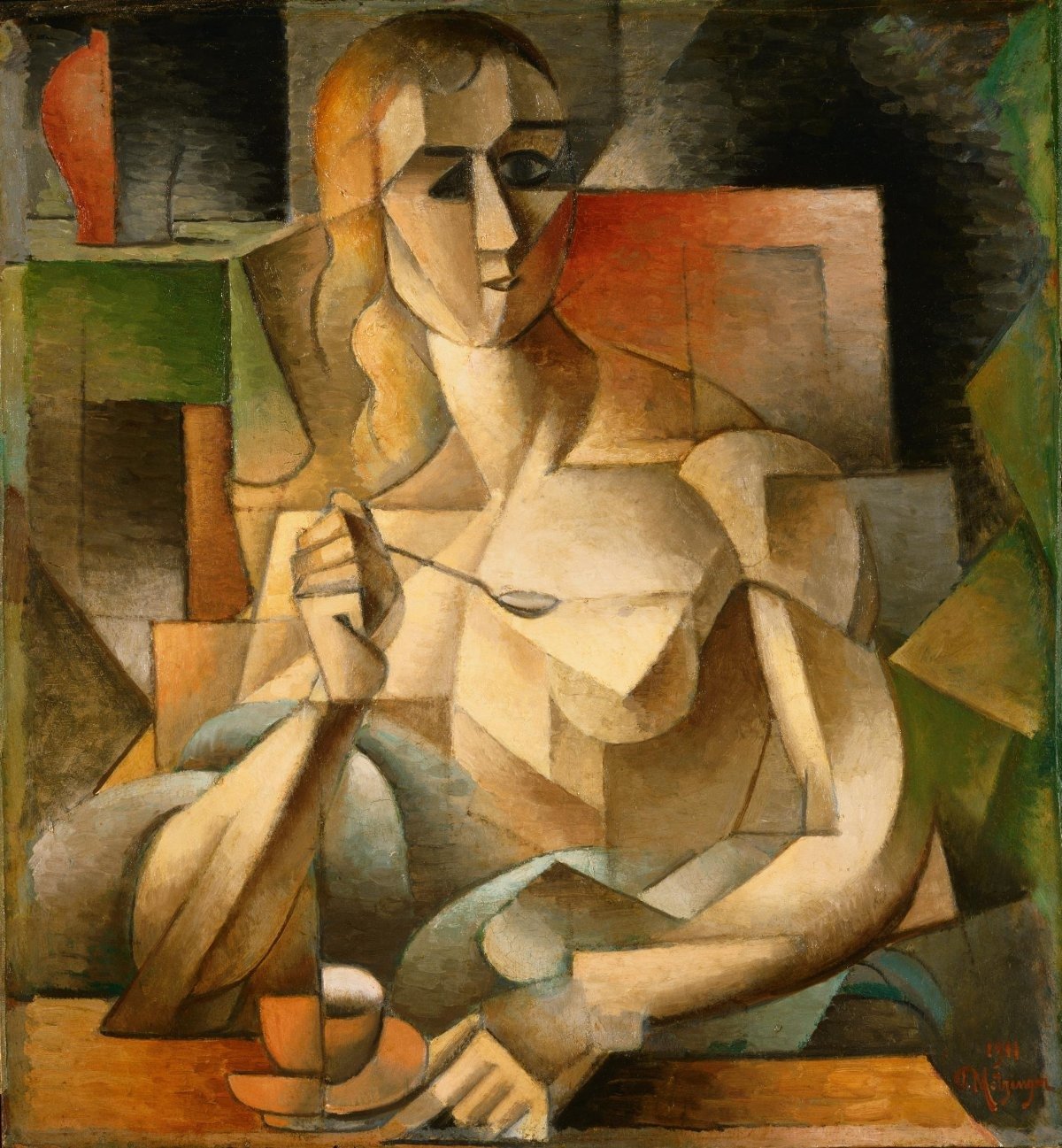
Look closely: Compare the face, torso, hands and cup. The woman remains comparatively legible, while shifts in angle and plane challenge a single consistent viewpoint.
Metzinger offers a productive comparison with the Picasso portraits. The figure is more readily identifiable, and the act of holding a spoon gives the composition an everyday framework. Faceting does not erase all narrative or bodily recognition. The tension lies in seeing familiar actions reorganised through different orientations and angular divisions.
The work was shown at the 1911 Salon d’Automne. Its medium is oil on cardboard, an easy detail to overlook when memorising “oil on canvas” for nearly every modern painting. It connects visual analysis with the public Salon history of Cubism, rather than only with Picasso and Braque’s studio dialogue.
Albert Gleizes: Man on a Balcony, 1912
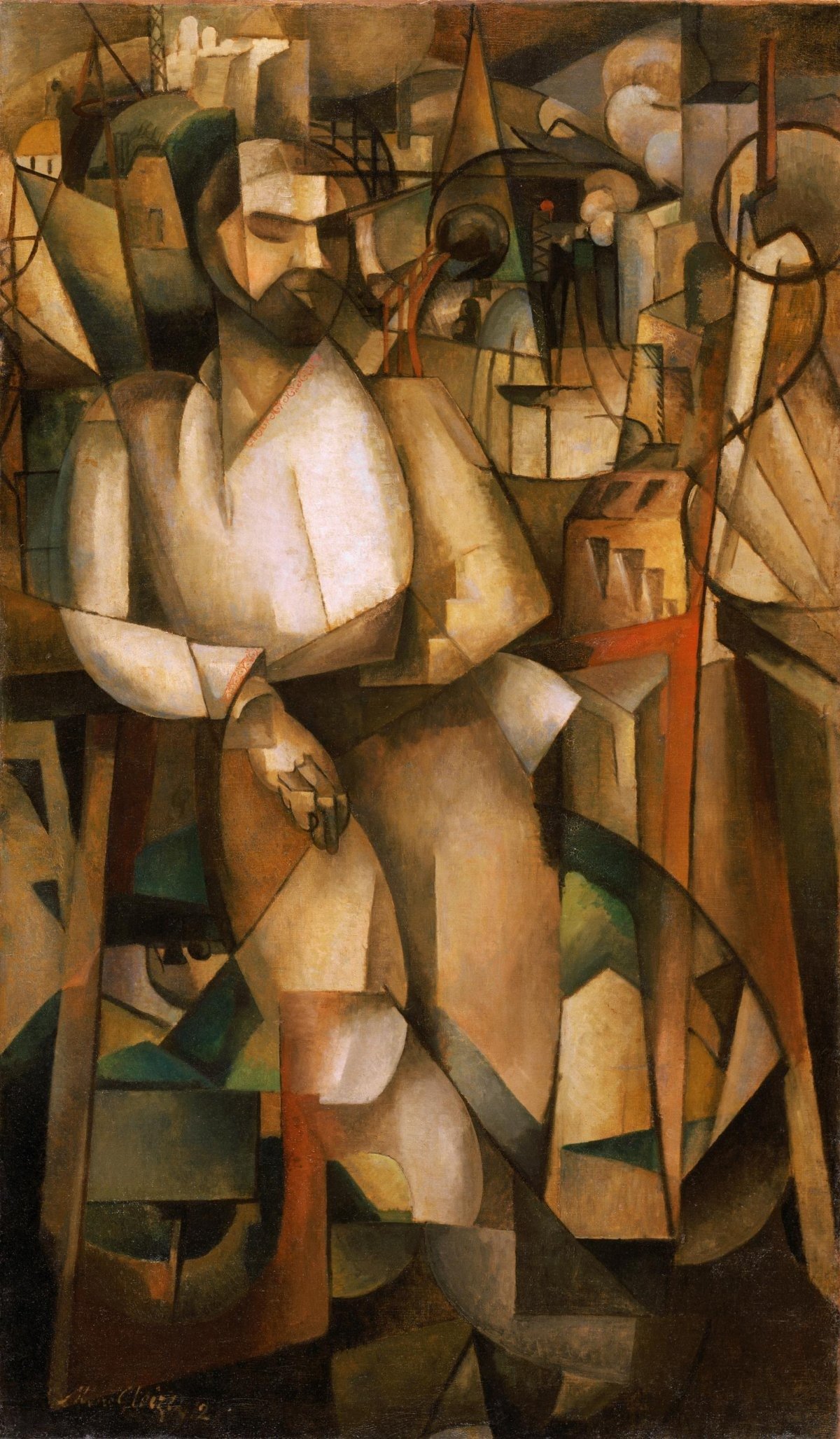
Look closely: Follow the large vertical figure and the angular divisions around him. Compare the scale of these planes with the smaller, denser facets in “Ma Jolie”.
The upright figure provides an organising presence. Surrounding architectural and landscape-like forms are brought into an energetic, closely connected structure. This gives you a useful comparative question: how does a Cubist artist organise the relationship between a person and the larger environment? The answer need not be identical to Picasso’s treatment of a studio portrait.
Match the alternative title Portrait of Dr. Théo Morinaud with Gleizes and 1912. That is also the publication year of Du “cubisme”, co-authored by Gleizes and Metzinger. The shared year helps memory, but the painting is not an illustration mechanically dictated by the book.
Juan Gris: Portrait of Pablo Picasso, 1912
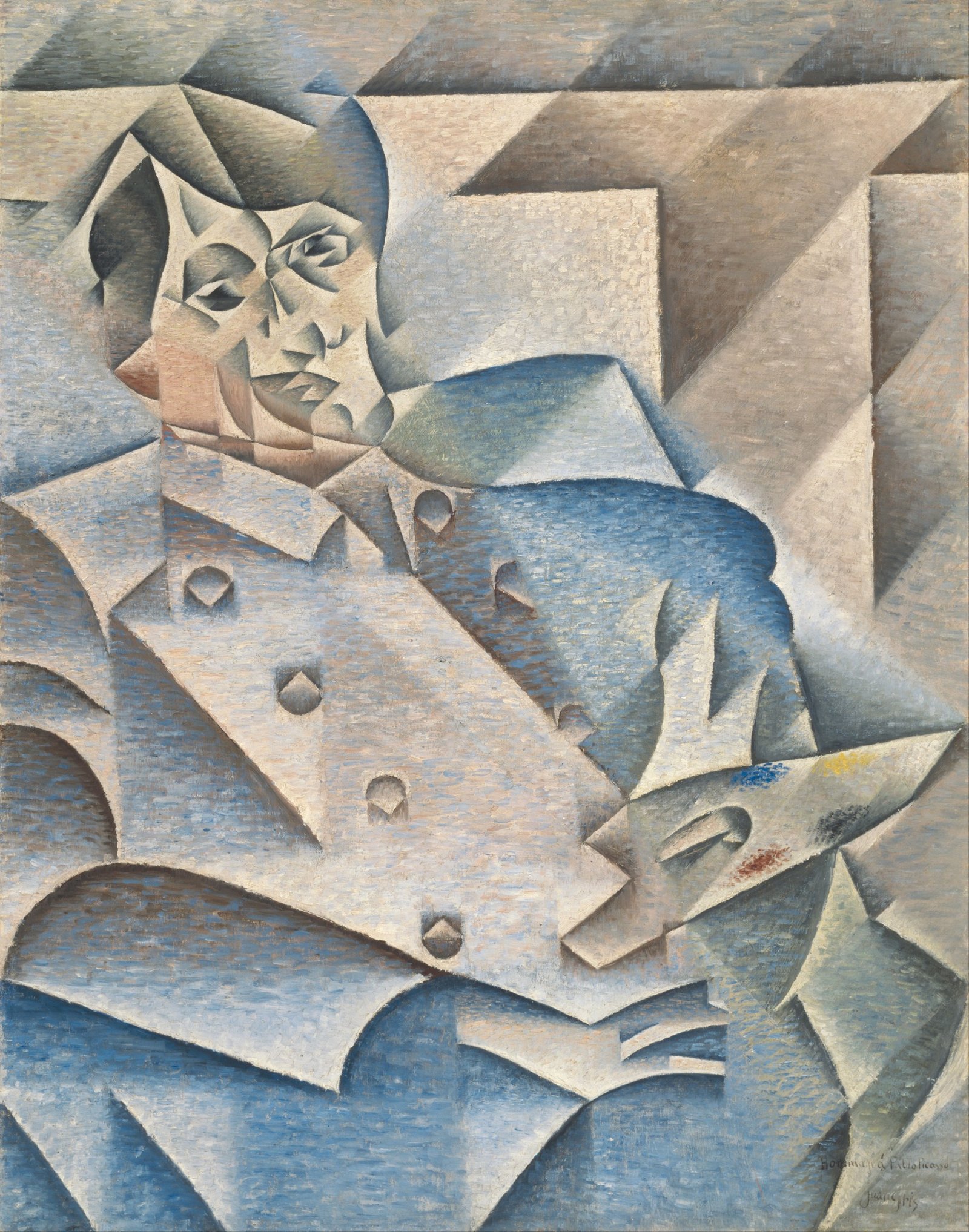
Look closely: Look at how broad, clearly bounded planes organise the head, jacket and background. Compare the figure’s readability with Kahnweiler’s portrait.
Gris’s portrait acknowledges Picasso while demonstrating an independent pictorial organisation. The angular divisions are relatively clear and emphatic. The figure does not dissolve into precisely the same kind of fine-grained field as the Kahnweiler portrait. Cubism therefore cannot be reduced to one visual handwriting shared by every artist.
The picture was exhibited at the 1912 Salon des Indépendants. It is a portrait by Gris of Picasso, not a self-portrait by Picasso. This distinction is especially useful in artist–artwork matching. A sitter’s fame often causes students to confuse the represented person with the maker of the image.
Pablo Picasso: Still Life with Chair Caning, 1912
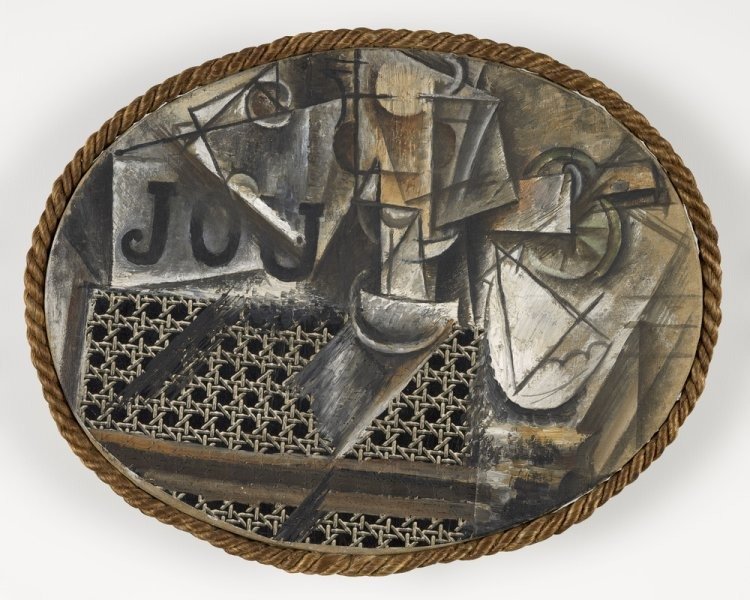
Look closely: Examine the oval rope frame, the printed cane pattern and the painted still-life fragments. Different kinds of “reality” occupy the same object.
This work introduces an essential material distinction. The cane pattern is printed on oilcloth; Picasso did not attach an actual section of woven chair cane. The rope, however, is a real material framing the oval. Painted marks, a manufactured printed imitation and an actual everyday material interact in one work.
That interaction makes the painting more than a simple combination of “real” and “fake”. The oilcloth is physically real as oilcloth while representing another material. The rope is both a thing and part of the frame. This is a landmark of modern collage and a major 1912 turning point. Avoid the unqualified claim that nobody anywhere had ever pasted materials before this work.
Georges Braque: Fruit Dish and Glass, 1912
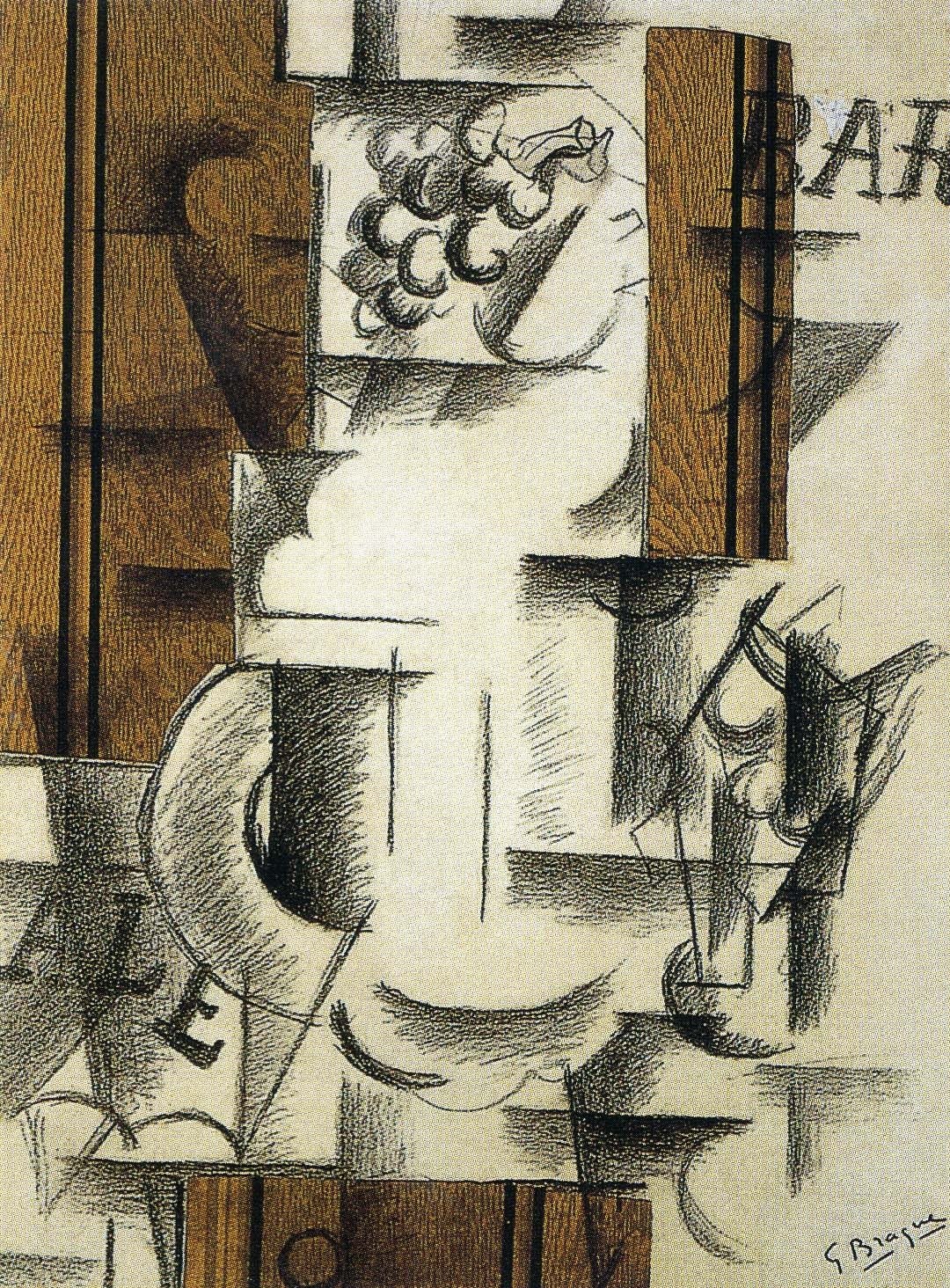
Look closely: Distinguish the printed faux-wood paper from the charcoal drawing. Ask whether the pasted wood pattern must represent only one particular wooden object.
According to Braque’s account, this was his first papier collé, made in September 1912. He used mass-produced faux bois, or imitation-wood, wallpaper. The pasted fragments remain flat sheets while participating in the represented still life. Drawing and paper therefore create a spatial proposition together.
The museum dates the work Sorgues, autumn 1912 and records charcoal, printed wallpaper and gouache on paper, mounted on paperboard. Compare that specific material description with the oilcloth and rope in Chair Caning. Both are central to the collage story; only the Braque example is the direct textbook match for this pioneering pasted-paper experiment.
Juan Gris: Book and Glass, 1914
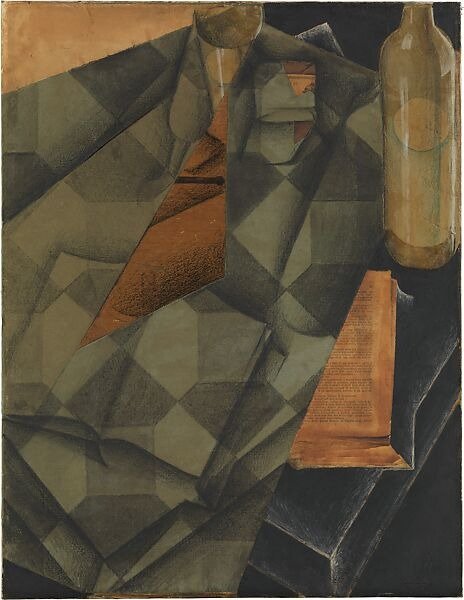
Look closely: Identify the printed book fragment, differently coloured papers and drawn marks. Follow how overlapping areas both suggest objects and declare their own edges.
Gris brings together printed and painted papers, blue and tracing papers, crayon, charcoal and oil paint. The book fragment refers to the popular Fantômas fiction. Mass-produced print thus participates in a deliberately organised still life. The image is constructed through selection and placement as much as through drawn description.
Do not describe every Synthetic Cubist work as brightly coloured or visually simple. Here, pale and dark papers, print and drawing produce a controlled network of distinctions. The important identification clues are the 1914 date, the mixed paper-based construction and Gris’s authorship. The museum’s medium record is more informative than calling it merely an “oil painting”.
Pablo Picasso: Guitar, 1914
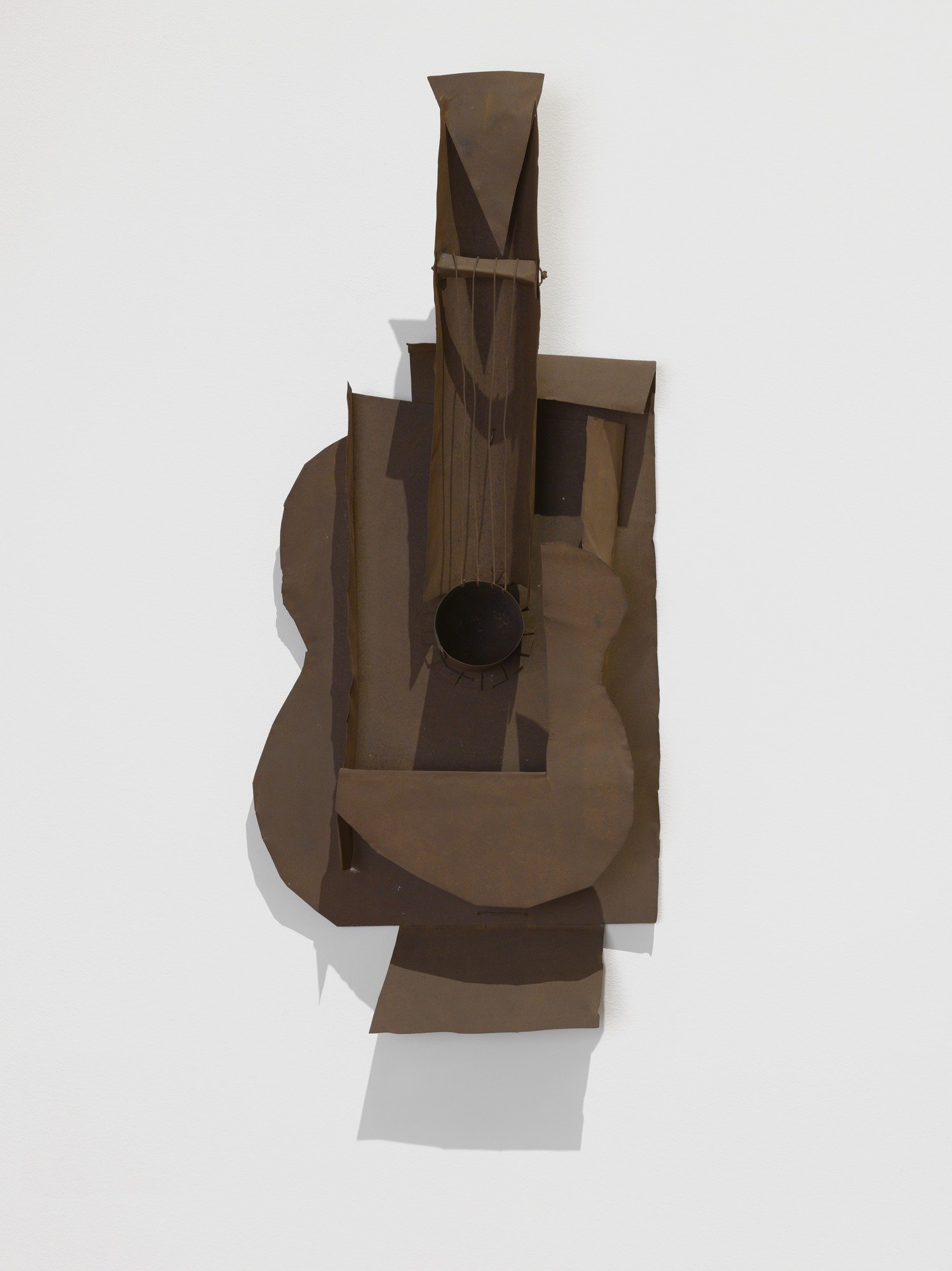
Look closely: Study the projecting cylinder, folded planes, open spaces and wire. Consider which parts stand for the instrument’s outer body and which turn an interior feature outward.
This January–February 1914 construction is made of ferrous sheet metal and wire. Picasso translated the instrument into an arrangement of planes and voids instead of carving a solid block or modelling a complete naturalistic body. A guitar’s normally recessed sound hole becomes a projecting cylindrical element. Space becomes an active part of the construction.
Do not confuse this metal work with Picasso’s earlier cardboard Guitar of 1912. Both are important, but their dates and materials differ. Nor should this 1914 object be called a bronze cast or attributed to Picasso’s later metalworking collaboration with Julio González.
Source: MoMA, Picasso: Guitars 1912–1914.
Robert Delaunay: Simultaneous Contrasts: Sun and Moon, 1913
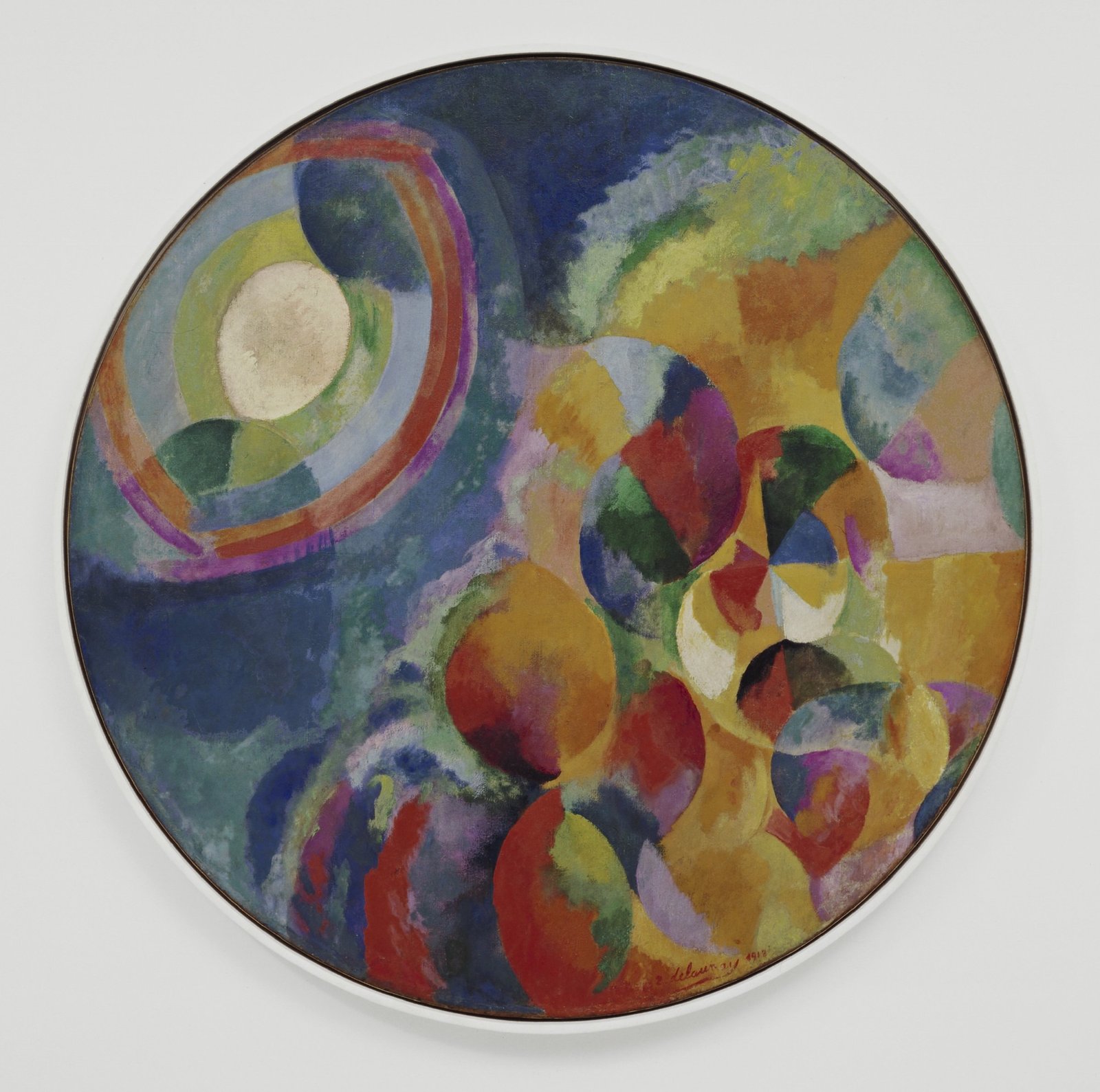
Look closely: Follow the circular rhythms and adjacent colour areas. Compare their chromatic movement with the restrained tonal organisation of “Ma Jolie”.
Delaunay pursued colour and light through a related but distinct path commonly discussed as Orphism. This circular canvas is a useful boundary example: it shows that artists engaging with Cubist questions did not all remain within the same still-life vocabulary or muted palette. The relationships between colours become central to the work’s structure.
MoMA gives the date as 1913 (dated 1912). Preserve that qualification. A date written on a work and the date assigned through curatorial research are not always identical. Do not flatten the entry to an unqualified 1912, and do not define Orphism as simply another name for Synthetic Cubism.
Marcel Duchamp: Nude Descending a Staircase (No. 2), 1912
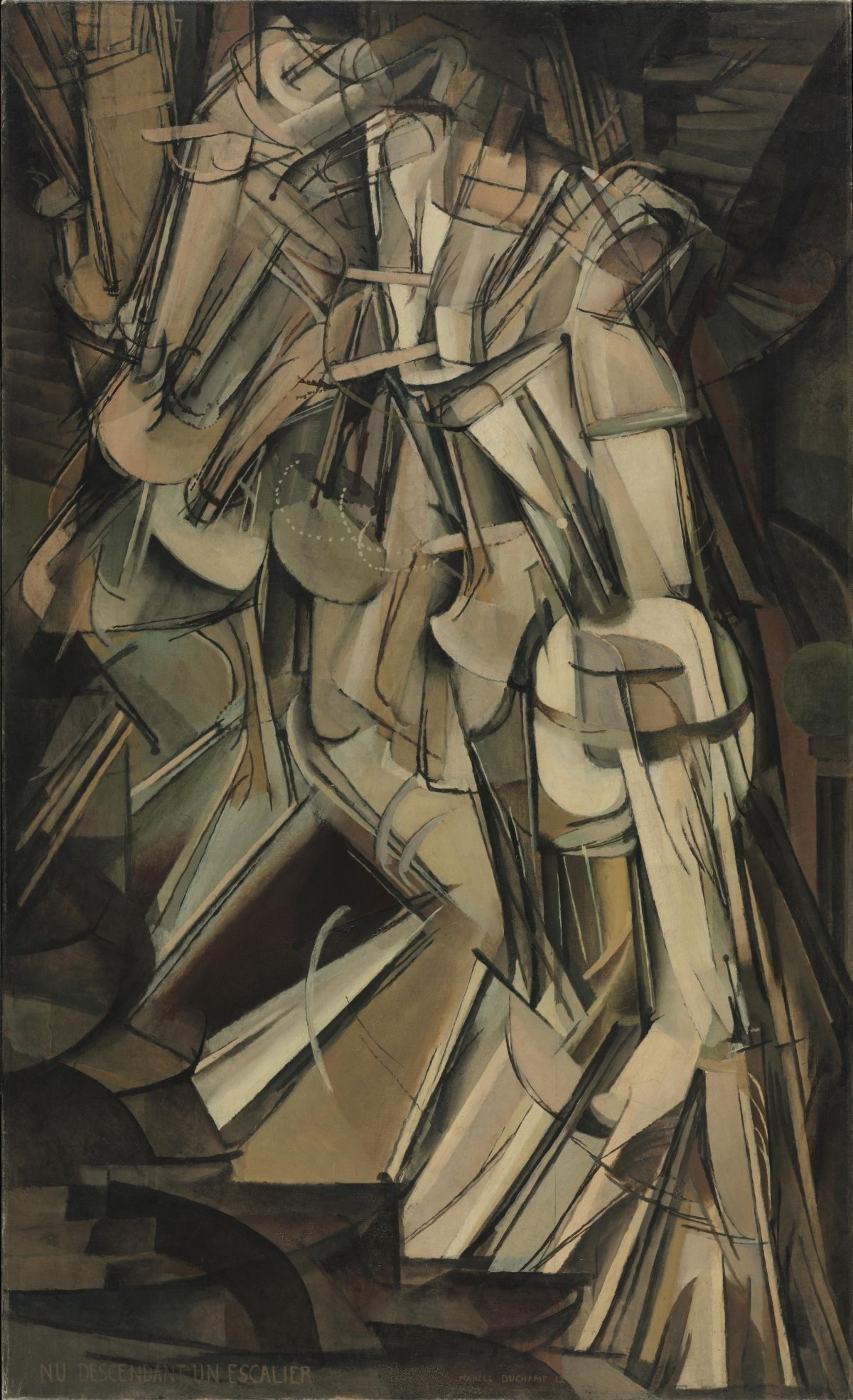
Look closely: Look for a descending sequence of bodily elements. Compare the suggestion of successive movement with the more stable seated figures in the portraits above.
Duchamp combines an angular vocabulary with the problem of movement. The repeated forms make the body appear to unfold through a sequence rather than occupy one stable pose. The painting is useful for discussing intersections between Cubist fragmentation, contemporary interest in motion and the concerns associated with Futurism. It is a boundary case, not a universal template for Cubism.
The work is dated 1912. Its fame at the American Armory Show in 1913 does not change the painting’s date. It was withdrawn from the 1912 Salon des Indépendants after objections from the hanging committee. Keep it distinct from Nude Descending a Staircase (No. 1), dated 1911.
Source: Philadelphia Museum of Art, Duchamp Research Portal.
Fernand Léger: The City, 1919
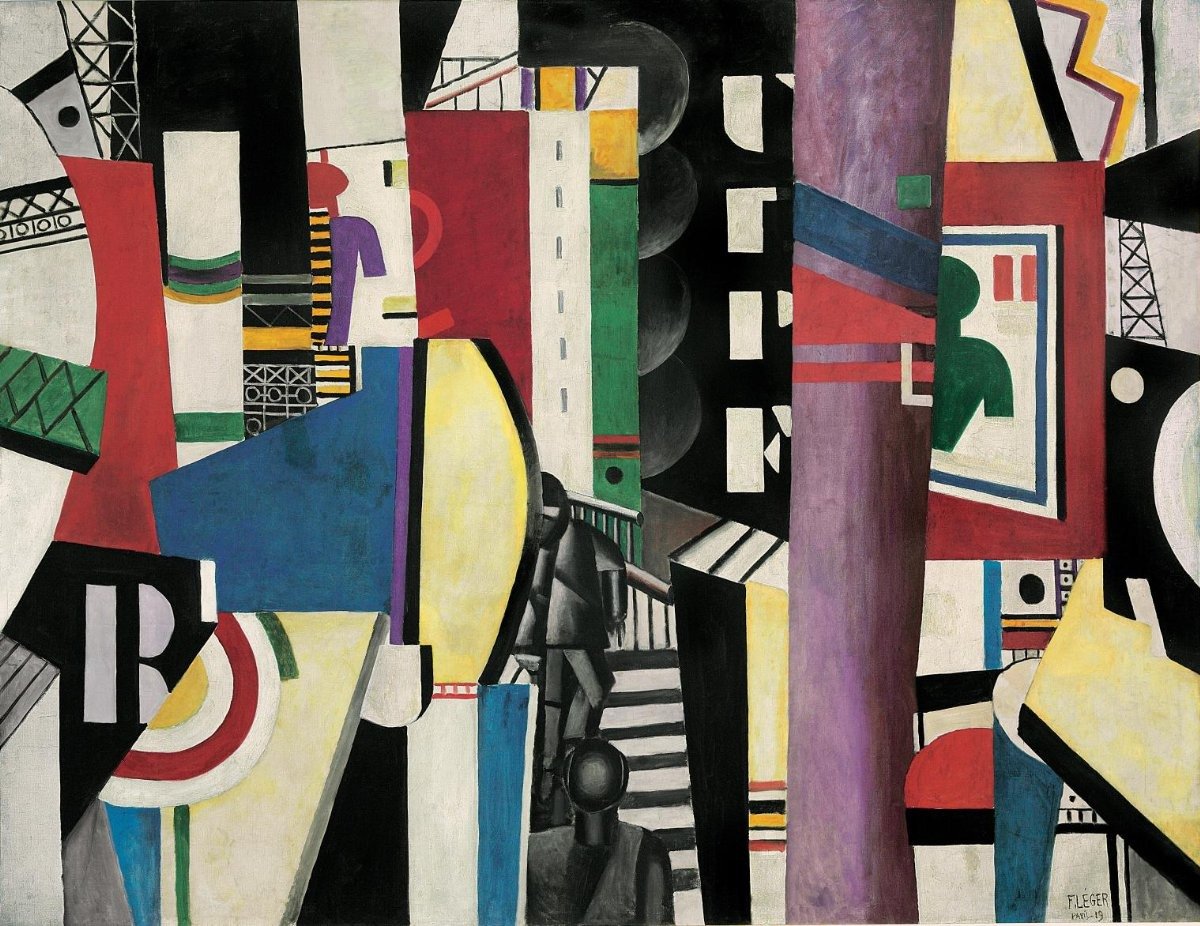
Look closely: Track the strong colours, cylindrical elements, abrupt changes of scale and fragments recalling urban signs or structures. The picture has a different visual rhythm from early Analytic portraiture.
Léger’s large canvas brings us into a postwar urban world. Distinct shapes and high-contrast colour create a dense pictorial environment. Forms associated with bodies, architecture and modern visual communication meet in an organised field. As a looking exercise, compare its assertive colour and scale with the muted, intimate still lifes of 1911.
The 1919 date is crucial. Cubist methods continued to develop after the First World War interrupted the earlier Picasso–Braque partnership. The work illustrated here is the large painting in the Philadelphia Museum of Art. Léger made related works and studies, so a title alone is less secure than title, date, collection and image together.
6. Main artists: individual contributions and differences
These profiles are arranged by birth year, with artists born in the same year ordered chronologically. “Connected with Cubism” does not mean that every artist belonged to one formal group or pursued an identical programme. Delaunay and Duchamp are included to clarify related developments and limits.
| Artist | Dates | Contribution and useful distinction |
|---|---|---|
| Fernand Léger | 1881–1955 | Developed a distinctive language of cylindrical and machine-like forms, strong contrasts and modern urban subjects; The City (1919) shows a later development. |
| Pablo Picasso | 1881–1973 | Co-developed Cubism with Braque; pursued early figural experiments, Analytic portraiture, collage and constructed sculpture. His Blue and Rose periods precede Cubism. |
| Albert Gleizes | 1881–1953 | A prominent Salon Cubist and co-author of Du “cubisme” (1912); organised figures and environments through large interacting planes. |
| Georges Braque | 1882–1963 | Co-developer, not merely Picasso’s follower; crucial to landscape experiments, Analytic still life, lettering and the development of papier collé. |
| Jean Metzinger | 1883–1956 | A prominent Salon Cubist and co-author of Du “cubisme”; Tea Time (1911) is a key image and an oil-on-cardboard identification. |
| Robert Delaunay | 1885–1941 | Related chromatic and circular investigations associated with Orphism; colour-based abstraction should not be equated automatically with Synthetic Cubism. |
| Juan Gris | 1887–1927 | A central Cubist with an individual approach to clearly organised planes, colour relationships and carefully constructed still lifes and paper works. |
| Marcel Duchamp | 1887–1968 | An early engagement with Cubist form led towards other investigations; Nude No. 2 is important for its treatment of movement and its 1913 American reception. |
How to compare artists: begin with the same question across two works. Compare Picasso’s Kahnweiler with Gris’s Picasso portrait for degrees of legibility and plane size. Compare Braque’s Fruit Dish and Glass with Gris’s Book and Glass for the relationship of printed material to drawing. Compare Metzinger’s figure with Gleizes’s for how a body relates to its setting. These comparisons produce stronger notes than memorising eight interchangeable biographies.
7. Materials and techniques: collage, papier collé and construction
| Term | Precise meaning here | Example or warning |
|---|---|---|
| Collage | An image or object assembled by attaching material fragments to a support. | Picasso’s Chair Caning combines oilcloth, paint and rope; collage is broader than pasted paper alone. |
| Papier collé | Literally pasted paper: a paper-based collage procedure. | Braque’s Fruit Dish and Glass uses printed wallpaper with drawing and gouache. |
| Faux bois | Imitation wood grain, painted or printed. | Braque’s wallpaper is printed to resemble another material; it is not a real wooden board. |
| Stencil lettering | Characters applied with a stencil or otherwise rendered as clear graphic signs. | Letters can establish a flat pictorial register; their presence does not by itself prove collage. |
| Construction / assemblage | A three-dimensional work built by joining or arranging components. | Picasso’s 1914 Guitar uses metal sheet and wire rather than carved stone or modelled clay. |
| Facet | A plane-like pictorial division. | An analytical tool for looking, not proof that every depicted object is a literal polyhedron. |
A useful material-analysis method has three steps. First name what is physically present: paper, printed oilcloth, paint, charcoal, rope or metal. Next identify what it may represent: wood, cane, an instrument, a table or a book. Finally explain the difference between the physical material and the represented thing. This prevents “real object added to the picture” from becoming an answer that overlooks imitation and substitution.
Cubist sculpture developed through more than Picasso alone. Alexander Archipenko, Raymond Duchamp-Villon, Jacques Lipchitz and Henri Laurens are important names in the wider history. Their objects should be studied individually for material, date and treatment of space. A later bronze cast can have a casting date different from the original conception. Do not infer the original material from a photograph of a bronze version.
Source: The Met, Cubism: painting and sculpture overview.
Picasso’s work with Julio González in 1928–32 belongs to a later chapter of metal sculpture. It helps explain subsequent technical possibilities but should not be moved back to 1912 as the origin of the cardboard Guitar. Keeping conception, construction, collaboration and later casting separate is good sculpture-history practice.
Source: Fundación MAPFRE, Julio González collection and Picasso collaboration.
8. Impact, legacy and related movements
Cubism changed the available vocabulary of modern art. A picture could be organised through overlapping signs rather than a continuous optical scene. A manufactured fragment could carry meaning within a work. A sculpture could be constructed from planes and intervals rather than conceived only as a solid mass. These were methods that later artists could develop in different directions, rather than a single appearance they all had to copy.
Orphism developed related concerns through colour and light, particularly in the work of Robert and Sonia Delaunay and František Kupka. Apollinaire used the term around 1912. It is helpful to understand its relationship to Cubism while preserving its distinct emphasis. The Delaunay work above provides a visual comparison, rather than a reason to rename every coloured Cubist work Orphist.
Source: MoMA, Orphism.
Futurism shared certain devices of fragmentation but gave particular emphasis to movement, speed and modern dynamism. Duchamp’s Nude helps us discuss the overlap without collapsing the two movements. Conversely, the stillness of a Cubist café object does not make it less radical. Its innovation may concern representation and material rather than the depiction of physical speed.
Abstraction and later collage practices drew possibilities from Cubist reorganisation. However, shared geometric shapes do not establish a direct historical influence by themselves. To claim a connection for a particular later artist, look for evidence in works, writings, exhibitions or documented encounters. This matters especially when comparing European Cubism with later Indian modernisms: comparison is useful, but visual resemblance alone does not establish a complete transmission history.
The First World War disrupted the close prewar partnership and redistributed artistic networks. It did not make Cubist practice vanish in 1914. Gris, Léger and others continued to work through its possibilities. Later painting, graphic design, photomontage and construction could use fragmentation, layering and found material for different purposes. Distinguish a documented influence from a broader formal parallel.
9. Cubism timeline: keep the events in order
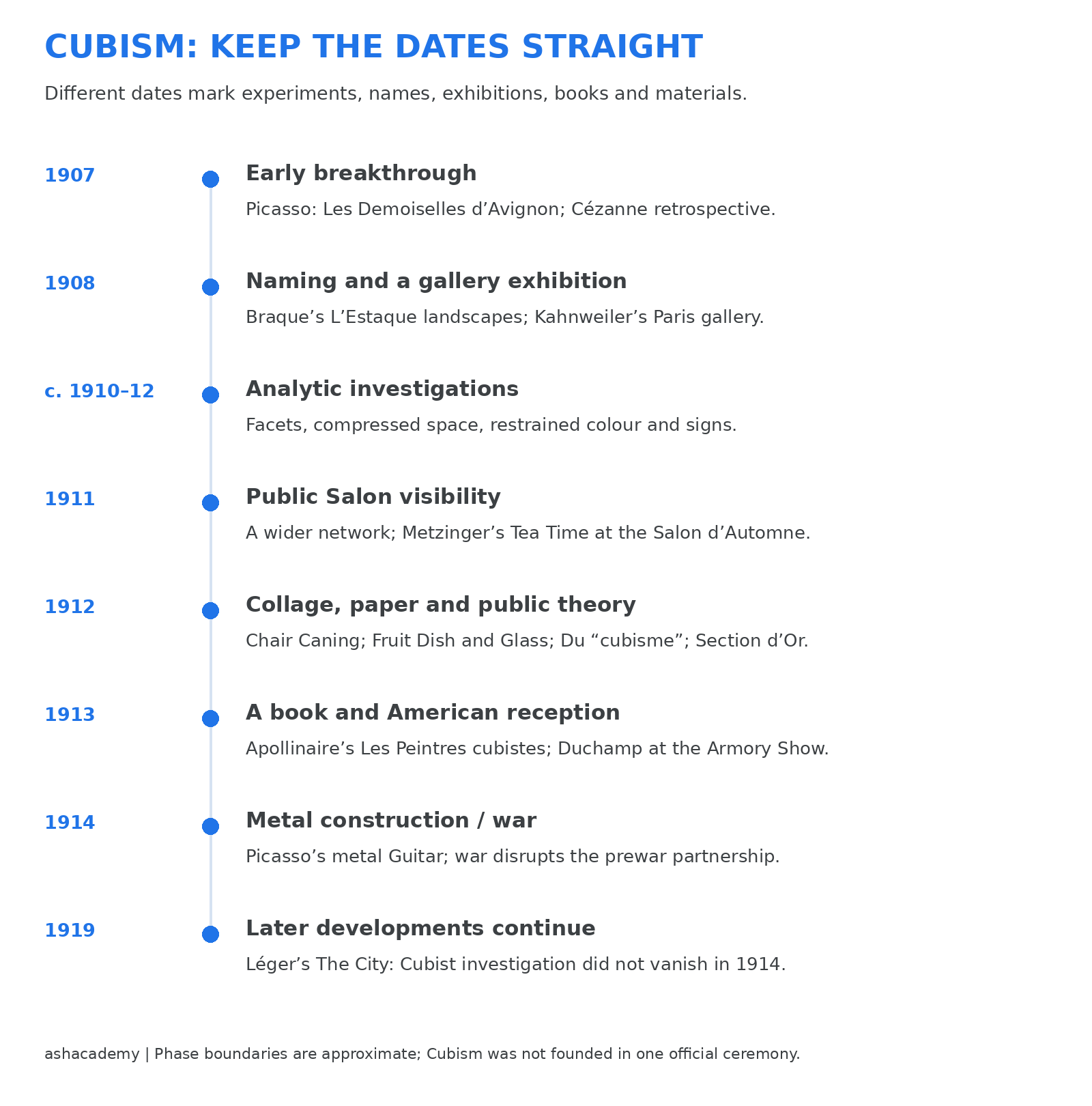
| Date | Milestone | Do not confuse it with |
|---|---|---|
| 1895–98 | Cézanne’s Still Life with Apples. | A painting by a Cubist group member. |
| 1907 | Picasso’s Les Demoiselles d’Avignon; Cézanne retrospective at the Salon d’Automne. | The mature Analytic phase of 1910–12. |
| 1908 | Braque’s L’Estaque landscapes; the critical naming context; Kahnweiler gallery exhibition. | The first large public Salon presentation of the wider network. |
| c. 1910–12 | Dense Analytic investigations; Kahnweiler (1910), Banderillas (1911), “Ma Jolie” (1911–12). | A phase with an exact universally agreed opening day. |
| 1911 | Major public Salon visibility; Metzinger’s Tea Time at the Salon d’Automne. | Du “cubisme”, published the following year. |
| 1912 | Chair Caning; Fruit Dish and Glass; cardboard Guitar; Du “cubisme”; Section d’Or exhibition. | The metal Guitar of 1914. |
| 1913 | Apollinaire’s Les Peintres cubistes; Duchamp’s Nude No. 2 at the Armory Show. | The Nude’s 1912 execution date. |
| 1914 | Picasso’s metal Guitar; Gris’s Book and Glass; war interrupts the prewar partnership. | The end of all Cubist art. |
| 1919 | Léger’s The City. | An early 1907–08 founding work. |
10. UGC NET Visual Arts revision: commonly confused facts
Use this material within your study of Western art movements, painting, sculpture and modern materials. These notes do not claim that a particular question will appear in the examination. The questions in the next section are original practice questions, not authenticated previous-year questions.
| Common confusion | Correction |
|---|---|
| Cubism means painting everything as cubes. | Its central issues include structure, viewpoints, signs, surface and representation; literal cubes are not a universal requirement. |
| Picasso alone invented every part of Cubism. | Braque was a co-developer; other artists made significant independent contributions. |
| Cézanne was a Cubist group member. | He was an influential predecessor. |
| Du “cubisme” was written by Picasso and Braque. | Albert Gleizes and Jean Metzinger, 1912. |
| Apollinaire’s book was published in 1912. | Les Peintres cubistes appeared in 1913. |
| Every geometric modern painting is Cubist. | Geometry appears in many movements; use date, context and pictorial organisation. |
| Chair Caning contains actual chair cane. | Its cane pattern is printed on oilcloth; the rope frame is an actual added material. |
| Every collage is a papier collé. | Papier collé specifically involves pasted paper. |
| Picasso’s 1914 Guitar is cardboard. | The illustrated work is ferrous sheet metal and wire; the earlier 1912 version is cardboard. |
| Metzinger’s Tea Time is oil on canvas. | The Philadelphia record specifies oil on cardboard. |
| Duchamp painted Nude No. 2 in 1913. | It was painted in 1912 and exhibited at the Armory Show in 1913. |
| Delaunay’s Sun and Moon is simply dated 1912. | MoMA records 1913 (dated 1912). |
| World War I ended all Cubism. | It disrupted the prewar partnership; Cubist approaches continued. |
| Einstein’s theory directly caused Cubism. | Do not state a direct causal relationship without specific historical evidence. |
Artist–artwork matching: compact revision set
| Artist | Secure matches |
|---|---|
| Cézanne | Still Life with Apples (1895–98): precursor. |
| Picasso | Les Demoiselles d’Avignon (1907); Daniel-Henry Kahnweiler (1910); “Ma Jolie” (1911–12); Still Life with Chair Caning (1912); metal Guitar (1914). |
| Braque | Still Life with Banderillas (1911); Fruit Dish and Glass (1912). |
| Metzinger | Tea Time (Woman with a Teaspoon) (1911). |
| Gleizes | Man on a Balcony (1912). |
| Gris | Portrait of Pablo Picasso (1912); Book and Glass (1914). |
| Delaunay | Simultaneous Contrasts: Sun and Moon (1913, dated 1912). |
| Duchamp | Nude Descending a Staircase (No. 2) (1912). |
| Léger | The City (1919), Philadelphia Museum of Art. |
Revision note: For each artwork, revise five linked items: artist → title → date → medium → collection. Then add one visual clue. This is more reliable than learning a list of titles without images.
11. Image-based practice quiz
Try each question before opening the answer. The questions refer to the full reproductions above; use the linked artwork section to revisit an image. Explanations identify the relevant distinction, not just the correct name.
1. In the portrait of Kahnweiler, what makes “non-objective abstraction” an incomplete description?
The sitter remains identifiable through selected clues such as hair, hands and clothing. Picasso reorganises a represented person through facets rather than removing every reference to a subject. See the portrait.
2. Which artist painted the 1912 portrait of Pablo Picasso shown above?
Juan Gris. Picasso is the sitter, not the maker. The clearer large planes distinguish its organisation from Picasso’s denser Kahnweiler portrait. See Gris’s portrait.
3. The printed cane pattern in Chair Caning is on which material?
Oilcloth. It is not actual woven cane. The work also incorporates a real rope frame. Its material combinations make it broader than a pasted-paper example. See Chair Caning.
4. Which Braque work is associated with his first papier collé in September 1912?
Fruit Dish and Glass. The faux-wood wallpaper is pasted paper, used with charcoal and gouache. Still Life with Banderillas is earlier and contains sand, but it is not this pasted-paper work. See the work.
5. Which illustrated painting is oil on cardboard, rather than oil on canvas?
Jean Metzinger’s Tea Time (Woman with a Teaspoon), 1911. A familiar photographic appearance cannot establish the support. The medium must be checked against the collection record. See Tea Time.
6. Match Du “cubisme” with its authors and year.
Albert Gleizes and Jean Metzinger, 1912. Picasso and Braque developed the core artistic partnership; Apollinaire wrote Les Peintres cubistes, published in 1913. These are separate matches.
7. Is “Ma Jolie” a title clue, a musical reference or a nickname?
It involves interconnected personal and musical associations. The readable title-like phrase and musical signs offer anchors within the fragmented image. The correct approach is to explain their combined function rather than choose a single exclusive meaning. See “Ma Jolie”.
8. What are the date and material of the metal Guitar illustrated above?
January–February 1914; ferrous sheet metal and wire. The earlier cardboard construction is dated 1912. Do not transfer one version’s date to the other version’s material. See Guitar.
9. Which date belongs to Nude Descending a Staircase No. 2: 1912 or 1913?
1912 is the painting’s date; 1913 is its Armory Show exhibition year. No. 1 is a different, earlier work from 1911. Execution, version and exhibition dates answer different questions. See the painting.
10. Is Delaunay’s illustrated circular painting a secure example of “all Cubism is monochrome”?
No. It foregrounds colour relationships and is discussed in relation to Orphism. Its presence helps clarify a related development, not erase distinctions between movements. MoMA records 1913 (dated 1912). See Sun and Moon.
11. Why is Léger’s The City useful at the end of the chronology?
Its 1919 date demonstrates a later development after the interruption of the prewar partnership. The war did not make all Cubist investigation cease in 1914. See The City.
12. Put these in order: Du “cubisme”; Les Demoiselles d’Avignon; metal Guitar; Kahnweiler portrait.
Les Demoiselles d’Avignon, 1907 → Kahnweiler portrait, 1910 → Du “cubisme”, 1912 → metal Guitar, 1914. Note that the book falls in the same important year as collage and the earlier cardboard Guitar.
12. Frequently asked questions about Cubism
What is Cubism in simple words?
Cubism is a modern art movement that reorganised subjects through planes, contrasting viewpoints and pictorial signs rather than relying on one continuous naturalistic view. It also introduced major experiments with pasted materials and construction. Many works still represent identifiable people or objects.
Who founded Cubism?
Pablo Picasso and Georges Braque developed its core early partnership in Paris. Juan Gris and a wider network made important contributions. The public Salon history includes artists such as Gleizes and Metzinger, who should not be omitted from a full account.
What is the difference between Analytic and Synthetic Cubism?
Analytic Cubism, usually c. 1910–12, often uses dense faceting and restrained colour. Synthetic developments from 1912 often build images through broader shapes, signs and pasted materials. These are approximate historical tendencies, not absolute rules for classifying every work.
Was Les Demoiselles d’Avignon the first Analytic Cubist painting?
It is a major early breakthrough from 1907, often described as proto-Cubist or foundational. Presenting it as a typical mature Analytic painting obscures the later developments of approximately 1910–12.
Is collage the same as papier collé?
Papier collé is a paper-based form of collage. Collage is broader and may incorporate other materials. Braque’s printed wallpaper and Picasso’s printed oilcloth should therefore be identified precisely.
Which Cubism facts should I revise first for UGC NET Visual Arts?
Begin with the Picasso–Braque partnership; the Analytic/Synthetic comparison; 1907, 1908 and 1912 milestones; the authors of Du “cubisme”; the 1913 Apollinaire book; and artwork–artist–date–medium matches. Use the full images to connect terminology with visible evidence.
Sources, image credits and further study
Research checked against museum, collection, archival and bibliographic records on 5 November 2026. Each artwork caption links its collection record and, where different, the reproduction source. Dates and materials follow the cited collections. Descriptions labelled “Look closely” and the comparative exercises are ashacademy’s visual analysis; they should be read as interpretation grounded in the reproduced works.
The cover is an AI-assisted editorial montage. The study images inside this article are reproductions of the identified artworks, not generated substitutes. The two revision graphics are original schematic teaching aids. Reproduction credits identify sources and rights where supplied; these credits do not grant permission to reuse the images elsewhere.
- The Metropolitan Museum of Art: Cubism, Sabine Rewald
- MoMA: What Is Cubism?
- MoMA: Analytic and Synthetic Cubism
- Centre Pompidou: Cubism educational dossier
- Musée national Picasso-Paris: Picasso and Cubism
- MoMA: Les Demoiselles d’Avignon research
- Paris Musées: Du “cubisme”, 1912
- FranceArchives: Section d’Or, 1912
- Musée national Picasso-Paris: Apollinaire’s The Cubist Painters
- MoMA: Picasso, Guitars 1912–1914
- Philadelphia Museum of Art: Duchamp Research Portal
- Fundación MAPFRE: Julio González
- MoMA: Orphism
Continue your Western art revision
Compare Cubism’s construction of form with Impressionism’s approaches to observation, Neo-Impressionism’s colour methods and Surrealism’s different uses of unexpected encounters and collage. Shared materials or modernist experimentation do not make these movements interchangeable.

You may also like
Surrealism: History, Characteristics, Artists and Important Artworks
Fauvism: History, Characteristics, Artists and Important Artworks