Surrealism: History, Characteristics, Artists and Important Artworks
Surrealism is an international artistic and literary movement that explores the unconscious, dreams, desire, chance and unexpected associations. Its major founding document is André Breton’s Manifesto of Surrealism, published in Paris in 1924. Salvador Dalí’s melting watches are famous examples, but Surrealism also includes automatic drawing, biomorphic abstraction, collage, photography, objects, film and collective experiments.
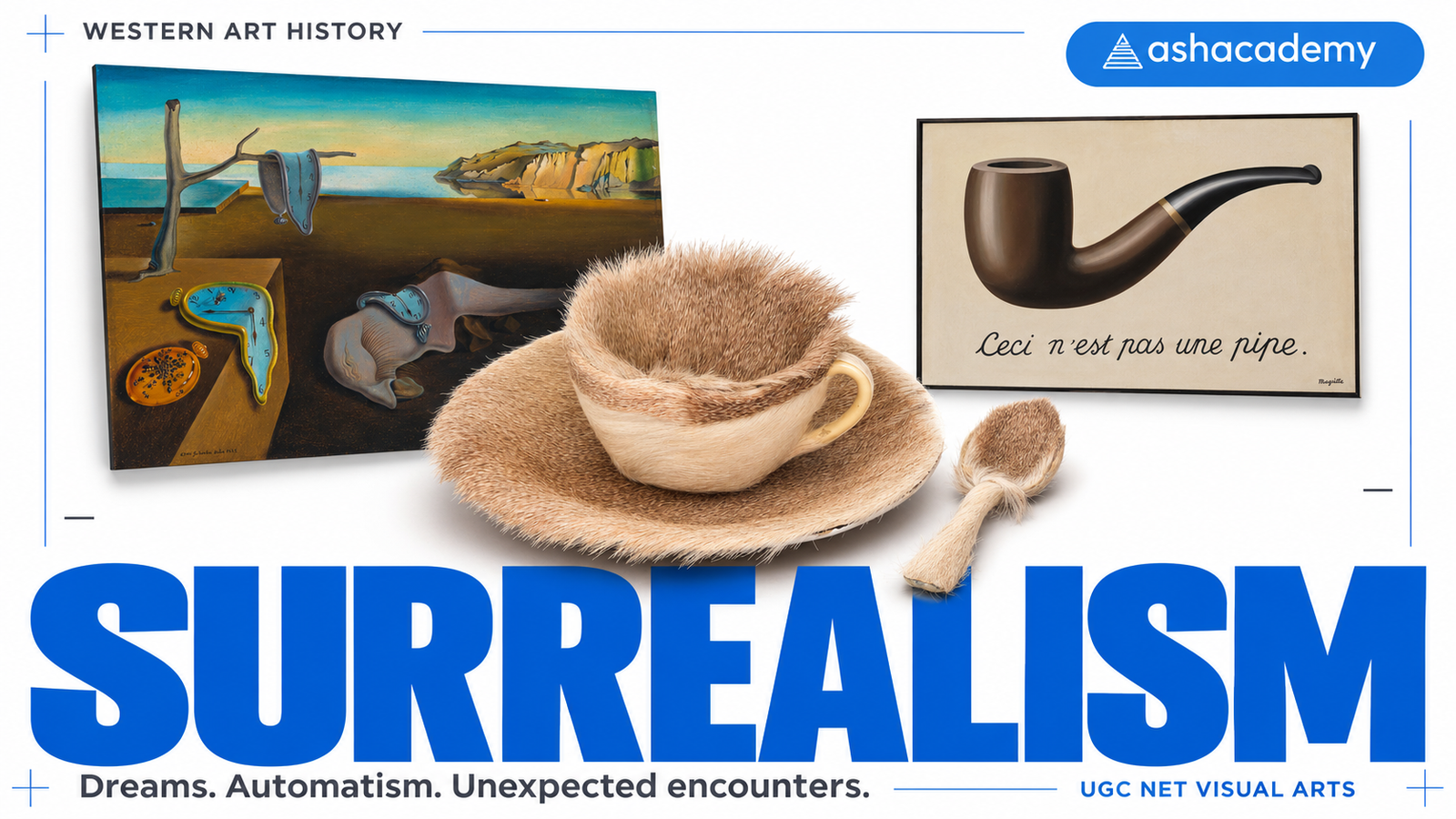
A fur-covered teacup. A painted pipe labelled “This is not a pipe.” A familiar room opening into impossible space. Surrealist works often begin with recognisable things, then disrupt the relationships that make them ordinary. Others begin with a moving line, a stain or a textured surface and allow images to emerge during the process.
This illustrated guide explains Surrealism’s history, characteristics, main artists, important artworks and techniques for art-history students and UGC NET Visual Arts aspirants. Sixteen complete artwork reproductions, two revision graphics, chronology, matching tables and original practice questions connect historical facts with visual identification.
Revision note: Three distinctions organise the topic: a dream image is not the same thing as an automatic process; a movement’s intellectual programme is not a single painting style; and the history of Surrealism extends beyond Dalí, Paris and the years before World War II.
Source: National Gallery, London: Surrealist.
Source: The Met: Surrealism Beyond Borders.
Explore the illustrated notes
- Surrealism at a glance
- Historical context and Dada
- Name, manifestos and publications
- Meaning, ideology and the unconscious
- Techniques: how Surrealists made images
- Visual characteristics
- De Chirico: an important precursor
- Main artists and sixteen artworks
- International networks, women artists and film
- Comparative chronology
- Surrealism compared with other movements
- Impact, changing directions and legacy
- UGC NET revision and common confusions
- Original practice questions
- Frequently asked questions
- Sources and image credits
Surrealism at a glance
| Question | Study answer |
|---|---|
| Major founding milestone | Paris, 1924: André Breton’s first Manifesto of Surrealism. |
| Origin of the term | Guillaume Apollinaire used surréaliste in 1917, before Breton’s movement. |
| Intellectual reference points | Freud’s writings on dreams and the unconscious; revolutionary and Marxist ideas; earlier poetry and experimental art. |
| Central methods | Automatism, chance procedures, unexpected juxtaposition and the transformation of ordinary objects and images. |
| Two useful visual tendencies | Automatist/biomorphic approaches and precisely rendered, illusionistic dream imagery. These are tendencies, not two official societies. |
| Important artists | Ernst, Miró, Masson, Magritte, Tanguy, Dalí, Man Ray, Oppenheim, Lam, Matta, Varo, Tanning and Carrington, among many others. |
| Important media | Painting, drawing, printmaking, sculpture and objects, photography, books, poetry, film and exhibition installations. |
| Historical duration | Founded in the interwar period; international activity continued through and after World War II. No single date adequately ends the entire movement. |
Historical context: from World War I and Dada to Surrealism
Surrealism emerged from the cultural disruption surrounding and following World War I. For many young writers and artists, the war undermined confidence in the institutions that claimed to represent rational civilisation. Dada’s provocations, experiments with chance and attacks on artistic convention formed an important background. Surrealism developed from these debates while proposing its own programme for transforming experience.
The distinction is more useful than the slogan “Dada destroyed and Surrealism created.” Both movements produced art, writing, performance and conceptual experiments; their participants also overlapped. Surrealists gave particular importance to discovering relationships that habitual reason and social convention suppressed, rather than merely reproducing accepted appearances.
Breton’s wartime medical experience and his engagement with Freud helped shape this interest in mental processes. Freud’s work was an intellectual resource for the movement, but Surrealist art was not a scientifically validated recording of the unconscious. Artistic experimentation, psychoanalytic theory and clinical practice are different activities.
Source: MoMA: André Breton.
Source: MoMA: Surrealist strategies.
Source: Grand Palais: from Dada to Surrealism.
Origins and naming: Apollinaire is not Breton
Guillaume Apollinaire used the word surréaliste in 1917; it appears in the context of his play Les Mamelles de Tirésias. André Breton subsequently adopted the term for the movement associated with his 1924 manifesto. The history of a word and the organisation of a movement are therefore related but distinct.
A useful short answer is: Apollinaire, 1917 = the term; Breton, 1924 = the principal founding manifesto. This avoids the common error of saying Dalí named or founded Surrealism. Dalí became a prominent participant later, joining the Paris Surrealist milieu in 1929.
Source: Cornell University Library: What is Surrealism?.
Source: The Dalí Museum: Paris in 1929.
Manifestos, journals and literary milestones
| Document or publication | Date | Why it matters |
|---|---|---|
| Breton and Philippe Soupault, Les Champs magnétiques (The Magnetic Fields) | Written 1919; published 1920. | A landmark experiment in automatic writing before the 1924 manifesto. |
| Breton, Manifeste du surréalisme | 1924. | Defines the programme around psychic automatism and the relation between dream and waking experience. |
| La Révolution surréaliste | 1924–1929. | A major journal for texts, images, collective inquiry and argument. |
| Breton, Second Manifesto of Surrealism | Journal publication: 15 December 1929; book edition: 1930. | Clarifies commitments while exposing disputes and exclusions within the group. |
| Breton, Nadja | 1928. | A major prose work connecting encounter, lived experience, images and Surrealist inquiry. |
| Le Surréalisme au service de la révolution | 1930–1933. | Its title makes the relationship between Surrealism and revolutionary politics explicit. |
| Minotaure | 1933–1939. | An important illustrated journal associated with Surrealist art and intellectual exchange. |
Why do books give 1929 or 1930 for the Second Manifesto? They may be referring to different publication events. The Art Institute of Chicago identifies its appearance in the final issue of La Révolution surréaliste on 15 December 1929; Cornell’s exhibition records the 1930 book edition. Retain the distinction instead of treating one date as a typographical error.
Source: Art Institute of Chicago: Dada and Surrealist journals.
Source: Cornell: genealogies and manifestoes.
Source: MoMA Library: primary-source bibliography.
The naming history also contains rival claims: Yvan Goll issued a journal titled Surréalisme in 1924. Breton’s text became the canonical manifesto, but acknowledging Goll prevents the misleading impression that the word had only one uncontested owner.
Source: Neue Deutsche Biographie: Yvan Goll.
Source: Yale University Press: the movement’s early texts and continuing life.
Meaning and ideology: what did the Surrealists want?
Dream and waking life
Breton’s programme sought a relationship between dream and waking reality that could exceed their conventional separation. Dreams offered surprising transformations and connections; waking encounters and everyday objects could also produce the marvellous, an experience in which the familiar suddenly became extraordinary. Surrealism was therefore not simply a retreat into sleep or an escape from the world.
Automatism and the limits of control
Automatism attempts to reduce deliberate planning or censorship so that unexpected associations can emerge. In writing, it may involve producing words without first arranging a rational argument. In drawing, the hand may move without a fixed subject. Artists could then recognise, select, modify or develop what appeared. The aim of spontaneity does not prove that a finished work involved no conscious decisions.
Liberation, politics and disagreement
Surrealist ideas about freeing desire and imagination were connected, for many participants, with revolutionary politics. Encounters with Marxism, communism and anti-colonial thought generated both alliances and conflicts. The group’s manifestos and journals record disagreements over artistic autonomy, political discipline and who could speak for the movement. Avoid assigning every associated artist the same political position.
Interpretation: not a universal dream dictionary
A repeated object can acquire significance within an artist’s work, but an eye, bird, doorway or animal does not have one automatic meaning in every Surrealist picture. Begin with the title, date, visible relationships and documented context. Then distinguish a supported interpretation from a plausible hypothesis. An image’s strangeness is a starting point for analysis, not its complete explanation.
Source: MoMA: Breton’s programme and writings.
Source: The Met: Surrealism, liberation and international networks.
Surrealist techniques: learn the action, result and artist
| Technique | What happens? | Artist or useful association |
|---|---|---|
| Automatic writing/drawing | Words or lines develop with reduced advance planning; emergent material may be revised. | Breton and Soupault; André Masson. |
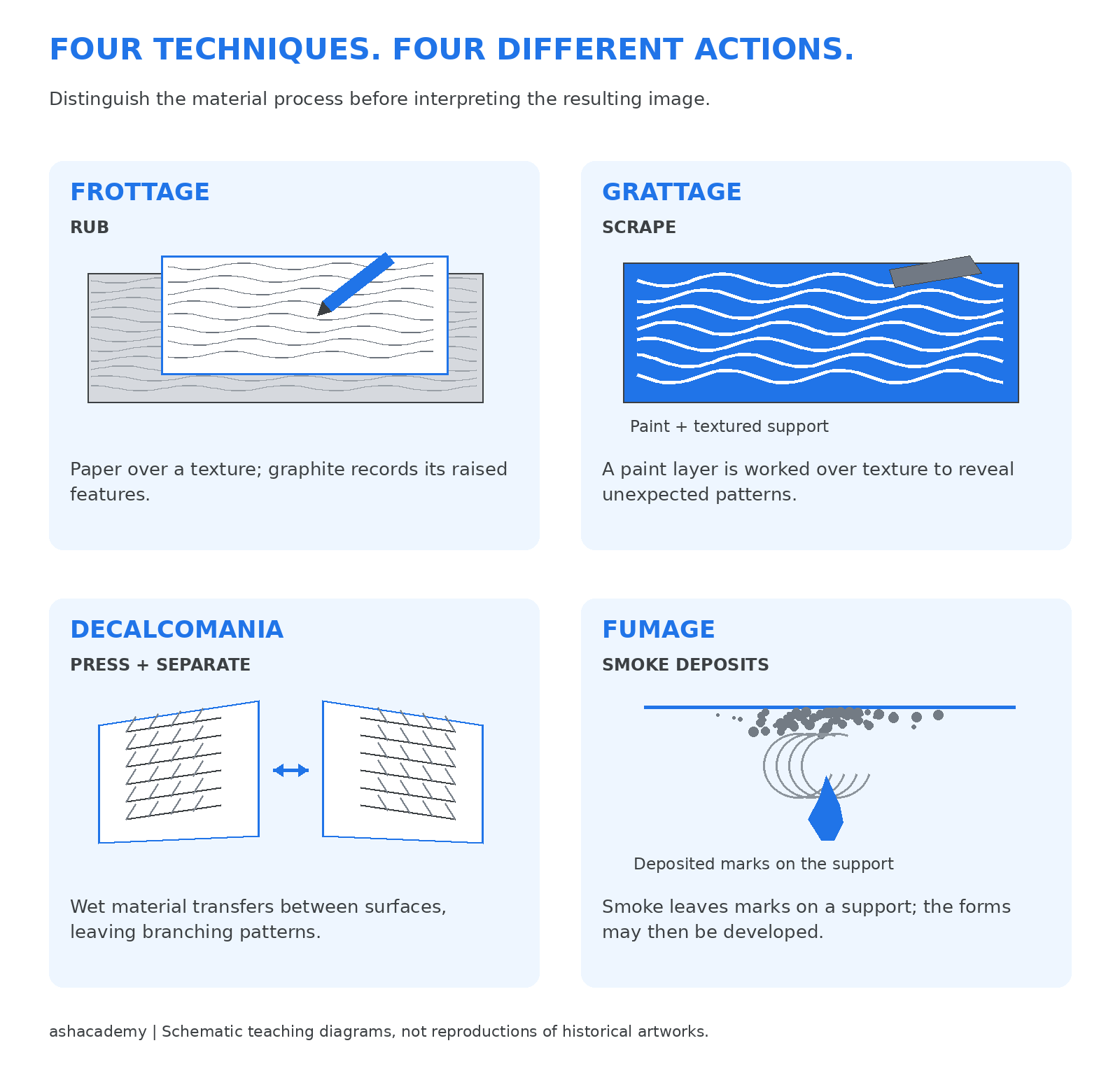
| Frottage | Paper is laid over a textured surface and rubbed with graphite or another dry medium. | Max Ernst; see Forest and Sun below. |
| Grattage | Paint is scraped or worked across a support placed over textured material, generating unexpected patterns. | Ernst’s translation of texture-based experimentation into painting. |
| Decalcomania | Wet ink or paint is pressed between surfaces; separating them produces transferred, branching patterns. | Óscar Domínguez and Ernst. The transfer process predates Surrealism. |
| Fumage | Smoke deposits marks on a support; these may become the starting point for developed imagery. | Wolfgang Paalen. It is not rubbing or scraping. |
| Collage | Existing fragments are cut, assembled and recontextualised to produce new relationships. | Ernst; Dada is an important precedent. |
| Exquisite corpse (cadavre exquis) | Participants contribute successively, often concealing earlier contributions, to a collective text or image. | A Surrealist collaborative game, developed in the 1920s. |
| Rayograph/photogram | Objects placed on or near photosensitive material produce a camera-less image when exposed to light. | Man Ray’s name for his photograms; he did not invent all camera-less photography. |
| Solarization/Sabattier effect | Light exposure during development partly reverses tones or produces distinctive tonal boundaries. | Man Ray and Lee Miller’s collaborative experiments. |
| Paranoiac-critical method | Dalí’s approach to generating and examining multiple or unstable associations and images. | An artistic method, not a diagnosis of every Surrealist artist. |
Aerography means applying paint with an airbrush. It is a tool-based process, not another word for automatism or a method invented exclusively for Surrealism. When answering a technique question, distinguish the physical action from the artistic purpose. A transfer, a rubbing and a sprayed layer can look unexpected for different material reasons.
Source: MoMA: Ernst, frottage and grattage.
Source: MoMA: decalcomania.
Source: MoMA: Dada, Surrealism, and Their Heritage, 1968.
Source: The Met: Man Ray and Lee Miller’s partnership.
Visual characteristics: how to recognise Surrealist approaches
| Visual strategy | Look for | Useful question |
|---|---|---|
| Unexpected juxtaposition | Objects sharing a space without an ordinary practical connection. | What relationship has been made strange? |
| Metamorphosis and hybridity | Bodies, animals, objects or vegetation changing into one another. | Where does one category become another? |
| Disrupted scale or function | Enlarged everyday objects or materials that frustrate familiar use. | What expectation about size, touch or purpose is challenged? |
| Illusionistic impossibility | Careful modelling and clear perspective applied to an impossible event. | Why does convincing description make the event more unsettling? |
| Biomorphic forms | Organic, body-like shapes without a single stable identification. | Can a form suggest several things without becoming one literal object? |
| Automatic marks and chance textures | Unplanned lines, rubbings, stains and transfers developed into imagery. | What may have emerged through the process? |
| Word–image tension | Text that complicates or contradicts what an image seems to show. | Are the object, its picture and its name being confused? |
The movement has no single palette, composition or finish. Dalí’s precise oil painting, Masson’s ink drawing and Oppenheim’s tactile object differ radically in materials. Their Surrealist relevance lies in particular methods, ideas and networks, not in one recognisable brushstroke.
Before 1924: Giorgio de Chirico and Metaphysical Painting
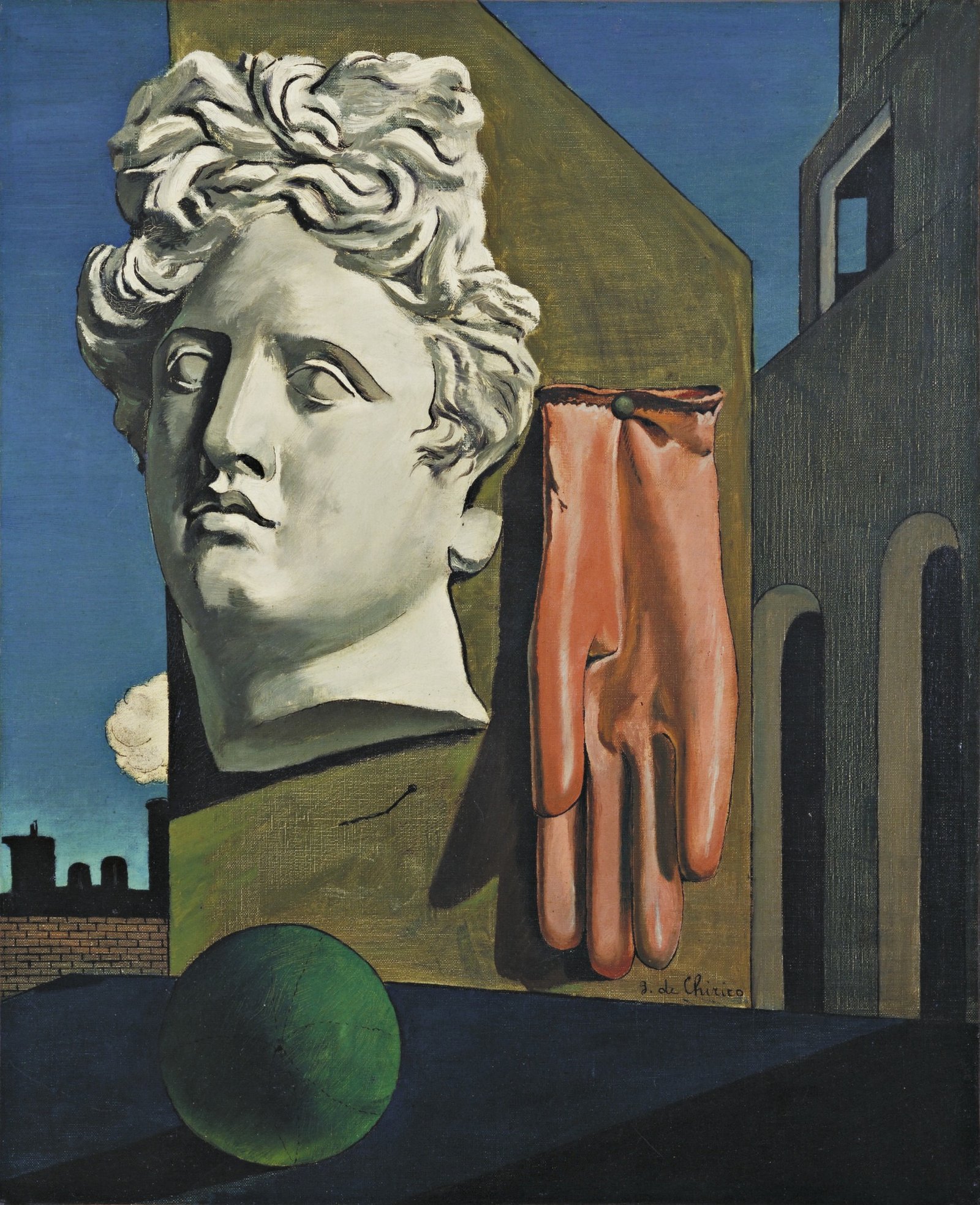
Look closely: A classical sculptural head, rubber glove and ball occupy an architectural setting. The objects are recognisable, but their encounter resists an ordinary narrative.
Giorgio de Chirico (1888–1978) is an important precursor, especially through Metaphysical Painting, or Pittura metafisica. MoMA dates The Song of Love to June–July 1914, a decade before Breton’s manifesto. The painting demonstrates how precise objects and convincing architectural space can generate an unsettling encounter.
The useful identification is the combination of classical head, glove and green ball, rather than “a dream landscape.” De Chirico’s importance to later Surrealists does not retroactively make the work a product of the organised 1924 movement. This is a distinction between historical influence and membership.
Main artists and important artworks: compare their approaches
The following profiles follow birth-year chronology. They include painting, drawing, texture-based work, photography and an object. Complete compositions are retained; collection records in the captions identify the specific work or photographic print. Click an image to open its supplied reproduction separately.
Man Ray (1890–1976): photography can construct the marvellous
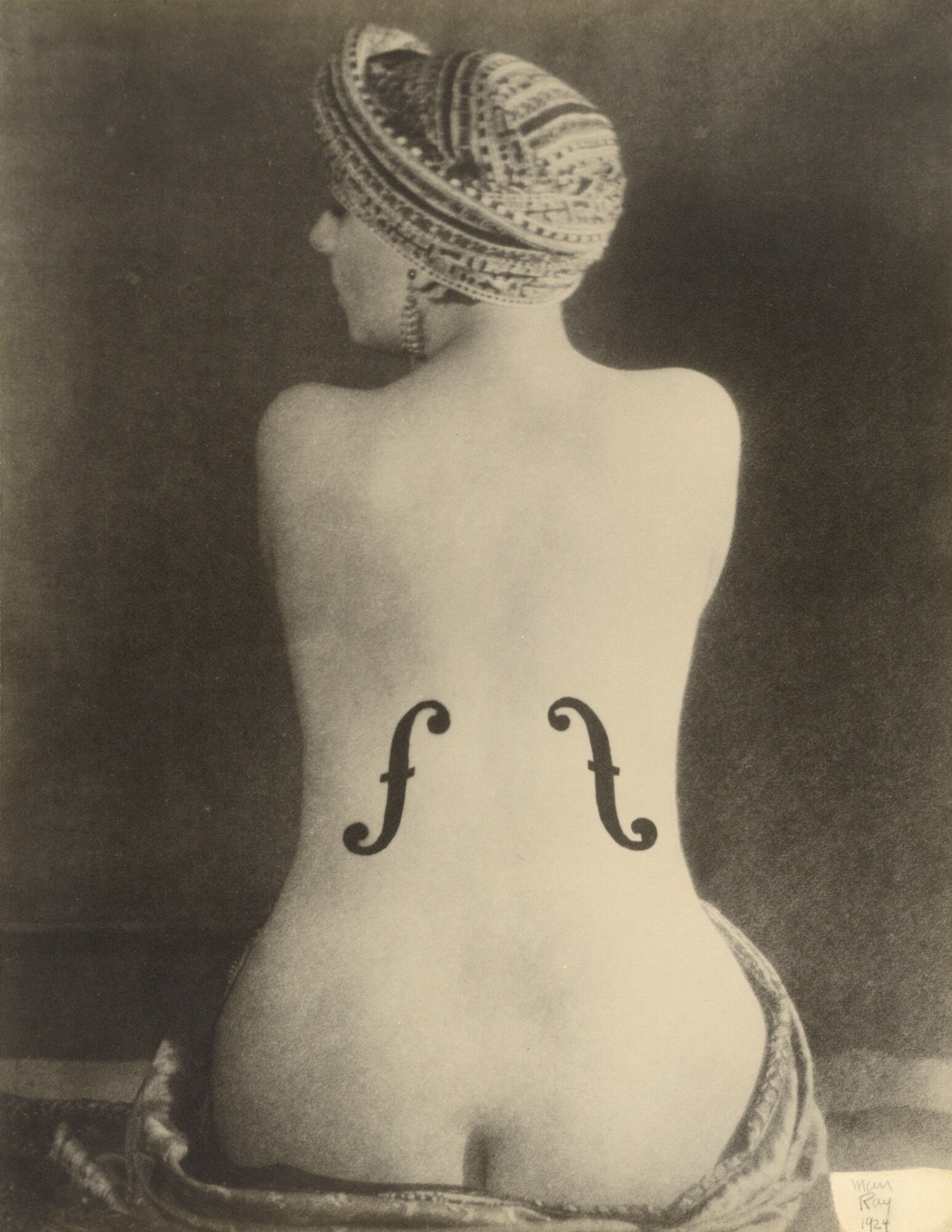
Look closely: Violin-like sound holes transform the photographed back into an image of an instrument. The carefully arranged pose remains visible beneath this intervention.
Le Violon d’Ingres, 1924, shows Kiki de Montparnasse, Alice Prin. Its title refers to Ingres and plays with the relationship between artistic practice and a secondary passion. The photographic body becomes an instrument through an intervention in the image. It demonstrates that photography can construct an impossible association rather than merely document an existing object.
Man Ray also made camera-less rayographs. Those should not be confused with this photograph. His work raises questions about the representation of the body, while Lee Miller’s independent practice and collaboration with him complicate a one-author account of their photographic experiments. In particular, their development of solarization should not erase Miller’s contribution.
Source: The Met: Violon d’Ingres and its constructed body image.
Source: The Met: An Overlooked Partnership.
Max Ernst (1891–1976): collage, assemblage and discovered texture
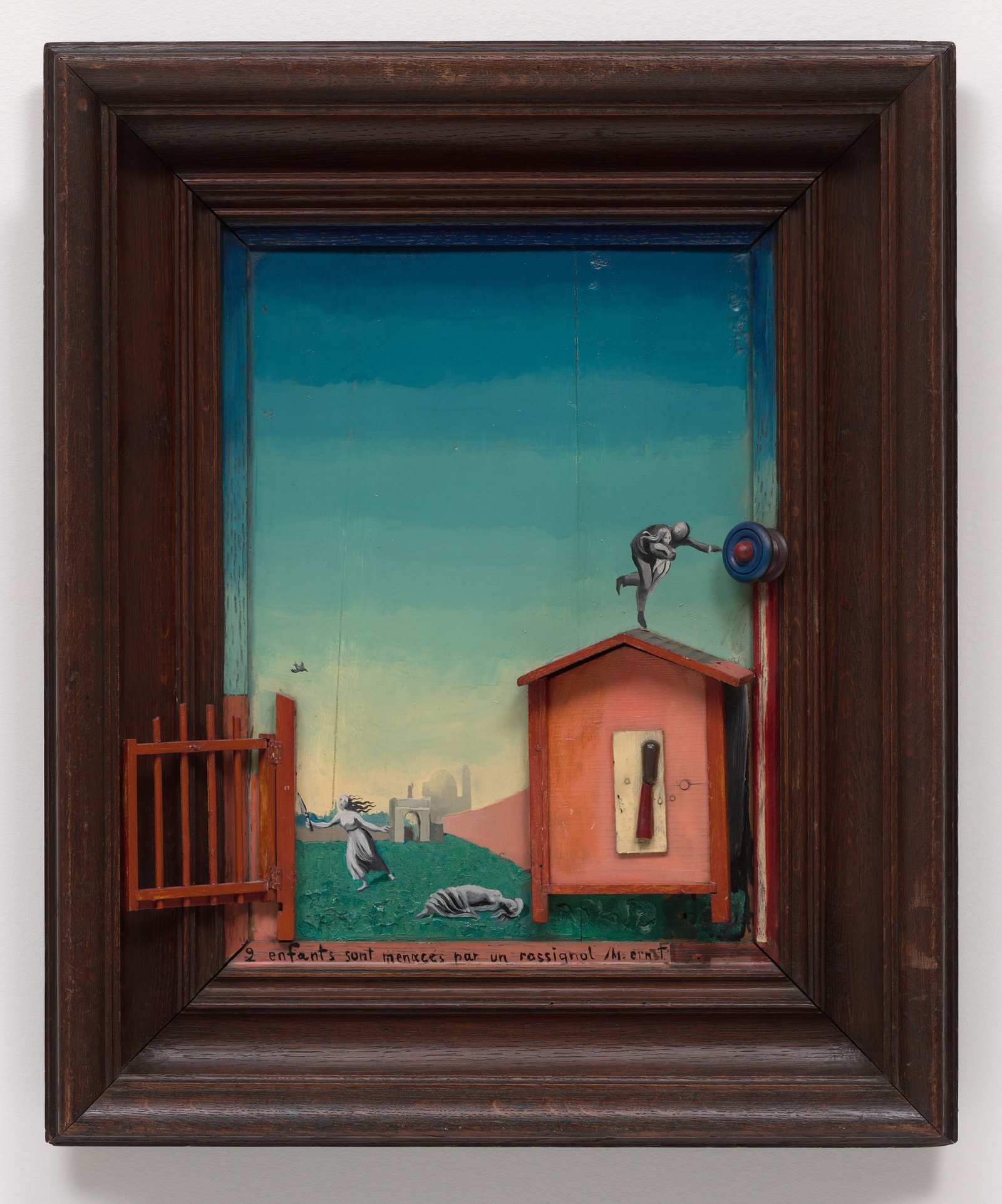
Look closely: The painted scene extends into actual wood elements and a projecting gate. Examine the entire construction, including the frame, rather than treating it as a flat canvas.
Two Children Are Threatened by a Nightingale, 1924, combines painting with a physical construction. Its small bird, running figures, architectural setting and protruding elements create an unstable relationship between depicted space and the viewer’s space. The title supplies a threatening connection that is not self-evident from the bird’s size.
MoMA connects the work with Ernst’s childhood “fever vision.” That documented association can inform interpretation, but it does not make every object a code with one fixed meaning. Medium matters: this is oil with painted wood elements and pasted printed paper on wood, with a wood frame. Calling it simply “oil on canvas” loses an essential identification point.
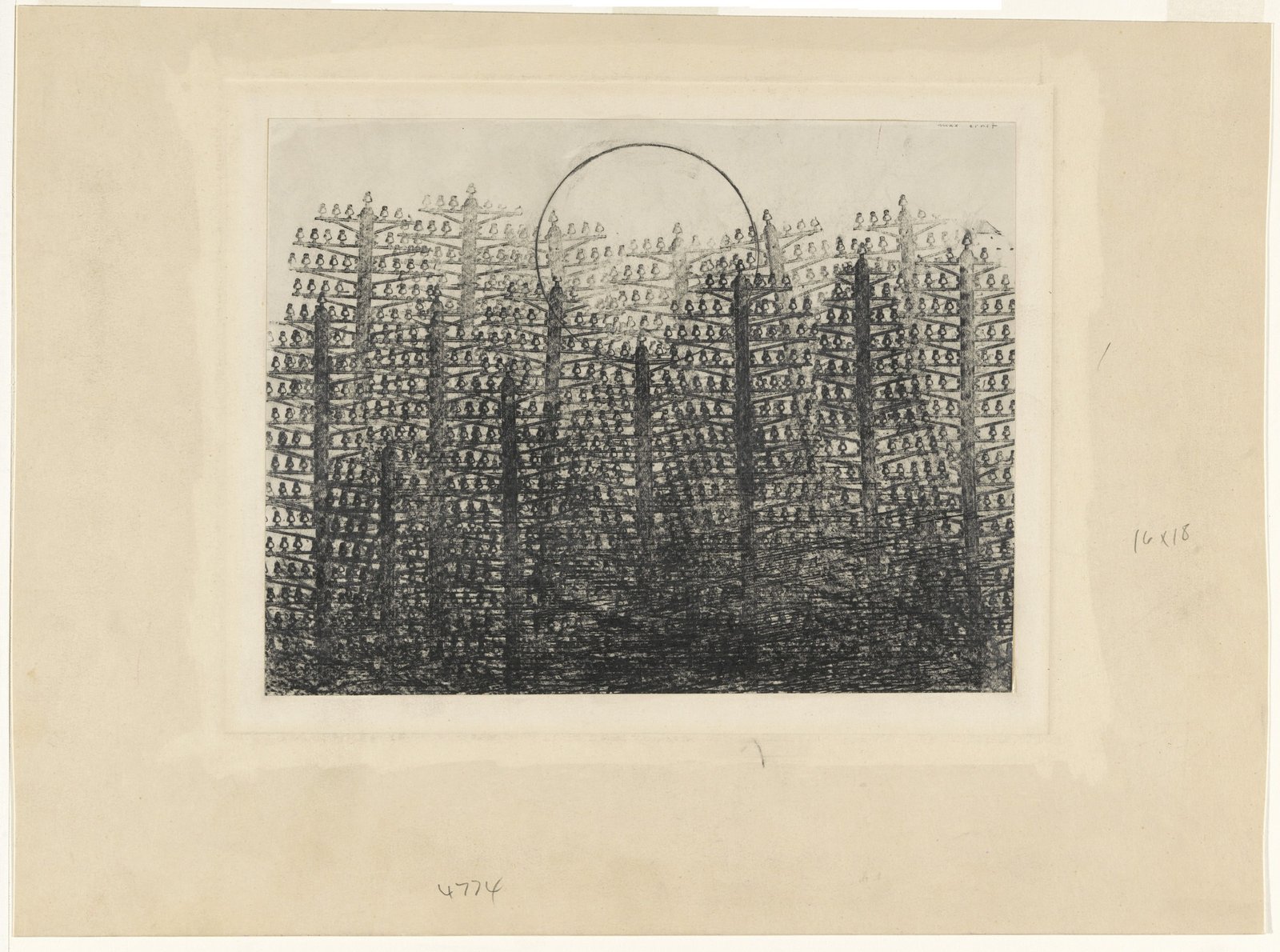
Look closely: Graphite rubbings generate dense tree-like forms around a circular sun. Look for repeated textures rather than an evenly modelled natural landscape.
Forest and Sun, 1931, provides an actual example of graphite frottage on paper. Ernst developed the rubbing process as a means of finding unexpected images in textures. The result involves both a materially generated pattern and an artist’s recognition and organisation of possibilities.
For revision, keep three actions separate: frottage rubs; grattage scrapes; collage assembles fragments. Ernst explored all three, but an image should be assigned the medium recorded for that particular work. His association with Dada also shows how an artist’s practice can cross movement histories.
Joan Miró (1893–1983): chance, signs and selective control
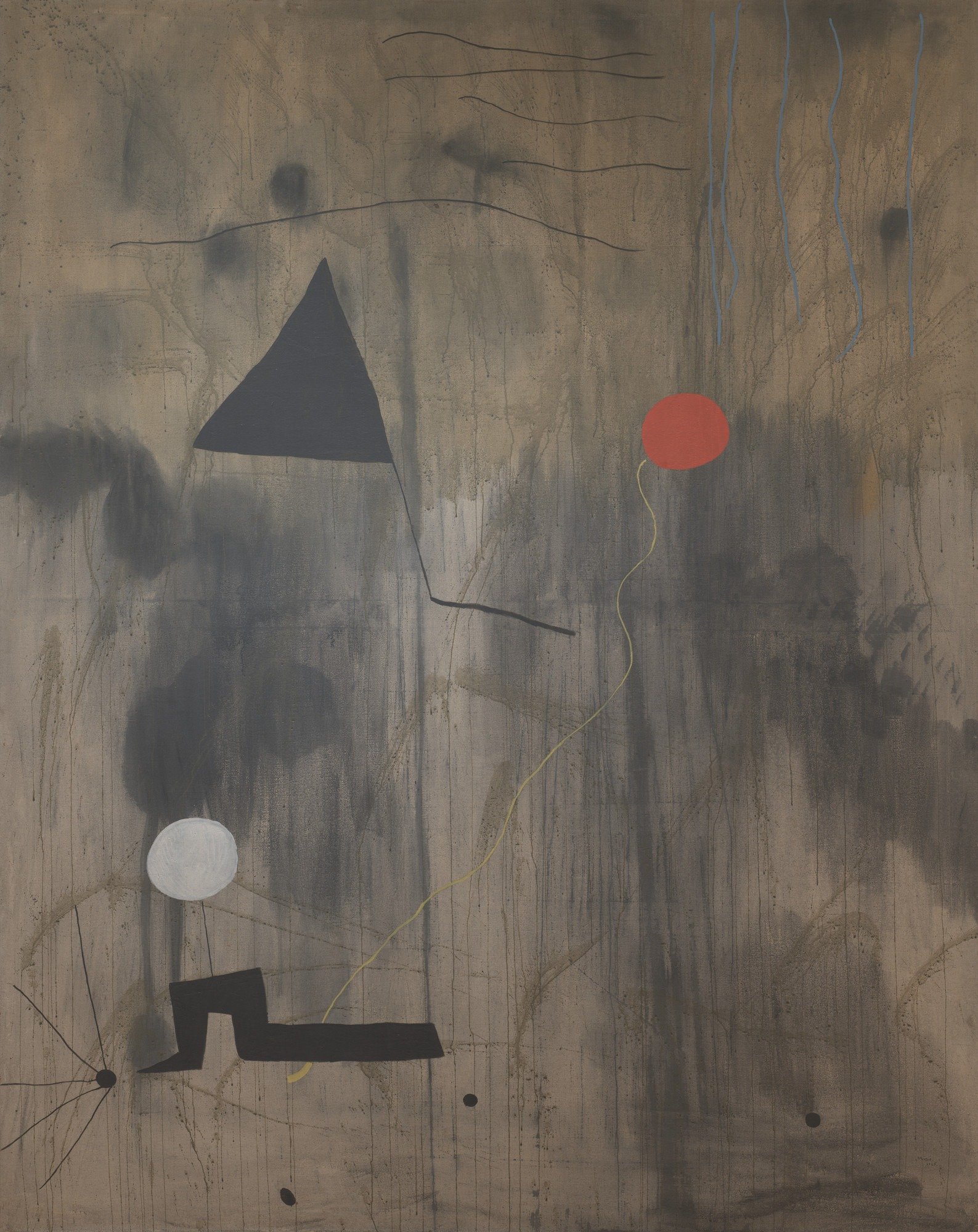
Look closely: A variable, stained-looking ground contrasts with sparse, sharper forms. Compare the background’s material effects with the placement of the red circular shape and fine lines.
The Birth of the World, late summer–fall 1925, is an important alternative to the idea that Surrealism must depict a detailed dream scene. Miró worked with a ground whose varied effects provided a field for more deliberately placed signs. The forms hover between suggestive associations and abstraction.
MoMA describes the work through a combination of chance and planning. This makes it especially useful for explaining why automatist interests do not require the absence of all intention. Instead of forcing every mark into a literal object, describe the contrast between ground and signs, their relative scale and their distribution across the tall canvas.
Source: MoMA Learning: The Birth of the World.
Source: MoMA audio: chance and careful planning in Miró.
André Masson (1896–1987): automatic drawing
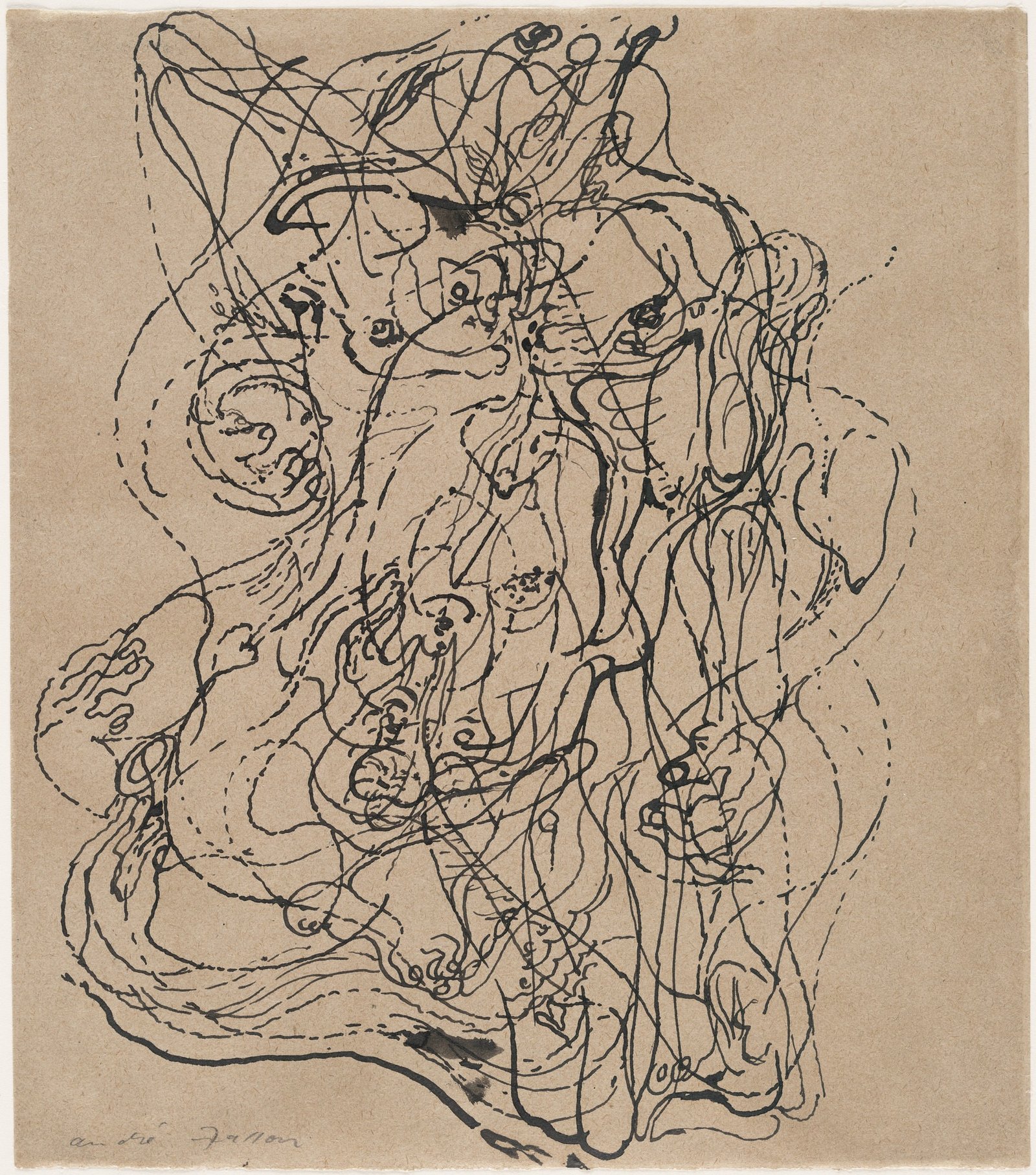
Look closely: Looping lines gather into a dense network. Body-like and object-like suggestions emerge without a single stable composition being obvious at first glance.
In Automatic Drawing, 1924, line develops without a fully predetermined subject. The image makes a method visible: movement generates material in which forms can be discovered. Masson’s ink drawing is therefore a useful starting point for understanding automatism before approaching its more complicated relationship with painting.
Try tracing one line until it crosses another, then identify a possible figure-like form. Another viewer may notice a different association. This exercise demonstrates the openness of the image; it does not prove access to Masson’s private mental state. Automatic describes an aspiration and procedure, not a guarantee that the hand was detached from every learned habit.
René Magritte (1898–1967): the object, its picture and its name
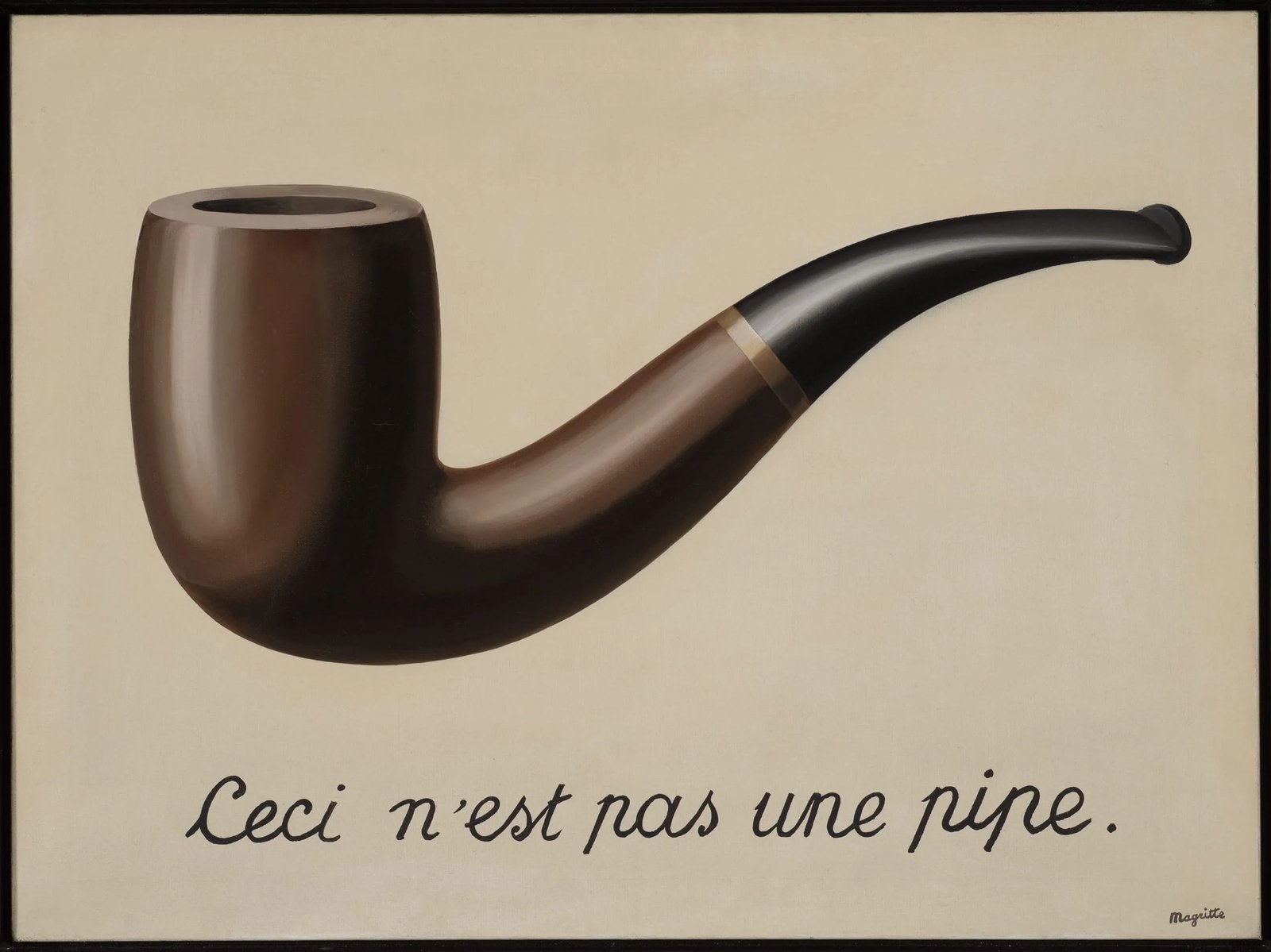
Look closely: The pipe is painted clearly, while the inscription reads “Ceci n’est pas une pipe.” The sentence changes how we understand the apparently straightforward image.
The Treachery of Images, 1929, makes a precise distinction: a painted representation of a pipe is not a usable pipe. The text does not deny the existence of the image. It exposes the habit of treating the thing represented, its visual representation and the language used for it as interchangeable.
Magritte’s relatively matter-of-fact painting is central to the effect. If the pipe were simply an unrecognisable scribble, the problem would be different. The work belongs to Surrealism through its disruption of habitual perception and language; it need not be explained as a report of a dream. LACMA also connects its word–image inquiry with later artists, including John Baldessari and Ed Ruscha.
Yves Tanguy (1900–1955): ambiguous objects in a persuasive space
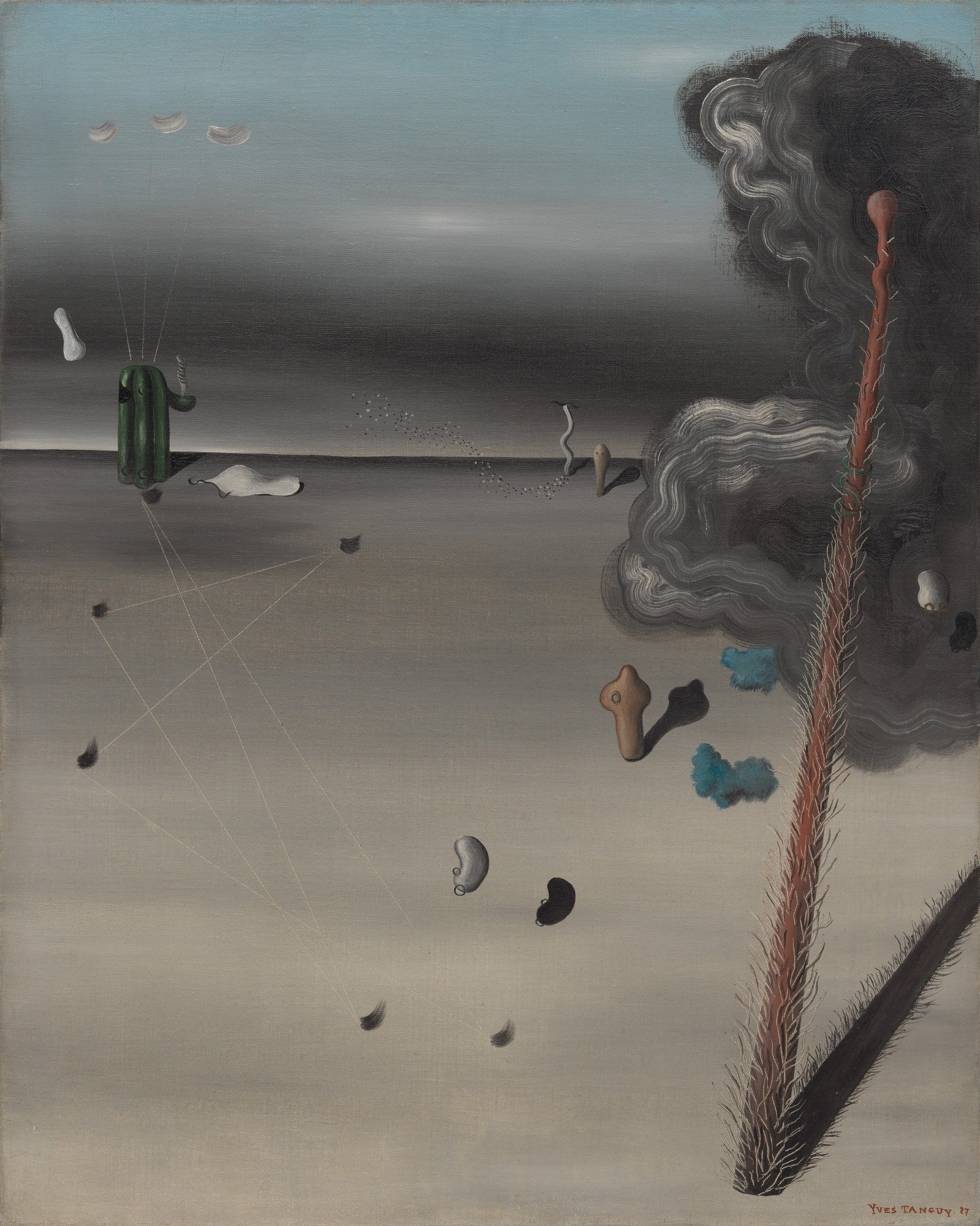
Look closely: Small, unfamiliar forms occupy a deep landscape with shadows and atmospheric distance. Their precise appearance contrasts with the difficulty of naming them.
Mama, Papa Is Wounded!, 1927, shows how a recognisable spatial setting can contain forms that remain uncertain. The recession and shadows encourage us to believe in a coherent environment, yet the objects resist stable identification. Tanguy’s method differs from Masson’s visibly tangled automatic line.
A strong exam answer describes this tension between illusionistic space and unidentifiable forms. Avoid turning every biomorphic shape into a definite anatomical part unless a documented interpretation supports it. The title adds an association, but it does not explain every form as a literal illustration of injury.
Wifredo Lam (1902–1982): Surrealism, Cuba and Afro-Caribbean histories
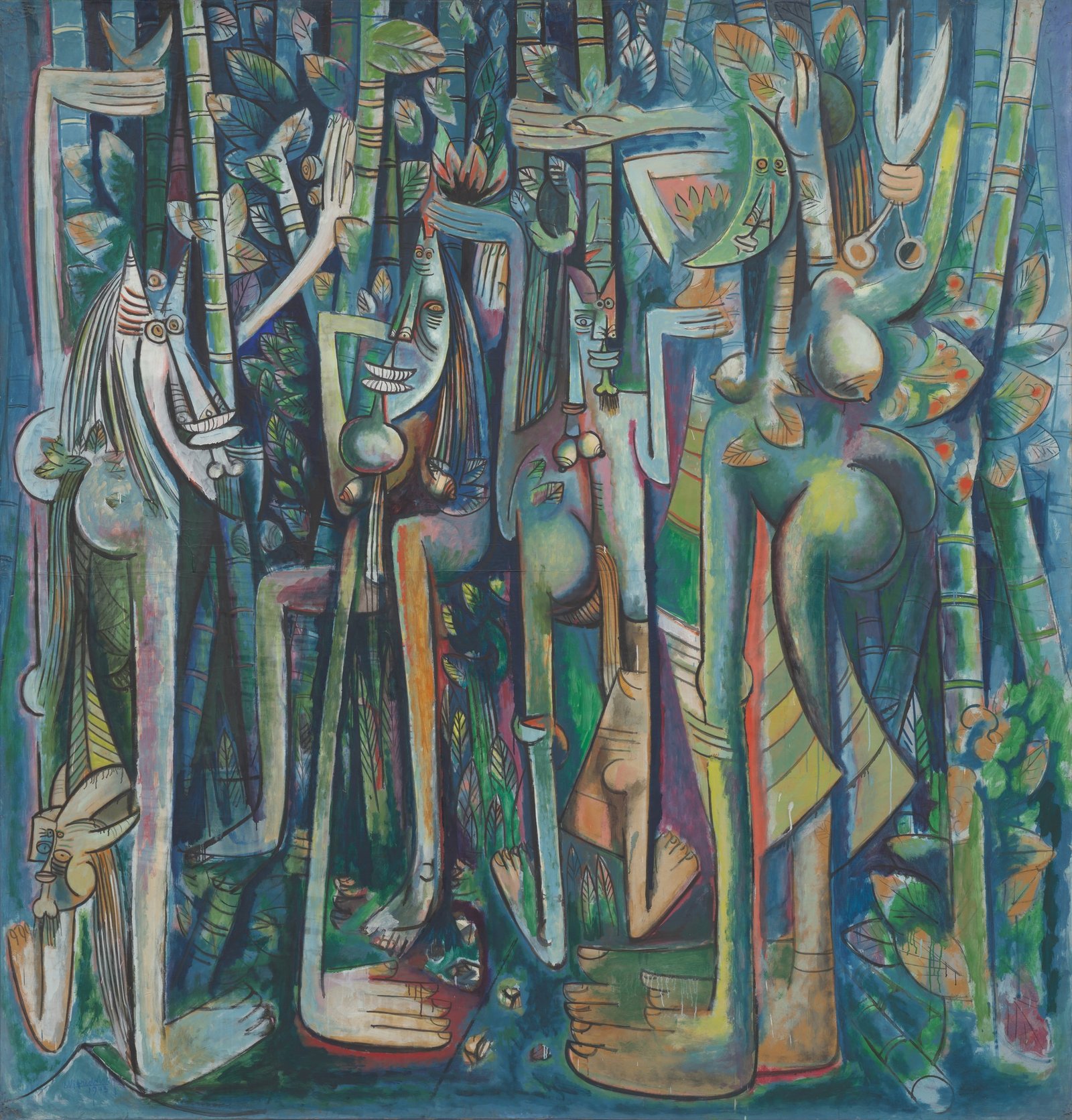
Look closely: Elongated hybrid bodies interweave with sugarcane and foliage. The dense, compressed field resists an easy separation of figure and vegetation.
La jungla (The Jungle) connects an international modernist vocabulary with Cuban and Afro-Caribbean histories. The title should not make us overlook the sugarcane: the landscape invokes plantation histories and the resilience of Afro-Caribbean cultures. Lam’s hybrid figures are more than generic “fantasy creatures.”
Revision note: Catalogue update: MoMA’s current record, consulted for this guide, dates The Jungle 1942–43 and lists oil and charcoal on paper mounted on canvas. Older MoMA teaching resources and catalogues describe it as 1943, gouache on paper mounted on canvas. The current label explains charcoal drawing followed by thinned oil paint. Distinguish the current record from older references when revising.
Source: MoMA: current collection record and 2025–26 label.
Source: MoMA Learning: older catalogue description.
Salvador Dalí (1904–1989): precise painting and unstable reality
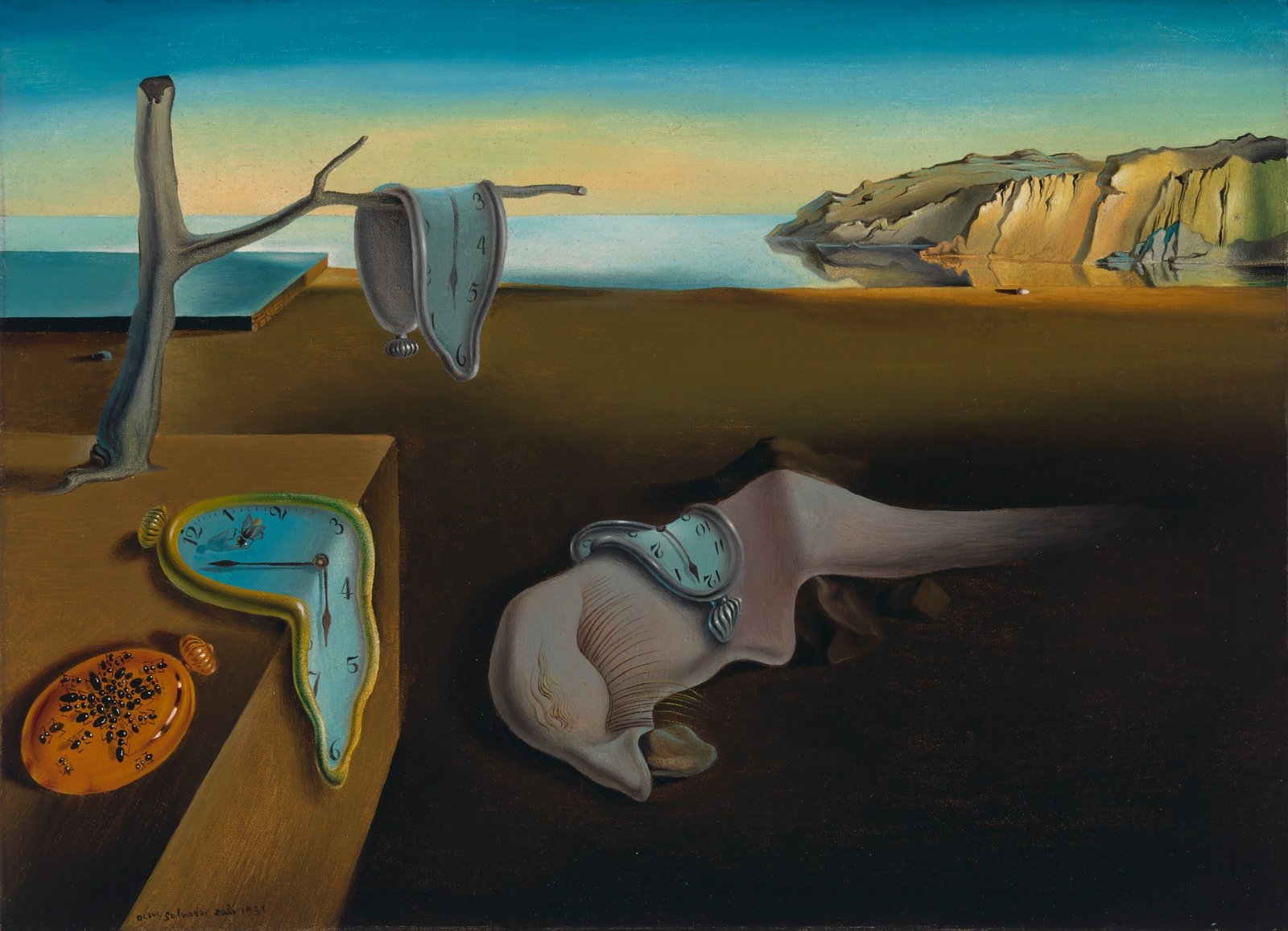
Look closely: Three soft watches bend over different supports; another watch is covered with ants. The distant cliffs remain sharply recognisable while familiar timepieces become physically impossible.
The Persistence of Memory, 1931, is a small oil painting, 24.1 × 33 cm, not a monumental canvas. The precise handling makes soft watches, the strange central form and the still landscape visually persuasive. Mechanical timekeeping confronts pliability and instability.
Dalí’s paranoiac-critical approach explored unstable associations and multiple readings rather than simply copying dreams. Be cautious about circulating the painting’s origin story as verified fact. MoMA’s technical study questions Dalí’s retrospective claim that he completed it in two hours: material evidence points to a more planned and extended process. An artist’s vivid autobiography and conservation evidence are not the same kind of source.
Source: Anne Umland, MoMA: The Persistence of Memory, technical evidence and the artist’s origin story.
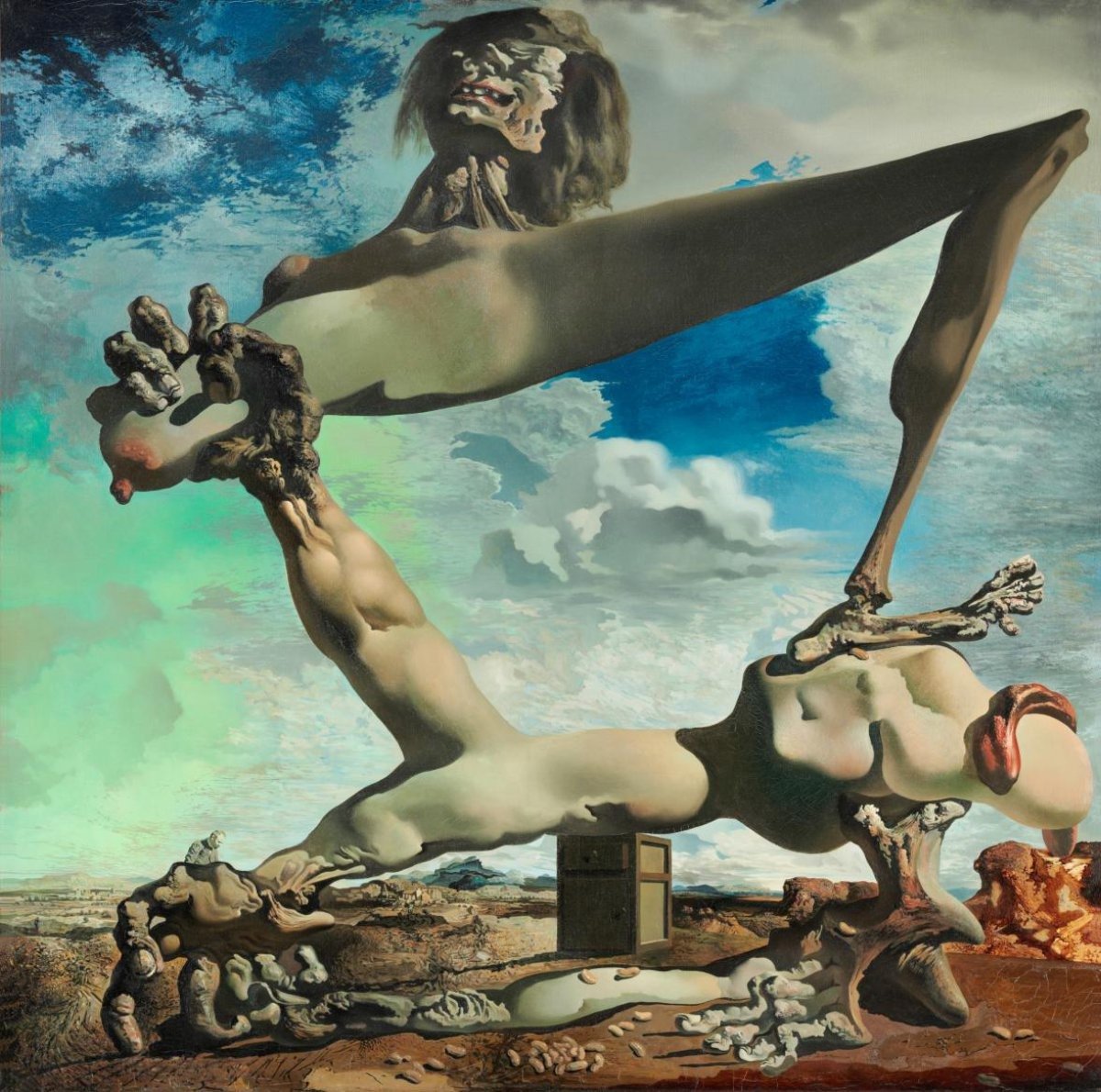
Look closely: A giant, dislocated body appears to tear itself apart above a comparatively small landscape. Follow how limbs join and how the low viewpoint makes the figure dominate the scene.
Soft Construction with Boiled Beans (Premonition of Civil War), 1936, introduces political violence into the discussion. Philadelphia’s record places its creation in early 1936, before the Spanish Civil War’s outbreak, amid a volatile political situation. The self-attacking body provides an image of destructive internal conflict.
The title’s “premonition” should not be presented as evidence of a supernatural prediction. The historical context is political crisis; the image transforms that crisis into a disturbing bodily construction. Compare its anatomical violence with the quieter dislocation of objects in The Persistence of Memory. Both are precisely rendered, but they produce different kinds of unease.
Remedios Varo (1908–1963): transformation and the figure as an agent
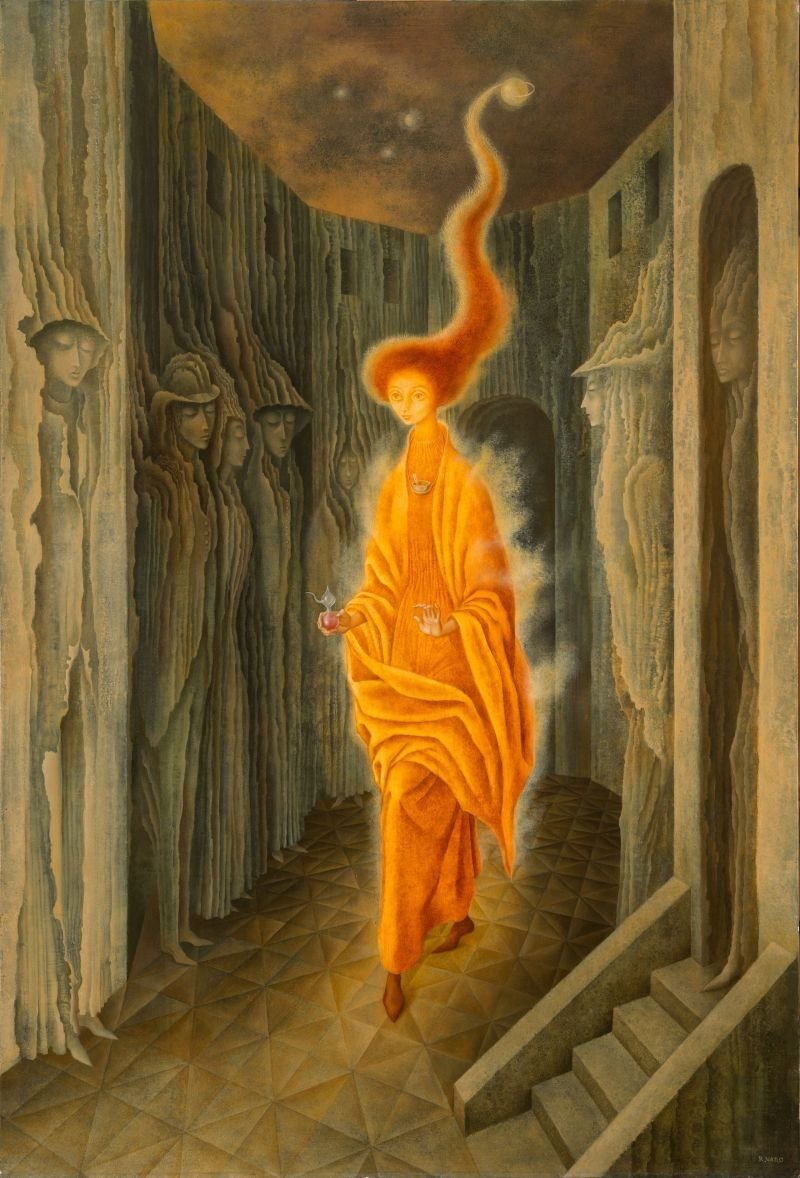
Look closely: A luminous orange figure advances through a muted architectural passage. Look for the vessel and tools, the upward-streaming hair and the figures embedded in the surrounding walls.
La llamada (The Call), 1961, belongs to Varo’s mature work in Mexico. The central figure appears active, purposeful and connected with a celestial source. NMWA relates the painting to her interests in alchemy and ambiguous narrative, while cautioning that her protagonists are not straightforward direct self-portraits.
Her celebrated Creation of the Birds, 1957, offers another important artist–artwork match: an owl-like maker combines creative and transformative activities. In both cases, agency and making matter. Varo’s work expands the account of Surrealism beyond women represented as mysterious objects of a male imagination.
Source: NMWA: The Magic of Remedios Varo, including Creation of the Birds.
Dorothea Tanning (1910–2012): the interior becomes a threshold
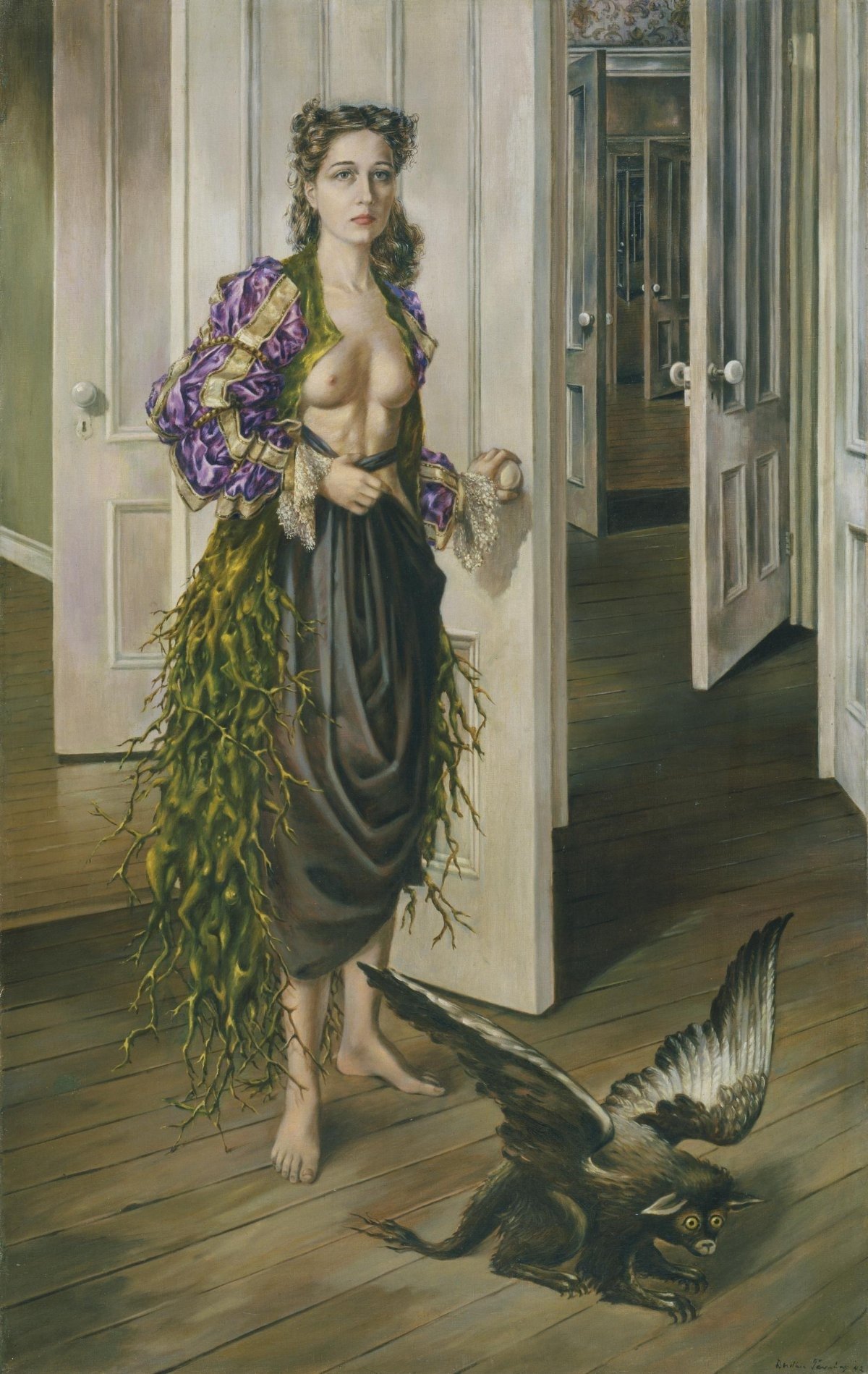
Look closely: The artist stands beside a sequence of open doors and a fantastic creature. Study the tilted floor and details of the garment as carefully as the conspicuous creature.
Birthday, 1942, presents Tanning as both a recognisable individual and a guide to an impossible interior. The repetition of doors invites the eye into depth while destabilising our confidence in the space. The body, costume and creature introduce further uncertainties.
The work connects Surrealism with self-representation and an interior that behaves like a psychological threshold. A productive comparison is with Carrington’s Self-Portrait below: each artist constructs her position within the image rather than merely serving as someone else’s symbol. Their narratives and visual devices remain distinct.
Roberto Matta (1911–2002): the “inscape” and new pictorial space
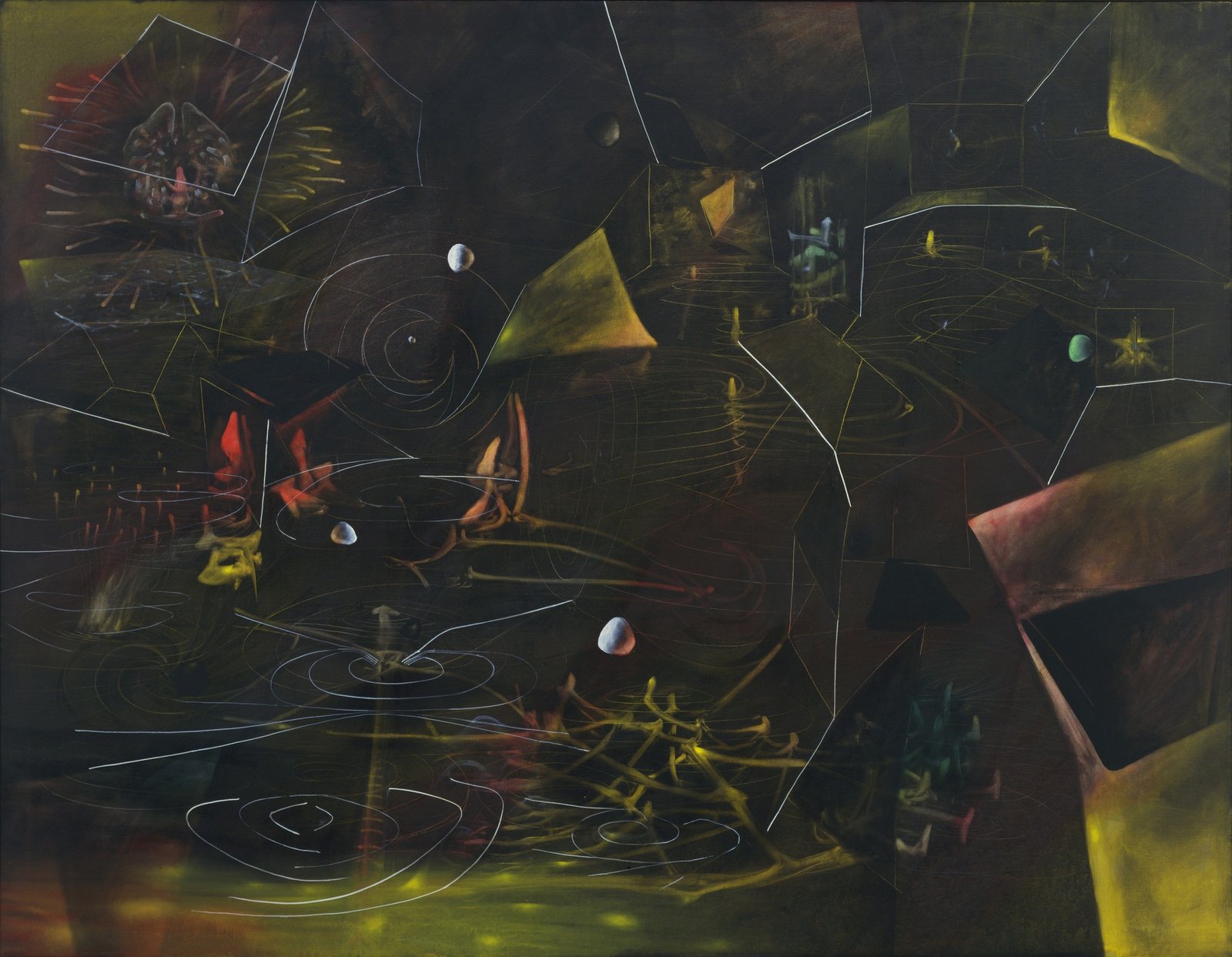
Look closely: Luminous, mobile forms occupy an expansive and unstable environment. Unlike a conventional landscape, the image offers no secure ground from which to measure every shape.
The Vertigo of Eros, 1944, is an example of Matta’s inscapes, imagined landscapes conceived as projections of psychic states. Its forms need not resolve into familiar objects. Compare this expansive environment with Tanguy’s more clearly legible horizon and shadows.
The Chilean-born Matta moved to New York in 1939 and interacted with artists there. MoMA connects his automatist experiments with the development of New York painting. This is a specific historical relationship that helps explain Surrealism’s impact on emerging Abstract Expressionism, rather than a claim that one movement simply changed its name into another.
Meret Oppenheim (1913–1985): an ordinary object becomes unusably strange
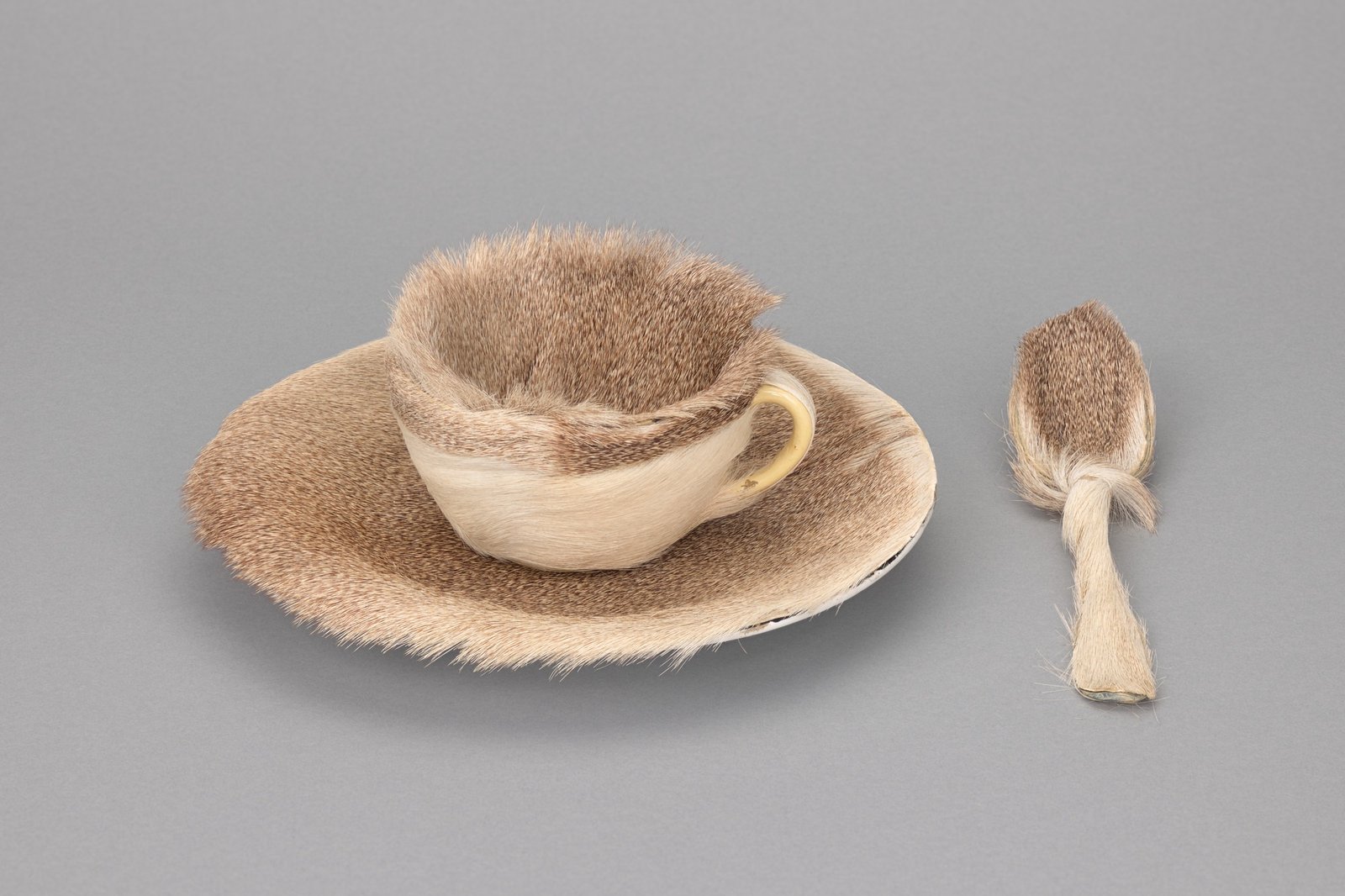
Look closely: The cup, saucer and spoon are covered in fur. The familiar function of a drinking set clashes with the imagined sensation of bringing its surface to the mouth.
Object, 1936, makes Surrealism tangible. The objects remain identifiable, but the change of material disrupts use and introduces competing sensations: attraction, softness, discomfort or repulsion. This is a transformation of familiar function, not just a painting of something unusual.
The work is often called the fur-covered cup, saucer and spoon, or associated with the French title Le Déjeuner en fourrure. MoMA’s collection title is Object. Remember the full three-part ensemble and its date, rather than reducing it to “a furry mug.” Oppenheim’s larger practice also extends beyond this single famous object.
Leonora Carrington (1917–2011): animals, selfhood and imaginative autonomy
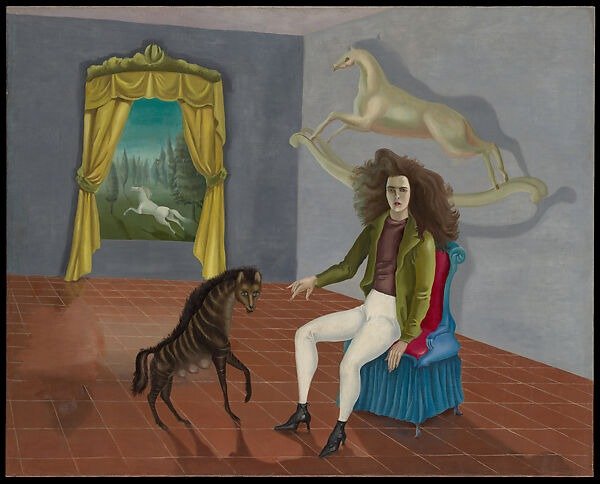
Look closely: Carrington sits on a chair and reaches towards a hyena. A rocking horse appears behind her, while another white horse runs beyond the window.
Self-Portrait, c. 1937–38, brings a human figure, animals and an interior into an enigmatic relationship. The Met identifies the white horse as a symbolic surrogate for the artist and connects the painting with her memories of animals, stories and childhood. These documented associations provide firmer ground than an invented universal meaning for horses.
Different states of freedom and movement organise the image: the seated figure, the animated hyena, the suspended rocking horse and the horse beyond the window. Carrington later developed a major artistic and literary practice in Mexico. Her work merits attention for its own imaginative construction, independently of her relationships with male Surrealists.
Surrealism beyond a single Paris circle
Paris was a decisive convergence point, but Surrealism developed through networks across Europe, the Americas, the Caribbean, North Africa and Asia. War and exile changed those networks; local artists also reworked its possibilities according to their own political and cultural concerns. Lam in Cuba, Varo and Carrington in Mexico, and Matta’s movement between Europe and the United States make this broader account visible in the works above.
The Met and Tate’s Surrealism Beyond Borders project traces exchanges involving places including Egypt, Japan, Mexico, the Caribbean, the Philippines and elsewhere. Its account challenges the idea that Surrealism was a finished Parisian style simply exported unchanged. Anti-colonial uses of the movement also require attention to the contradictions of European artists collecting or appropriating Indigenous cultural objects.
Source: Stephanie D’Alessandro and Matthew Gale, editors: Surrealism Beyond Borders, 2021.
Women artists: creators, collaborators and critics
Varo, Tanning, Oppenheim and Carrington are not supplementary names added to a history whose ideas belonged only to men. Their works address making, self-representation, bodily experience and the transformation of everyday life. Lee Miller, Claude Cahun, Toyen, Eileen Agar and Kay Sage offer further important routes into photography, identity, objects and painting.
At the same time, a balanced account should examine Surrealism’s recurring treatment of women as muses, enigmas or objects of desire. Recognising that tension is more useful than declaring the movement either uniformly emancipatory or uniformly oppressive. Compare the agency of a figure in Varo or Tanning with the transformation of the body in Man Ray’s photograph.
Surrealism in film
Luis Buñuel and Salvador Dalí’s Un Chien andalou, 1929, is a central film reference. Its striking transitions and discontinuities challenge the expectation that successive images must form a logically continuous story. Their collaboration also includes L’Âge d’or, 1930. Surrealist film can therefore be discussed through editing, association and disrupted narrative, not just the presence of bizarre objects.
Source: MoMA: Dalí, creator and collaborator.
Source: MoMA: Dalí, painting and film.
Further names and the limits of movement labels
Paul Delvaux is important for precisely rendered, enigmatic figure settings. Alberto Giacometti made significant Surrealist objects before moving in a different direction; The Palace at 4 a.m., 1932, is an essential associated work. Dora Maar and Hans Bellmer are important for photography and the body. Frida Kahlo exhibited in Surrealist contexts, but should not be reduced uncritically to the movement: exhibition participation, an artist’s own position and a later stylistic label are different kinds of evidence.
Surrealism timeline: texts, exhibitions and continuing networks
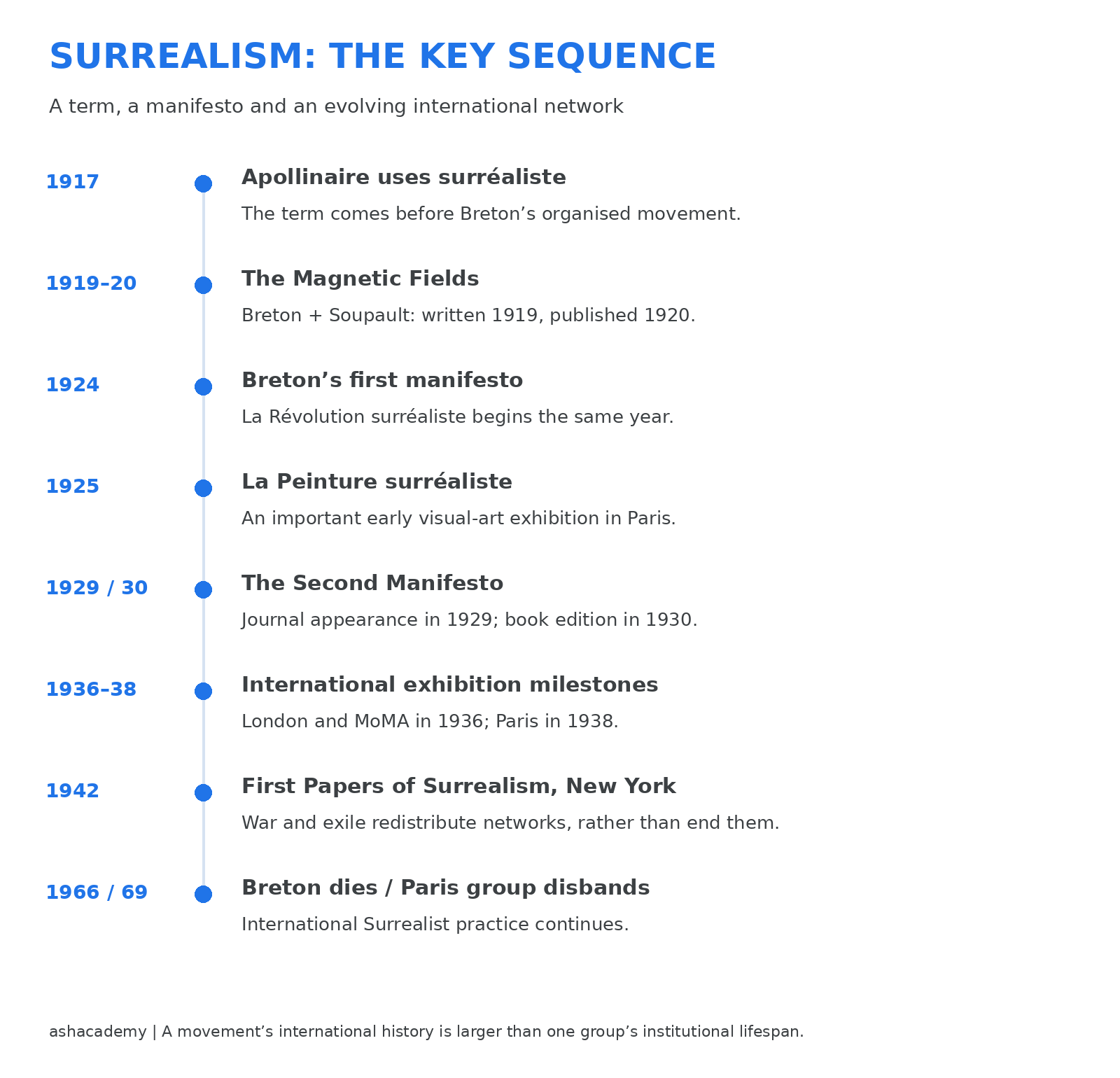
| Date | Milestone | Why it belongs in your notes |
|---|---|---|
| 1917 | Apollinaire uses surréaliste. | The word predates the organised movement. |
| 1919–1920 | Breton and Soupault: The Magnetic Fields. | Written in 1919; published in 1920. |
| 1924 | Breton’s first manifesto; La Révolution surréaliste begins. | A literary and intellectual foundation for a wider movement. |
| 1925 | La Peinture surréaliste, Galerie Pierre, Paris. | A crucial early exhibition milestone for visual art. |
| 1929 / 1930 | Second Manifesto in the journal / as a book. | Keep original appearance and book publication separate. |
| 1933–1939 | Minotaure. | Illustrated journals were important sites of exchange. |
| 1936 | International Surrealist Exhibition, London; Fantastic Art, Dada, Surrealism, MoMA. | Institutional visibility increased internationally. MoMA’s exhibition ran into January 1937. |
| 1938 | Exposition internationale du surréalisme, Paris. | Exhibition design and the viewer’s experience became part of the encounter. |
| 1942 | First Papers of Surrealism, New York. | A key wartime exhibition associated with Breton and Duchamp. |
| 1940s–1960s | New York, Mexico and other continuing networks. | War redistributed activity; it did not end Surrealism everywhere. |
| 1966 / 1969 | Breton dies / the Paris group formally disbands. | Neither date is the end of all international Surrealist practice. |
Source: MoMA Library: historical exhibitions and journals.
Source: National Gallery of Australia: 1936 international exhibitions.
Source: The Met: First Papers of Surrealism, 1942.
Source: Yale University Press: the Paris group and 1969.
Surrealism compared with Dada, Symbolism and other approaches
| Compare with | Shared ground | A useful distinction |
|---|---|---|
| Dada | Chance, provocation, collage and challenges to convention. | Surrealism developed a sustained programme around dreams, unconscious associations and liberation; the histories still overlap. |
| Symbolism | Imagination, suggestion and inward experience. | Surrealism has a distinct twentieth-century history of manifestos, automatism, psychoanalytic interests and collective experiments. |
| Metaphysical Painting | Uncanny encounters and enigmatic spaces. | De Chirico’s key early paintings predate the 1924 movement and helped inspire it. |
| Abstract Expressionism | Automatist experiments and interest in the processes of making. | Later New York artists developed distinct problems of scale, surface, gesture and pictorial presence. |
| Fantasy imagery | Impossible beings or worlds may appear in both. | An imaginative subject alone does not establish Surrealist historical affiliation. |
| Magic realism | Ordinary and extraordinary experiences can intersect. | The term has its own art-historical and literary histories; it is not interchangeable with Surrealism. |
Compare methods, not just subjects: Masson’s line generates possible images; Magritte carefully constructs a word–image problem; Oppenheim changes an object’s material and use. Calling all three “paintings of dreams” would misidentify both their media and their operations.
Impact, changing directions and legacy
Surrealism contributed methods for generating and reorganising images, models of collective creativity, new relationships between image and language, and challenges to familiar objects and bodily representation. Its effects extend into photography, experimental film, later painting, conceptual practice, design and advertising. Similar imagery alone, however, does not establish a direct historical influence.
Wartime exile brought Surrealists into contact with New York artists, contributing to the environment in which Abstract Expressionism emerged. Matta and Masson are relevant to automatist discussions; Magritte’s word–image inquiry offers a different route towards later conceptual and image-based work. These specific connections are more informative than a single claim that Surrealism “led to all modern art.”
Accounts of its decline must distinguish the weakening or reorganisation of a particular circle from the end of a movement across the world. Breton’s death in 1966 and the Paris group’s formal dissolution in 1969 are important institutional markers. Artists and groups elsewhere continued to find Surrealism useful for artistic, political and personal transformation.
UGC NET Visual Arts: key terms, matches and common confusions
| Term | Precise revision meaning |
|---|---|
| Unconscious | Mental processes outside immediate conscious awareness; a key theoretical concern, not a visible substance a painting can simply photograph. |
| Automatism | Reducing advance planning and rational censorship to permit unexpected associations. |
| Biomorphism | Organic or living-form suggestions without necessarily depicting an identifiable organism. |
| Juxtaposition | Placing things together; Surrealist effects often arise from an unexpected relationship. |
| The uncanny | An unsettling experience in which something familiar becomes strangely unfamiliar. |
| The marvellous | The extraordinary possibility discovered within experience, objects or encounters. |
| Inscape | Matta’s term for an imagined pictorial landscape of psychic states. |
Artist–artwork–date matching
| Artist | Key work | Date / identification cue |
|---|---|---|
| De Chirico | The Song of Love. | 1914; classical head, glove and ball; precursor. |
| Man Ray | Le Violon d’Ingres. | 1924; constructed photographic body/instrument image. |
| Ernst | Two Children Are Threatened by a Nightingale; Forest and Sun. | 1924, mixed construction; 1931, graphite frottage. |
| Miró | The Birth of the World. | 1925; ground and sparse signs; chance with planning. |
| Masson | Automatic Drawing. | 1924; ink on paper; generating forms through line. |
| Magritte | The Treachery of Images. | 1929; picture, word and object. |
| Tanguy | Mama, Papa Is Wounded! | 1927; ambiguous forms in a deep space. |
| Lam | The Jungle. | 1942–43 in MoMA’s current record; compare older descriptions. |
| Dalí | The Persistence of Memory; Soft Construction with Boiled Beans. | 1931, soft watches; 1936, self-attacking body. |
| Varo | Creation of the Birds; The Call. | 1957; 1961. The latter is reproduced above. |
| Tanning | Birthday. | 1942; self-representation and open doorways. |
| Matta | The Vertigo of Eros. | 1944; inscape. |
| Oppenheim | Object. | 1936; fur-covered cup, saucer and spoon. |
| Carrington | Self-Portrait. | c. 1937–38; seated artist, hyena and horses. |
Revision note: Common corrections: Apollinaire coined the term, not Dalí. Breton’s first manifesto is 1924, not 1934. The Second Manifesto has a 1929 journal appearance and a 1930 book edition. Frottage is rubbing, not scraping. A rayograph is camera-less, not simply a manipulated portrait. Automatism does not require every finished work to be unrevised. Surrealism did not end worldwide in 1939. Frida Kahlo’s exhibition connections do not settle every question of artistic identity.
Original practice questions: identify and explain
These are original teaching exercises, not authenticated UGC NET previous-year questions. Attempt each before revealing the explanation. For image questions, use the full reproductions above.
1. Match the person with the correct role: Apollinaire / Breton / Dalí.
Answer: Apollinaire: the term surréaliste, 1917. Breton: the principal founding manifesto, 1924. Dalí: a major artist who entered the Paris Surrealist milieu in 1929. These are different historical roles.
2. Why are 1929 and 1930 both associated with the Second Manifesto?
Answer: It appeared in La Révolution surréaliste on 15 December 1929 and was issued as a book in 1930. Identify the publication event named in a question rather than treating the dates as automatically contradictory.
3. Which pairing is correct? A. Frottage—scraping B. Grattage—camera-less exposure C. Decalcomania—wet transfer D. Fumage—graphite rubbing
Answer: C. Frottage involves rubbing through paper, grattage involves scraping/work with paint and texture, and fumage uses smoke deposits. The physical action distinguishes the terms.
4. Image-based: identify the work with a classical head, glove and green ball. Why is it described as a precursor?
Answer: Giorgio de Chirico, The Song of Love, June–July 1914, MoMA. Its uncanny encounter helped inspire later Surrealists, but the painting predates the organised 1924 movement.
5. Image-based: which 1924 work combines a painted scene with projecting wood elements and a gate?
Answer: Max Ernst, Two Children Are Threatened by a Nightingale. Its physical construction makes “oil on canvas” an inadequate medium description. Use the complete frame and projecting elements as identification evidence.
6. Does Miró’s The Birth of the World show that automatism meant absolutely no planning?
Answer: No. MoMA explains its combination of chance effects and more deliberate organisation. The contrast between ground and signs helps make that relationship visible.
7. Image-based: explain why the inscription in The Treachery of Images need not be a logical mistake.
Answer: A representation of a pipe is not the usable object itself. Magritte distinguishes an image, a word and the thing referred to, while his clear painting initially encourages their identification.
8. What is missing from the description “Oppenheim’s furry mug, 1931”?
Answer: The date is 1936, and the work includes a cup, saucer and spoon. MoMA’s title is Object. Its transformation of material and expected use is central to the Surrealist effect.
9. Image-based: compare Masson’s Automatic Drawing with Tanguy’s Mama, Papa Is Wounded!
Answer: Masson’s line generates an unstable network of possible forms; Tanguy locates ambiguous forms in a more illusionistically persuasive space. They demonstrate different Surrealist approaches rather than one uniform style.
10. How should you revise The Jungle’s date and medium when older notes differ from the current museum record?
Answer: Record the distinction: current MoMA entry, 1942–43, oil and charcoal on paper mounted on canvas; older MoMA resources, 1943, gouache on paper mounted on canvas. For an actual examination, read the wording and use the official key when analysing an authenticated paper. Do not silently merge different cataloguing descriptions.
11. Image-based: distinguish Tanning’s Birthday from Carrington’s Self-Portrait.
Answer: Birthday, 1942, has a standing figure, repeated doorways and a fantastic creature; Carrington’s work, c. 1937–38, has a seated figure, hyena, rocking horse and a horse beyond a window. Both involve self-representation, but the visual evidence is different.
12. Which statement is most defensible? A. All Surrealists copied dreams B. The movement ended everywhere in 1939 C. Different media and international networks developed distinct approaches D. Dalí founded Surrealism in 1917
Answer: C. The reproduced works include different procedures, materials and contexts. War transformed the networks without ending all Surrealist activity. Apollinaire, Breton and Dalí must not be collapsed into one founding story.
Frequently asked questions about Surrealism
What is Surrealism in simple words?
Surrealism explores dreams, unconscious associations, chance and unexpected relationships. It can make ordinary things strange or allow images to emerge through a process. It includes more than realistic paintings of imaginary scenes.
Who founded Surrealism, and when?
André Breton’s 1924 Manifesto of Surrealism is the principal founding document of the organised movement in Paris. Apollinaire used the term earlier, in 1917, and there were rival contemporary claims, including Yvan Goll’s 1924 publication.
What are the main characteristics of Surrealist art?
Useful characteristics include unexpected juxtapositions, metamorphosis, ambiguous organic forms, disrupted scale or function, impossible events rendered convincingly, automatic marks and word–image tensions. Different works use different combinations.
What is the difference between automatist and illusionistic Surrealism?
Automatist approaches explore what can emerge through lines, marks or chance processes; illusionistic approaches often render impossible relationships with convincing detail and space. The categories overlap and do not describe two formally separate groups.
Which artists are important beyond Salvador Dalí?
Study Ernst, Miró, Masson, Magritte, Tanguy, Man Ray, Oppenheim, Lam and Matta, together with Varo, Tanning and Carrington. De Chirico is an important precursor. Delvaux, Giacometti, Cahun, Miller and other artists broaden the account across media.
Which Surrealism facts should I prioritise for UGC NET Visual Arts?
Revise the 1917 term, 1924 manifesto, 1929/1930 Second Manifesto distinction, techniques and artist–artwork–date matches. Practise comparing images and checking the medium. These are study priorities, not predictions of the next examination paper.
Research sources, collection records and image credits
Museum, archival and institutional sources support the historical account. Each artwork caption links to the specific collection record; the caption preserves that record’s date, medium and collection. Formal comparisons and practice questions are ashacademy’s teaching analysis. Where catalogue descriptions differ, the difference is stated rather than concealed.
- James Voorhies, “Surrealism,” The Metropolitan Museum of Art, 2004. Read alongside the later international account.
- Stephanie D’Alessandro and Matthew Gale, editors, Surrealism Beyond Borders, The Met/Tate, 2021.
- MoMA Library: Surrealism, primary publications, manifestos, journals and historical exhibitions.
- Cornell University Library: Surrealism and Magic, historical introduction.
- Art Institute of Chicago: Documents of Dada and Surrealism, Mary Reynolds Collection.
- MoMA: Max Ernst, frottage and grattage.
- MoMA: decalcomania definition and historical technique.
- Anne Umland, “One on One: Salvador Dalí’s The Persistence of Memory,” MoMA, 4 December 2025.
- Ami Bouhassane, “An Overlooked Partnership,” The Met, 10 October 2025.
- National Museum of Women in the Arts: The Magic of Remedios Varo.
- Yale University Press: “Is Surrealism Dead?”, 2024.
Artwork reproductions are included for contextual art-historical study and criticism. Rights remain with the credited holders; no blanket open licence is asserted. Original compositions and colours are retained, with proportional resizing. The cover is an AI-assisted editorial collage and is not an authentic historical artwork or archival image. The two revision graphics are original teaching aids. Research checked: 4 November 2026.
Continue your revision: Symbolism · Impressionism · Realism · ashacademy book library.

You may also like
Cubism: History, Characteristics, Artists and Important Artworks
Fauvism: History, Characteristics, Artists and Important Artworks