Fauvism: History, Characteristics, Artists and Important Artworks
Fauvism was an early twentieth-century movement in which colour became a powerful means of expression rather than a faithful description of appearances. Henri Matisse, André Derain and their associates made recognisable portraits, landscapes and interiors with unexpectedly intense hues, simplified forms and conspicuous brushwork. Its decisive public breakthrough came at the 1905 Salon d’Automne in Paris; its most concentrated phase is usually placed around 1905–1908.
Why is a face painted green? Why does a river become pink or yellow? These are useful questions because Fauvism concerns the relationships between colours across an entire painting. A convincing answer should connect colour with composition, surface, space and expression, rather than simply identify a “wrong” colour.
These illustrated notes explain Fauvism’s history, characteristics, main artists and important paintings for UGC NET Visual Arts and art-history revision. Twelve full artwork reproductions, a chronology, comparison tables and original practice questions help turn names and dates into visual understanding. Click an artwork to open the supplied image separately.
Revision note: Learn the sequence: 1904, Matisse and Divisionism → summer 1905, Collioure → autumn 1905, the Fauve label → 1906–07, expansion and differences → 1908, diverging directions. These stages overlap; they are a revision framework, not the dates of a formally constituted society.
Source: MoMA: Fauvism.
Source: National Galleries of Scotland: Fauvism.
In this illustrated guide
- Fauvism at a glance
- Historical context and artistic origins
- 1905 Salon d’Automne and the name
- Meaning, ideology and Matisse’s writing
- Visual characteristics and technique
- Matisse: five essential paintings
- Other main artists and their differences
- Chronology and turning points
- Fauvism compared with other movements
- Impact, limits and legacy
- Exam revision and commonly confused facts
- Original visual-identification practice
- Frequently asked questions
- Sources and image credits
Fauvism at a glance
| Question | Exam-ready answer |
|---|---|
| Meaning of the name | French les fauves: “wild beasts.” Originally a critical label. |
| Where and when? | France; central public milestone: Paris, 1905. Concentrated activity: approximately 1905–1908. |
| Who supplied the label? | Critic Louis Vauxcelles, responding to the 1905 Salon d’Automne. |
| Leading figures | Henri Matisse and André Derain; Maurice de Vlaminck is another central figure. |
| Other important associates | Albert Marquet, Kees van Dongen, Raoul Dufy, Othon Friesz, Georges Braque, Henri Manguin, Charles Camoin and Jean Puy. The network had no single official membership list. |
| Central visual idea | Expressive, often non-naturalistic colour working with simplified form and a visibly painted surface. |
| Was there a founding manifesto? | No single collectively signed Fauvist founding manifesto. Matisse’s Notes d’un peintre appeared in 1908. |
| Important distinction | Fauvism is a historical movement, not a synonym for every colourful painting or for Matisse’s entire career. |
Historical context: why did Fauvism emerge?
Fauvism developed in the exhibition and studio networks of early twentieth-century France. Paris offered access to independent Salons, dealers and the work of recently established modern painters. The Mediterranean coast and towns along the Seine supplied subjects and opportunities for artists to work together. This combination of metropolitan exchange and regional painting campaigns matters more than the idea that the movement began in one isolated studio.
There was no single political event that “caused” Fauvism, and the group did not share a unified political programme. Its historical setting included modern urban leisure, travel, ports, suburbs and an expanding market for experimental art. These conditions should not be converted into a claim that every Fauve work celebrates industrial progress or expresses the same social position.
Artistic sources: what did the Fauves learn?
| Source | Useful connection | What not to conclude |
|---|---|---|
| Vincent van Gogh | Forceful brushwork and colour could carry expressive intensity. Particularly useful when studying Vlaminck. | Every swirling brushstroke is automatically Fauvist. |
| Paul Gauguin and Synthetist painting | Broad colour areas, contour and departure from descriptive colour offered alternatives to naturalistic modelling. | Fauvism and Symbolism were the same movement. |
| Georges Seurat and Paul Signac | Separated touches and colour relationships provided an experimental starting point, particularly for Matisse. | Fauves followed one uniform optical-scientific procedure. |
| Paul Cézanne | The construction and ordering of a picture remained crucial; renewed attention to Cézanne encouraged changes after 1907. | Cézanne was a Fauve or all Fauves became Cubists. |
| Gustave Moreau’s teaching | An important background for Matisse and several studio associates; artistic individuality mattered. | Moreau founded Fauvism in 1905. |
Think of these sources as different possibilities available to artists. Borrowing the separated mark of Divisionism did not oblige an artist to accept all of its theoretical aims. Similarly, a simplified figure need not carry Gauguin’s particular symbolism. The result depended on how an artist reorganised these resources within a new painting.
Source: Sabine Rewald, The Metropolitan Museum of Art: Fauvism.
Source: MoMA: About Matisse.
Three overlapping networks to remember
| Network | Artists and locations | Why it helps |
|---|---|---|
| Paris training and studio connections | Matisse and associates including Marquet, Manguin, Camoin and Puy. Moreau’s studio was one important point of contact. | Explains affinities without inventing a single founding meeting. |
| Chatou and the Seine | Derain and Vlaminck worked in and around Chatou. | Connects forceful landscape painting with the Paris suburbs. |
| Le Havre and the Normandy connection | Dufy, Friesz and Braque; subsequent travel also took these artists south. | Prevents treating Fauvism as exclusively Mediterranean. |
These are teaching categories rather than formal subcommittees. Artists moved, met and exhibited across them. The Dutch-born Van Dongen’s participation also makes “a group of French-born landscape painters” an inadequate definition.
Source: John Elderfield, The “Wild Beasts”: Fauvism and Its Affinities, MoMA exhibition catalogue, 1976.
1905: Collioure, the Salon d’Automne and “wild beasts”
In the summer of 1905, Matisse and Derain worked together in Collioure, a fishing port on France’s Mediterranean coast. Their experiments pushed colour beyond the description of local appearances. Mediterranean light was a stimulus, but their paintings are interpretations of experience, not colour photographs of the coast.
The Salon d’Automne in Paris later that year gave these experiments a prominent public setting. Reviewing the exhibition for Gil Blas, Louis Vauxcelles used the term fauves. The familiar naming anecdote contrasts a Renaissance-like sculpture by Albert Marque with the intense colours around it. Albert Marque, the sculptor, and Albert Marquet, the painter, are different people.
The nickname was not a declaration that the painters were incapable of drawing. It registered the disruption their colour and handling presented to expectations of finish and naturalistic representation. A critical epithet subsequently became a movement name, but it did not erase the differences between the artists.
Source: The Met: Vertigo of Color visiting guide.
Source: MoMA: The “Wild Beasts”, naming and exhibition context.
Revision note: Place pair: Collioure = a crucial site of Matisse–Derain experimentation; Paris = the 1905 exhibition and naming milestone. Critic pair: Vauxcelles = Fauve label; Félix Fénéon = the term Neo-Impressionism. Do not interchange them.
Meaning and ideology: colour becomes an active force
A useful distinction is between local colour, the colour conventionally associated with an object, and the colour relationship an artist needs within a painting. A face can remain identifiable while its planes are organised through pink, yellow and green. The question becomes how these colours balance, contrast or connect across the surface.
Fauve paintings challenged the assumption that convincing art required continuous tonal modelling, carefully concealed brushwork and colours subordinate to realistic description. They could simplify the object while intensifying its pictorial presence. This did not eliminate structure: the arrangement of shapes, intervals, lines and hues could be highly considered.
Matisse’s Notes of a Painter: a key publication
Henri Matisse’s Notes d’un peintre (Notes of a Painter) was published in La Grande Revue on 25 December 1908. It is an important statement about expression and the organisation of a painting. It should not be described as a collective Fauvist manifesto issued at the 1905 exhibition.
For revision, connect Matisse with the idea that expression belongs to the picture as a whole: the placement and relationship of forms matter, as well as the depicted face or gesture. This helps explain why an apparently simple composition can be the outcome of sustained decisions.
Source: Centre Pompidou: Matisse, Notes d’un peintre.
Source: Smithsonian Archives of American Art: La Grande Revue, 25 December 1908.
Visual characteristics of Fauvism
| Feature | What to look for | How to explain it |
|---|---|---|
| Non-naturalistic colour | Unexpected skin, trees, water or shadows. | Colour contributes to expression and pictorial organisation. |
| Strong contrasts | Warm–cool differences; red–green or blue–orange relationships. | Adjacent colours can heighten one another; identify the actual pair. |
| Visible brushwork | Dabs, streaks, broad patches, broken marks or exposed ground. | The paint surface becomes conspicuous, though handling varies. |
| Simplified forms | Reduced facial planes, blocks of architecture, abbreviated foliage. | Selectivity makes colour areas and structural relationships prominent. |
| Flattened or compressed space | Overlapping objects with limited tonal recession; shallow intervals. | Depth remains suggested while the flat surface asserts itself. |
| Active contour | Coloured edges and emphatic outlines. | Line can secure a form, create rhythm or separate colour areas. |
| Familiar subjects | Portraits, landscapes, ports, interiors, leisure and festive streets. | The innovation need not lie in a novel subject; it can lie in its treatment. |
Technique and materials: do not turn tendencies into rules
The twelve works reproduced here are oil paintings on canvas. Oil paint permits both thin and loaded applications. A visible mark does not by itself demonstrate impasto, and a bright-looking hue does not prove that the artist used unmixed paint. Identify texture and exposed support cautiously from a digital reproduction.
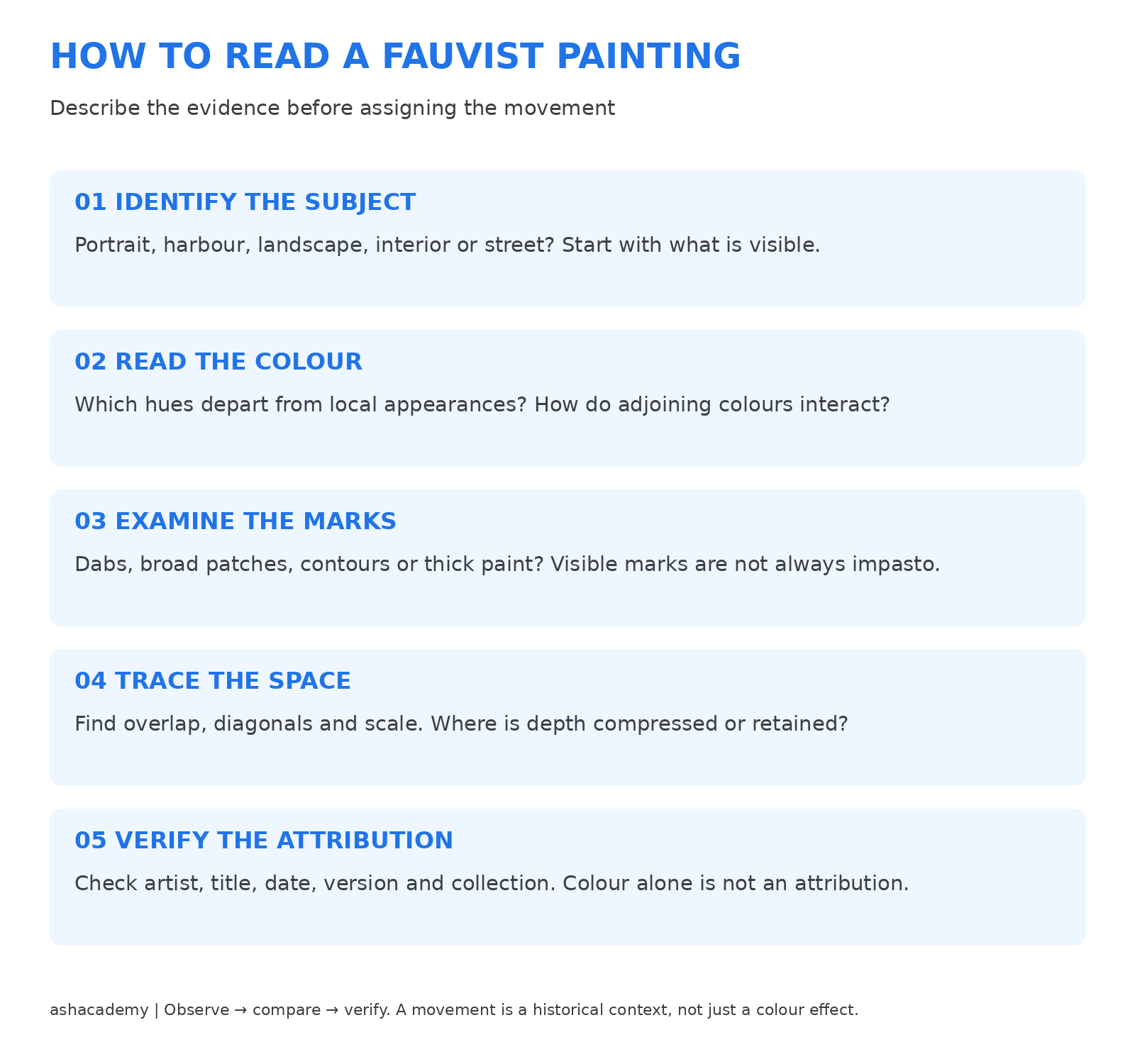
Some Fauve pictures retain separated touches; others rely on larger colour zones. There is no compulsory dot size or uniform brushstroke. Nor does “flatness” mean the disappearance of every spatial cue: overlap, diagonals and scale can still make a landscape readable. These distinctions are especially useful in image-based questions.
Henri Matisse (1869–1954): five essential paintings
Matisse is central to Fauvism, but his career extends far beyond it. The following works trace an important movement from separated colour touches towards broad, interrelated shapes. The sequence should be read as a set of experiments, not a simple replacement of one technique by another.
1. Luxe, calme et volupté, 1904: the Divisionist bridge
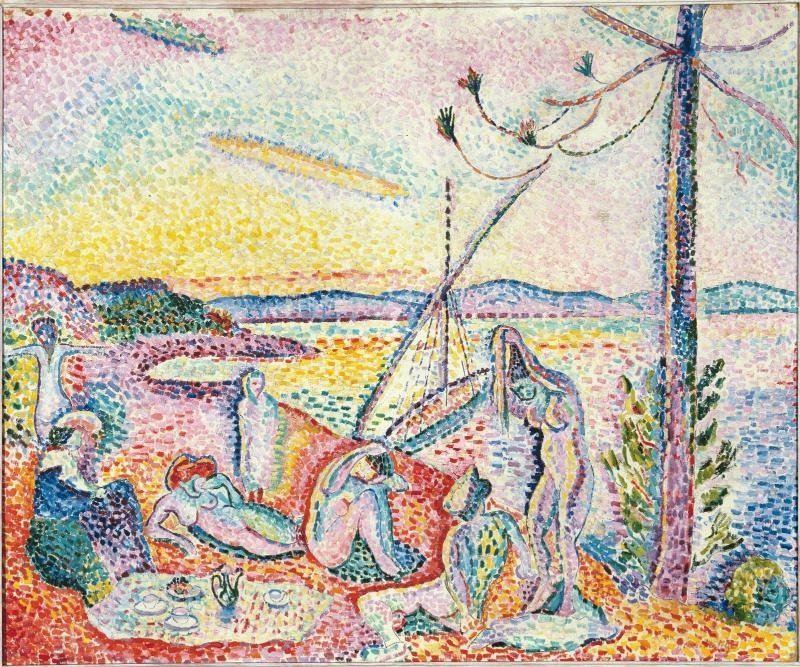
Look closely: Separated coloured touches build the figures, shore and water. Compare their scale with the broader shapes in The Joy of Life below.
This painting belongs to the important 1904 prehistory of Fauvism. Matisse’s contact with Signac in Saint-Tropez informed its divided colour. The title invokes Baudelaire’s L’Invitation au voyage, while the scene transforms a bathing setting into a deliberately composed idyll. It was exhibited at the 1905 Salon des Indépendants, a different exhibition from the Salon d’Automne.
For visual revision, first locate the horizon, the upright tree and the dispersed figures. The small marks can attract attention independently, yet they also build larger passages across the scene. This makes the work useful for discussing both continuity with Neo-Impressionism and Matisse’s changing priorities. The full painting reproduced here should not be confused with MoMA’s separate study.
Source: Centre Pompidou: teaching resource on Luxe, calme et volupté.
Source: The Met: Matisse, early pairings and Divisionism.
2. Open Window, Collioure, 1905: interior and landscape interact
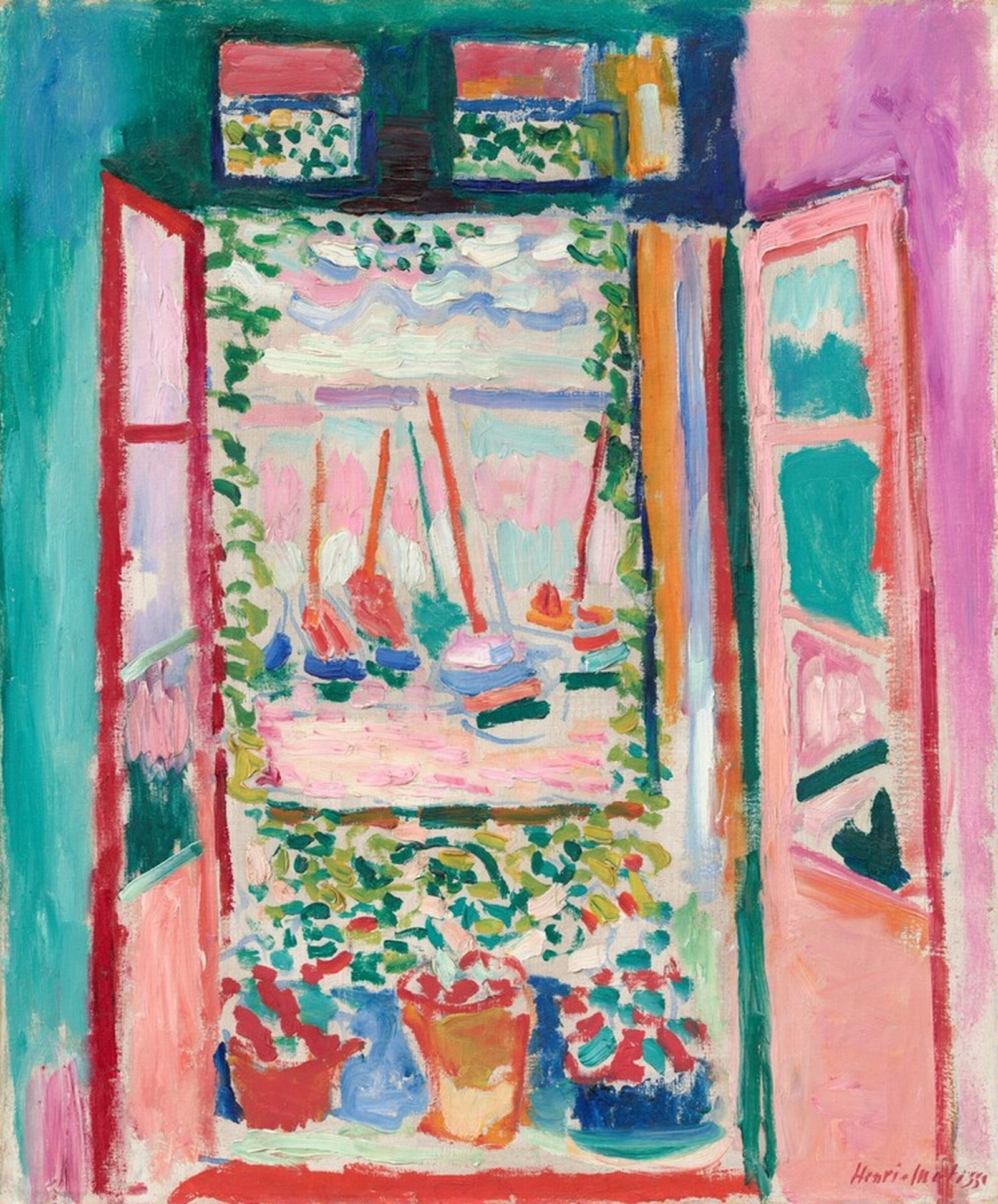
Look closely: The upright window frame organises a view of harbour boats, while pink, green and blue passages connect the interior with the outside.
The open window establishes a recognisable boundary between room and harbour. Matisse makes that boundary visually unstable: intense colour and conspicuous marks keep returning attention to the painting’s surface. The outside view is not merely an illusion seen through a neutral frame; the frame itself participates in the colour structure.
Identification cue: a tall open window, flowering plants and small harbour boats. In an answer, connect the compressed space with the distribution of pinks and greens. Do not reduce the work to “a landscape with arbitrary colours”: the window is the device through which the relationships become visible.
3. Woman with a Hat, 1905: a portrait becomes a colour event
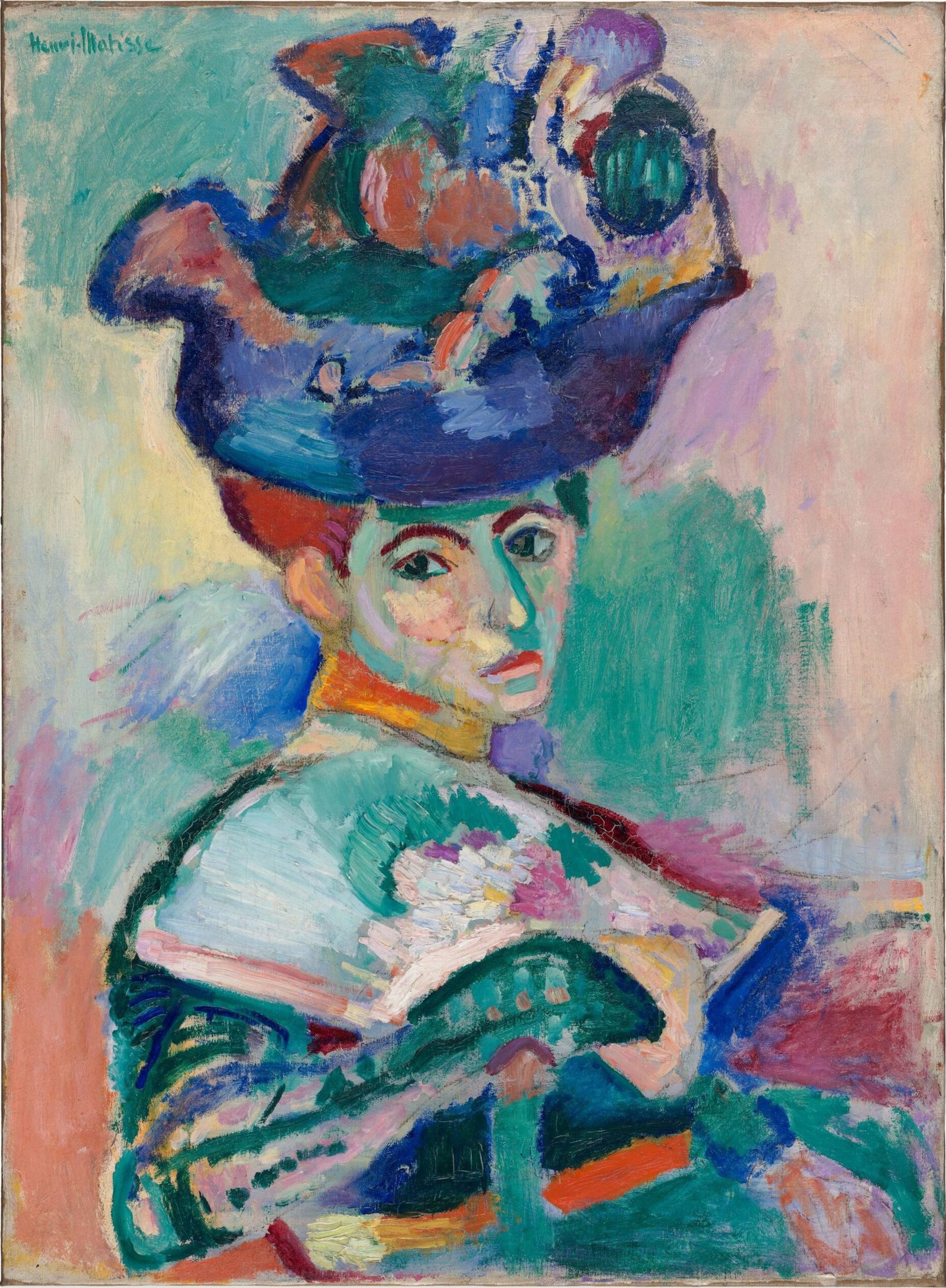
Look closely: Observe the large hat, the turned head, and the green, pink and blue marks across the face and clothing. The sitter remains recognisable despite discontinuous colour.
The sitter is Amélie Matisse, the artist’s wife. The portrait was a prominent work in the 1905 Salon d’Automne controversy. Its challenge lies partly in treating a socially recognisable portrait subject through broken, conspicuous patches rather than a seamless finish.
Look for the relationship between the head, elaborate hat and surrounding background. Individual colour marks can seem abrupt at close range, yet the larger arrangement holds the figure together. This is an opportunity to distinguish an apparently rapid appearance from a claim about the artist’s actual working time, which the appearance alone cannot establish.
Source: SFMOMA: Femme au chapeau, from scandal to icon.
4. The Green Stripe, 1905: colour organises a face
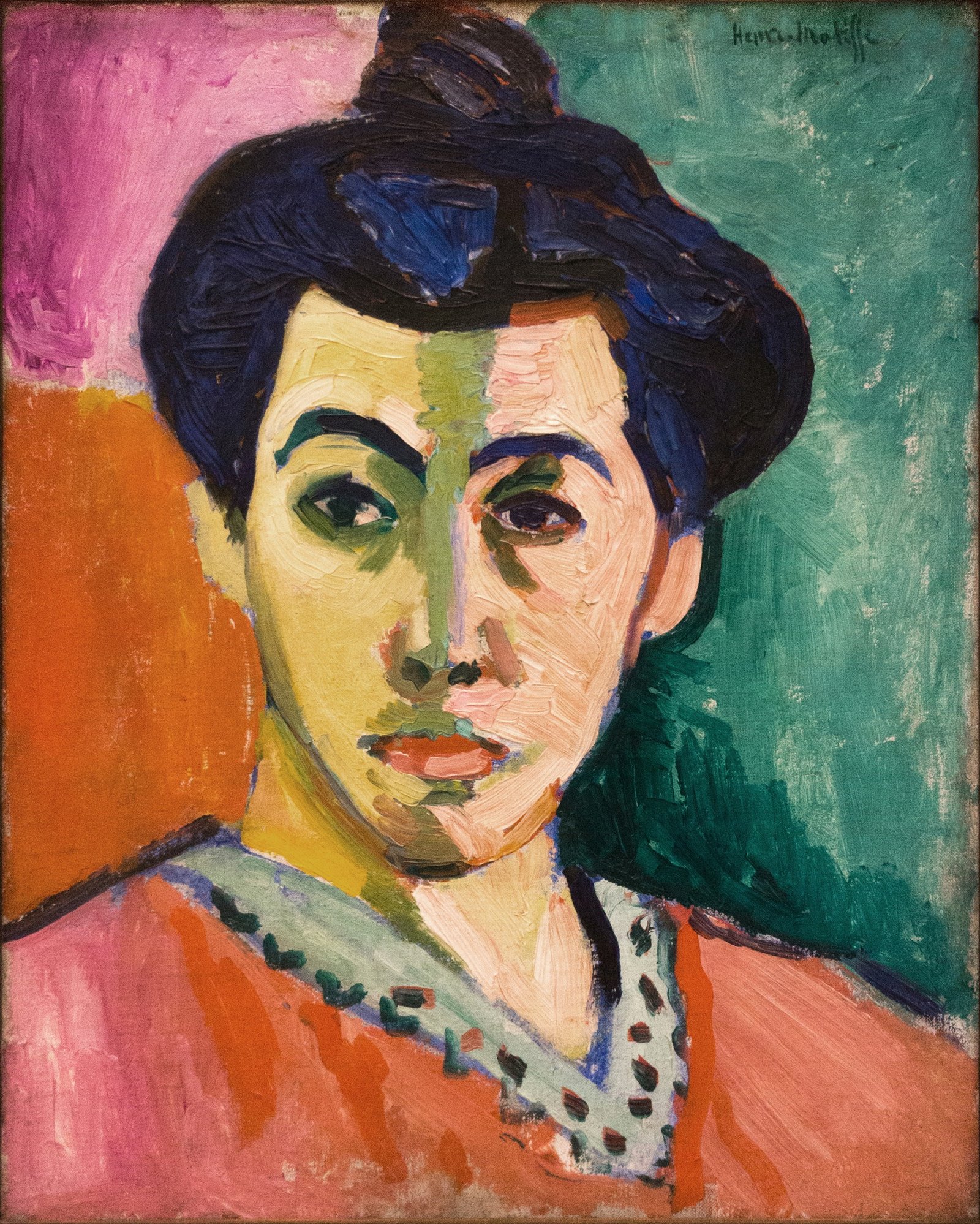
Look closely: A green band divides the face; contrasting pink, yellow and green fields continue into the background. Follow the band’s relation to the nose and the surrounding facial planes.
Another portrait of Amélie, this work is known by several translated titles, including The Green Stripe and The Green Line. The frontal format makes its colour organisation especially clear. A band down the face works with differences between its two sides and with the background’s large colour areas.
What the image supports: a structural analysis of contrasting facial planes and colour zones. What it does not establish: that the sitter literally had green skin or that a fixed psychological diagnosis can be inferred from the hue. Explain what the colour does within the composition before proposing an emotional reading.
5. The Joy of Life, 1905–06: the whole picture as a colour harmony
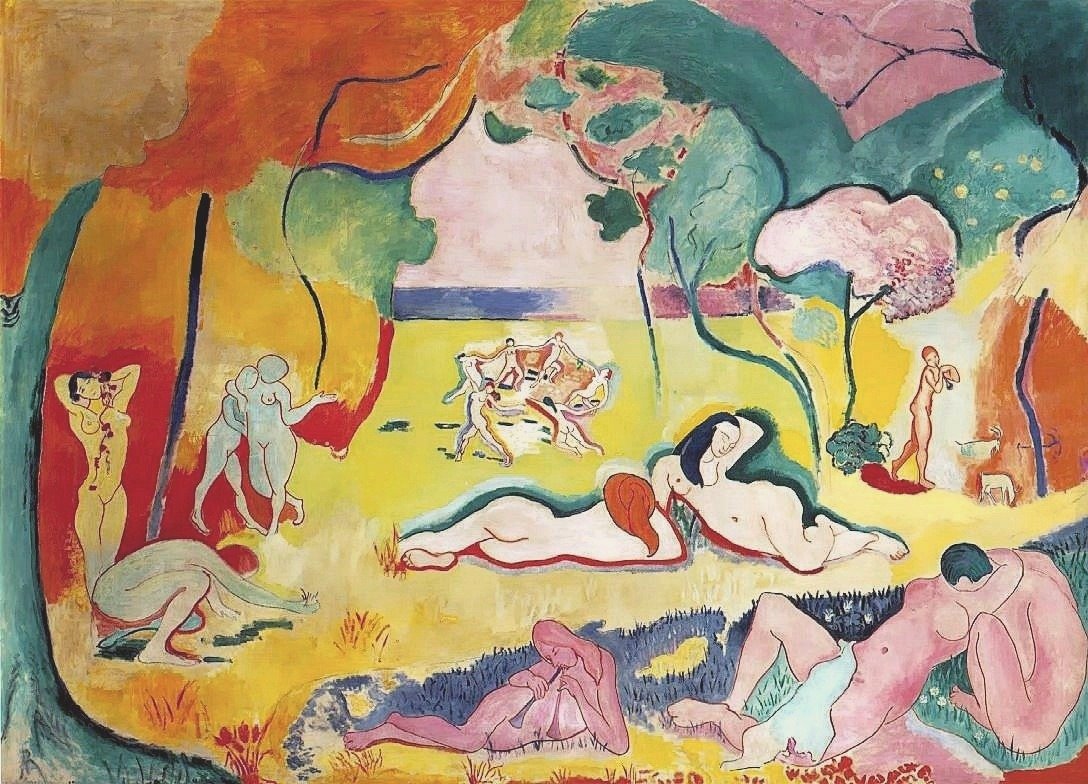
Look closely: The large landscape encloses reclining and standing figures. Locate the small circle of dancers in the distance, then compare the broad colour areas with the divided touches in Luxe, calme et volupté.
The Barnes Foundation dates the painting between October 1905 and March 1906. It belongs to Matisse’s expansion of the idyllic figure landscape into a large decorative organisation. Curving bodies, tree trunks and coloured ground establish a rhythm that is not dependent on conventional anatomical modelling.
The image offers a useful distinction between subject and formal organisation. The subject evokes leisure and an imagined pastoral world; the formal argument lies in the way colour fields and contours make this world cohere. The Barnes painting is the finished work, not SFMOMA’s separate Sketch for Le Bonheur de vivre.
Other main Fauvist artists: compare their individual approaches
The profiles below follow birth-year order. The visual differences are the point: a movement label should help comparison, not make twelve paintings look identical. Brief stylistic observations refer to the reproduced works and should not be applied indiscriminately to an artist’s whole career.
Albert Marquet (1875–1947): structure and restraint
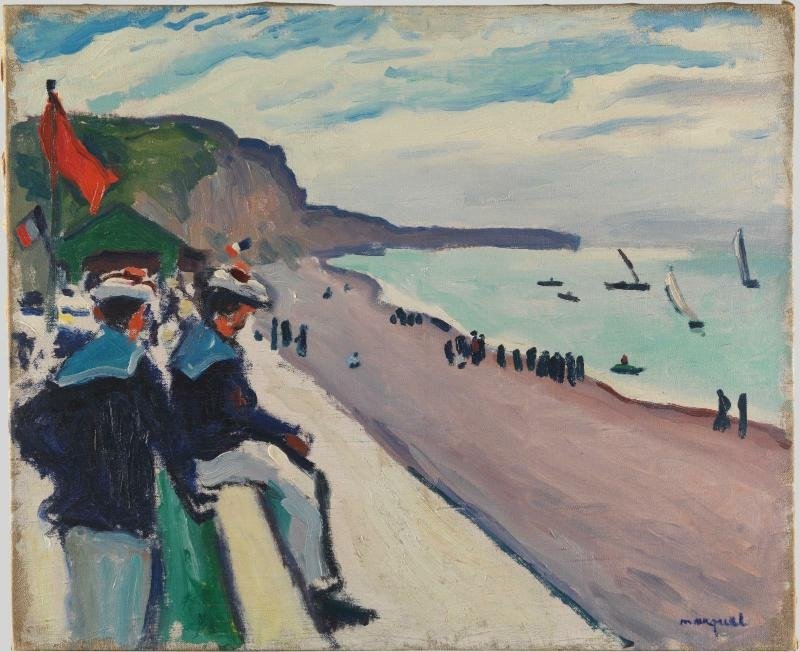
Look closely: A strong diagonal divides the coastal view. The two foreground sailors act as dark anchors; small colour accents punctuate a comparatively restrained landscape.
Marquet is an essential corrective to the idea that every Fauve picture is equally saturated. In Plage de Fécamp, the compositional divisions and abbreviated figures matter as much as colour intensity. The painting was shown at the 1906 Salon d’Automne. It is not the separate Port de Fécamp.
Study task: identify the parapet, sloping ground and beach as large shapes before counting figures. Then examine how small dark marks suggest people and spatial distance. The painting shows that simplification can generate a legible panorama without making every surface a brilliant primary colour.
Maurice de Vlaminck (1876–1958): paint, gesture and the Seine
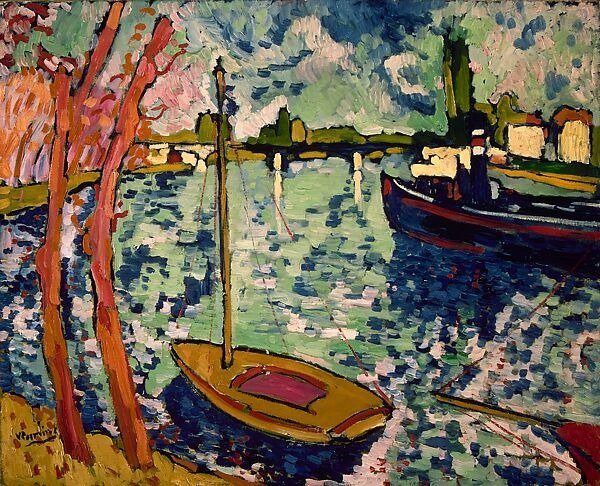
Look closely: Red-orange trunks frame the water, while strong dabs and streaks energise the scene. Compare the paint’s conspicuous activity with Marquet’s more economical marks.
Vlaminck and Derain’s Chatou connection belongs at the centre of Fauvism’s history. In The Seine at Chatou, Van Gogh’s expressive example is especially relevant to the handling. The river is articulated through numerous distinct marks; vigorous contours and colour contrasts make an ordinary riverside subject visually insistent.
Identification cue: the foreground boat, conspicuous red-orange trunks, dense colour marks and the larger vessel behind. Describe these together. Bold paint on a river scene is useful evidence, but neither “river” nor “thick brushwork” is exclusive to Vlaminck.
Kees van Dongen (1877–1968): urban portraiture
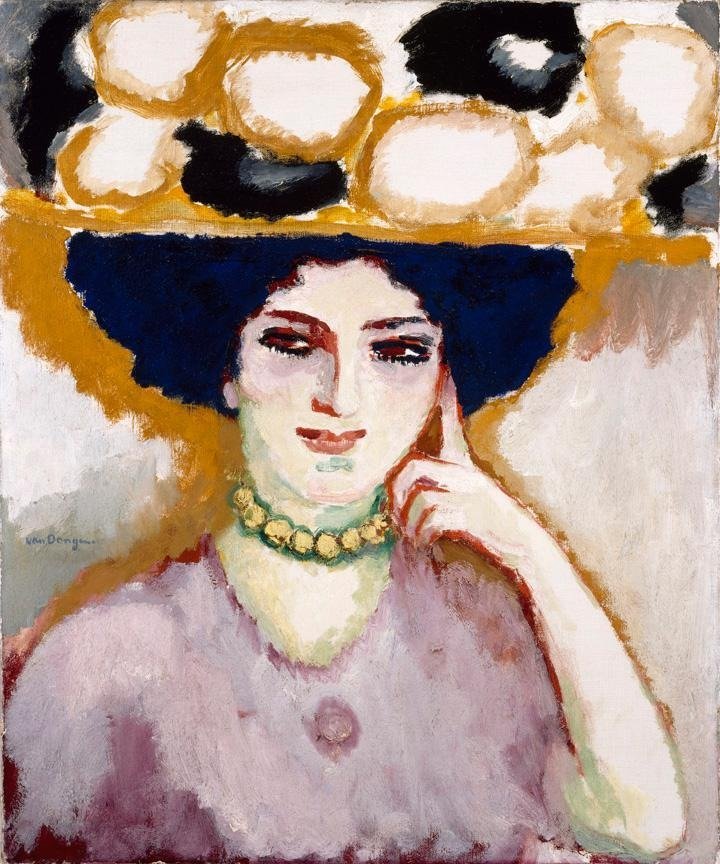
Look closely: The broad hat frames the face. Strong outlines, green-tinted shadows and concentrated colour accents organise features and accessories.
The Dutch-born Van Dongen broadens the story beyond French landscape. Stella in a Flowered Hat, dated c. 1907, belongs to his Fauve portraiture. The National Gallery of Ireland connects such subjects with the cafés and entertainment culture of Montmartre, while treating the sitter’s precise social identity as a probability rather than a certainty.
For identification, distinguish the hat’s large pattern from the finer concentration of marks around the eyes and mouth. Do not confuse this work with Matisse’s Woman with a Hat: compare the sitter’s pose, contour, accessories and treatment of the surrounding space. Similar subjects make visual precision more important.
Raoul Dufy (1877–1953): the festive modern street
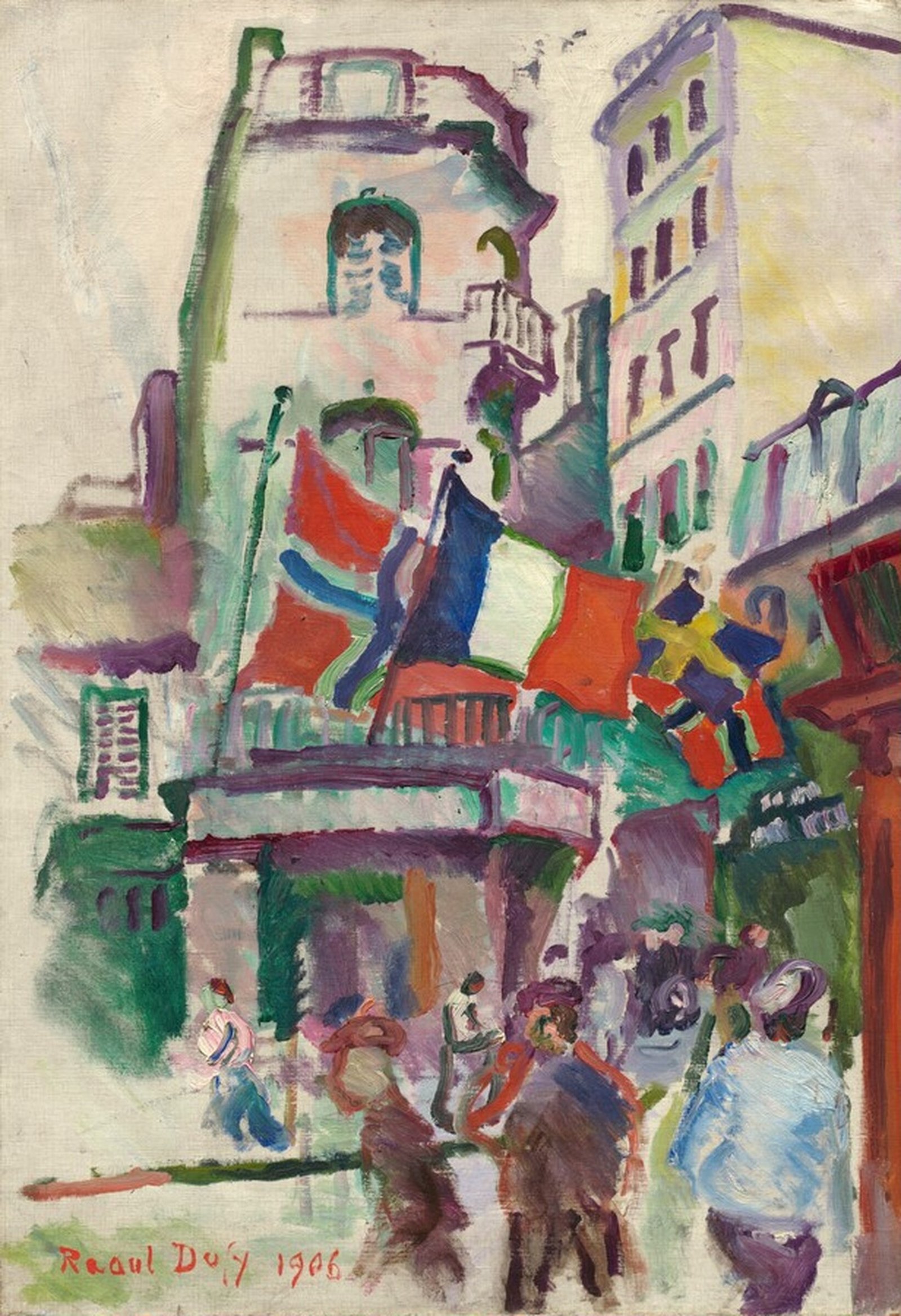
Look closely: Flags, diagonal street edges and loosely indicated people create an animated urban scene. The tall format differs from a broad Mediterranean harbour panorama.
July 14 in Le Havre presents a festive street rather than an isolated stretch of nature. Dufy makes flags and coloured accents interact with the surrounding architecture. The subject demonstrates why “the Fauves painted only the south of France” is incorrect.
Try tracing the street’s recession, then look at how abbreviated figures and flag shapes break up that recession. Spatial cues remain active, while individual marks and colour accents also establish a lively surface. Dufy’s later decorative production should not be used to date this particular 1906 painting.
André Derain (1880–1954): Collioure and London
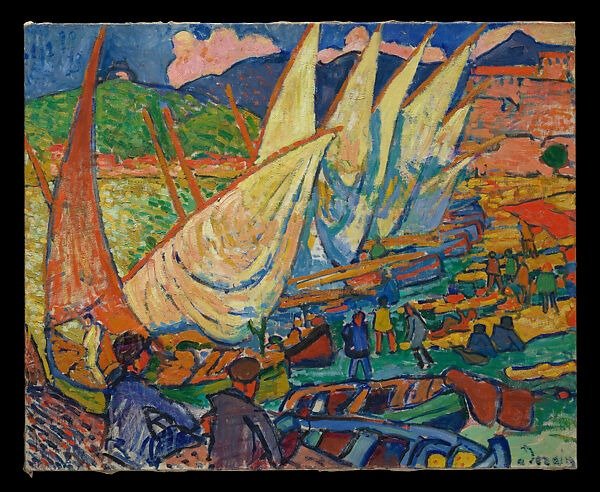
Look closely: Sails overlap across a harbour seen from an elevated viewpoint. Strong diagonals and interlocking colour shapes organise a busy scene.
Fishing Boats, Collioure belongs to Derain’s crucial summer of 1905 with Matisse. The subject remains a specific port, but strong colour and the accumulation of sails turn observation into a constructed visual pattern. Locate the larger diagonal before studying the smaller boats and people.
Several Derain works have similar Collioure titles. The example reproduced here is The Met’s oil painting, accession 1982.179.29. A different museum record or a watercolour with a similar title should not be attached to this image. Accession numbers are useful when titles repeat.
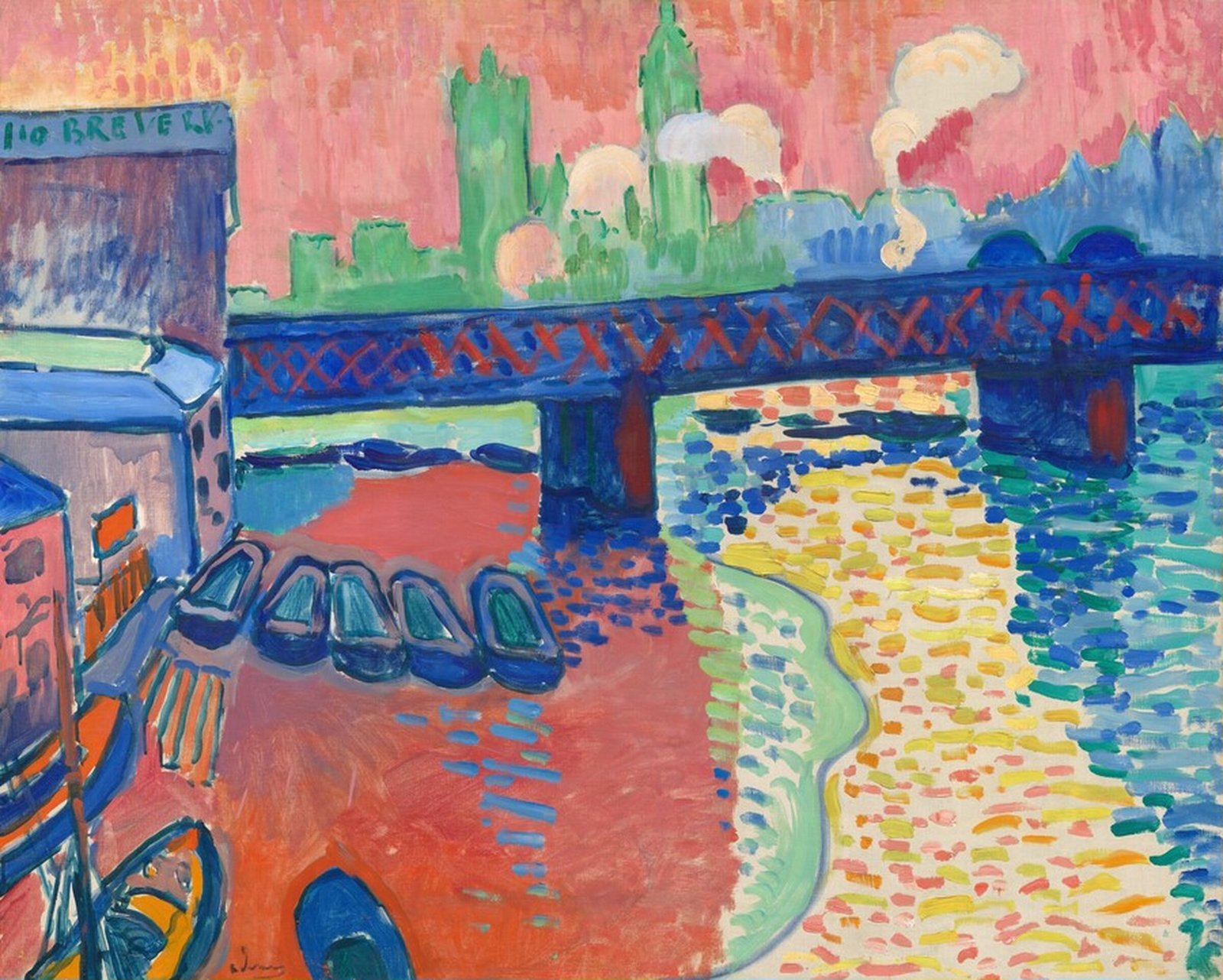
Look closely: The bridge crosses the picture as a strong horizontal; coloured reflections and repeated marks animate the water below. The distant skyline is recognisable but chromatically transformed.
In Charing Cross Bridge, London, 1906, Derain applies a heightened palette to a modern metropolitan landscape. The bridge, river traffic and skyline provide order, while warm and cool passages intensify the view. Colour is doing more than registering the grey atmosphere conventionally associated with London.
Identification cue: the bridge’s dark blue span, the skyline behind it and bright, separated reflections. This is the National Gallery of Art version, 1982.76.3; the Musée d’Orsay holds a different Charing Cross painting. Shared place names do not make different canvases interchangeable.
Georges Braque (1882–1963): before Cubism

Look closely: Heavy contours, simplified vegetation and intense colour hold a compressed landscape together. Follow the outlines of the trees and the placement of the small buildings.
MoMA dates Landscape at La Ciotat to summer 1907. It belongs to Braque’s Fauve phase, before the work through which he and Picasso developed Cubism. The name “Braque” therefore does not automatically make an image Cubist.
The flattened, strongly outlined landscape also lets us ask how colour and structure can coexist. Compare its enclosed shapes with Derain’s fragmented water reflections. Both depart from conventional naturalistic colour, but the rhythm and density of their marks are different.
The wider circle: names to recognise
Othon Friesz, Henri Manguin, Charles Camoin and Jean Puy are important associated painters. Their inclusion prevents a three-name account from masquerading as a complete membership history. Georges Rouault shared Moreau’s studio background and appeared in related exhibition networks, but his strongly personal, often sombre expression should not be flattened into the same landscape formula. Exhibition participation, personal association and lasting stylistic commitment are distinct kinds of connection.
Fauvism timeline: origins, milestones and changing directions

| Date | Milestone | What to remember |
|---|---|---|
| 1904 | Matisse’s work around Signac at Saint-Tropez; Luxe, calme et volupté. | A Divisionist starting point before the famous naming event. |
| 1905, spring | Luxe, calme et volupté shown at the Salon des Indépendants. | Do not merge the two different Paris Salons. |
| 1905, summer | Matisse and Derain experiment at Collioure. | A decisive collaboration; other Fauve networks also mattered. |
| 1905, autumn | Salon d’Automne; Vauxcelles’s critical label. | The central naming and public-recognition milestone. |
| 1905–06 | Matisse develops The Joy of Life. | Barnes dates it October 1905–March 1906. |
| 1906 | Derain’s London paintings; Dufy and Marquet’s Normandy subjects. | Geographical range and individual approaches expand. |
| 1907 | Braque’s La Ciotat work; Cézanne retrospective at the Salon d’Automne. | A significant moment for renewed questions of construction. |
| 1908 | Increasing divergence; Notes d’un peintre published on 25 December. | An approximate closing horizon for the concentrated phase, not a dissolution meeting. |
Fauvism vs Impressionism, Neo-Impressionism, Expressionism and Cubism
Use the table as a starting distinction, then test it against a documented work. The categories overlap in technique and artistic genealogy. A movement can have characteristic priorities without every artist obeying a fixed checklist.
| Movement | Useful emphasis | A distinction to test |
|---|---|---|
| Impressionism | Changing visual experience, light and atmosphere; often broken brushwork. | Do the colours primarily describe perceived conditions, or visibly reorganise the subject beyond them? Not an absolute binary. |
| Neo-Impressionism | Systematic separation of colour and colour-theoretical ambitions; Seurat and Signac. | Regular or divided marks alone do not establish adherence to the movement’s programme. |
| Fauvism | Expressive colour relationships, conspicuous handling and simplified forms. | Recognisable subjects remain; intensive colour can work with structural decisions. |
| Expressionism | A broad, varied field in which subjective experience and distortion can be central. | Fauvism and German Expressionist groups have affinities, but different histories and networks. |
| Early Cubism | Reconsideration of form, volume and pictorial space; associated especially with Picasso and Braque. | Ask how planes and viewpoints are organised, rather than assuming every simplified shape is Cubist. |
| Symbolism | Ideas, suggestion and imaginative or inward experience are important. | Unnatural colour can serve Symbolist meaning without making a work historically Fauvist. |
For a close comparison, place Luxe, calme et volupté, The Green Stripe and Braque’s Landscape at La Ciotat side by side. Ask three questions: how large are the colour units, how is a contour established, and what makes the space readable? This produces a better answer than memorising “dots, wild colour, geometry” as isolated labels.
Impact and legacy: a short phase, a lasting change
By around 1908, the artists were increasingly following different paths. Cézanne’s example helped renew attention to construction; Braque moved towards Cubism, while Matisse continued developing a distinctive art of colour and composition. Derain, Vlaminck and others also changed their approaches. It would be inaccurate to say the entire Fauve network collectively became Cubist.
Fauvism helped make colour’s relative independence from local appearances a central possibility of modern painting. Its relevance to later expressive and colour-centred practices is substantial, but influence should be demonstrated through particular artists, contacts or works. “All later abstraction came from Fauvism” is a claim too broad to defend.
Its history also reminds us that radical-looking paintings can depict familiar sites of recreation and leisure. A full art-historical account asks who travelled, who exhibited and who could purchase the paintings, as well as how colours interact. The movement’s formal innovations do not remove the need for social or cultural analysis.
Source: National Galleries of Scotland: development and legacy.
Source: MoMA: Braque’s Fauve phase before Cubism.
UGC NET Visual Arts revision: key terms and common confusions
| Term | Precise meaning for this topic |
|---|---|
| Local colour | The colour conventionally associated with an object, distinguished from its treatment in a painting. |
| Non-naturalistic colour | Colour that departs from natural appearances; the departure can serve formal or expressive aims. |
| Complementary contrast | A relationship between opposed hues, such as red and green in a conventional artists’ colour wheel. Identify actual colours rather than assuming every strong contrast is complementary. |
| Divisionism | Separation of colour into distinct touches; especially associated with Neo-Impressionism. It is not interchangeable with all Fauve handling. |
| Impasto | Paint applied with a noticeably raised body. Visible brushwork and impasto are not identical. |
| Flattening | A reduction or compression of convincing three-dimensional recession; spatial cues may persist. |
| Decorative organisation | An arrangement of colour, line, shape and rhythm across the surface; not simply an ornamental addition. |
Artist–artwork matching sheet
| Artist | Works in this guide | Memory cue |
|---|---|---|
| Matisse | Luxe, calme et volupté; Open Window, Collioure; Woman with a Hat; The Green Stripe; The Joy of Life. | Divisionist bridge → window and portraits → broad idyllic landscape. |
| Marquet | Plage de Fécamp, 1906. | Coastal diagonal, two foreground sailors, restrained palette. |
| Vlaminck | The Seine at Chatou, 1906. | Conspicuous river marks and red-orange trunks. |
| Van Dongen | Stella in a Flowered Hat, c. 1907. | Urban portraiture, patterned hat and emphatic facial accents. |
| Dufy | July 14 in Le Havre, 1906. | Flags, festive street and Normandy. |
| Derain | Fishing Boats, Collioure, 1905; Charing Cross Bridge, London, 1906. | Port sails and a chromatically transformed London. |
| Braque | Landscape at La Ciotat, summer 1907. | A Fauve landscape before Cubism. |
Revision note: Seven corrections: Vauxcelles, not Fénéon, supplied the Fauve label. Collioure is not Paris. Salon des Indépendants is not Salon d’Automne. Albert Marque is not Albert Marquet. Matisse’s 1908 essay is not a 1905 collective manifesto. Not every Fauve used a uniform pointillist technique. Not every later Matisse or Braque work is Fauvist.
Original practice: identify, compare and explain
These are original teaching questions, not authenticated UGC NET previous-year questions. Attempt each before opening the answer. For the image-based items, refer back to the complete reproductions and use visible evidence.
1. Who supplied the label “fauves” in connection with the 1905 Salon d’Automne? A. Félix Fénéon B. Louis Vauxcelles C. Jean Moréas D. Paul Signac
Answer: B, Louis Vauxcelles. Fénéon is associated with naming Neo-Impressionism. Moréas wrote the 1886 literary Symbolist manifesto; Signac was an artist and theorist central to Neo-Impressionism. The distractors test different roles, not merely unfamiliar names.
2. Put these in order: The Green Stripe; Luxe, calme et volupté; Notes d’un peintre.
Answer: Luxe, calme et volupté (1904) → The Green Stripe (1905) → Notes d’un peintre (1908). A publication that articulates an artist’s ideas can postdate the paintings it helps us understand.
3. Image-based: identify the frontal portrait with a green band down the face. Give artist, date and collection.
Answer: Henri Matisse, Portrait of Madame Matisse. The Green Stripe, 1905, SMK, Copenhagen. Explain the relation between the band, facial planes and background fields. “Green means jealousy” would be an unsupported fixed symbolism here.
4. Image-based: which reproduced painting shows two foreground sailors and a strongly diagonal beach?
Answer: Albert Marquet, Plage de Fécamp, 1906, Centre Pompidou collection. Its comparatively restrained colour is a useful reminder that membership in an artistic network does not require an identical palette.
5. Which pair belongs together? A. Dufy—July 14 in Le Havre B. Vlaminck—The Green Stripe C. Braque—Woman with a Hat D. Derain—The Joy of Life
Answer: A. The three other listed works are by Matisse. A strong answer also connects Dufy’s painting with festive flags, a street setting and the 1906 date.
6. Image-based: identify the landscape with heavy outlines and simplified vegetation by an artist later central to Cubism.
Answer: Georges Braque, Landscape at La Ciotat, summer 1907, MoMA. The later Cubist association does not override the work’s date and its particular Fauve treatment.
7. Does a separated brushmark prove that a painting is Neo-Impressionist rather than Fauvist?
Answer: No. Both historical context and the organisation of the work matter. Matisse’s Luxe, calme et volupté makes the connection especially visible. One visible technique is insufficient to establish a movement’s complete programme.
8. Identify the error: “Matisse and Derain founded an official Fauvist society in Collioure, then published its manifesto in 1905.”
Answer: Their 1905 collaboration is documented, but this account invents a formal society and founding manifesto. Matisse’s Notes d’un peintre appeared in La Grande Revue on 25 December 1908 and expresses his own artistic thinking.
9. Image-based: which Derain work reproduced here belongs to London, and how does it retain a readable structure?
Answer: Charing Cross Bridge, London, 1906, National Gallery of Art, 1982.76.3. The bridge span, skyline and river traffic establish recognisable relationships despite the intensified palette. Avoid borrowing the catalogue details of the different Orsay canvas.
10. Which statement is most accurate? A. All Fauves became Cubists by 1908 B. All Fauves painted only portraits C. Fauvism was a loose network with diverging later paths D. Green skin proves a painter rejected all structure
Answer: C. Braque’s later direction does not describe everyone. The illustrated works include several subjects, and departures from natural colour can coexist with rigorous pictorial organisation.
Frequently asked questions about Fauvism
What is Fauvism in simple words?
Fauvism is an early twentieth-century movement associated with intense, often non-naturalistic colour, simplified forms and conspicuous brushwork. The colours help organise and express the painting rather than simply copy an object’s usual appearance.
Who is considered the leading Fauvist artist?
Henri Matisse is generally treated as its leading figure, with André Derain and Maurice de Vlaminck central to the story. “Founder” should be used cautiously because the network was not an organisation with a single founding act.
When did Fauvism begin and end?
Its best-known public milestone is the 1905 Salon d’Automne. The concentrated phase is commonly placed around 1905–1908, with earlier experiments and later continuities. These are approximate historical boundaries, not official registration and closure dates.
Why were the artists called wild beasts?
The name came from Vauxcelles’s response to the forceful colour and unconventional appearance of paintings at the 1905 Salon d’Automne. It began as a critical label, not a claim that the artists lacked training.
Is Fauvism the same as Pointillism or Neo-Impressionism?
No. There are important connections, including Matisse’s use of divided touches in 1904. Neo-Impressionism is a historical movement with colour-theoretical ambitions, while Fauve artists varied their methods and often expanded into broader colour areas.
Which Fauvism facts should I revise for UGC NET Visual Arts?
Prioritise Vauxcelles, the 1905 Salon d’Automne, Collioure, Matisse–Derain–Vlaminck, the main artist–artwork matches and Matisse’s 1908 Notes d’un peintre. Use the images to practise colour, contour, brushwork and spatial analysis. This is a study priority, not a prediction of a future examination paper.
Sources, collection records and image credits
This guide uses museum and archival sources for historical claims and collection metadata. Artwork-specific records are linked in every caption. The formal observations and revision exercises are ashacademy’s teaching analysis. Where dates are approximate or collection records specify a range, that qualification is retained.
- Sabine Rewald, “Fauvism,” The Metropolitan Museum of Art, 2004.
- The Met and Museum of Fine Arts, Houston: Vertigo of Color, exhibition visiting guide.
- John Elderfield, The “Wild Beasts”: Fauvism and Its Affinities. MoMA, 1976.
- MoMA: Fauvism, collection glossary and related works.
- National Galleries of Scotland: Fauvism glossary.
- Centre Pompidou: Notes d’un peintre, publication history.
- Smithsonian Archives of American Art: La Grande Revue, 25 December 1908.
- SFMOMA: Matisse’s Femme au chapeau, From Scandal to Icon, March 2026.
- Centre Pompidou: teaching dossier on Luxe, calme et volupté.
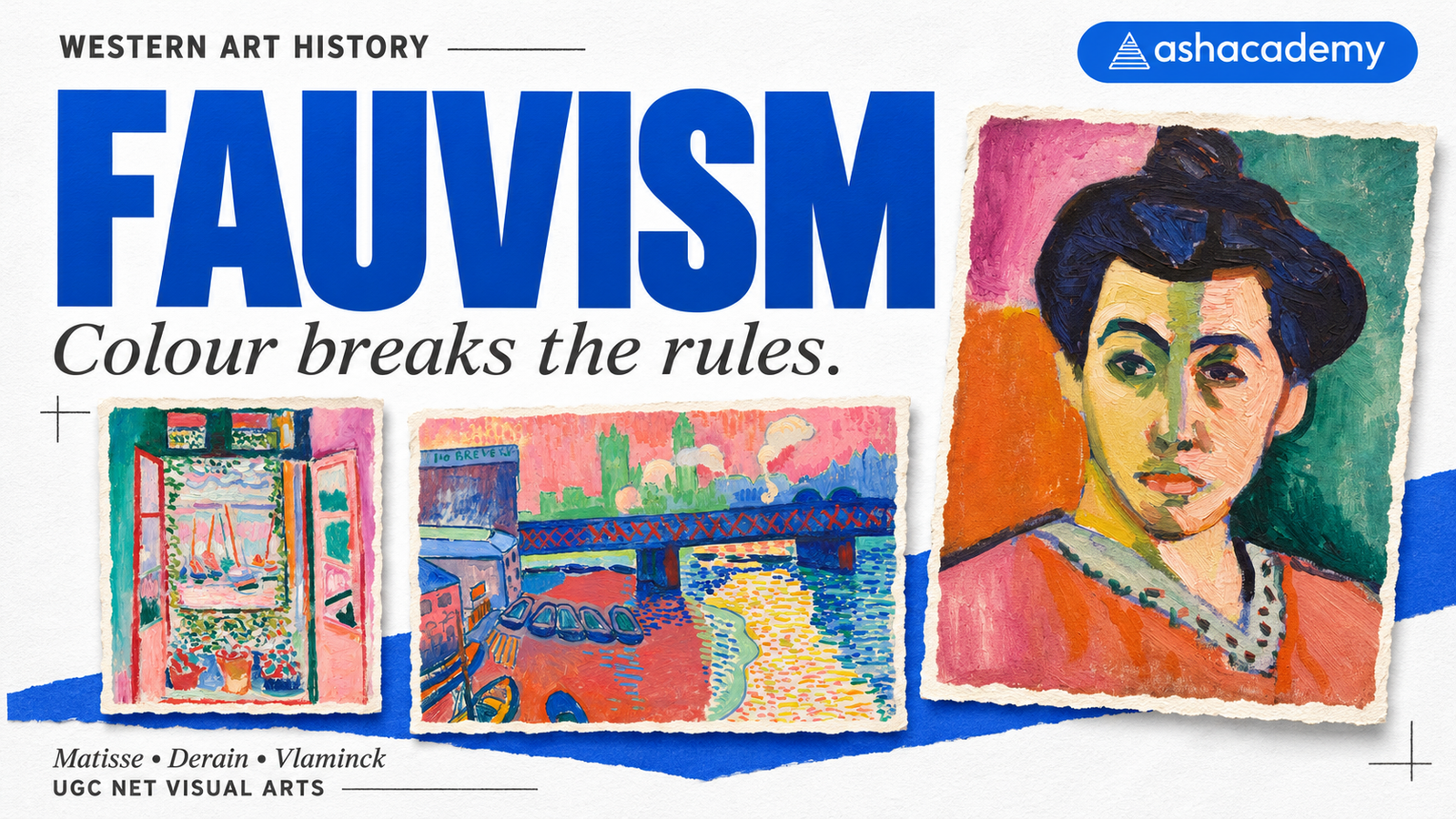
Images are reproduced for contextual art-historical study and criticism with collection and source credits. Public-domain reproductions are identified individually; no blanket open licence is asserted for every image. Rights in other reproductions remain with the stated holders. Artwork images retain their full composition and are resized proportionally. The cover is an AI-assisted editorial collage, not an authentic historical artwork or archival document. The two revision graphics are original teaching aids. Research checked: 4 November 2026.
Continue your revision: Symbolism · Realism · ashacademy book library.

You may also like
Symbolism in Art: History, Characteristics, Artists and Artworks
Neo-Impressionism: History, Characteristics, Artists and Artworks