Realism: History, Characteristics, Artists and Artworks
WESTERN ART MOVEMENTS · ILLUSTRATED STUDY NOTES · UGC NET VISUAL ARTS
Realism was a major tendency in nineteenth-century French art that gave contemporary life, ordinary people and observed environments the seriousness traditionally associated with elevated subjects. It developed during the 1840s and became especially forceful around the Revolution of 1848 and in the following decades. Gustave Courbet was its leading public advocate, while Jean-François Millet, Honoré Daumier and Rosa Bonheur pursued distinct but related interests.
The central question is more demanding than “Does this painting look real?” It is: Who deserves to be represented, on what scale, through whose point of view, and with what claim to truth? This guide explains the context, ideas, artists, materials and important artworks through original reproductions, visual-analysis prompts, chronology and exam revision.
| Quick question | Essential answer |
|---|---|
| Where? | Primarily France: Paris, Courbet’s Franche-Comté and rural environments such as Barbizon. |
| When? | Developing in the 1840s; a major force around 1848 and through the mid-to-late nineteenth century. |
| Leading exponent? | Gustave Courbet, especially through his paintings and independent 1855 exhibition. |
| Key institutional event? | Courbet’s Pavillon du Réalisme at the time of the Paris Exposition Universelle, 1855. |
| Central subjects? | Contemporary labour, social life, ordinary people, animals, portraiture and landscape. |
| Is it just accurate drawing? | No. Subject, scale, handling, social relationships and historical context matter too. |
Jump to: Context · Meaning · Origins and manifesto · Visual characteristics · Artists · Courbet · Millet · Daumier · Bonheur · Comparisons · Revision · Quiz · Sources
1. Historical context: a new public for ordinary life
French art was shaped by academies, official exhibitions, state patronage, collectors and the press. The Salon was a major route to visibility. Within the traditional hierarchy of genres, history painting occupied a privileged position. Large biblical, mythological or historical narratives could claim moral and intellectual importance; everyday subjects were often assigned a lower status.
Realist artists challenged this distribution of importance. A rural funeral, manual labour or a railway compartment could become the subject of a serious work. The challenge was especially sharp when an artist used a large canvas or gave ordinary people an imposing physical presence. What critics found disturbing was not always poor drawing or unfamiliar subject matter alone: it could be the public status the image granted its subjects.
Source: National Gallery, London: the historical Realist movement.
The Revolution of 1848 ended the July Monarchy and brought the Second Republic. Its hopes, conflicts and aftermath intensified debates about citizenship, labour and social inequality. The Second Empire under Napoleon III followed. Realism developed within this unsettled society, rather than within a politically neutral world of artistic technique.
Industrialisation and changing transport also altered everyday experience. Railways brought different social groups into newly structured spaces; migration and urban growth made work, poverty and class distinctions increasingly visible. Rural labour remained fundamental to French life even as cities expanded. Millet’s fields and Daumier’s railway passengers therefore offer different perspectives on the same century, not a simple opposition between an ancient countryside and a modern city.
This context does not mean every Realist painting illustrates a political doctrine. A picture can make inequality visible without providing a party programme. Artists, patrons and critics disagreed about its meanings. Political interpretation should be connected to a particular work and its reception, rather than attached automatically to every labouring figure.
Source: The Met: Realism in its social and artistic context.
2. Meaning and ideology: Realism is more than resemblance
Realism with a capital R names a historical movement or tendency. Realistic representation describes a broader quality that can appear in art from many periods. An ancient portrait, a Dutch still life and a twentieth-century photograph may all be observant or lifelike without belonging to nineteenth-century French Realism.
Courbet’s position gave unusual authority to contemporary experience and to the artist’s own judgement. Instead of accepting inherited subjects as the highest form of painting, he claimed the right to represent the customs and appearances of his own time. That commitment did not eliminate invention: selecting figures, arranging a composition, changing scale and applying paint are all interpretive decisions.
Realism therefore does not mean a transparent copy of reality. It can involve a deliberately rough surface, compressed space, a monumental pose or a carefully constructed group. Nor does it require the rejection of every older model. Courbet, Millet and Bonheur learned from earlier art even while rethinking its uses.
Source: Musée Courbet: observed reality, inherited traditions and interpretation.
Revision note: In an examination, connect historical Realism + contemporary subject + particular artist and work. “Looks like a photograph” is an unreliable definition. Daumier’s expressive distortions can serve a Realist concern more effectively than a smoothly finished but imaginary scene.
3. Origins, the 1855 pavilion and important writing
Realism did not begin with a single meeting, one shared studio or a membership register. The term had earlier uses, but Courbet made it a conspicuous public identity in the 1850s. His work at the Salon of 1850–51 brought the people and environments of Ornans into sustained controversy. The familiar label “father of Realism” signals his prominence; it should not erase other artists or turn a varied movement into one person’s invention.
In 1855, during the Paris Exposition Universelle, Courbet organised his own exhibition in the Pavillon du Réalisme. Major works including The Painter’s Studio had not been accepted for the official exhibition. The pavilion asserted his authority to present a substantial selection of his own work outside the official arrangement. It was an important precedent for later independent exhibiting, but it was not the Salon des Refusés of 1863.
Source: Musée Courbet: the artist’s career and the 1855 exhibition.
Courbet’s 1855 catalogue preface is commonly described as the Realist Manifesto. It sets out an individual artistic position and his ambition to respond to his own epoch. It is not a manifesto jointly signed by Millet, Daumier and Bonheur. A statement by one artist should not be presented as proof that every associated painter accepted identical principles.
Source: The Met: Courbet, the Pavilion of Realism and the accompanying manifesto.
| Person or publication | Date | Why it matters |
|---|---|---|
| Courbet’s Pavillon du Réalisme and catalogue preface | 1855 | Independent self-presentation and an explicit public defence of Realism. |
| Edmond Duranty’s journal Réalisme | 1856–1857 | A critical and literary forum; distinguish it from Champfleury’s book. |
| Champfleury, Le Réalisme | 1857 | A collection of critical writing associated with the Realist debate. |
| Courbet’s statement on contemporary, concrete art | 1861 | A later articulation of his position; it should not be misdated as the 1855 preface. |
| Duranty, La Nouvelle Peinture | 1876 | A later text connected with the new painting and Impressionist debates, not the title of the 1856 journal. |
The journal and book are easy to confuse because their titles are almost identical. Duranty = journal, 1856–57; Champfleury = book, 1857. They helped shape debate, but their ideas were not entirely interchangeable. Realism in painting also interacted with literary questions without making all realist novelists and painters members of one organised group.
The wider literary context includes Honoré de Balzac and Gustave Flaubert, with Émile Zola important to later Naturalist debates. Their concerns with social experience help explain why Realism mattered beyond painting. These parallels do not make a novel a painting manifesto or establish one uniform doctrine shared by every writer and artist.
Source: Scholarly edition of Duranty’s journal: publication history and common confusions.
Source: Concordia University: Courbet and primary texts in the Realist debate.
4. Visual characteristics: what to look for
| Feature | How it may appear | Qualification |
|---|---|---|
| Contemporary subjects | Workers, villagers, passengers, animals and familiar places. | Realism is not restricted to poverty. |
| Unidealised presence | Individual faces, worn clothing, bodily effort, ordinary gestures. | Different artists idealise or generalise to different degrees. |
| Scale and status | Large formats or imposing figures give everyday life public importance. | A small Realist work can also be important. |
| Material paint surface | Visible marks, dense paint, strong tonal masses and tactile surfaces. | There is no one compulsory Realist brushstroke. |
| Social relationships | Differences in class, labour, patronage or access to space become visible. | Meaning depends on the particular image and context. |
| Composition | Frieze-like groups, repeated gestures, close interiors or deliberately staged encounters. | A constructed arrangement is compatible with Realism. |
| Colour | Earth colours and dark tones occur in many works; outdoor colour also matters. | “Realism always uses brown” is false. |
| Media | Oil painting, lithography, drawing and sculpture can all contribute. | Daumier’s prints are central, not supplementary decoration. |
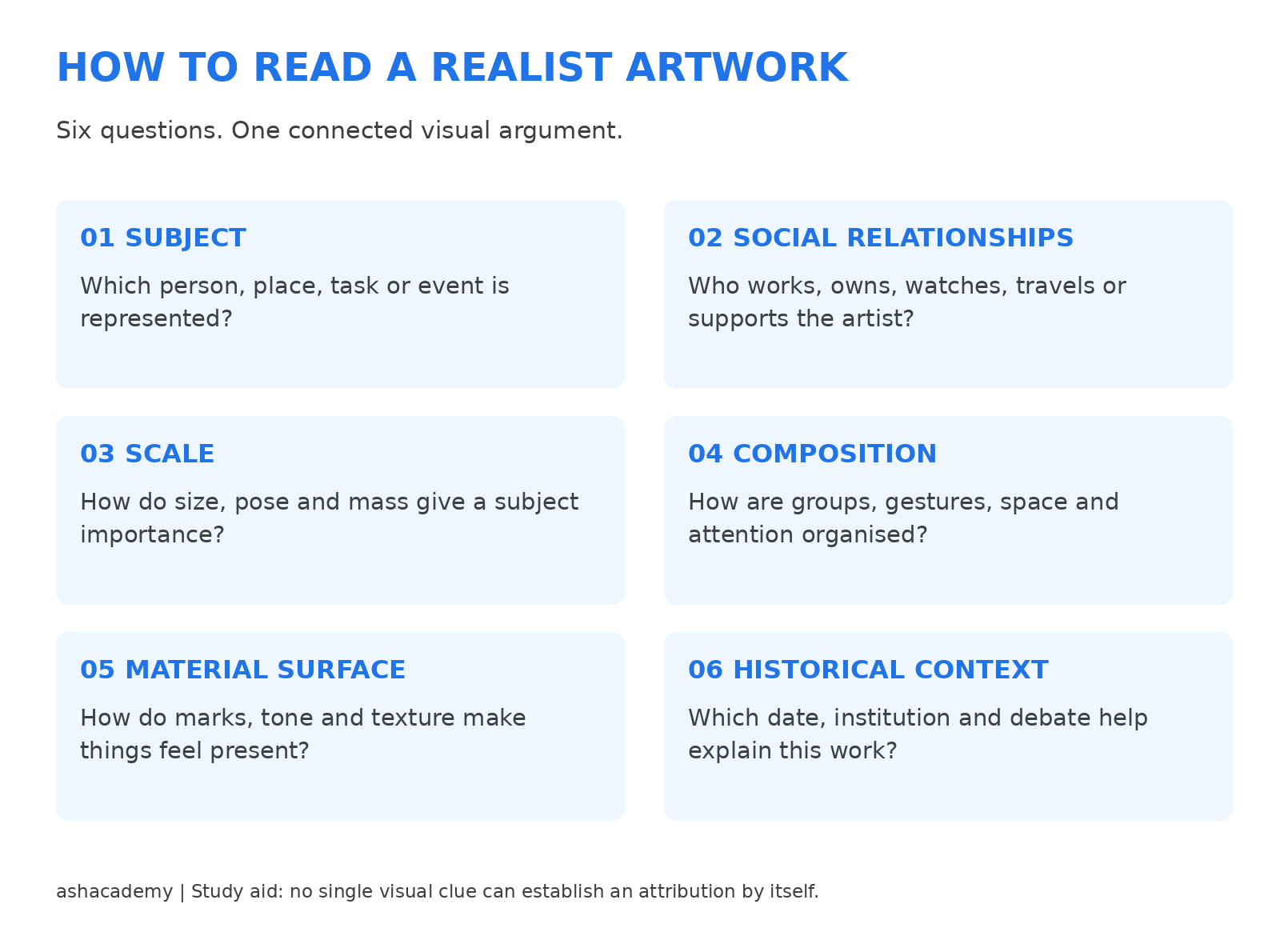
A useful identification sequence is: subject → social relationship → scale → composition → handling → artist. Start with what the people are doing and how the image positions the viewer. Then examine whether the visual evidence fits a specific work. A dark palette by itself cannot identify Courbet, just as a field cannot automatically identify Millet.
5. Materials and techniques: observed life, constructed form
Oil on canvas is the medium of most paintings discussed here. Its flexibility allowed thin and thick passages, revision, modelling and textured marks. In Courbet’s work, a brush or palette knife could help make soil, rock, fabric and flesh feel materially different. The visible paint surface could challenge academic expectations of smooth finish.
At the same time, careful drawing, anatomical study and sustained preparation remained important for other artists. Bonheur’s animals were supported by close observation rather than a quick formula. Millet could concentrate the body’s effort into simplified, weighty gestures. Realism does not establish a single rule about the amount of preparatory work or the speed of execution.
Source: Musée d’Orsay: Courbet’s handling, materials and inherited models.
Lithography, especially important to Daumier, is a planographic printing process based on the different behaviour of greasy drawing materials and water on a prepared surface. It made expressive drawn images available in multiple impressions and in the periodical press. A lithograph is not a woodcut or an etching: these involve different printing principles.
Print circulation also changes the image’s audience and function. Daumier could address political violence, official behaviour and everyday manners through works encountered beyond an exhibition room. Different impressions, states and publication dates should be distinguished; a date inside a title can refer to the event rather than the month the print appeared.
Source: The Met: Daumier’s Rue Transnonain and its July 1834 publication.
6. Main artists in birth-year chronology
The table separates the central French Realist figures from related predecessors and later developments. Birth years organise the list; they do not establish a sequence of formal membership.
| Artist | Life dates | Contribution and relationship |
|---|---|---|
| Jean-Baptiste-Camille Corot | 1796–1875 | Important landscape painter and predecessor; associated with outdoor observation and the wider Barbizon context, not a founder of Courbet’s pavilion. |
| Honoré Daumier | 1808–1879 | Political and social lithography, painting, sculpture and the experience of modern urban life. |
| Jean-François Millet | 1814–1875 | Peasant labour, repeated gestures and the rhythms of rural life; closely associated with Barbizon. |
| Gustave Courbet | 1819–1877 | Leading exponent and public advocate of Realism; ordinary subjects, self-representation and material landscape. |
| Rosa Bonheur | 1822–1899 | Animal painting, rural labour and anatomical observation; international professional success. |
| Édouard Manet | 1832–1883 | A younger modern-life painter linked to Realism and to the origins of Impressionism; not an exhibitor at the eight Impressionist group shows. |
| Jules Bastien-Lepage | 1848–1884 | A later Naturalist development, combining close observation of rural life with a different treatment of setting and figures. |
Museum biographies: Daumier, Millet, Courbet and Bonheur. Artists can share a historical problem without using identical methods or holding the same politics.
7. Gustave Courbet: changing who can occupy a major painting
Courbet’s native Ornans and the wider Franche-Comté gave him subjects, relationships and a strongly asserted regional identity. His Realism includes workers and villagers, but also friends, patrons, self-portraits, landscapes, hunting and other subjects. Reducing his career to “paintings of poor people” loses much of its range.
His challenge worked through both imagery and self-presentation. He could raise the public status of local experience while presenting himself as an independent artist with the authority to choose. This involved exhibitions, criticism and patronage as well as formal choices on canvas. The artist who challenged institutions still operated within relationships of support and exchange.
Source: The Met: Courbet’s career, varied subjects and public identity.
Courbet’s later political activity belongs to a different moment from the 1848 Revolution. He was involved in the Paris Commune of 1871 and was imprisoned after its fall. He went into exile in Switzerland in 1873 and died there in 1877. These events affected his later life and subjects, but should not be projected backwards as the immediate circumstances of every painting he made in 1849 or 1855.
Source: Musée Courbet: the Commune, imprisonment and Swiss exile.
The Stonebreakers: labour without a heroic reward
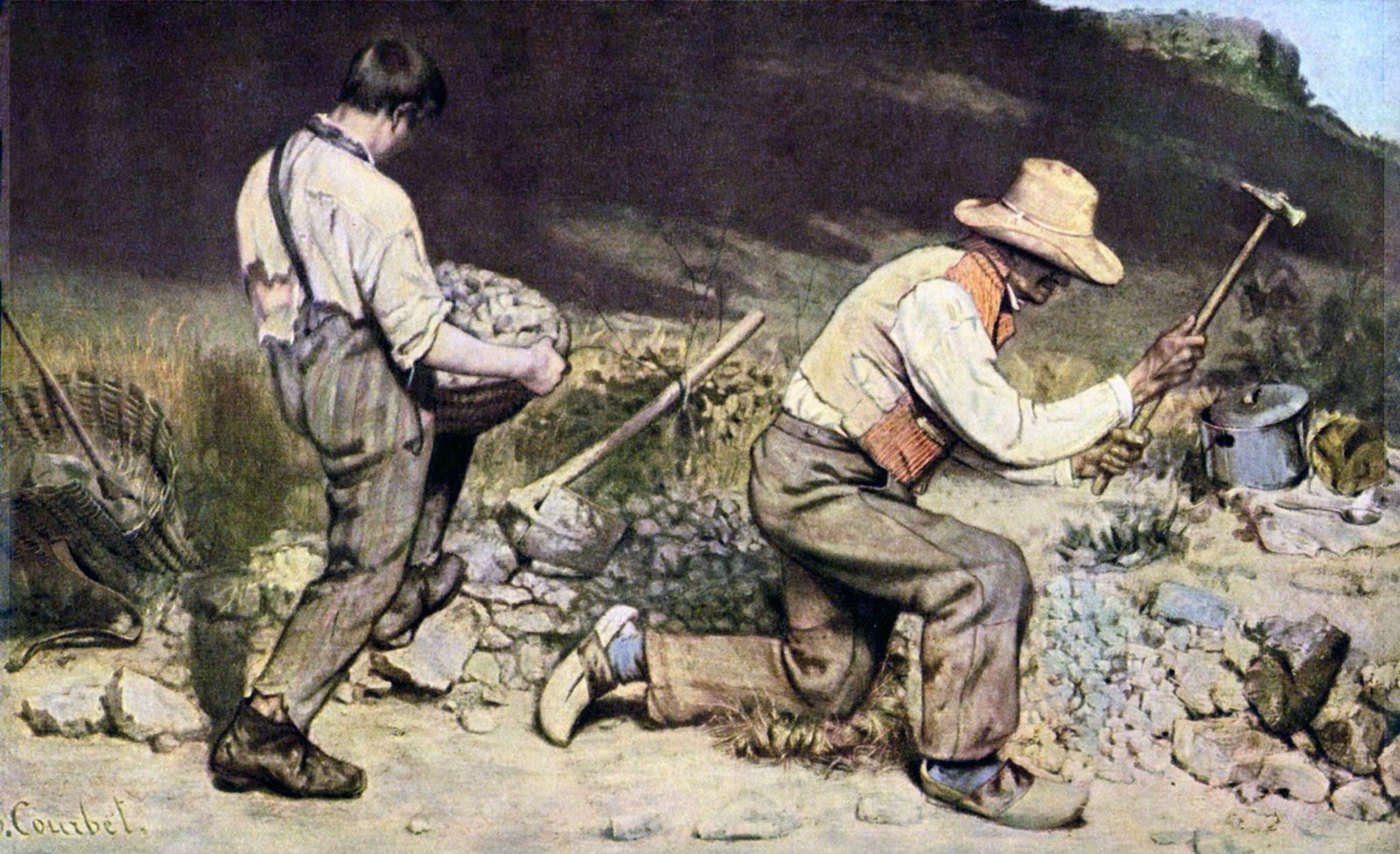
Look closely: Two labourers of different ages are absorbed in heavy work. The bodies, tools, rough clothing and restricted setting keep attention on effort. Their obscured faces discourage a conventional portrait-based reading.
The familiar date is 1849; some exhibition accounts use 1849–50. It appeared at the Salon of 1850–51. The juxtaposition of a younger and an older worker can be read as a cycle of persistent hardship, rather than a story in which effort guarantees upward mobility. That is an interpretation grounded in the pairing and task, not a documented biography of two named sitters.
Revision note: The original painting is generally recorded as destroyed in 1945, formerly in Dresden. The image shown is a surviving reproduction, not an extant canvas newly photographed in Musée d’Orsay. Its precise wartime fate has been discussed; do not add an unverified story about a particular truck, route or bombing.
Source: Museo Thyssen-Bornemisza: the work, Salon context and recorded destruction.
A Burial at Ornans: a local event at the scale of history
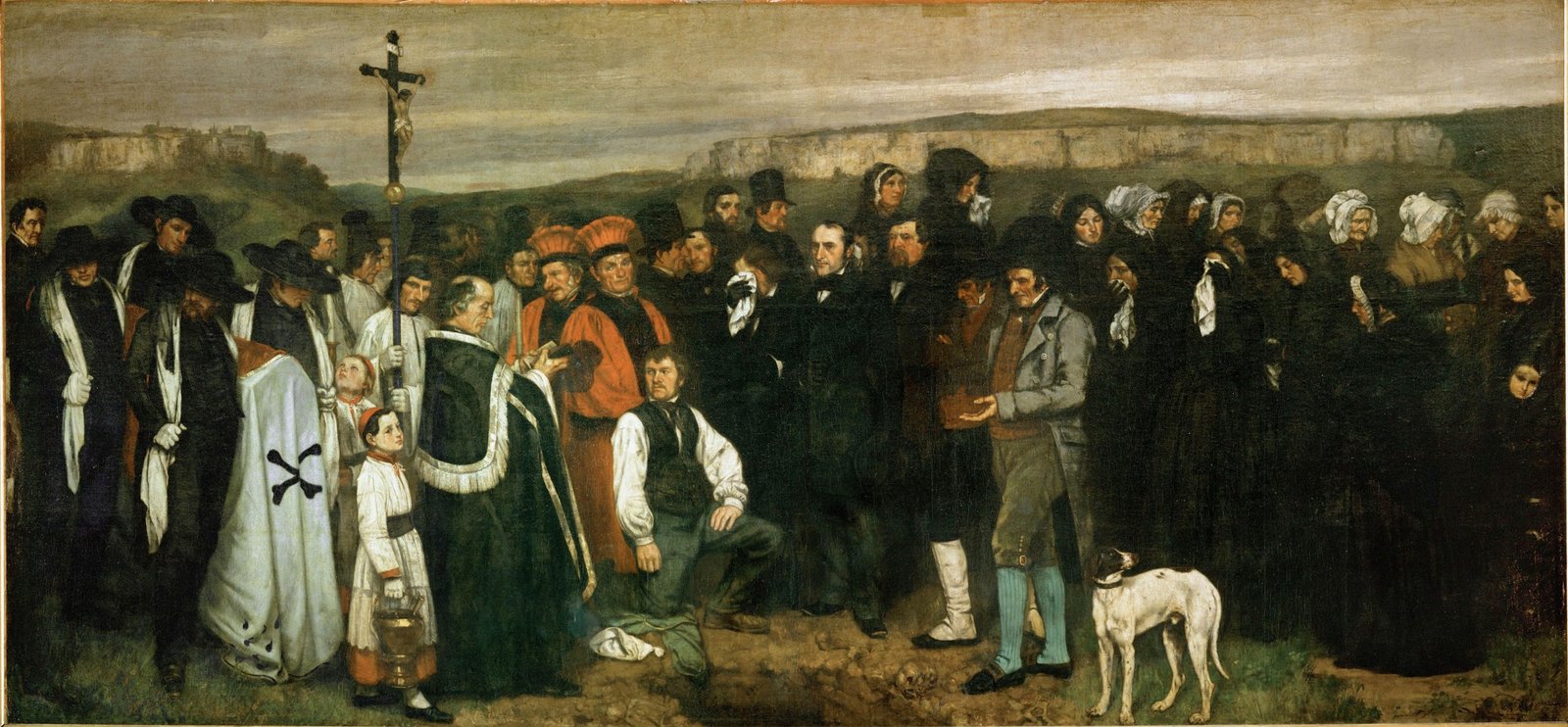
Look closely: The long line of villagers, clergy and mourners spreads across the canvas without a single idealised hero. The open grave, dog, uneven gestures and dark clothing resist the expectation of an elevated, theatrically unified history scene.
Painted in 1849–1850, the work measures approximately 3.15 × 6.68 metres. Its importance lies partly in this relation between an ordinary local funeral and a format associated with major history painting. Courbet does not need a legendary battle to claim monumental seriousness for the community of Ornans.
The exact identity of the person being buried is not securely established in the museum’s account. Do not confidently identify the funeral as Courbet’s grandfather’s. Political readings exist, but the museum cautions against treating one allegorical interpretation as certain. The painting’s challenge to pictorial hierarchy is better established than a single concealed political code.
Source: Musée d’Orsay: scale, subject, technique and interpretive uncertainty.
The Meeting: artistic independence and patronage

Look closely: Courbet stands with his travelling equipment, facing collector Alfred Bruyas and Bruyas’s attendant, accompanied by a dog. The open setting gives the figures a conspicuous silhouette and turns a social encounter into a statement about relationships.
The 1854 painting is also known as Bonjour, Monsieur Courbet! It is in Musée Fabre, Montpellier. The image has often been discussed as a self-assertion by the artist, but it also records the importance of a patron. Independence here does not mean that Courbet had no need of collectors.
It was displayed at the 1855 Exposition Universelle. This is a useful correction to the assumption that every Courbet work was rejected by official institutions in that year. Separate the history of this painting from the rejection and independent display of The Painter’s Studio.
Source: Musée Fabre: La Rencontre.
The Painter’s Studio: why a Realist painting can be an allegory

Look closely: Courbet paints at the centre, with a child, a female model and a cat nearby. Groups on either side present a social and artistic world. The carefully constructed gathering should not be mistaken for a photograph of one actual studio meeting.
The full title identifies it as a real allegory concerning seven years of the artist’s life. Musée d’Orsay dates it to 1854–1855; 1855 is the familiar concise study date and the year of its independent presentation. Figures represent a mixture of identifiable people and social types. The opposition between the groups helps establish Courbet’s place within a wider world.
This is the key conceptual complication: Realism does not exclude symbolic construction. Courbet can use observed people and concrete objects within an allegorical arrangement. Recognising that structure is more accurate than forcing every detail into the claim that Realism simply copies what happened in front of the painter.
Source: Musée d’Orsay: the painting’s title, date and interpretive structure.
The Source of the Loue: Realism beyond the human figure
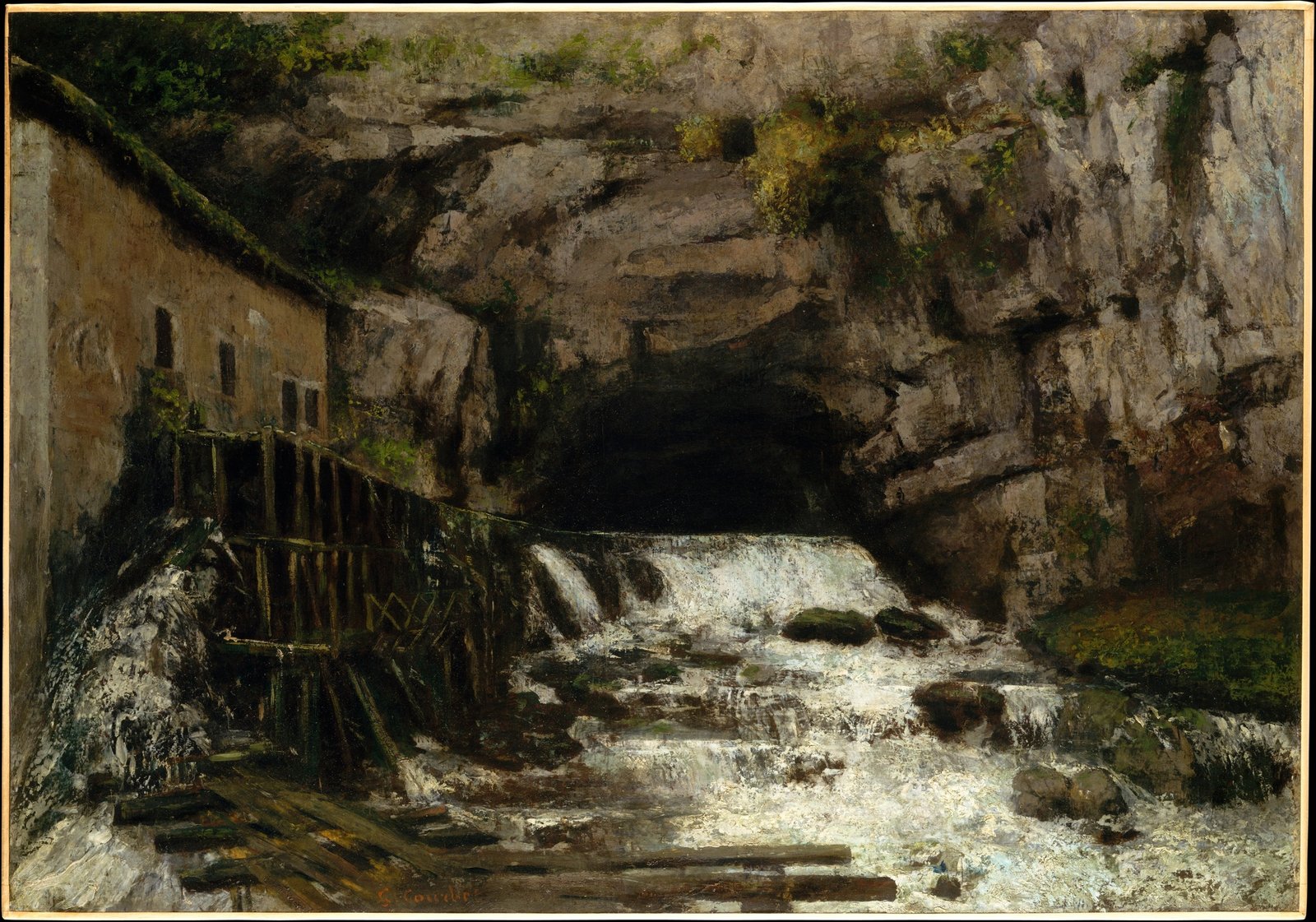
Look closely: The cavern’s dark opening, rock mass and moving water make geology and material surface central. The contrast between solid rock and flowing water carries the image without a heroic protagonist.
The Met painting is dated 1864. Courbet made several versions of the Loue’s source, so the title does not refer to one universal object. His attention to the landscape of his region expands Realism beyond social figure painting. Ask how paint makes the site feel weighty, resistant and physically present.
8. Jean-François Millet: the body and the rhythms of rural labour
Millet settled in Barbizon in 1849. His rural figures often have simplified, substantial forms and repeated gestures. The paintings can lend labour a grave dignity, but they are not interchangeable with Courbet’s treatment of particular villagers or Daumier’s urban passengers.
Millet’s subjects attracted political readings in a society anxious about class and rural poverty. Reception and intention should nevertheless be distinguished: the fact that a critic saw a threat does not establish that the painter supplied a revolutionary instruction. His imagery could carry gravity, memory, hardship and religious associations in different combinations.
Source: National Gallery, London: Millet and his rural subjects.
The Sower: a repeated action becomes an imposing figure
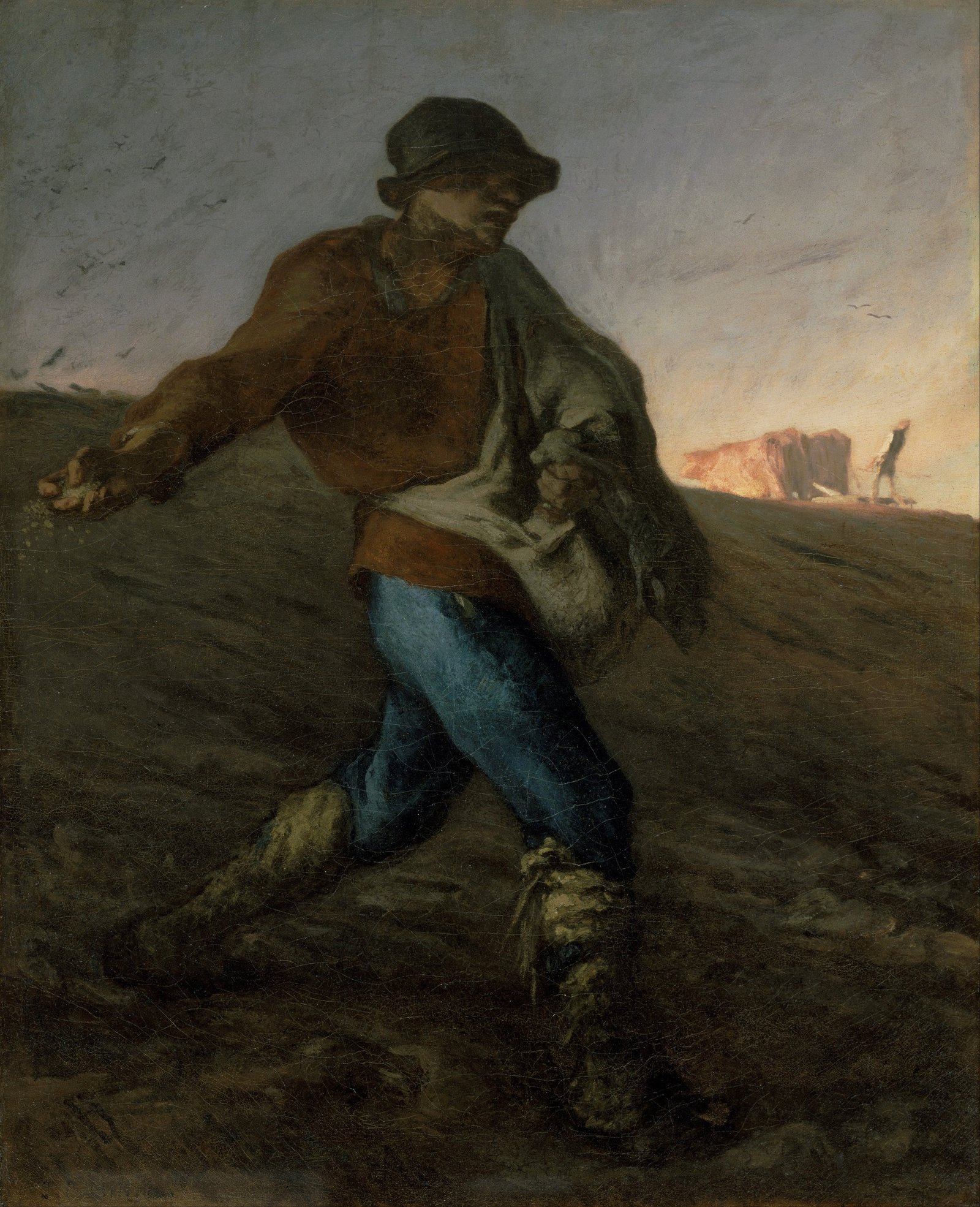
Look closely: The large forward-moving body and sweeping arm dominate the sloping field. The gesture is readable before individual facial detail. Look at how the stride and scattering action give a working figure force and scale.
The Boston painting is dated 1850 and was shown at the Salon of 1850–51. Related versions and studies exist; distinguish this canvas from an earlier version in Wales or later works after Millet. The image was important to later artists, including Van Gogh, through different versions and reproductions, rather than through one simple chain of direct copying from this exact Boston object.
Source: Museum of Fine Arts, Boston, via Google Arts & Culture: The Sower.
The Gleaners: scarcity in the presence of abundance
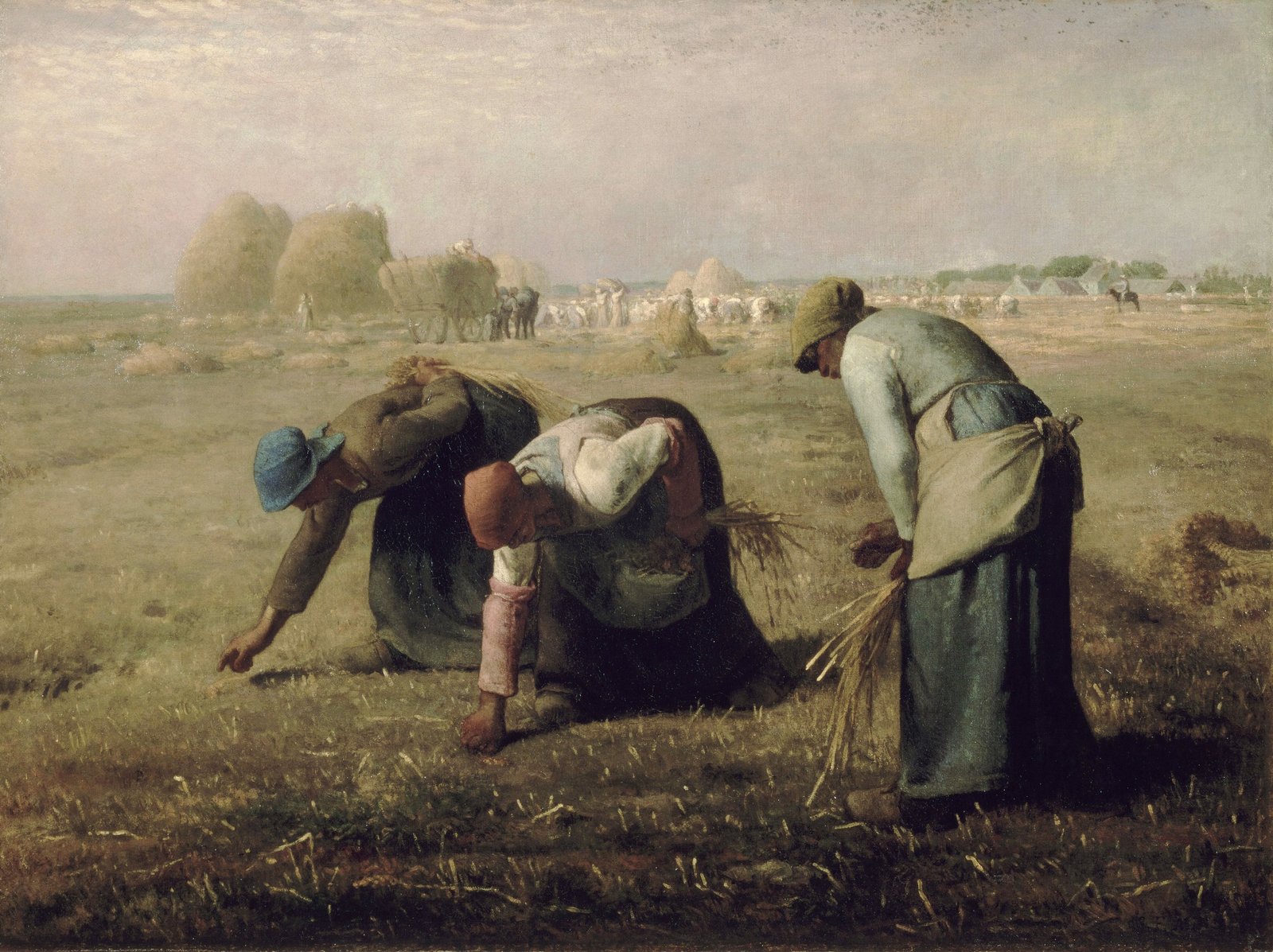
Look closely: Three bent figures repeat the act of gathering leftover grain. Behind them, a much larger harvest and organised work occupy the distance. The contrast matters as much as the foreground gestures.
The Gleaners is dated 1857 and was exhibited at the Salon that year. Gleaning means collecting what remains after the main harvest. It is not the same activity as sowing seed, cutting standing grain or ploughing a field. Identifying the action correctly helps distinguish several frequently confused rural images.
The repeated bent bodies communicate effort and limited means. At the same time, the structured arrangement gives the figures a lasting pictorial dignity. The painting does not need to show a dramatic confrontation in order to make unequal access to the harvest visible.
Source: Musée d’Orsay: The Gleaners, its action and reception.
The Angelus: a pause in work
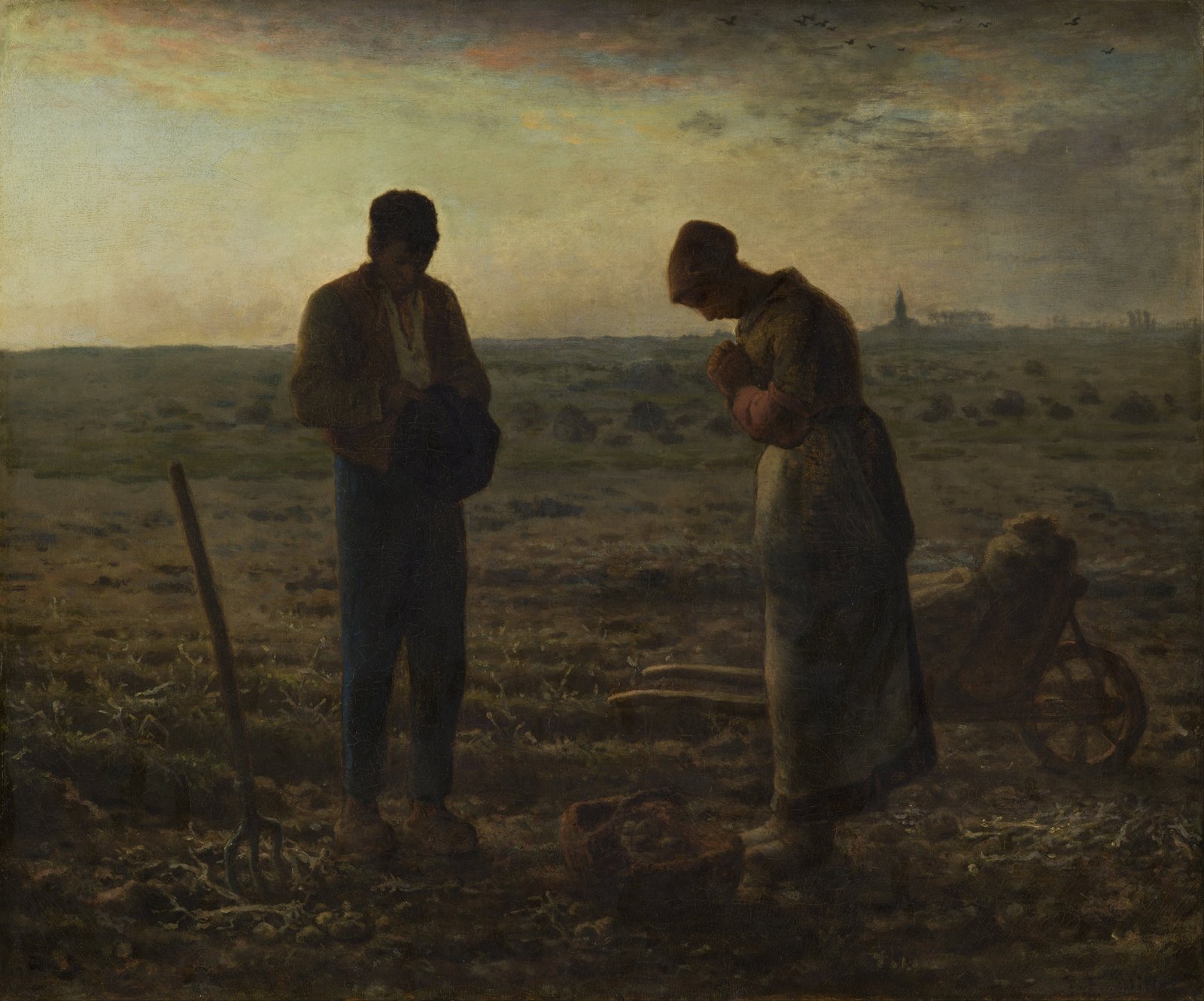
Look closely: Two figures pause with lowered heads amid their tools and potato harvest. The distant church, basket, fork and wheelbarrow support the relationship between work, time and prayer.
Musée d’Orsay dates The Angelus to 1857–1859. The figures recite the Angelus prayer. Their stillness contrasts with the repeated physical action in The Gleaners. Similar rural settings therefore carry different human activities and meanings.
The museum connects the subject to Millet’s recollection of stopping work when his grandmother heard the bell. It does not require treating the image as straightforward religious propaganda. Later responses, including Dalí’s fascination, belong to its reception history and should not be substituted for Millet’s original subject.
Source: Musée d’Orsay: The Angelus and Millet’s recollection.
9. Honoré Daumier: the press, political violence and urban experience
Daumier was a painter, draughtsman, lithographer and sculptor. His graphic work in the periodical press made political figures, institutions and everyday behaviour subjects for visual judgement. The expressive deformation of a face or body can clarify a social argument, which is one reason “Realism = photographic accuracy” fails.
The difference between satire and documentary description is important. A caricature deliberately sharpens or exaggerates. A work can nevertheless be grounded in contemporary institutions and events. The relevant question is how the artist makes that world intelligible, rather than whether every contour functions like a camera record.
Source: National Gallery, London: Daumier.
Rue Transnonain: an event date is not the publication date

Look closely: The interior and fallen bodies confront the viewer with the aftermath of state violence. Tonal contrasts and the weight of the central body create a severe argument without turning the scene into a heroic battle.
The title refers to 15 April 1834; the Met impression shown is dated July 1834. It is a lithograph, not an oil painting. It concerns troops firing on inhabitants during the disturbances of April 1834. Daumier’s image is a constructed response, not a claim that he personally witnessed and sketched every part of the event.
Because it predates Courbet’s 1855 pavilion, it also corrects a false chronology in which socially engaged observation supposedly began in that year. Courbet’s public declaration was a milestone within a broader history.
Source: The Met: Rue Transnonain, its medium, event and publication.
The Third-Class Carriage: modern transport and social position
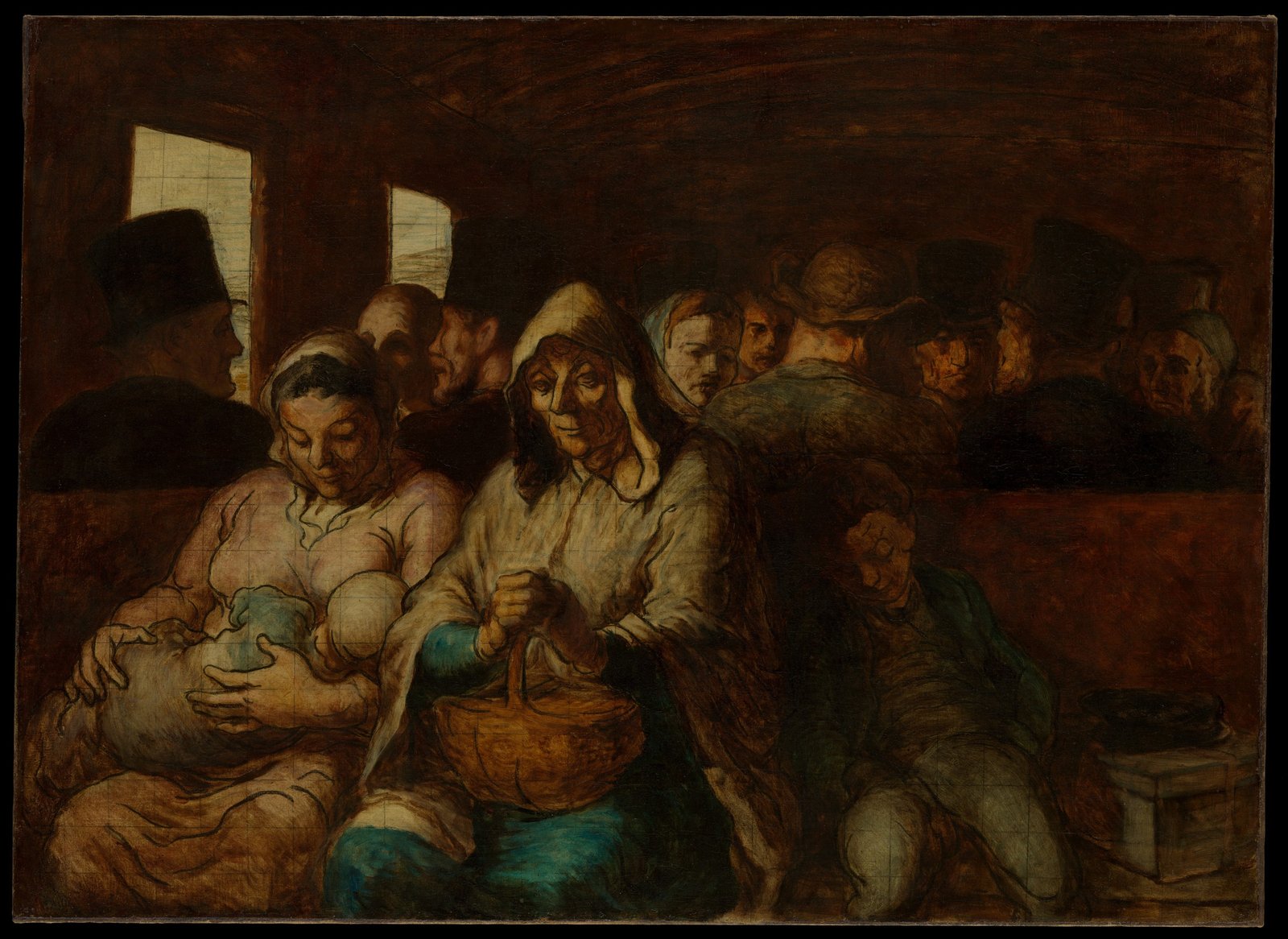
Look closely: A nursing mother, an older woman and a sleeping boy form a foreground group within a crowded compartment. Heavy outlines and tonal masses communicate bodily presence and the fatigue of travel.
The current Met collection record dates this canvas to 1864. It is unfinished and squared for transfer. Related treatments include a watercolour in the Walters Art Museum and a finished oil painting in the National Gallery of Canada. Dates such as c. 1862–64 circulate in older accounts; retain the current record when identifying the specific Met object.
The railway is modern, but the picture’s concern is not simply a celebration of technology. Compartment class and the passengers’ circumstances organise the viewer’s understanding. Compare it with Impressionist leisure scenes: both address contemporary life, but their emphases and handling need not be identical.
Source: The Met: current date, unfinished state and related versions.
10. Rosa Bonheur: animals, labour and professional authority
Bonheur developed an international reputation through animal painting and rural subjects. Her sustained observation of anatomy and movement belongs within the history of Realism, even though her polished handling and public success differ from the familiar story of Courbet’s scandals.
Her career also makes gender and professional access visible. She worked in environments that were not equally accessible to all women artists and established authority in a demanding specialist field. Her achievements should not be reduced to an anecdote about clothing, nor her animal subjects treated as a minor alternative to “serious” social art.
Source: National Museum of Women in the Arts: Rosa Bonheur’s professional career.
Ploughing in the Nivernais: the weight of animals and soil
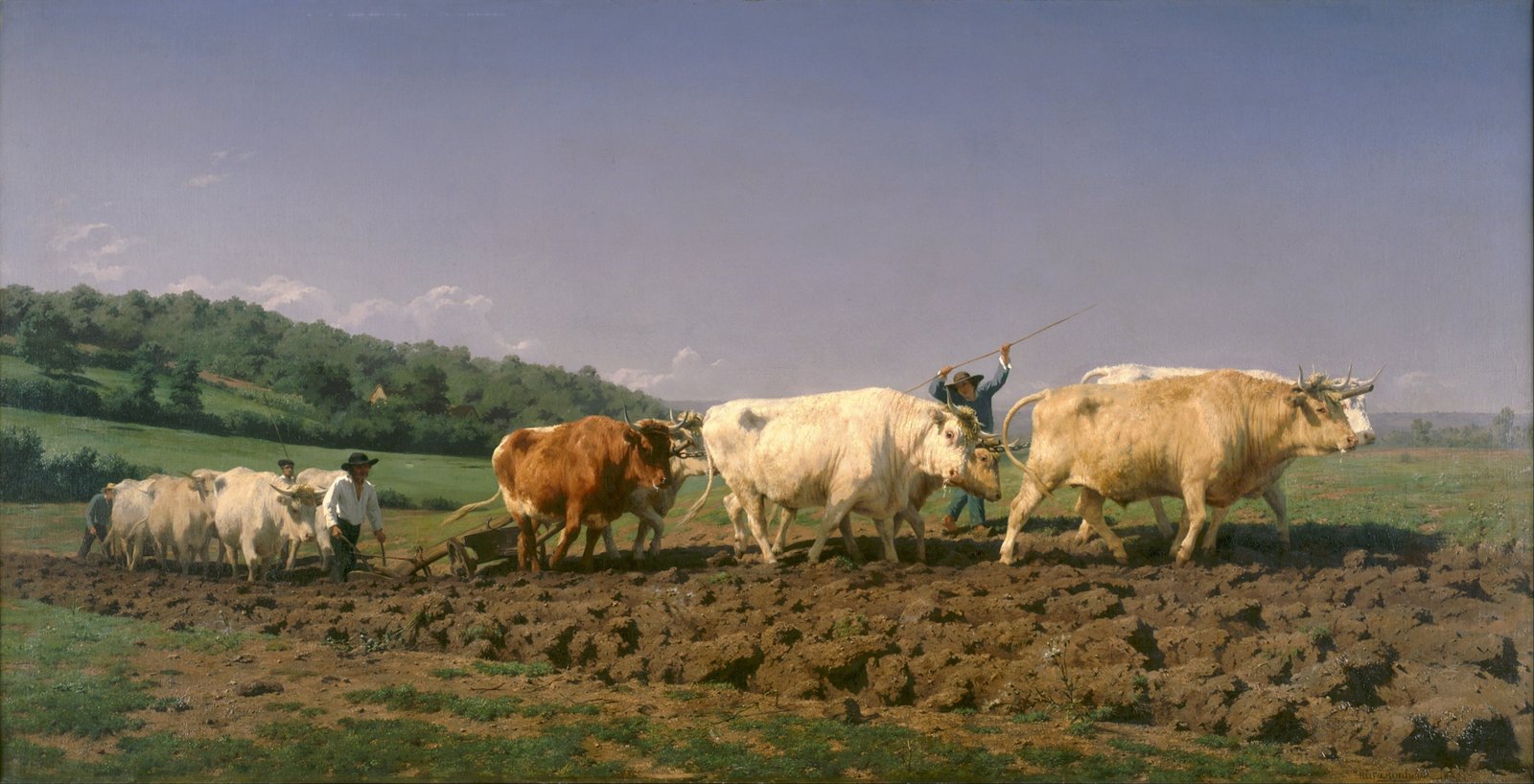
Look closely: Teams of oxen pull heavy ploughs across the field. Their scale, musculature and relation to the turned soil make animal effort and the material transformation of the land central.
The painting is dated 1849, following a state commission in 1848. Musée d’Orsay explains the action as the first autumn ploughing, or sombrage. This is not Millet’s gleaning or sowing. The work is also evidence that observed rural life could receive official support: associated Realist artists did not all follow an identical anti-institutional career.
Source: Musée d’Orsay: the commission, date and agricultural action.
The Horse Fair: observation on a monumental canvas
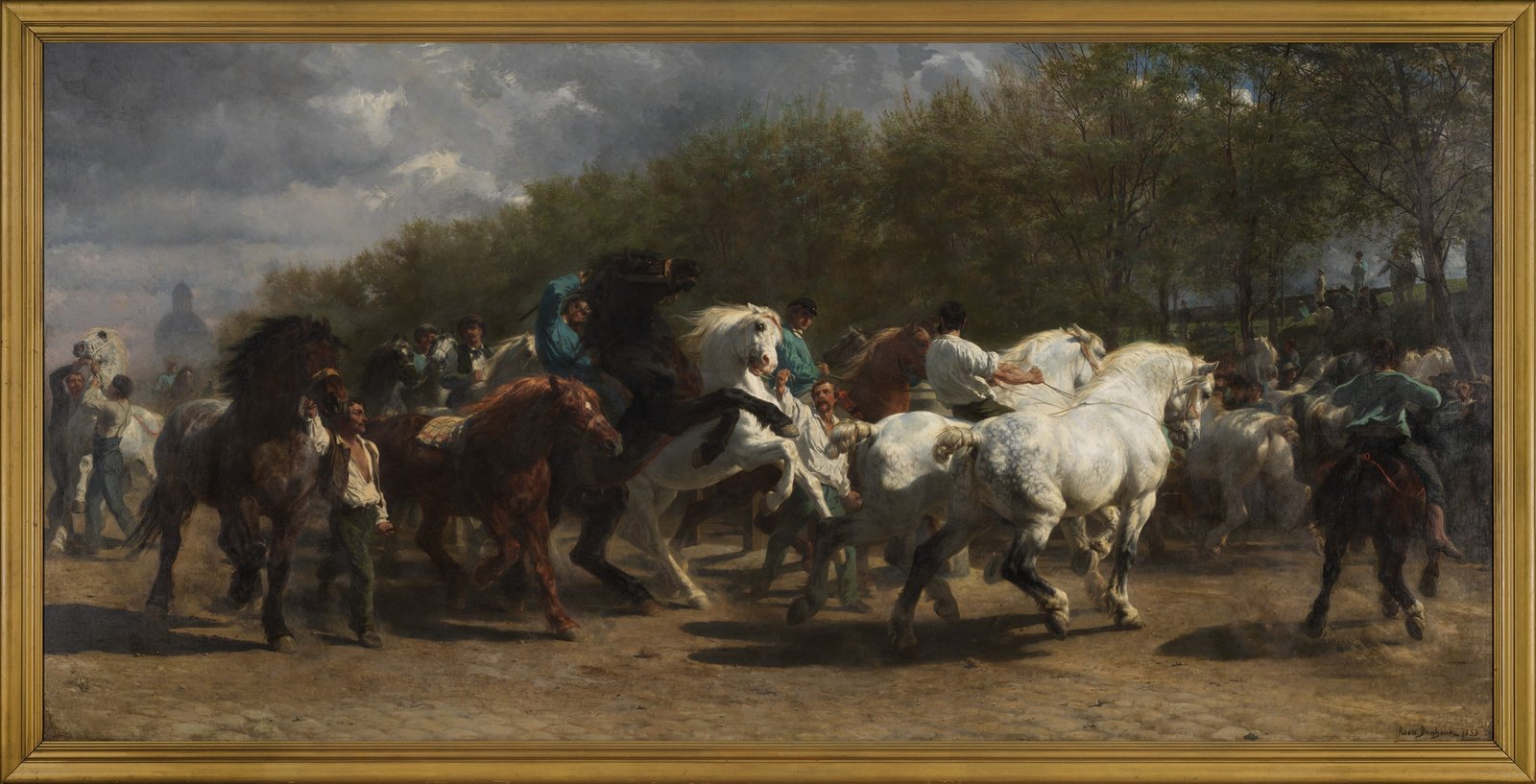
Look closely: A surge of horses, handlers and opposing movements fills the broad composition. Carefully studied animal forms work within a deliberately dramatic arrangement. The setting is a commercial horse market, not a battlefield.
The Met dates the painting 1852–1855. Bonheur began it in 1852, showed it at the Salon of 1853 and continued revising it. “1853” therefore identifies its exhibition history and an important stage, while 1852–55 records the broader making of the Met canvas. Its dimensions, approximately 2.45 × 5.07 metres, help explain its commanding effect.
This is a useful test of a mature understanding of Realism. Observation, anatomical knowledge and everyday subject matter coexist with compositional drama and inherited artistic models. Realist concerns do not require removing every element of pictorial ambition.
Source: The Met: The Horse Fair, production, exhibition and scale.
11. Manet: a younger modern-life challenge
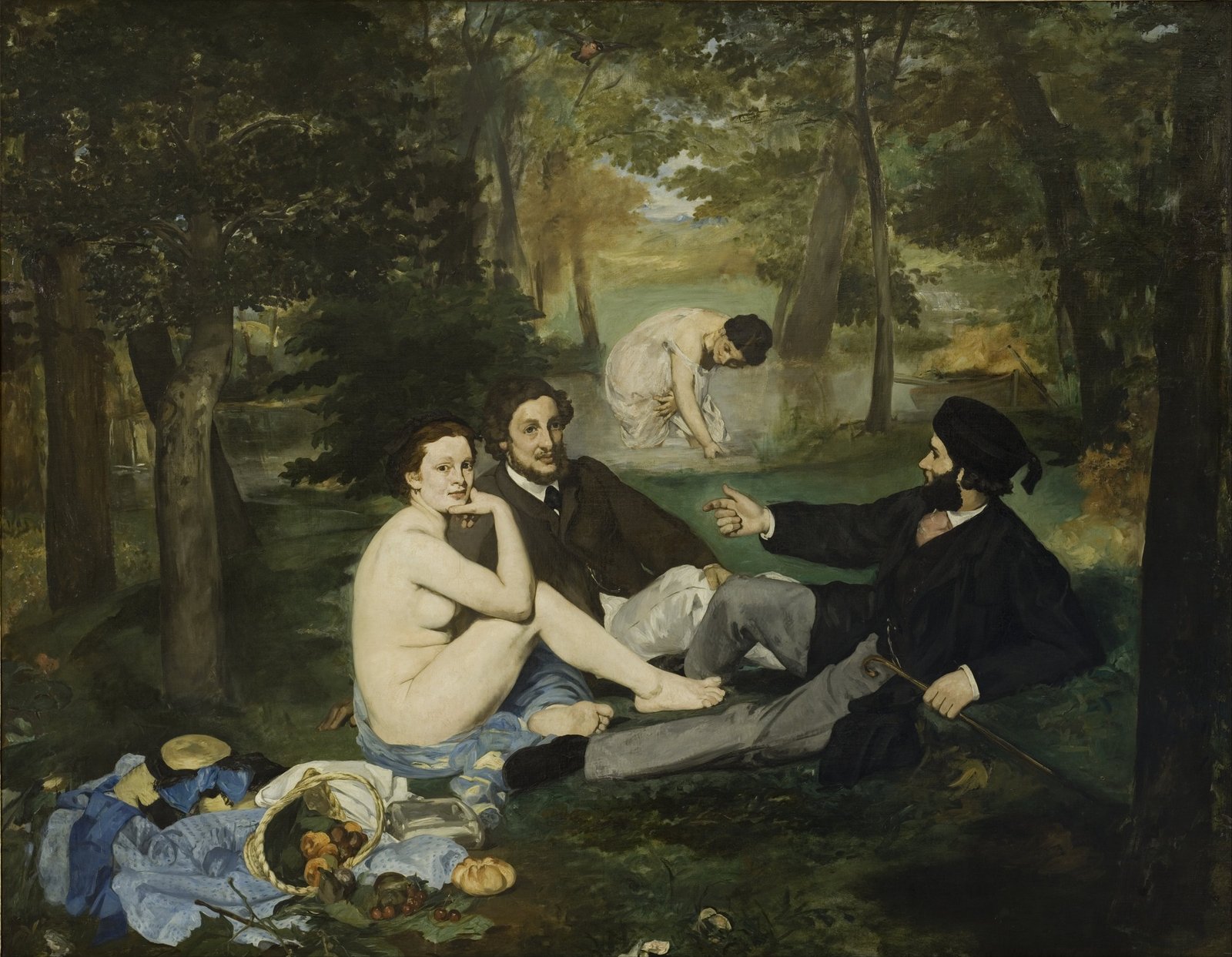
Look closely: Contemporary clothed men sit beside a nude woman who looks outward, with another figure behind. Contrasting bodies, light and spatial relationships unsettle the expectation of a safely mythological nude.
Luncheon on the Grass is dated 1863. Rejected by the Salon jury, it appeared at the Salon des Refusés, under the title Le Bain. The subject’s contemporary appearance and the treatment of the nude generated controversy. The work also refers to earlier art, so it should not be explained as an entirely spontaneous record of a picnic.
Manet belongs in the transition between Realist challenges and later modern painting, but his career cannot be reduced to a single category. Distinguish Manet from Monet, and 1863 from the first Impressionist group exhibition in 1874. Manet did not exhibit in the eight independent Impressionist shows.
Source: Musée d’Orsay: Manet’s painting and the 1863 Salon des Refusés.
12. Later Naturalism: Bastien-Lepage’s Haymaking
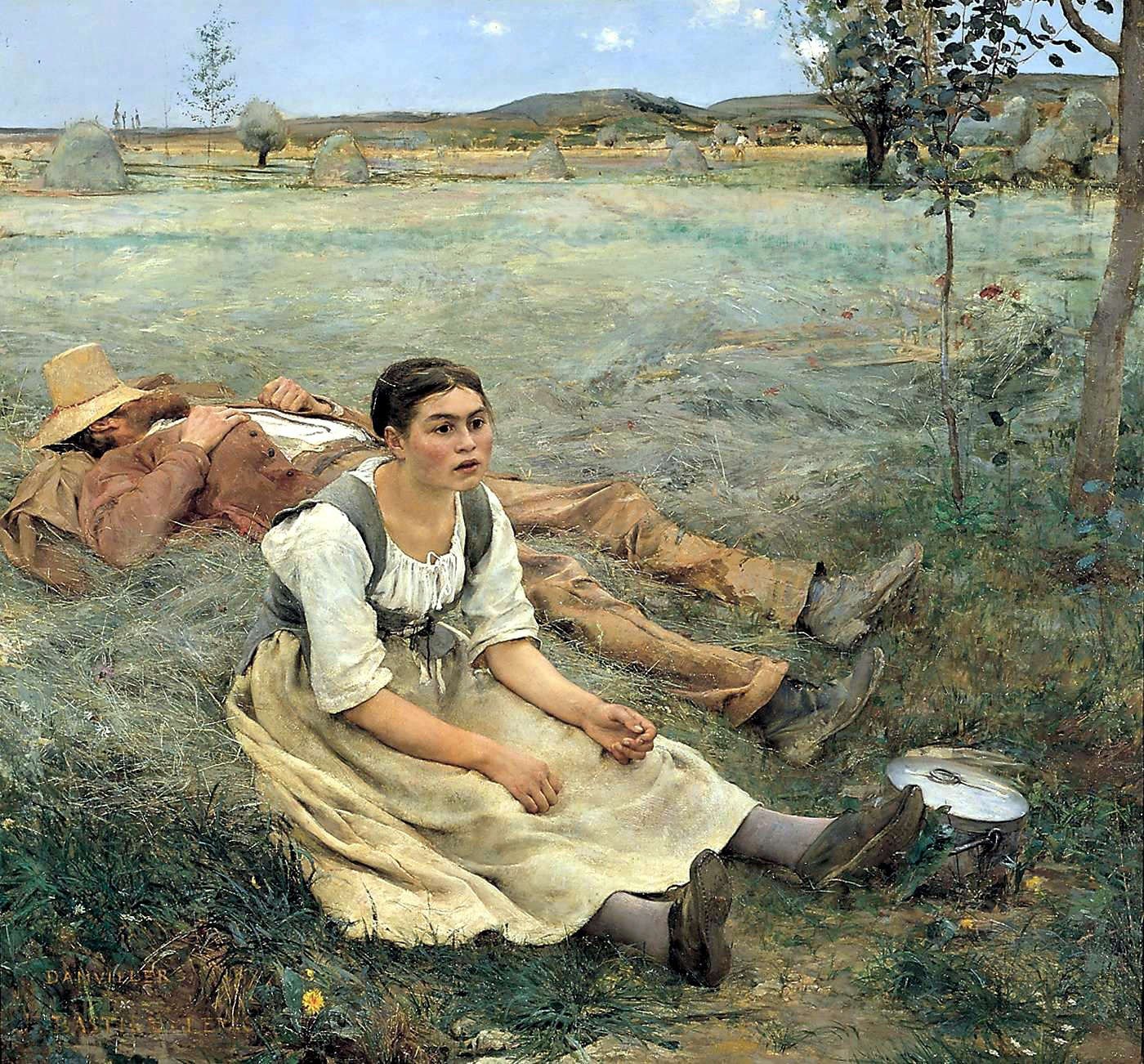
Look closely: A tired seated woman and a reclining man occupy the foreground after labour. The unusually high horizon leaves a large field of hay around them. Exhaustion rather than picturesque activity directs attention.
Bastien-Lepage painted Haymaking in 1877; it was shown at the Salon of 1878. Its rural subject connects it with earlier Realist concerns, but its later Naturalist approach belongs to a different phase. The precise date and exhibition sequence matter more than a broad claim that all paintings of workers are simply “Courbet-style Realism.”
Naturalism and Realism overlap in historical usage, and museums do not always draw their boundaries in exactly the same place. A useful revision distinction is that Naturalism often places sustained emphasis on observed bodies, environments and conditions, while the historical Realist debate also centres on the social and institutional authority of representation. This is an explanatory distinction, not a universally accepted hard border.
Source: Musée d’Orsay: Haymaking and its Naturalist context.
13. Realism, Romanticism, Naturalism and Impressionism
| Tendency | Useful emphasis | Visual caution |
|---|---|---|
| Romanticism | Emotion, drama, imagination, history, contemporary events and the sublime. | It also addresses real events and can include close observation; it is not simply “fantasy”. |
| Historical Realism | Contemporary life, ordinary subjects, material presence and challenges to established hierarchies. | It is not one palette, one finish or one political party. |
| Naturalism | Close study of people and environments; often associated with later nineteenth-century rural and social painting. | It overlaps with Realism; classifications vary. |
| Impressionism | Modern experience and changing appearance, often through light, colour and visible touches. | It is not exclusively landscape or cheerful leisure; artists differ. |
A practical comparison is Courbet’s stonebreakers → Millet’s gleaners → Daumier’s passengers → Monet’s outdoor scenes. Ask how each image constructs contemporary experience. The sequence is a comparison of concerns, not a claim that one artist simply replaced another or that every later movement abandoned social meaning.
Social Realism is a broader term for art addressing social conditions, often including hardship, labour or injustice. Socialist Realism is a distinct, later doctrine associated especially with the Soviet Union and formally articulated in the 1930s. Neither should be substituted automatically for Courbet’s nineteenth-century Realism. Shared working-class subjects do not establish identical institutions or ideology.
Source: Australian National University Press: Socialist Realism and its Soviet institutional context.
14. Impact and legacy: what changed?
Realism strengthened the claim that modern experience and ordinary subjects could support ambitious art. Its legacy includes the status of labour and everyday life, an interest in material paint and the artist’s right to choose subjects independently. The image’s public role became a question of social and institutional power as well as taste.
Courbet’s independent exhibition provided a precedent for later challenges to official systems, but later exhibitions were not replicas of his pavilion. Manet and the Impressionists developed different positions. Millet’s repeated working gestures also had a powerful afterlife in the work of Van Gogh, whose responses could involve reproductions and intermediary versions.
Source: The Met: Van Gogh, First Steps, after Millet, 1890.
The broader history also includes different national Realisms. These should be studied in their own political and institutional settings rather than treated as provincial copies of a French programme. The present article concentrates on France so that the central chronology and artist–artwork relationships remain clear.
Revision note: For an answer on “the significance of Realism”, explain a change in subject status, artistic authority and representation. Listing Courbet and Millet without describing what their works changed is a weaker answer.
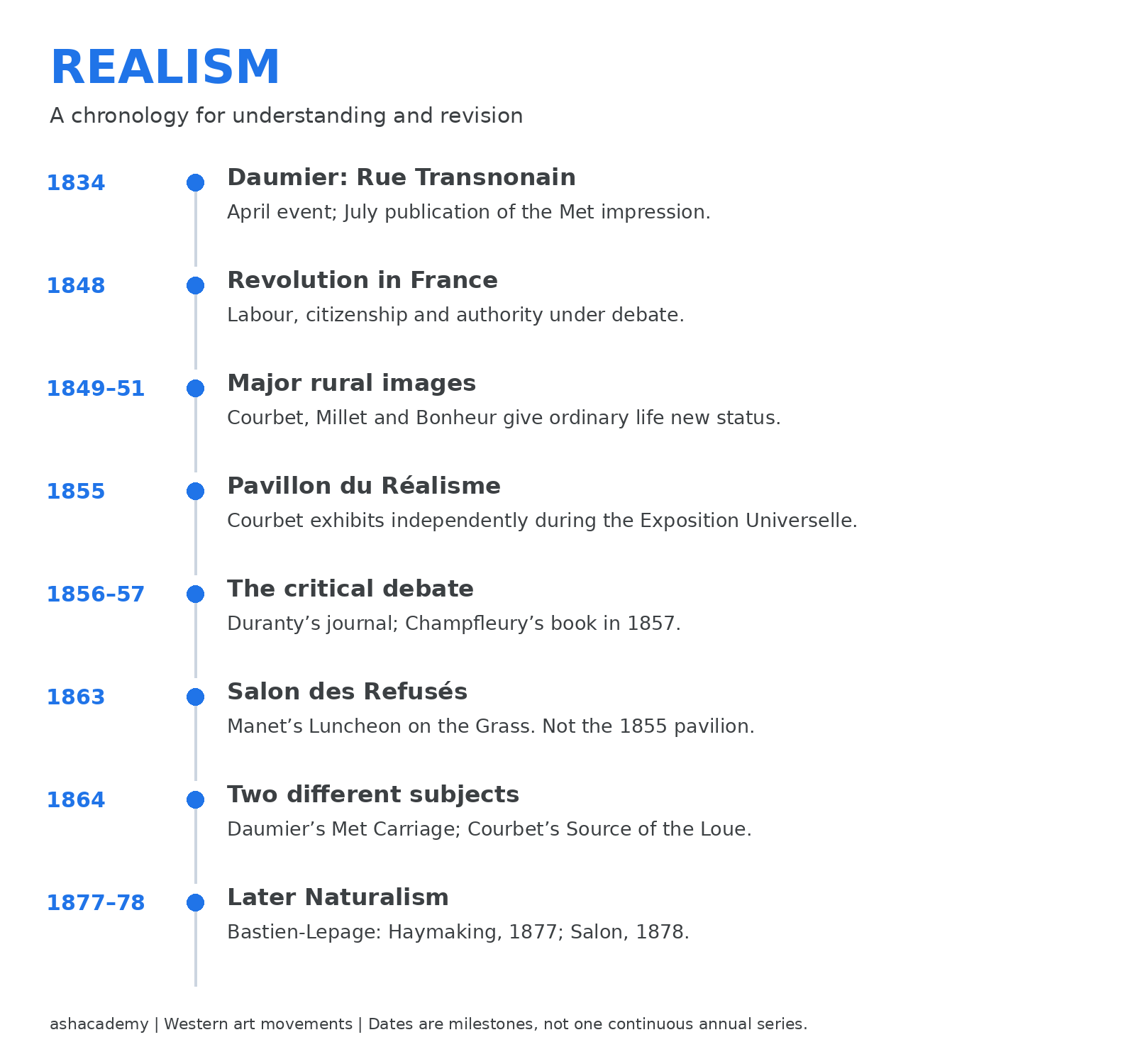
15. Chronology and artist–artwork matching
| Date | Milestone | Keep separate |
|---|---|---|
| 1834 | Daumier’s Rue Transnonain. | Event: 15 April; publication of the Met impression: July. |
| 1848 | French Revolution; Bonheur’s rural commission. | A political context, not a universal start date for all Realist art. |
| 1849 | The Stonebreakers; Bonheur’s Ploughing in the Nivernais. | A destroyed Courbet painting versus an extant Bonheur painting. |
| 1849–1850 / 1850–1851 | Making and Salon display of A Burial at Ornans. | Production date versus exhibition date. |
| 1850 | Millet’s Boston The Sower. | Different versions and later works after Millet. |
| 1852–1855 / 1853 | Making of The Horse Fair; Salon presentation. | The full production span versus the exhibition year. |
| 1854 | Courbet’s The Meeting. | Shown at the official Exposition Universelle in 1855. |
| 1854–1855 / 1855 | The Painter’s Studio; Pavillon du Réalisme. | Canvas date range versus independent exhibition year. |
| 1856–1857 / 1857 | Duranty’s journal; Champfleury’s book. | Journal and book are different publications. |
| 1857 / 1857–1859 | The Gleaners; The Angelus. | Gleaning versus a pause for prayer. |
| 1863 | Manet at the Salon des Refusés. | Not Courbet’s pavilion and not the first Impressionist show. |
| 1864 | The Met’s Third-Class Carriage; The Source of the Loue. | Different artists and very different subjects. |
| 1877 / 1878 | Bastien-Lepage’s Haymaking; its Salon exhibition. | Production date versus exhibition year. |
| Artwork | Artist | Date | Medium and collection |
|---|---|---|---|
| The Horse Fair | Rosa Bonheur | 1852–55 | Oil on canvas; The Metropolitan Museum of Art, New York |
| The Third-Class Carriage | Honoré Daumier | 1864 | Oil on canvas; The Metropolitan Museum of Art, New York |
| Rue Transnonain, le 15 Avril, 1834, Plate 24 of l’Association mensuelle | Honoré Daumier | July 1834 | Lithograph; The Metropolitan Museum of Art, New York |
| The Source of the Loue | Gustave Courbet | 1864 | Oil on canvas; The Metropolitan Museum of Art, New York |
| A Burial at Ornans | Gustave Courbet | 1849–1850 | Oil on canvas; Musée d’Orsay, Paris |
| The Painter’s Studio: A Real Allegory Summing Up Seven Years of My Artistic and Moral Life | Gustave Courbet | 1854–1855 | Oil on canvas; Musée d’Orsay, Paris |
| The Gleaners | Jean-François Millet | 1857 | Oil on canvas; Musée d’Orsay, Paris |
| The Angelus | Jean-François Millet | 1857–1859 | Oil on canvas; Musée d’Orsay, Paris |
| Ploughing in the Nivernais (Labourage nivernais) | Rosa Bonheur | 1849 | Oil on canvas; Musée d’Orsay, Paris |
| Haymaking (Les Foins) | Jules Bastien-Lepage | 1877 | Oil on canvas; Musée d’Orsay, Paris |
| Luncheon on the Grass (Le Déjeuner sur l’herbe) | Édouard Manet | 1863 | Oil on canvas; Musée d’Orsay, Paris |
| The Meeting (Bonjour, Monsieur Courbet!) | Gustave Courbet | 1854 | Oil on canvas; Musée Fabre, Montpellier |
| The Sower | Jean-François Millet | 1850 | Oil on canvas; Museum of Fine Arts, Boston |
| The Stonebreakers | Gustave Courbet | 1849 | Oil on canvas; Formerly Dresden; generally recorded as destroyed in 1945 |
16. Key terms in easy language
| Term | Meaning |
|---|---|
| Hierarchy of genres | A system that assigned different prestige to subjects such as history, portraiture, genre scenes, landscape and still life. |
| Genre painting | Scenes of everyday life; not the same thing as the entire hierarchy of genres. |
| Monumentality | An imposing effect created through scale, mass, pose or presentation; it does not always mean a physically enormous canvas. |
| Allegory | A constructed representation that communicates an idea through figures, objects or relationships. |
| Impasto | Paint applied thickly enough to produce a raised surface. |
| Lithography | Planographic printing using the different behaviour of greasy drawing materials and water. |
| Gleaning | Collecting grain left after the main harvest. |
| Patronage | Material, financial or institutional support for artists and artworks. |
| Naturalism | A related, historically variable emphasis on observed life and environments; it overlaps with Realism. |
| Pavillon du Réalisme | Courbet’s independent exhibition project of 1855, not the name of an academy. |
17. Commonly confused facts
| Incorrect shortcut | Accurate correction |
|---|---|
| Realism began because photography was invented. | Photography is part of the visual context, not a complete explanation or the source of every work. |
| Realism means a perfectly photographic finish. | Daumier’s expressive drawing and Courbet’s material handling complicate that definition. |
| Courbet’s pavilion was the Salon des Refusés. | Pavilion: 1855. Salon des Refusés: 1863. |
| Every Courbet painting was officially rejected in 1855. | Several were accepted; The Meeting appeared at the Exposition Universelle. |
| The Painter’s Studio contradicts Realism because it is allegorical. | Its “real allegory” is an important demonstration of observed reality within symbolic construction. |
| The Stonebreakers can be seen today at Musée d’Orsay. | The original is generally recorded as destroyed; reproductions survive. |
| Every rural image is by Millet. | Compare the activity, figures, animals, handling and composition. |
| The Third-Class Carriage has one date across all versions. | Use the specific object record; the Met currently dates its unfinished canvas 1864. |
| Bonheur’s Horse Fair was made only in 1853. | The Met records 1852–55, with Salon display in 1853. |
| Realism, Social Realism and Socialist Realism are synonyms. | They have different historical scopes and institutional meanings. |
18. Image-based revision quiz
The following are original practice questions, not claimed UGC NET previous-year questions. Refer to the complete artwork above each section. Open an answer only after attempting the identification.
1. Two labourers of different ages break stones. Identify the painter, date and present status.
Gustave Courbet, The Stonebreakers, usually dated 1849. The original, formerly in Dresden, is generally recorded as destroyed in 1945. A reproduction should not be labelled as an extant Musée d’Orsay canvas.
2. A long line of villagers faces an open grave. What made this picture historically provocative?
Courbet’s A Burial at Ornans, 1849–1850. Its ordinary local subject received a monumental format associated with elevated history painting. The issue is subject status and presentation, not merely the use of dark paint.
3. Which is earlier: Courbet’s Pavillon du Réalisme or the Salon des Refusés?
The Pavillon du Réalisme, 1855. The Salon des Refusés followed in 1863. The first Impressionist group exhibition was later still, in 1874.
4. Three women bend over leftover grain. What are they doing, and who painted them?
Millet’s The Gleaners, 1857. They collect grain remaining after the main harvest. They are not sowing, ploughing or pausing for the Angelus prayer.
5. A working couple stands with bowed heads among a potato harvest and tools. Identify the work.
Millet, The Angelus, 1857–1859, Musée d’Orsay. The work depicts a pause for prayer. Similar rural settings do not make it the same subject as The Gleaners.
6. Why should “15 April 1834” and “July 1834” both appear in a note on Rue Transnonain?
The first belongs to the event referred to by the title. July is the publication date recorded for the Met impression. Daumier’s work is a lithograph, not an oil painting.
7. A mother, older woman and sleeping boy occupy a crowded railway compartment. Which artist?
Honoré Daumier, The Third-Class Carriage. The Met currently dates its unfinished, squared canvas 1864. The related finished painting in Canada is a separate object.
8. A large market scene is filled with horses and handlers. Identify its painter and date distinction.
Rosa Bonheur, The Horse Fair, 1852–1855. It was shown at the Salon in 1853, with later revisions. It is not a battle or Millet’s agricultural field scene.
9. A painter stands at the centre of a deliberately arranged social gathering. Why is “real allegory” important?
Courbet’s The Painter’s Studio, 1854–1855, combines concrete people and objects with a symbolic arrangement. Realism involves artistic construction rather than a ban on allegory.
10. Which publication belongs to Champfleury: Réalisme, the 1856–57 journal, or Le Réalisme, the 1857 book?
Le Réalisme, the 1857 book. Duranty directed the journal Réalisme. Duranty’s La Nouvelle Peinture is a different, later text from 1876.
19. Frequently asked questions about Realism
What is Realism in art, in simple words?
Historical Realism gave serious artistic attention to contemporary life and observed people, places and work. In nineteenth-century France it challenged assumptions about which subjects deserved major paintings. It is broader than making an image look photographic.
Who is called the father of Realism?
Gustave Courbet is commonly given that label because of his paintings, public arguments and independent 1855 exhibition. He was the leading exponent, but the label should not imply that Millet, Daumier and Bonheur followed one identical programme invented entirely by him.
When did the Realist movement start?
It developed in the 1840s and became especially prominent around 1848 and in the following decades. Courbet’s 1855 pavilion was a defining public milestone rather than the date on which every Realist concern suddenly began.
Which Realist artworks are important for revision?
Prioritise Courbet’s The Stonebreakers, A Burial at Ornans, The Meeting and The Painter’s Studio; Millet’s The Sower, The Gleaners and The Angelus; Daumier’s Rue Transnonain and The Third-Class Carriage; and Bonheur’s Ploughing in the Nivernais and The Horse Fair. Learn specific versions and collections.
How does Realism differ from Impressionism?
Realism places particular emphasis on contemporary subjects, social relationships and the authority of ordinary experience. Impressionism often foregrounds changing appearance, light and colour. Both are diverse and overlap in their interest in modern life; neither can be reduced to one subject or brushstroke.
Were all Realists socialist artists?
No. Artists differed in politics, patronage and intention. Some images attracted radical readings, but neither a labouring subject nor association with Realism establishes membership of a political party. Do not confuse the movement with twentieth-century Socialist Realism.
Continue your Western art revision
Compare this guide with Impressionism: history, characteristics, artists and artworks. To review a different use of history, ideal form and public authority, read the Neoclassicism guide. Build comparisons from actual images rather than memorising movements as opposite slogans.
Sources, image credits and scope
Research is grounded in collection records and educational material from Musée d’Orsay, Musée Courbet, Musée Fabre, The Metropolitan Museum of Art, National Gallery (London), Museo Thyssen-Bornemisza, Museum of Fine Arts (Boston) and National Museum of Women in the Arts, with scholarly sources for publications and later terminology. Section links and artwork captions identify the references. “Look closely” passages are ashacademy teaching commentary.
Dates follow the identified collection or institutional record wherever possible. Production dates, exhibition dates and publication dates are kept separate. Interpretations are identified as readings rather than established eyewitness facts. Original artwork reproductions retain the complete compositions and their source colours; image quality and colour rendering vary. The Stonebreakers is explicitly identified as a reproduction of a lost work.
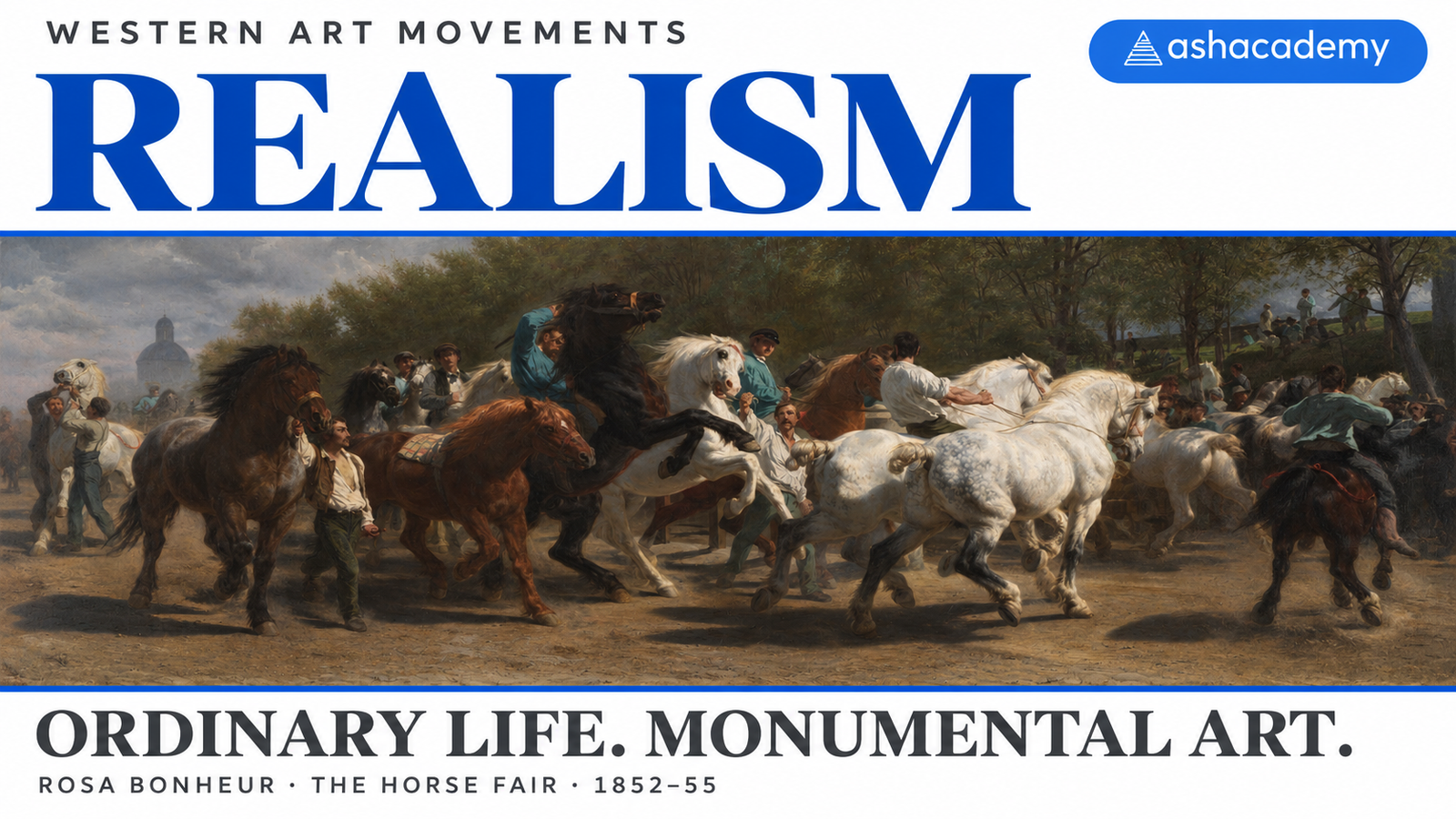
The featured cover is an editorial design inspired by Bonheur’s painting; use the full museum reproduction in the article for close visual study. Revision graphics are contemporary teaching aids, not period documents. This guide focuses on nineteenth-century French Realism and adjacent developments, rather than claiming to catalogue every national Realism.
Further academic reading: Linda Nochlin, Realism (1971); Linda Nochlin, Realism and Tradition in Art, 1848–1900: Sources and Documents (1966); T. J. Clark, Image of the People: Gustave Courbet and the 1848 Revolution (1973); and the exhibition publication Gustave Courbet accompanying the 2007–2008 retrospective. Read these as complementary historical approaches, not interchangeable summaries.

You may also like
Fauvism: History, Characteristics, Artists and Important Artworks
Symbolism in Art: History, Characteristics, Artists and Artworks